Before dragons ruled the seas as kings, one ancient dragon fought beside the Yellow Emperor.
Its weapon was water.
Its enemies answered with wind and rain.
Later tradition remembered the same dragon drawing paths through the earth so the waters of the Great Flood could escape.
This is Yinglong (应龙 / 應龍, Yìnglóng)—an ancient Chinese dragon associated with war, rain, flood control and the legendary rulers of early China.
Today Yinglong is usually described as a winged dragon, but the surviving texts tell a more interesting story. Its wings belong most clearly to later definitions and artistic tradition, while the Shan Hai Jing focuses instead on what Yinglong does.
Yinglong Quick Facts
| Chinese | 应龙 / 應龍 |
| Pinyin | Yìnglóng |
| Common translation | Responding Dragon |
| Type | Ancient divine dragon |
| Best-known feature | Wings in later tradition |
| Associated with | Rain, water, warfare, flood control |
| Serves | Yellow Emperor in one major myth |
| Famous enemies | Chiyou and Kuafu |
| Later connection | Yu the Great and flood control |
| Primary ancient source | Shan Hai Jing |
Who Is Yinglong?
Yinglong is an ancient Chinese dragon associated with rain and water, best known for fighting Chiyou for the Yellow Emperor and, in later tradition, helping Yu the Great control the Great Flood.
The name is written 应龙 / 應龍.
应 / 應 (yìng) can mean to respond or answer, while 龙 / 龍 (lóng) means dragon. For this reason, Yinglong is often translated as the “Responding Dragon.” Modern scholarly reference works likewise use this translation.
But Yinglong is not simply another name for the Chinese Dragon as a whole.
It is a specific mythological figure with its own stories.
Yinglong and the Yellow Emperor
Yinglong’s most important surviving story appears in the Shan Hai Jing.
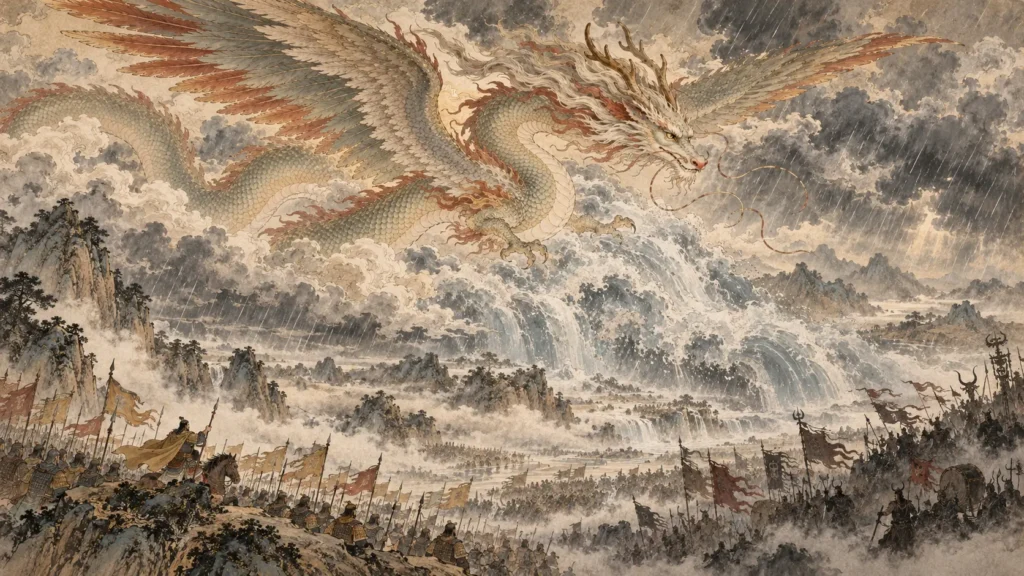
Chiyou raises an army against the Yellow Emperor.
The Yellow Emperor responds by commanding Yinglong to attack him in the wilderness of Jizhou.
The dragon stores up water.
Chiyou then calls upon the Wind Lord and Rain Master, who release violent wind and rain across the battlefield.
The Yellow Emperor finally sends down the drought figure Nüba. The rain stops, and Chiyou is defeated.
The passage is important because Yinglong is not merely decorative.
It participates directly in the struggle through control of water.
That makes the battle almost a conflict of weather itself:
stored water against storm, rain against drought.
Did Yinglong Kill Chiyou?
Different passages preserve slightly different versions.
In one Shan Hai Jing account, the Yellow Emperor commands Yinglong to attack Chiyou and the narrative ends with Chiyou’s death after Nüba stops the rain.
Another passage states more directly that Yinglong killed Chiyou and later killed Kuafu as well.
These versions should not be forced into one perfectly consistent modern storyline.
The Shan Hai Jing preserves multiple mythic fragments.
That is part of what makes the text valuable.
Yinglong and Kuafu
Kuafu is famous for the story in which he pursues the sun and dies after desperately seeking water.
Yet another Shan Hai Jing tradition gives Yinglong a role in his death.
The Great Wilderness: North says that after Yinglong had already killed Chiyou, the dragon also killed Kuafu.
This differs from the better-known version in which Kuafu dies from thirst during his pursuit of the sun.
Rather than choosing one as the single “true” myth, it is better to recognize that ancient Chinese mythological traditions often existed in parallel forms.
Why Is Yinglong Associated With Rain?
The rain connection becomes especially clear after the battles.
The Great Wilderness: East says Yinglong went to the far south after killing Chiyou and Kuafu and was unable to return upward.
As a result, drought repeatedly struck below.
When drought came, people made the form or image of Yinglong, and great rain followed.
Guo Pu’s later commentary connected this passage with the practice of making earthen dragons to seek rain.
An academic study of Chinese dragon mythology likewise treats Yinglong as part of the ancient dragon tradition in which water, rainfall, drought and human survival are closely connected.
This gives Yinglong an unusual dual role.
It can store water in battle.
But its image can also bring rain during drought.
Did Yinglong Really Have Wings?
This is one of the most important distinctions in the story.
Today Yinglong is almost universally depicted as a winged dragon.
There is strong historical basis for that tradition—but not exactly where many modern summaries imply.
The surviving Shan Hai Jing passages about Chiyou, Kuafu and rain do not stop to describe Yinglong’s anatomy or explicitly say that it has wings.
The winged definition appears clearly in later lexicographic tradition.
A traditional classification preserved in Chinese sources states:
a dragon with scales is called Jiaolong, while a dragon with wings is called Yinglong.
Later scholars also explicitly described Yinglong as a dragon capable of winged flight.
Museum collections show that the image endured visually. The Gardiner Museum describes Yinglong as an ancient winged dragon connected with rain and notes its appearance on later imperial Chinese porcelain.
So the safest conclusion is:
Yinglong is firmly a winged dragon in later Chinese tradition, but the famous Shan Hai Jing battle passages themselves focus on its actions rather than its wings.
Yinglong and Yu the Great
Another major tradition connects Yinglong with Yu the Great, the legendary hero who controlled the Great Flood.
The Questions of Heaven in the Chu Ci mentions Yinglong in the context of Yu, rivers and seas.
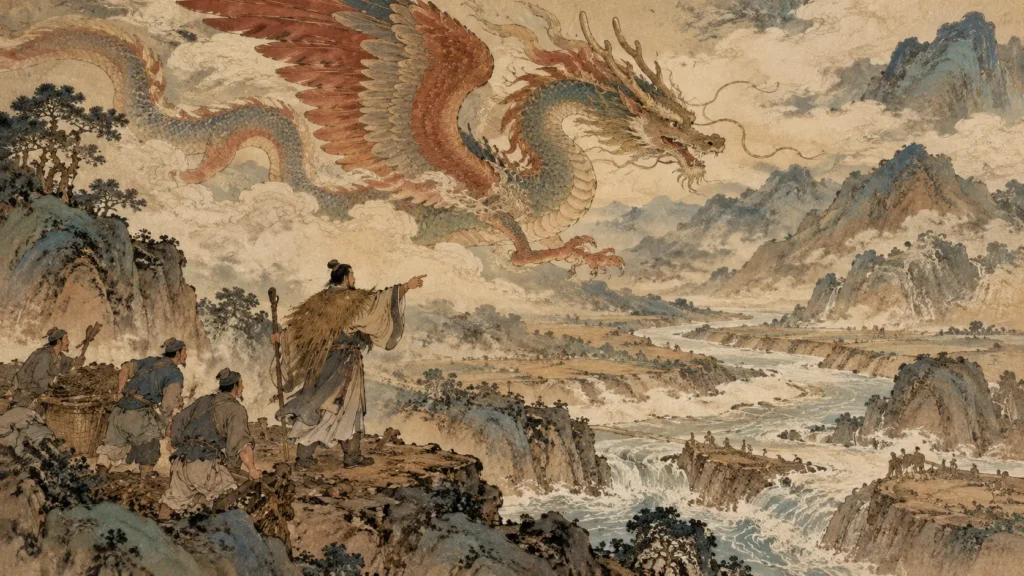
Later commentary explains the mysterious passage by saying that during Yu’s flood-control work, a divine dragon drew lines across the earth with its tail, showing where water should be released and channels opened.
Later literature makes the story even more explicit: Yinglong moves ahead of Yu, tracing the route of waterways so the flood can drain away.
But source chronology matters here.
The famous image of Yinglong’s tail physically drawing river channels is clearest in commentarial and later narrative tradition.
We should not pretend every detail appears identically in the earliest surviving text.
Yinglong vs Jiaolong
Yinglong is also distinct from the Jiaolong.
Later dragon classifications separate them clearly:
Jiaolong is associated with a scaled or aquatic dragon category.
Yinglong is the dragon defined by wings.
Our existing Jiaolong article therefore owns the ancient aquatic-dragon tradition, while this page owns Yinglong as the specific dragon connected with Huangdi, rain, Chiyou and later Yu traditions.
Yinglong vs the Azure Dragon
Yinglong should also not be confused with the Azure Dragon, Qinglong.
Qinglong belongs to the cosmological system of the Four Symbols and represents the eastern direction.
Yinglong belongs to a different narrative tradition centered on legendary rulers, warfare and water.
Both are important Chinese dragons.
They are not interchangeable.
Yinglong and the Dragon Kings
Yinglong also predates the familiar Dragon King framework in terms of the traditions preserved around it.
Longwang belongs to a developed religious tradition of dragon kings governing waters, seas and rainfall.
Yinglong appears instead in ancient mythic narratives surrounding Huangdi, Chiyou, Kuafu and Yu.
That distinction matters because “Chinese dragon god” is not one single character.
Chinese dragon traditions developed into many different beings with different roles.
Why Yinglong Matters
Yinglong sits at the center of several of China’s greatest legendary stories.
It fights beside Huangdi.
It battles Chiyou.
It kills Kuafu in one tradition.
Its absence is connected with drought.
Its image brings rain.
And later storytellers place it beside Yu the Great as the floodwaters are guided back toward rivers and seas.
Few dragons connect so many different layers of early Chinese mythology.
Yet Yinglong’s most memorable quality may be the simplest.
It responds.
To war with water.
To drought with rain.
And in later tradition, to a flooded world by showing water where to go.
References & Sources
Shan Hai Jing — Great Wilderness: North
Primary source for Yinglong’s role in the Yellow Emperor’s conflict with Chiyou and the storing of water.
Read the primary text on Wikisource
Shan Hai Jing — Great Wilderness: East
Primary source for Yinglong killing Chiyou and Kuafu, remaining in the south and the rainmaking image tradition.