Imagine an ancient court where two people give completely different versions of the truth.
The judge does not call another witness.
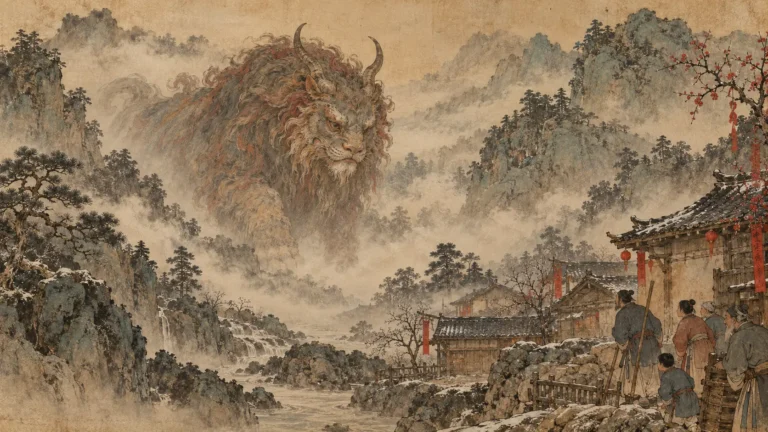
Instead, a strange one-horned beast is brought forward.
According to Chinese tradition, the creature can recognize guilt on sight. It turns toward the person in the wrong—and strikes.
This is Xiezhi (獬豸, Xièzhì), one of the most unusual creatures in Chinese mythology: a legendary beast associated not with destruction or treasure, but with justice, law and the ability to distinguish right from wrong.
Over time, Xiezhi became more than a mythical animal. Its image was connected with judges, censors and officials responsible for enforcing the law.
Xiezhi Quick Facts
| Chinese | 獬豸 |
| Pinyin | Xièzhì |
| Type | Mythical beast |
| Main symbolism | Justice, law, moral judgment |
| Common appearance | One horn; ox-, sheep- or goat-like body |
| Special ability | Distinguishing the guilty from the innocent |
| Associated figure | Gao Yao (皋陶) |
| Historical symbolism | Legal officials, censors and judicial authority |
| Related Korean tradition | Haechi / Haetae |
What Is Xiezhi?
Xiezhi is a legendary Chinese one-horned beast believed to recognize right from wrong and punish the guilty.
Descriptions of its appearance are not completely consistent.
The Shuowen Jiezi tradition describes Xiezhi as resembling an ox with a single horn. Other transmitted accounts compare it to a sheep, while another description gives it green or blue-green hair and legs resembling those of a bear.
That variation is important.
There was never one perfectly standardized Xiezhi design comparable to a modern fictional character sheet.
What remained consistent was its function.
Xiezhi could judge.
How Did Xiezhi Know Who Was Guilty?
Some of the most memorable descriptions give Xiezhi an almost supernatural sense of justice.
A passage preserved in later Chinese encyclopedic sources describes a one-horned creature that, when it saw people fighting, would strike the person who was in the wrong. When it heard an argument, it could identify dishonesty or injustice.
This gave Xiezhi a role very different from many famous Chinese mythical creatures.
The Qilin might appear as an auspicious sign.
The Bai Ze became famous for supernatural knowledge.
Xiezhi represented something else:
the belief that truth itself could be recognized.
It was justice imagined as a living animal.

Xiezhi and Gao Yao
One of the most important traditions connecting Xiezhi with law involves Gao Yao (皋陶, Gāo Yáo), the legendary minister associated with justice in the age of China’s ancient sage rulers.
A passage attributed to Wang Chong’s Lunheng describes the creature as a one-horned sheep capable of recognizing guilt.
When Gao Yao faced a doubtful case, according to the story, the animal was brought before the accused.
If the person was guilty, the beast would strike them.
If they were innocent, it would not.
The story even says that Gao Yao treated the creature with reverence.
This should not be read as evidence for an actual supernatural judicial animal in ancient China.
Its importance is symbolic.
Gao Yao represented ideal justice, while Xiezhi represented the impossible dream of perfect judgment without uncertainty.
What Did Xiezhi Look Like?
The most famous feature is its single horn.
Beyond that, the texts vary.
Xiezhi may resemble:
- an ox
- a sheep or ram
- a horned quadruped with bear-like legs
Some descriptions also give the beast a blue-green coloration.
This is why modern images of Xiezhi can look surprisingly different from one another.
Some resemble a powerful ox.
Others look closer to a lion, goat or fantastical horned guardian.
The horn, however, carries obvious symbolic importance because the creature uses it against injustice.
Is Xiezhi a Chinese Unicorn?
It is sometimes called a “Chinese unicorn” in English, but that description can be misleading.
Xiezhi does have a single horn in many traditional descriptions, so the comparison is understandable.
But it does not belong to the same mythological tradition as the European unicorn.
Its defining characteristic is not purity, virginity or magical healing.
It is moral discernment.
Xiezhi knows who is wrong.
That makes “mythical beast of justice” a much more useful description than simply calling it a Chinese unicorn.
From Mythical Beast to Symbol of Law
The Xiezhi legend eventually moved beyond stories about a supernatural animal.
Its symbolism became attached directly to Chinese legal officials.
The Tongdian records a legal headdress known as the Xiezhi Guan (獬豸冠). Officials responsible for enforcing law wore versions of this hat, and the tradition connected its horn-like form to the mythical creature that could distinguish right from wrong. The association continued through multiple dynasties, including the Tang.
That is an extraordinary transformation.
A mythical animal becomes a political symbol.
The creature that once identified guilt in legend eventually appeared in the visual language of people whose real job was to investigate wrongdoing.
Xiezhi on Official Rank Badges
Xiezhi also entered court art and official clothing.
The Metropolitan Museum of Art notes that Xiezhi was associated with the Censorate and appeared on Ming-dynasty rank badges. The museum describes it as a one-horned mythical creature capable of distinguishing virtue from evil and attacking wrongdoers.
The Censorate had an especially appropriate connection to the animal.
Its officials were responsible for scrutinizing conduct, investigating abuses and criticizing wrongdoing within government.
The symbolism is almost perfect:
the official watches the state as Xiezhi watches the guilty.
Xiezhi and the Yellow Emperor
Later compilations preserve another tradition connecting Xiezhi with the Yellow Emperor, Huangdi.
A passage attributed to the Shuowen tradition says that a Xiezhi was presented during Huangdi’s age and describes the creature’s habits and environment.
This should not be treated as a historical encounter between a real emperor and a real mythical animal.
Instead, it shows how Xiezhi became woven into the legendary age of the ancient sage rulers.
That makes it a natural part of the same early-civilization mythology cluster as Huangdi, Shennong, Yao, Shun and Yu the Great.
Xiezhi vs Haetae or Haechi
Search for Xiezhi today and another name frequently appears:
Haetae, also called Haechi, from Korea.
The traditions are closely related, particularly through their shared association with judgment and moral order, but they should not simply be treated as identical in every period and region.
Korean tradition developed its own imagery and meanings around Haechi.
The Seoul Metropolitan Government describes Haechi as a mythical creature capable of distinguishing good from evil and right from wrong. It also developed a protective role against disasters and harmful forces and is today used as an official symbol of Seoul.
So for this article, the distinction is simple:
Xiezhi is our Chinese owner topic.
Haechi/Haetae can be explained as a related Korean tradition, but Korean history should not be retroactively copied into every Chinese description of Xiezhi.

Why Xiezhi Matters
Many mythical creatures embody things humans fear.
Others represent things humans desire.
Xiezhi represents something more difficult:
the certainty that justice is possible.
Real courts depend on evidence, interpretation and imperfect human judgment.
The mythical court of Xiezhi had another possibility.
A creature looked at both sides and simply knew.
That idea survived because people never stopped wanting what Xiezhi represented—a world where deception could be exposed, guilt could be recognized and authority itself was expected to answer to a standard of justice.
The beast’s single horn was frightening.
But it was never meant to frighten everyone.
Only the person in the wrong.
References & Sources
Chinese Text Project — Taiping Yulan: Xiezhi
Preserves earlier passages attributed to the Shuowen Jiezi, Shenyi Jing and Lunheng describing Xiezhi’s appearance, one horn and ability to identify injustice.
Chinese Text Project — Lunheng parallel tradition
Preserves the Gao Yao story in which the one-horned beast identifies guilty people.
Chinese Text Project — Tongdian: Legal Headdress
Documents the Xiezhi Guan and the creature’s connection with officials responsible for enforcing the law.