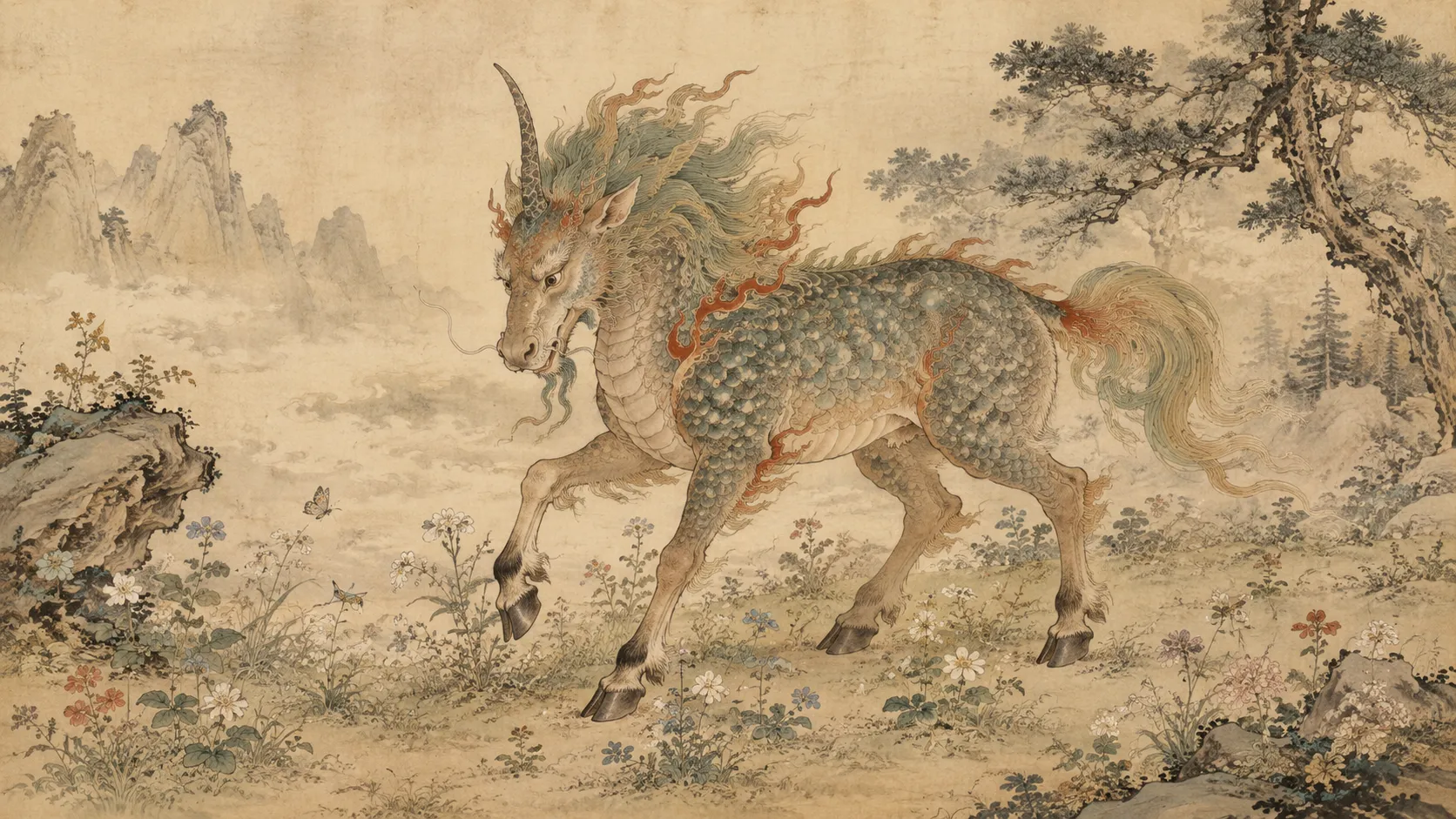
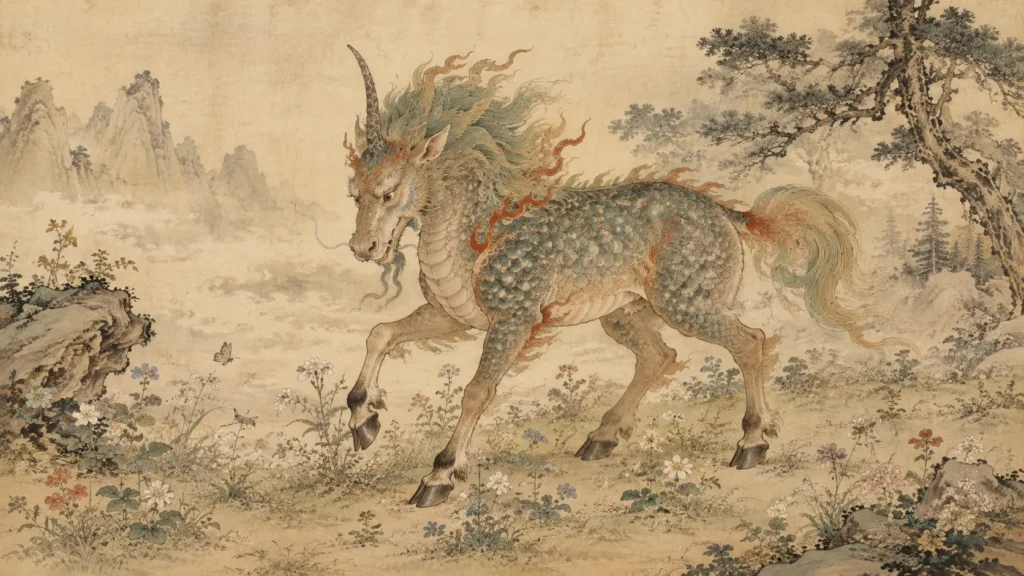
A strange creature walks silently through the grass.
It has the hooves of a deer, the scales of a dragon and a horn rising from its head. Flames appear to curl around its body, yet it burns nothing.
It does not hunt.
It does not destroy.
According to Chinese tradition, the Qilin appears only when the world is ready for an exceptional ruler, a great sage or a future leader.
Its arrival does not announce conquest.
It announces virtue.
The Qilin, written 麒麟, is an auspicious creature in Chinese mythology associated with benevolent government, peace, noble descendants and extraordinary human potential. It is often called the “Chinese unicorn,” although its appearance and symbolism are far more complex.
What Does the Qilin Look Like?
There is no single official design.
Chinese artists have depicted the Qilin with a deer-like body, cloven hooves, dragon scales, horns, a flowing mane and the tail of a lion or ox. Some versions possess one horn, while others have two or more.
This variety is one reason the translation “Chinese unicorn” can be misleading.
The Western unicorn is normally imagined as a white horse with one spiralling horn. The Qilin is a composite animal whose body combines features associated with several powerful creatures.
A nineteenth-century example preserved by the Metropolitan Museum of Art combines the body and hooves of a deer, the head and scales of a dragon and the tail of a fantastic lion. Its unusual anatomy marks it as something that belongs neither entirely to nature nor entirely to the divine world.
Its appearance could change.
Its moral character remained far more consistent.
The Gentle Beast That Refused to Harm Life
The Qilin could look dangerous.
Ancient descriptions gave it horns, scales and enormous supernatural power. Yet it was remembered as a benevolent beast, not a predator.
The Book of Song describes the Qilin as a creature that does not trample living insects, break growing grass or walk into traps. Its strength is restrained by an instinctive respect for life.
Even its horn was sometimes imagined with a fleshy covering, suggesting that the animal possessed the ability to injure without the desire to use it.
That distinction matters.
Many mythical creatures demonstrate power by destroying something.
The Qilin demonstrates power by choosing not to.
Why Did the Qilin Appear Before Great Rulers?
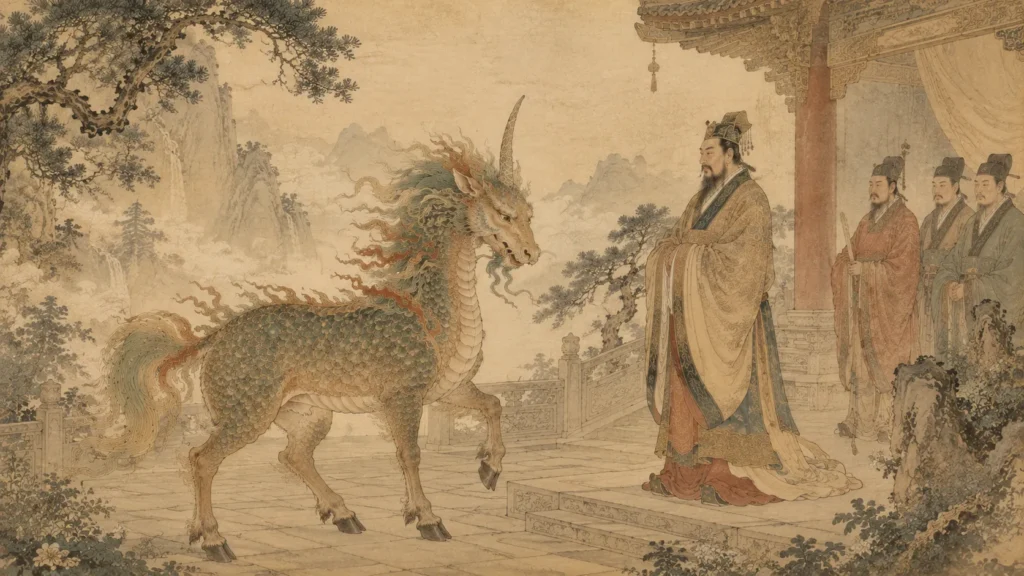
In Confucian tradition, the Qilin was believed to appear when a wise and humane ruler came to power.
It was not simply attracted to wealth, military victory or imperial rank. Its arrival suggested that government had become righteous enough for Heaven and the human world to exist in harmony.
A Qilin-shaped paperweight from the Ming dynasty is described by the Metropolitan Museum of Art as an auspicious object connected with the arrival of a sage ruler. Other artworks used the creature to represent virtuous government, political legitimacy and the hope for a peaceful age.
Older traditions went even further.
They claimed the creature would appear when a ruler loved life and rejected unnecessary killing. In this sense, the Qilin did not create a great leader.
It revealed that one had already become worthy of recognition.
The Qilin and Confucius
The Qilin became deeply connected with Confucius.
The Spring and Autumn Annals ends with a brief and mysterious event: during the fourteenth year of Duke Ai, hunters in the west captured a Qilin.
The animal had appeared during an age of disorder rather than under an ideal ruler. Later commentators treated its capture as tragic. A creature associated with peaceful government had entered a world incapable of recognising or protecting it.
Later traditions connected the event with the final years of Confucius. The wounded or captured Qilin became a symbol of virtue appearing at the wrong moment—wisdom entering a society that no longer understood its value.
The Tang writer Han Yu captured this problem perfectly.
Everyone knew the Qilin was auspicious, he explained, but because it resembled no ordinary animal, people might fail to recognise it even when it stood before them.
That idea gave the creature a deeper meaning.
Greatness is not always ignored because it is weak.
Sometimes it is ignored because it is unfamiliar.
The Qilin and Exceptional Children
The Qilin was also associated with noble descendants and children expected to achieve great things.
An ancient poem called “The Feet of the Lin” compares the sons, grandsons and relatives of a prince with the Qilin. The comparison praises their noble character rather than their physical power.
Over time, images of children riding a Qilin became visual wishes for the birth of talented sons and the continuation of a successful family line.
In Chinese art, the creature could therefore represent both an ideal ruler and the hope that a future generation would produce someone wise enough to lead. The Smithsonian notes that Qilin imagery was used as a wish for the birth of sons, while later prints connected the creature with examination success and distinguished descendants.
This is where the idea that the Qilin appears before great people becomes especially powerful.
It does not celebrate fame after it arrives.
It recognises potential before the rest of the world can see it.
When a Giraffe Became a Qilin
In 1414, an unfamiliar animal arrived at the court of the Yongle Emperor.
It had an extremely long neck, patterned skin and an appearance unlike anything most people in China had seen.
It was a giraffe.
Court officials quickly associated it with the legendary Qilin. Because the mythical creature was supposed to appear during the reign of a sagacious ruler, the giraffe became politically useful evidence that the emperor possessed Heaven’s approval.
Paintings were created to commemorate its arrival, while poets and officials praised it as a supernatural omen.
The giraffe did not create the Qilin legend.
The mythology had existed for centuries.
But the encounter shows how people interpret the unknown through stories they already understand—and how symbols of virtue can be used to strengthen political authority.
The Lesson of the Qilin
The Qilin is not remembered for winning a war.
It does not defeat a demon, steal a divine weapon or challenge Heaven.
Its power is quieter.
It walks carefully even when it possesses the strength to crush what lies beneath it.
That is a form of discipline rarely celebrated today.
Anyone can appear controlled while powerless. The greater test comes when you have enough strength, authority or influence to harm others—and still choose restraint.
Training should not make a person more reckless.
Knowledge should not make him arrogant.
Leadership should not become permission to dominate everyone beneath him.
The Qilin appeared when power and virtue existed together.
That is why it represented the arrival of a great leader.
Not because the leader was feared.
Because he had become strong enough to rule—and disciplined enough not to become a monster.
References:
- The Metropolitan Museum of Art — Paperweight in the Shape of a Qilin
The Qilin as an auspicious creature associated with the arrival of a sage ruler. - The Metropolitan Museum of Art — Embroidered Qilin Toy
Museum description of the creature’s dragon, deer and lion-like physical features. - Chinese Text Project — Book of Song, Auspicious Omens