High in the strange geography of the Shan Hai Jing, there is a barren mountain of sand and stone.
A river begins there and flows south through the landscape.
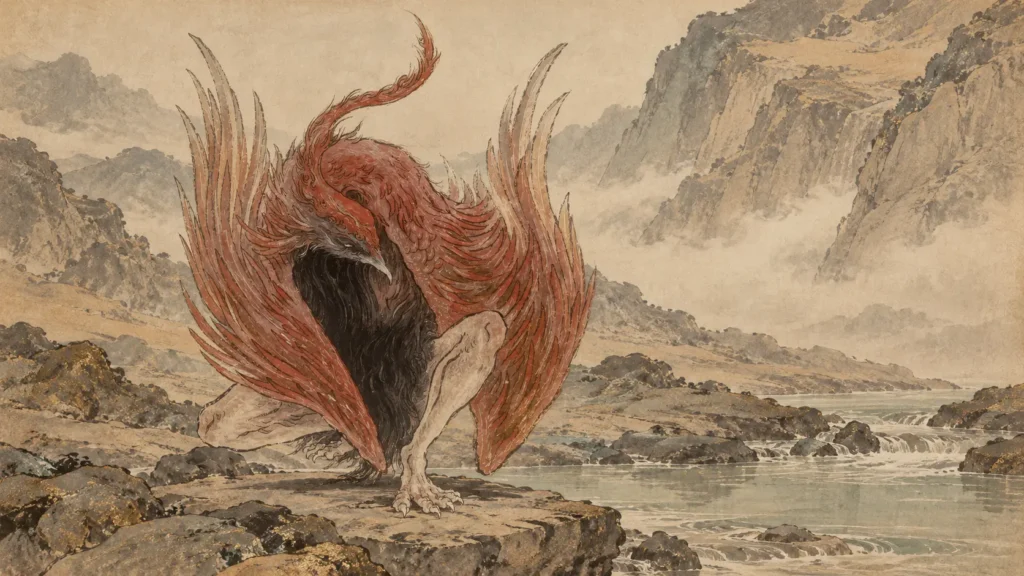
Within its waters lives an unusual bird.
It resembles a mandarin duck—but its feet look human.
Its cry seems to call its own name.
And when the creature appears, the land is said to become filled with great construction works.
This is Lihu (鵹鹕 / 鵹鶘, Líhú), one of the more obscure birds described in the Classic of Mountains and Seas.
Unlike creatures that bring drought, war or disease, Lihu carries a remarkably specific omen:
earthworks and building.
Lihu Quick Facts
| Chinese | 鵹鹕 / 鵹鶘 |
| Pinyin | Líhú |
| Source | Shan Hai Jing — Eastern Mountains |
| Location | Mount Luqi (卢其之山) |
| Appearance | Resembles a mandarin duck |
| Strange feature | Human-like feet |
| Cry | Calls its own name |
| Omen | Its appearance means many earthworks or construction projects |
| Possible later identification | Sometimes compared with a pelican |
What Is Lihu?
Lihu is a strange bird described in the Eastern Mountains section of the Shan Hai Jing. It resembles a mandarin duck, has feet like those of a human, calls its own name and is associated with an omen of extensive earthworks.
The original passage places the bird at Mount Luqi (卢其之山).
The mountain itself is described as having no vegetation and being covered with sand and stone. The Sha River rises there and flows south into the Cen River.
Within those waters, the text says, there are many Lihu.
The setting matters.
Lihu is not introduced in a heavenly palace or supernatural battlefield.
It belongs to a landscape of mountain, stone and water, exactly like many of the strange animals catalogued throughout the Shan Hai Jing.
What Did Lihu Look Like?
The original description is remarkably short:
Lihu resembles a mandarin duck and possesses human-like feet.
That combination is what makes the creature strange.
Its body is not described as monstrous. There are no multiple heads, enormous fangs or supernatural flames.
At first glance, it is simply a bird.
Then you reach the feet.
The book page you photographed follows this same description and emphasizes the resemblance between the bird’s feet and human feet.
Did Lihu Call Its Own Name?
Yes.
The Shan Hai Jing says that its cry calls itself—a recurring formula used for several creatures in the text.
In other words, its sound was understood as resembling the name Lihu.
This detail may seem small, but it gives the creature another recognizable characteristic.
A traveler would not merely see the strange bird.
They could supposedly hear its identity announced by its own voice.

What Happened When Lihu Appeared?
This is the most interesting part of the description.
The text states:
“When it appears, its state will have much tugong (土功).”
The term 土功 refers broadly to earthworks or construction works.
Depending on context, this could include major building activity such as walls, hydraulic works, fortifications or other projects involving large amounts of labor and earth. A modern annotated reading of the passage similarly explains the term through works such as water control, city construction and palace building.
That makes Lihu unusual among the omen-creatures of the Shan Hai Jing.
Many creatures announce catastrophe:
floods, droughts, epidemics or warfare.
Lihu predicts building.
The text does not clearly tell us whether this should be understood as fortunate or disastrous.
Large construction projects could represent prosperity and political organization—but they could also mean enormous demands on labor.
So the safest interpretation is simply the one the text gives us:
Lihu’s appearance signaled that extensive earthworks were coming.
Lihu and Lili: Two Creatures of Construction
Lihu is not the only creature in the Shan Hai Jing associated with 土功.
Another creature, Lili (狸力), is described elsewhere as a pig-like beast whose appearance also predicts extensive earthworks.
Later commentary even grouped the two creatures together.
Guo Pu’s Shan Hai Jing tradition was followed by a poetic interpretation in which Lili and Lihu—one moving on the ground and the other flying—were both treated as signs connected with construction and building activity.
This makes the omen less random than it first appears.
Within the strange symbolic geography of the text, certain animals could function almost like warnings that human activity was about to reshape the landscape.
Was Lihu Really a Pelican?
Possibly—but we should be careful.
Later commentators attempted to identify many Shan Hai Jing creatures with real animals.
Guo Pu’s commentary on this passage notes that the feet of the pelican (鹈鹕) somewhat resemble human feet.
That connection influenced later interpretations, and the explanatory section of the book page you photographed also treats Lihu as related to a pelican-like waterbird.
But there is a problem.
The original Shan Hai Jing does not simply say:
“Lihu is a pelican.”
It specifically says that the bird resembles a mandarin duck and has human feet.
Some later commentators themselves noticed that a pelican does not otherwise look much like a mandarin duck and questioned whether the transmitted description might contain an old textual problem.
So the best conclusion is:
Lihu may have been associated by later scholars with the pelican, but the creature described by the Shan Hai Jing should not automatically be reduced to an ordinary pelican.
The ancient description remains stranger than that.
Mount Luqi and the World of Lihu
The Shan Hai Jing gives Mount Luqi a stark landscape.
There are no grasses or trees.
Sand and stone dominate the mountain.
Water flows away from it toward another river.
Then, inside that landscape, the text places large numbers of these human-footed birds.
There is no surviving elaborate adventure involving Lihu.
No hero fights it.
No god captures it.
Its importance lies in the encounter itself.
A strange bird appears.
Its body is almost familiar.
Its feet are not.
Its call announces its own name.
And somewhere beyond the mountain, people begin moving earth.
Why Lihu Is Worth Remembering
Lihu is exactly the kind of creature that makes the Shan Hai Jing fascinating.
It does not need a long myth.
Only a few details are enough.
A barren mountain.
A river.
A bird with human feet.
A voice calling its own name.
And an omen that civilization itself is about to reshape the land.
For a creature described in only a few lines, Lihu leaves behind a surprisingly vivid image.
Not a monster destroying the world.
But a strange witness to the moment when humans begin rebuilding it.
References & Sources
Shan Hai Jing — Dongshan Jing / Eastern Mountains
Primary passage describing Mount Luqi, the Sha River, Lihu’s mandarin-duck-like form, human feet, self-naming cry and association with earthworks.
Wikisource — Shan Hai Jing, Dongshan Jing