First comes the flash.
Then comes the thunder.
Chinese tradition gave those two forces different divine faces.
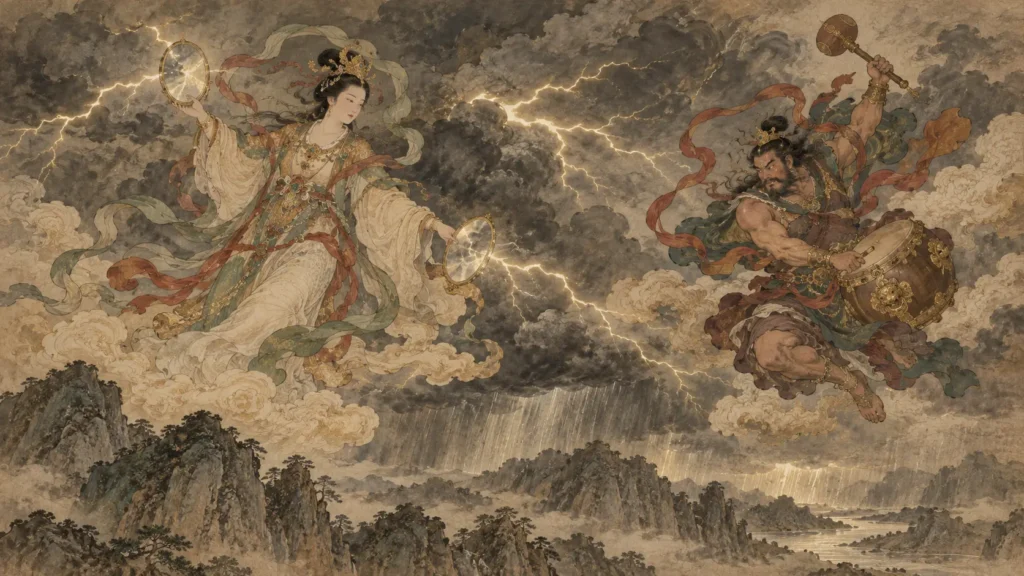
Thunder belonged to the fearsome Lei Gong. Lightning belonged to Dianmu (电母 / 電母, Diànmǔ)—the “Mother of Lightning,” a female deity traditionally shown holding mirrors that illuminate the world before thunder strikes.
But Dianmu is more than Lei Gong’s companion.
Her story developed across different layers of Chinese religion and literature: from a named lightning deity in Song-period texts, to a member of the celestial weather bureaucracy, to later folk legends in which her light helps prevent the Thunder God from punishing the innocent.
Dianmu Quick Facts
| Chinese | 电母 / 電母 |
| Pinyin | Diànmǔ |
| Meaning | Mother of Lightning |
| Role | Deity of lightning |
| Traditionally paired with | Lei Gong, the Thunder God |
| Common attribute | Two mirrors |
| Other name | 闪电娘娘 — Shǎndiàn Niángniang, “Lady of Lightning” |
| Associated with | Lightning, storms, divine judgment |
| Appears in | Chinese folk religion, Daoist-influenced traditions and literature |
| Literary appearance | Journey to the West |
Who Is Dianmu?
Dianmu is the Chinese deity traditionally responsible for lightning and commonly paired with Lei Gong, the god of thunder.
Her name is unusually direct:
电 / 電 — diàn: lightning, electricity
母 — mǔ: mother
The name can therefore be translated as “Mother of Lightning.”
Taiwan’s Ministry of Education dictionary defines Dianmu as the deity specifically responsible for lightning and notes the traditional belief that she is Lei Gong’s companion or spouse. She is also popularly called Shandian Niangniang, the Lady of Lightning.
How Old Is the Dianmu Tradition?
Thunder gods in China are much older than Dianmu’s best-known later image.
That distinction matters.
One clear textual reference to Dianmu by name appears in the poetry of the Northern Song writer Su Shi (1037–1101).
In his poem Ciyun Zhang Chuandao Xiyu, written around prayers for rain, Su Shi places Lei Gong and Dianmu together among the supernatural forces associated with the storm.
This gives us firm evidence that Dianmu was already a recognizable lightning deity in the Song period.
Later texts continue the pairing.
Taiwan’s Ministry of Education historical dictionary also cites a Yuan-period drama in which Lei Gong and Dianmu are sent together to observe a supernatural conflict.
So we should avoid imagining Dianmu as one unchanged goddess with one fixed biography stretching back into China’s earliest mythology.
Her familiar identity belongs to a developing religious and literary tradition.
Dianmu and Lei Gong
Dianmu is most often understood together with Lei Gong, the Thunder God.
The division is simple:
Lei Gong creates or governs thunder.
Dianmu governs lightning.
Later folk tradition turns this natural sequence into a divine partnership.
According to the Taiwan Folk Religion and Cultural Heritage dictionary, Dianmu carries a large mirror and illuminates the world before Lei Gong strikes, allowing him to distinguish right from wrong.
This provides a mythological explanation for an everyday observation:
lightning is seen before thunder is heard.
That is folklore, not a scientific explanation of thunderstorms—but it is a memorable example of how natural phenomena became part of religious storytelling.
Why Does Dianmu Carry Mirrors?
The mirrors are Dianmu’s most recognizable attribute.
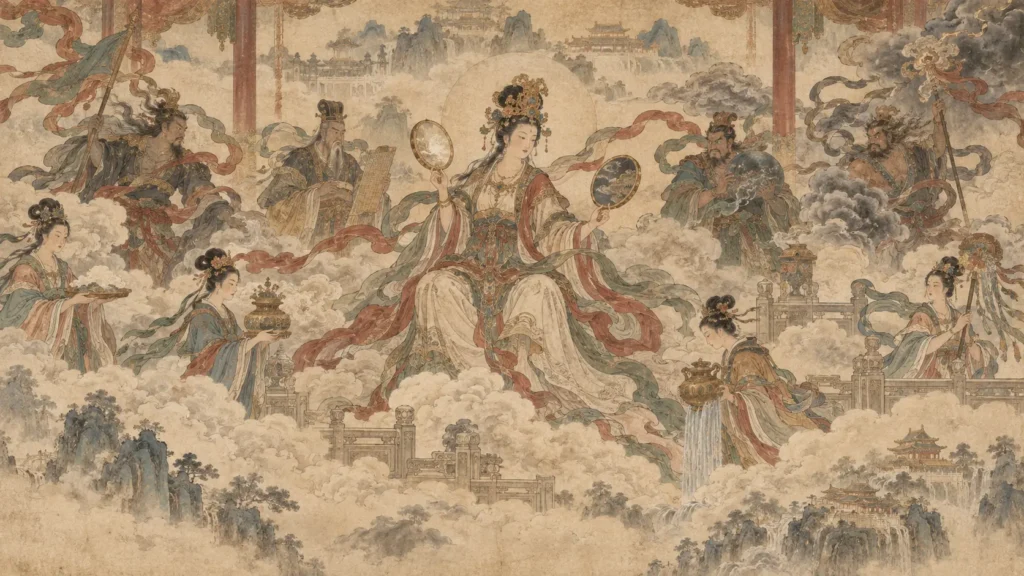
Traditional imagery often presents her holding two mirrors, which produce or symbolize flashes of lightning.
A painting preserved through Taiwan’s National Cultural Memory Bank shows Dianmu holding two mirrors alongside Lei Gong, the Rain Master and the Wind Earl as part of a larger group of celestial weather deities.
The mirrors are therefore not simply decoration.
They visually identify her function.
Lei Gong may carry the violent instruments of thunder.
Dianmu carries reflected light.
Together they transform a storm into a coordinated supernatural event.
The Legend of Dianmu and the Innocent Woman
One popular folk story attempts to explain why Dianmu must illuminate Lei Gong’s targets.
In this version, Lei Gong mistakenly kills a virtuous woman because he misunderstands what she is doing.
The woman appeals against the injustice, and she is eventually elevated to become Dianmu.
From then on, she remains close to Lei Gong and shines her mirror first so that he can clearly see the person he is about to punish.
Taiwan’s National Cultural Memory Bank preserves this legend in connection with a traditional Dianmu figure and explains the mirrors as a safeguard against another wrongful strike.
The important phrase here is folk legend.
We should not treat this story as the earliest documented origin of Dianmu.
It is a later narrative explaining her relationship with Lei Gong, her mirrors and her connection with moral judgment.
Was Dianmu a Goddess of Justice?
Not primarily.
Her basic divine function is lightning.
But later folk tradition gives that lightning a moral purpose.
The same Taiwanese folklore source describes Lei Gong and Dianmu as punishing serious moral wrongdoing, while Dianmu’s light allows guilt and innocence to be distinguished before punishment falls.
This gives her a subtle role.
She is not the executioner.
She is the one who reveals.
In that sense, her light becomes more than weather.
It becomes clarity before judgment.
Dianmu in Journey to the West
Dianmu also appears within the supernatural bureaucracy of Journey to the West.
During the episode at the Kingdom of Cart Slow, Daoist magicians attempt to summon rain.
The celestial weather powers arrive—including Lei Gong and Dianmu.
Sun Wukong eventually gives them his own sequence of commands: wind, clouds, thunder and lightning, then rain, and finally clear skies. When he signals for thunder and lightning, Lei Gong and Dianmu respond together.
Another chapter likewise lists Dianmu together with the Wind Earl, Thunder Duke and Cloud Youth as part of the forces involved in producing rain.
This is useful because it shows Dianmu not as an isolated goddess but as one specialist inside a much larger celestial weather system.
Dianmu and the Chinese Weather Gods
Traditional Chinese religion could imagine weather almost like a heavenly administration.
Different divine figures governed different forces.
Lei Gong handled thunder.
Dianmu handled lightning.
Fengbo was associated with wind.
Yushi, the Rain Master, was associated with rain.
Dragon deities and Dragon Kings also became deeply connected with rainfall and water.
The system was not perfectly identical across every period or region, but the underlying idea was powerful:
weather was not random.
It belonged to an ordered cosmos.
Dianmu Is Not the Same as Ancient Leishen
Dianmu should also be distinguished from much older thunder-deity traditions.
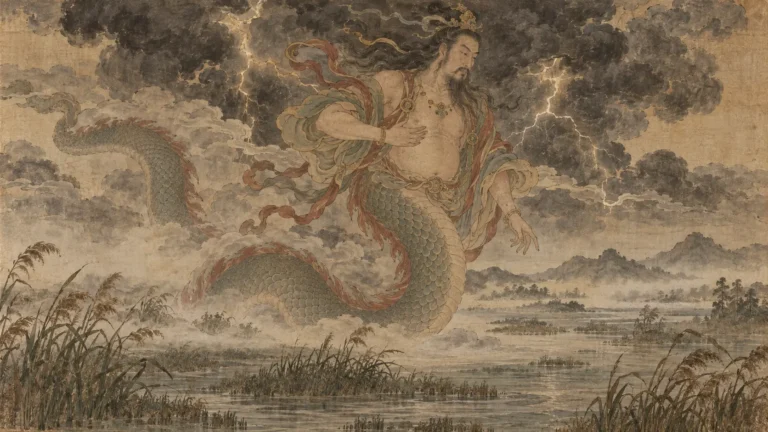
Our article on Leishen of Leize covers a strange dragon-bodied thunder being described in the Shan Hai Jing.
That ancient figure belongs to a very different textual world.
Dianmu’s familiar role is part of the later differentiated storm pantheon in which thunder and lightning have separate divine specialists.
This distinction helps prevent thousands of years of Chinese mythology from being flattened into one single “Thunder God story.”
What Did Dianmu Look Like?
Later visual tradition usually presents Dianmu as a dignified female deity.
One surviving religious painting described by Taiwan’s National Cultural Memory Bank shows her dressed in pink and holding two mirrors, while Lei Gong appears nearby with his own characteristic weaponry.
This contrast works visually as well as symbolically.
Lei Gong is often fierce.
Dianmu can appear calm.
He represents the crash.
She represents the flash.
Why Dianmu Matters
Dianmu transforms one instant of a storm into a complete myth.
A flash appears across the sky.
For a moment, everything hidden becomes visible.
Then the thunder arrives.
Later storytellers turned that sequence into a moral idea.
Dianmu shines first so that judgment can see clearly.
Only then does Lei Gong strike.
It is a surprisingly sophisticated role for a deity sometimes reduced to little more than “the wife of the Thunder God.”
Dianmu does not merely accompany thunder.
She gives it light.
References & Sources
Taiwan Ministry of Education — Dianmu
Official dictionary entry defining Dianmu as the deity responsible for lightning and recording her traditional relationship with Lei Gong.
Su Shi — Ciyun Zhang Chuandao Xiyu
Northern Song primary text explicitly mentioning Lei Gong and Dianmu together.
Taiwan Folk Religion and Cultural Heritage Dictionary — Lei Gong and Dianmu
Useful source for the later mirror tradition, moral-judgment role and folk explanation of lightning preceding thunder.