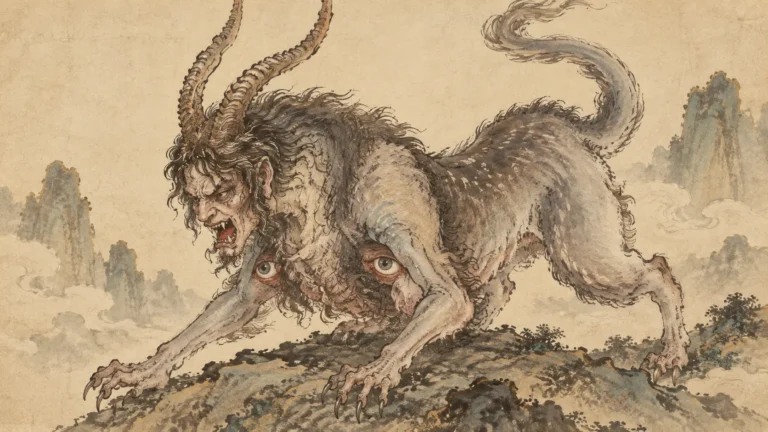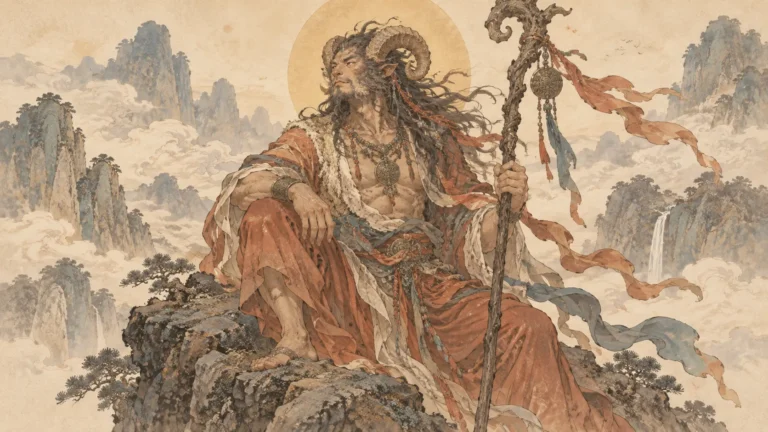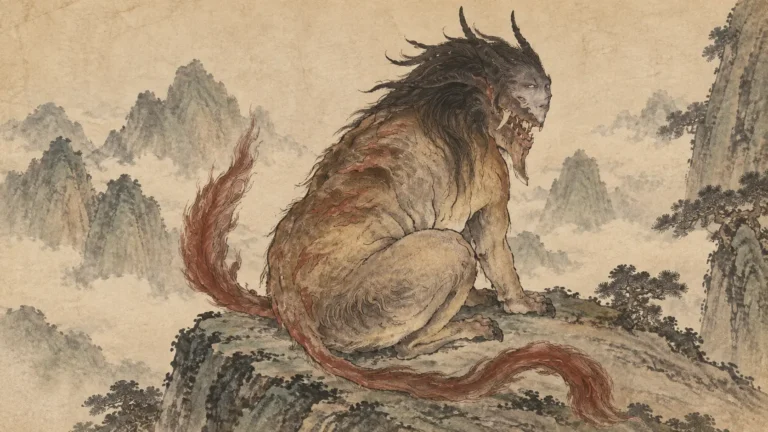
Before the winged Lei Gong beat his heavenly drums, Chinese mythology imagined thunder differently.
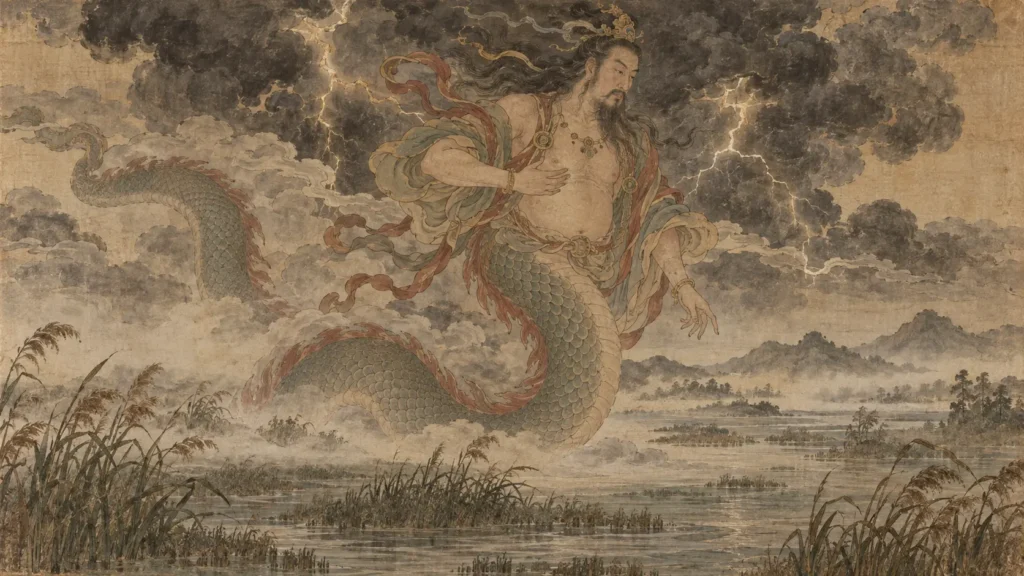
Deep within a mysterious marsh called Leize, something moved beneath the storm.
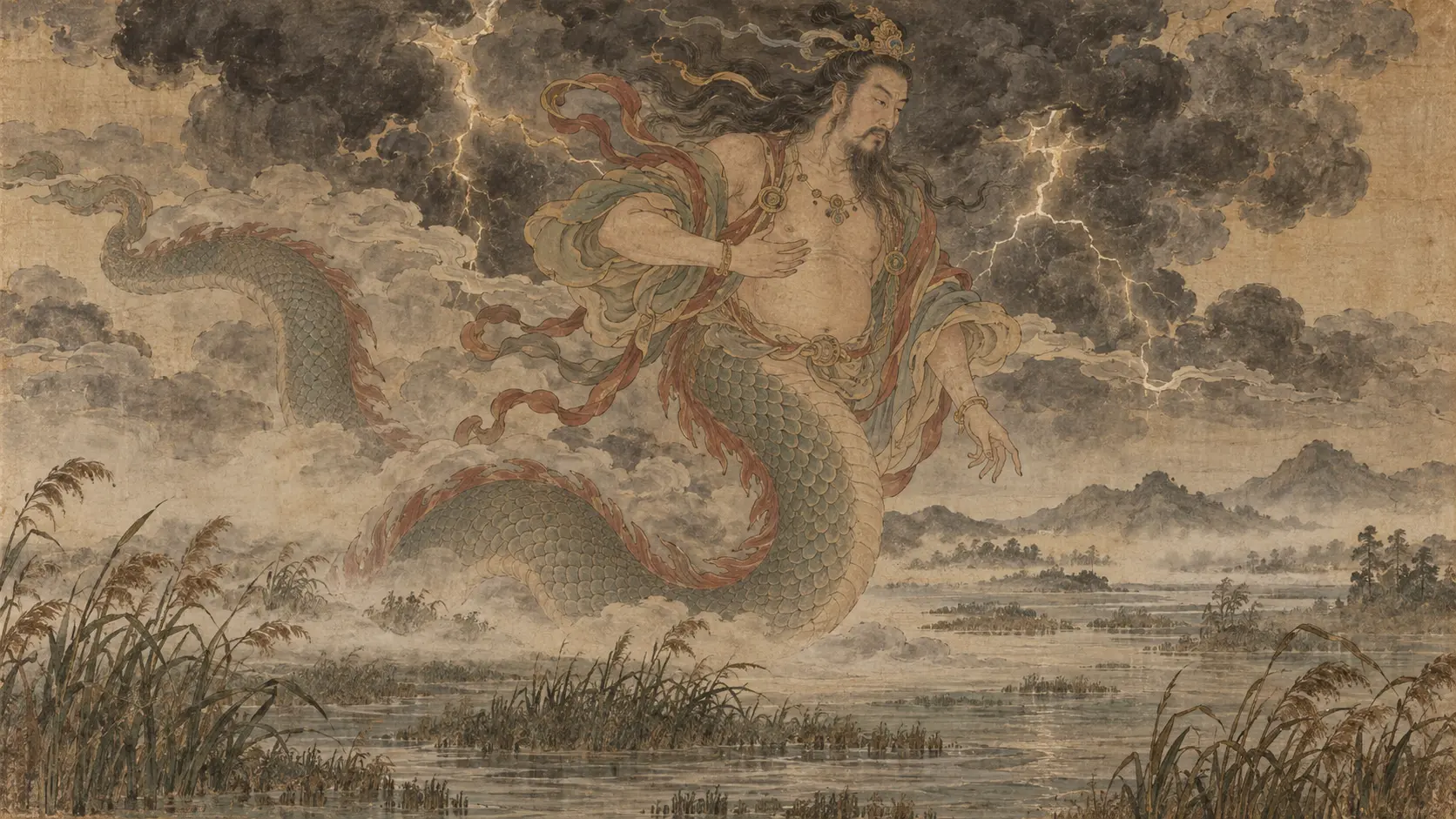
It had the body of a dragon.
The head of a human.
And it needed no weapon to create thunder.
It simply struck its own belly.
This is the Thunder God of Leize (雷神, Léishén) — one of the oldest and strangest thunder-deity images preserved in the Shan Hai Jing.
The Thunder God of Leize at a Glance
| Chinese name | 雷神 |
| Pinyin | Léishén |
| Meaning | Thunder God / Thunder Spirit |
| Primary source | Shan Hai Jing 山海經 |
| Section | Hainei Dong Jing 海內東經 |
| Home | Leize 雷澤 |
| Appearance | Dragon body with a human head |
| Thunder | Produced by beating/drumming the belly |
| Later connection | Huaxu and the birth tradition of Fuxi |
| Not the same article as | Later Lei Gong tradition |
Who Is the Thunder God of Leize?
The Thunder God of Leize is an ancient thunder deity described in the Shan Hai Jing as having a dragon’s body and a human head. It lives in the marsh called Leize, and thunder is produced when it beats its belly. Later commentary also connects Leize with the miraculous conception tradition surrounding Huaxu and Fuxi.
This is a remarkably different image from the bird-beaked, winged Lei Gong found in later Chinese religious art.
No hammer.
No chain of drums.
No divine courtroom.
Just a dragon-bodied god living in a marsh whose own body produces the sound of thunder.
What Does the Shan Hai Jing Actually Say?
The Hainei Dong Jing gives only a few words:
雷澤中有雷神,龍身而人頭,鼓其腹。在吳西。
The basic meaning is:
In Leize there is a Thunder God. It has the body of a dragon and the head of a human. It beats its belly, producing thunder. Leize lies west of Wu.
As with many entries in the Shan Hai Jing, there is no long biography.
The text does not explain who created the god.
It does not describe a battle.
It does not give the deity a personal name beyond Leishen — Thunder God.
What it gives us instead is an image.
And that image is ancient, physical and strange.
Why Does the Thunder God Have a Dragon Body?
The source does not explain why.
But the association between dragons, clouds, rain and thunder became deeply embedded in early Chinese thought.
Centuries later, the Han thinker Wang Chong discussed the relationship between dragons and thunder in his Lunheng. While skeptical of supernatural explanations, he preserves the idea that dragons and thunder were understood as naturally connected phenomena — he writes that thunder and dragons belong together and respond to related qi.
That does not prove why the Shan Hai Jing chose a dragon body.
But it shows that connecting dragons with storm phenomena was not an isolated idea.
For the Thunder God of Leize, the storm is literally embodied as a dragon.
Why Does Leishen Beat Its Belly?
This may be the creature’s strangest feature.
The phrase 鼓其腹 (gǔ qí fù) literally evokes drumming, striking or sounding the belly.
Later transmitted versions make the implication more explicit: when the god strikes its abdomen, thunder results.
This is very different from later Lei Gong imagery.
Lei Gong needs a drum and mallet.
The Leize Thunder God effectively is the drum.
Its body is the instrument of thunder.
That difference gives us one of the clearest signs that Chinese thunder-god imagery changed over time.
Is the Leize Thunder God the Same as Lei Gong?
Not exactly — and for our site, we should keep the two traditions separate.
The term 雷神 (Leishen) can simply mean “Thunder God,” and dictionaries may use it broadly for thunder deities, including Lei Gong.
But the deity in the Shan Hai Jing has a very specific early appearance:
dragon body + human head + Leize + thunder from the belly.
Our existing Lei Gong (雷公) article covers a later tradition in which the thunder god develops into a supernatural enforcer associated with hidden crimes, bird-like features, wings, drums, and later Daoist celestial bureaucracy.
Those traditions overlap historically.
But merging them into one fixed character would erase how much the thunder god changed.
A cleaner chronology is:
Shan Hai Jing → dragon-bodied Thunder God of Leize
Han and later traditions → increasingly anthropomorphic thunder gods
Later religion and folklore → Lei Gong with drum, wings and divine punishment
That is much more useful than saying every Chinese thunder god is simply the same figure.
Is Fuxi the Son of the Thunder God?
This is where your book gives us a fascinating connection — but one that needs careful wording.
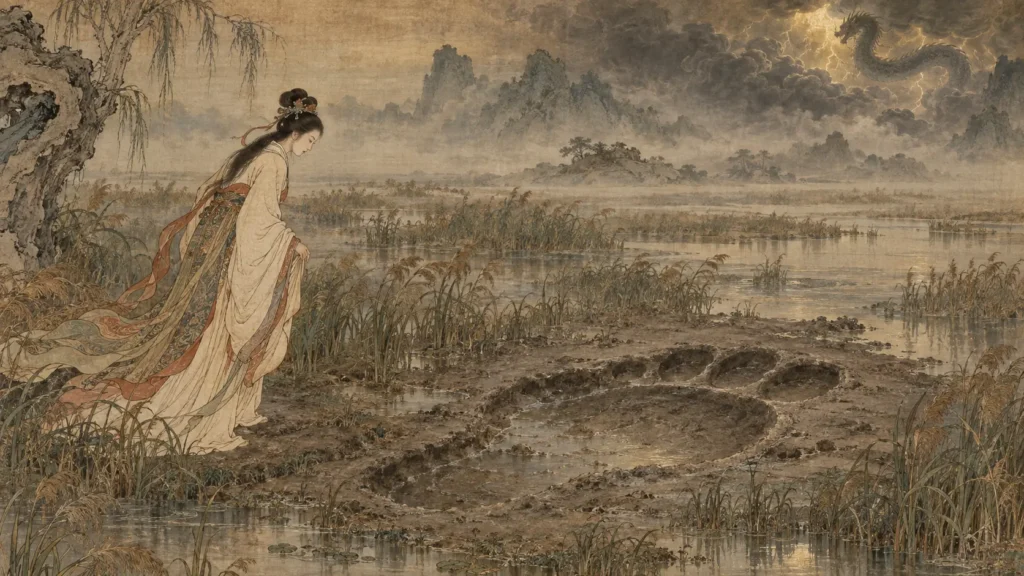
Guo Pu’s commentary on the Shan Hai Jing passage cites an older Hetu tradition:
a great footprint appeared at Leize, Huaxu stepped into it, and afterward she gave birth to Fuxi.
Later retellings sometimes interpret this as linking Fuxi’s birth directly with the Thunder God.
But the surviving quotation does not literally say:
“The Thunder God fathered Fuxi.”
It says:
Leize → mysterious giant footprint → Huaxu steps on it → Fuxi is born.
That distinction is important.
The connection between Fuxi and the sacred thunder landscape is real within the later commentary tradition.
The exact identity behind the footprint is less explicit.
And that uncertainty is far more interesting than pretending we know more than the source tells us.
Was Leize a Real Place?
Ancient and later commentators tried to identify it.
Guo Pu associated the Leize of the text with a marsh known from historical geography, while later scholars debated whether the location should be placed elsewhere. Modern research continues to discuss where the mythical geography behind the passage may have originated.
That means we should avoid confidently pinning the mythological Leize to one modern GPS point.
For the story, what matters most is its function:
Leize is the watery landscape where thunder takes physical form.
A marsh.
A dragon.
A human face.
And a body that sounds like the sky breaking open.
From Leishen to Lei Gong
The book page you sent notes that later Chinese traditions contain many different thunder gods.
That is correct — and it is one of the best conclusions we can draw from this creature.
There was never only one completely stable image of “the Chinese thunder god.”
Different periods imagined thunder differently.
The Shan Hai Jing gives us a dragon-bodied being in a marsh.
Later art gives us human or monstrous figures.
Daoist religion develops sophisticated Thunder Departments and thunder officials.
Popular tradition gives us Lei Gong and Dianmu.
Chinese thunder mythology is therefore not one character biography.
It is a tradition that changed for centuries.
Why the Thunder God of Leize Matters
This figure occupies only a sentence in the Shan Hai Jing.
But that sentence preserves a world before the familiar image of Lei Gong fully formed.
Thunder was not yet a winged celestial officer striking a drum in the clouds.
It was something older.
Something living in water.
Something with a dragon’s body and a human face.
Something whose own flesh could become the sound of a storm.
And that may be what makes the Thunder God of Leize so important.
It lets us see Chinese mythology changing in front of us.
References
Primary source — Shan Hai Jing: Hainei Dong Jing
Records the Thunder God in Leize as a dragon-bodied, human-headed being that beats its belly.