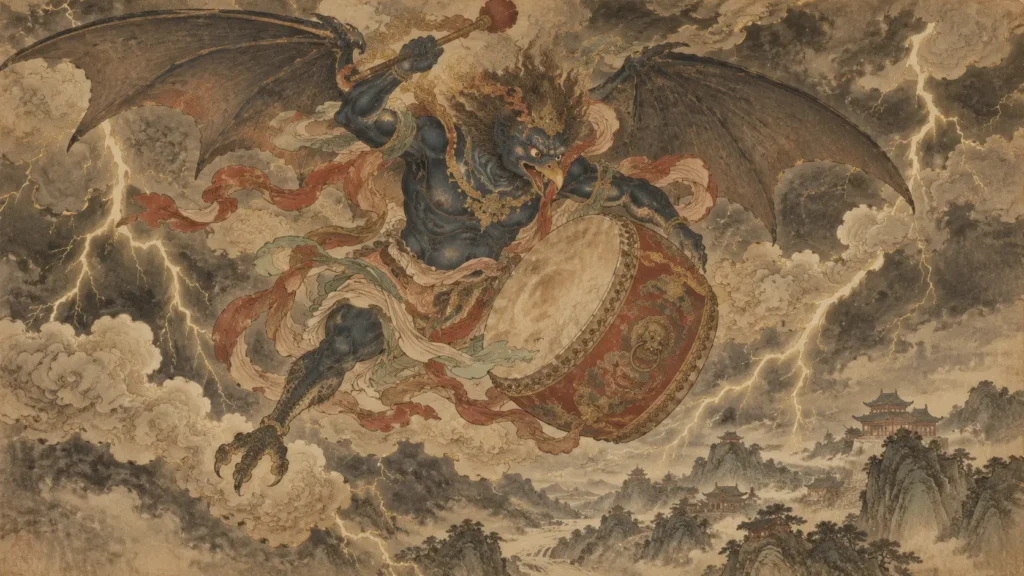
Somewhere above the clouds, thunder is not simply weather.
It is a verdict.
A crime committed where nobody was watching. A betrayal never discovered. Cruelty hidden behind a closed door.
In Chinese tradition, there was a terrifying possibility: human justice might miss what you had done, but Heaven would not.
And when Heaven decided to answer, Lei Gong (雷公, Léi Gōng) brought the thunder.
Lei Gong at a Glance
| Chinese | 雷公 |
| Pinyin | Léi Gōng |
| Literal meaning | “Duke of Thunder” |
| Also known as | Lei Shen (雷神, “Thunder God”); older romanization: Lei Kung |
| Domain | Thunder; divine punishment of hidden, unprosecuted wrongdoing |
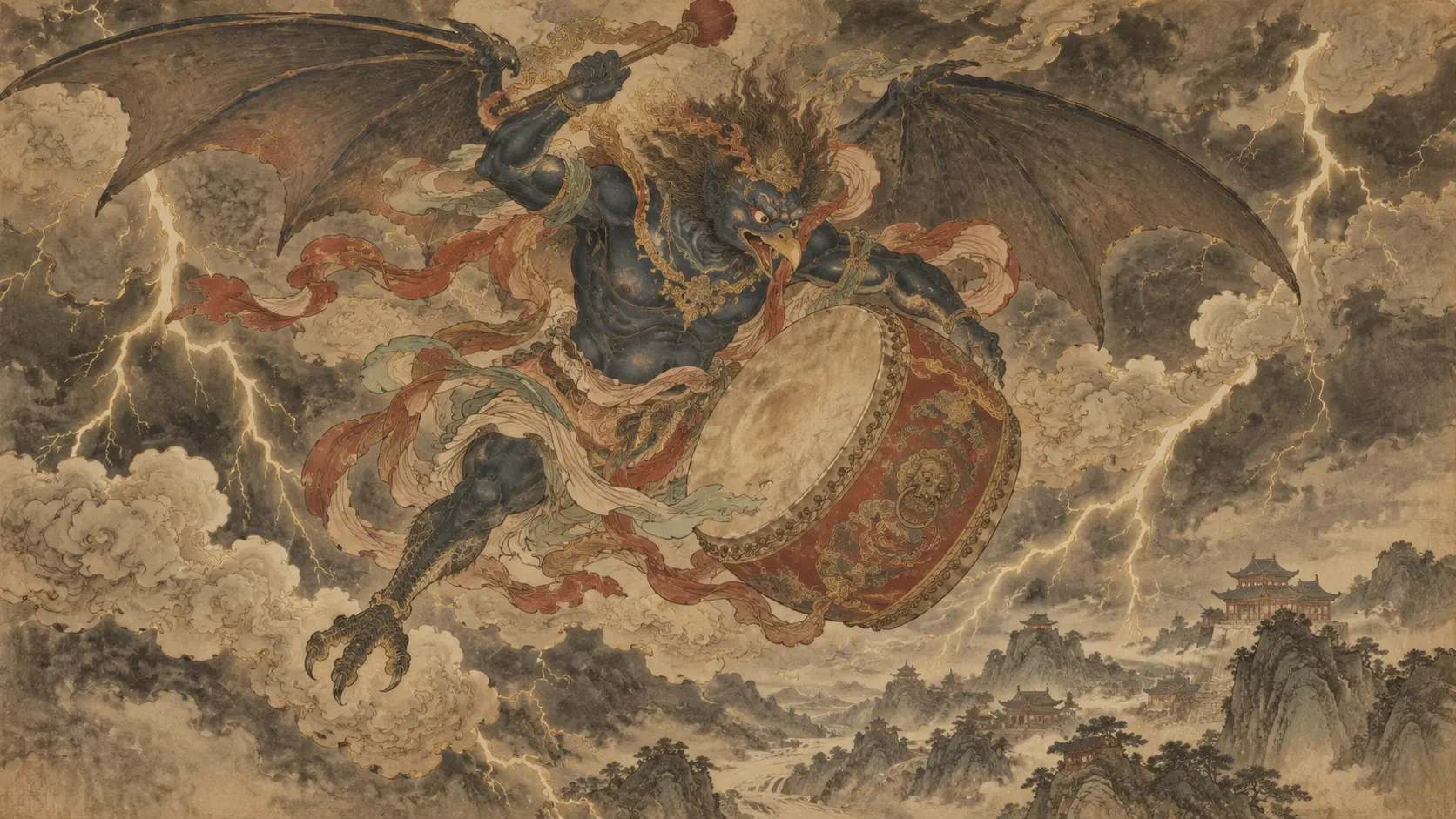
| Appearance | Blue-black body, bird’s beak, bat-like wings, claws, loincloth |
| Tools | Drum and mallet (to produce thunder), chisel or hammer (to punish) |
| Serves under | The Jade Emperor, within the Daoist “Ministry of Thunder” (雷部, Léibù) |
| Closely linked to | Dianmu (電母), goddess of lightning |
| Key sources | Ming-Qing Daoist folk religion, Fengshen Yanyi (via the related figure Lei Zhenzi) |
Who Is Lei Gong in Chinese Mythology?
Lei Gong is the Chinese god of thunder, a divine figure associated with storms, heavenly punishment and moral justice. In later Chinese religion and folklore, he is often imagined as a fearsome winged being who beats drums to create thunder and strikes wrongdoers whose crimes escape human justice.
His name literally means “Duke of Thunder.”
Lei Gong is also called Lei Shen (雷神, Léishén), meaning “Thunder God.” But reducing him to a Chinese equivalent of Thor or Zeus misses what makes him unusual.
Lei Gong is not primarily a king.
He is an enforcer.
And the idea behind him is much older than many of the famous images people recognize today.
Lei Gong Is Older Than His Famous Monster-Like Appearance
One of the most interesting things about Lei Gong is that his appearance changed dramatically over time.
The name Lei Gong already appears in the Chu Ci poem Far Journey, where the speaker describes supernatural attendants surrounding his celestial journey:
Rain Master stands to the left, while Lei Gong serves as a guard on the right.
That early reference tells us that Lei Gong was already imagined as a divine power associated with thunder and protection.
But it does not describe the blue-skinned, bird-beaked creature familiar from later art.
A much more revealing description appears in Wang Chong’s Lunheng, written during the Eastern Han period.
Wang Chong was skeptical of popular supernatural beliefs, which makes his account especially useful. While arguing against them, he accidentally preserves what people around him apparently believed.
He describes artists painting Lei Gong as a powerful man carrying a chain of drums in one hand and a mallet in the other. Thunder was imagined as the sound of those drums being struck.
So the earliest surviving image is not a bird demon.
It is a strong man with drums.
The creature-like Lei Gong came later.
What Does Lei Gong Look Like?
In later Chinese religious art, Lei Gong becomes far more frightening.
He is commonly represented with a bird-like beak, wings, clawed feet and a powerful supernatural body, often wearing little more than a loincloth and carrying instruments associated with thunder and punishment.
Museum collections preserve this later form clearly. The British Museum describes a representation of Lei Gong as half-man and half-bird, while a Qing-period statue from Fujian held by the Musée des Confluences shows him with bird claws, a beak and wings.
His most recognizable attribute remains the drum and mallet.
This is important because the drum is not a modern fantasy addition. The association stretches back at least to the Lunheng, where the sound of thunder is already explained through Lei Gong striking drums.
The monster changed.
The thunder drum survived.
Why Does Lei Gong Punish Hidden Crimes?
Lei Gong became more than an explanation for storms.
He became an explanation for justice that humans could not deliver.
The Lunheng records a widespread belief that when lightning killed someone, people could interpret it as punishment for hidden wrongdoing — crimes concealed from ordinary human knowledge.
Wang Chong himself rejected this explanation, but his criticism proves something valuable: the belief was important enough in his time to argue against.
Later religious and popular traditions developed this moral role even further.
Lei Gong was imagined as a heavenly punisher who could strike people guilty of secret wrongdoing and supernatural beings who abused their powers.
That changes the meaning of thunder.
A storm is no longer random noise above the roof.
It becomes the possibility that something hidden has been seen.
Lei Gong and the Ministry of Thunder
Chinese divine worlds are often organized like governments.
There are rulers, officials, departments, records and supernatural jurisdictions — something readers of the Chinese underworld and its courts will immediately recognize.
Thunder eventually became part of this celestial bureaucracy as well.
But there is an important distinction that many modern retellings miss:
Lei Gong is associated with the Thunder Department, but he is not universally its supreme ruler.
The Ming-dynasty novel Fengshen Yanyi provides a perfect example. Near the end of the novel, Wen Zhong is appointed to oversee the Thunder Department (雷部, Léibù) together with twenty-four thunder officials whose duties include rainmaking, punishing evil and protecting the good.
Daoist thunder traditions became far more complex than a single thunder god commanding everything.
That makes Lei Gong more interesting, not less.
He belongs to a much larger Chinese idea: Heaven itself can operate like an administration.
Is Lei Gong the Same as Lei Zhenzi?
No — Lei Gong and Lei Zhenzi should not simply be treated as the same figure.
This is one of the most common problems in modern retellings.
Lei Zhenzi (雷震子, Léizhènzǐ) is a specific character in the Ming novel Fengshen Yanyi.
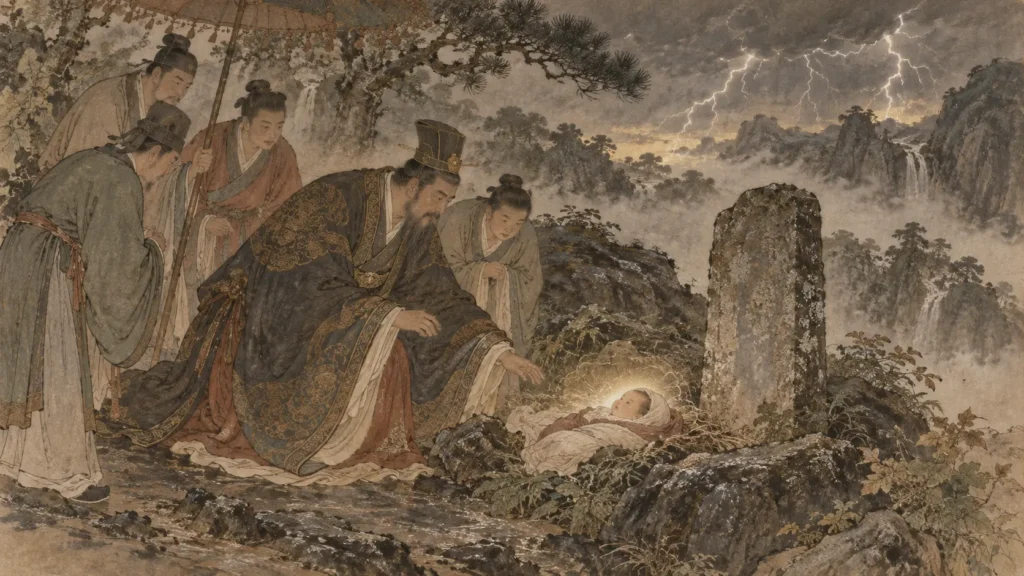
After a violent thunderstorm at Yanshan Mountain, Ji Chang, the future King Wen of Zhou, hears a baby crying near an ancient tomb. He adopts the child, and the Daoist Yunzhongzi later takes him away as a disciple. Because the child appeared after thunder, he receives the name Lei Zhenzi.
Years later, Lei Zhenzi eats two supernatural red apricots.
His body transforms dramatically: wings emerge from beneath his arms, his face turns blue, his hair becomes red and his appearance becomes terrifying.
The similarities to later Lei Gong imagery are obvious.
Thunder.
Wings.
A frightening transformed body.
But the novel presents him as Lei Zhenzi, not simply as Lei Gong.
They belong to overlapping visual and thunder traditions, but collapsing them into one person erases an important distinction between older thunder-god tradition and Ming-dynasty literature.
Lei Gong and Dianmu
Thunder rarely travels alone.
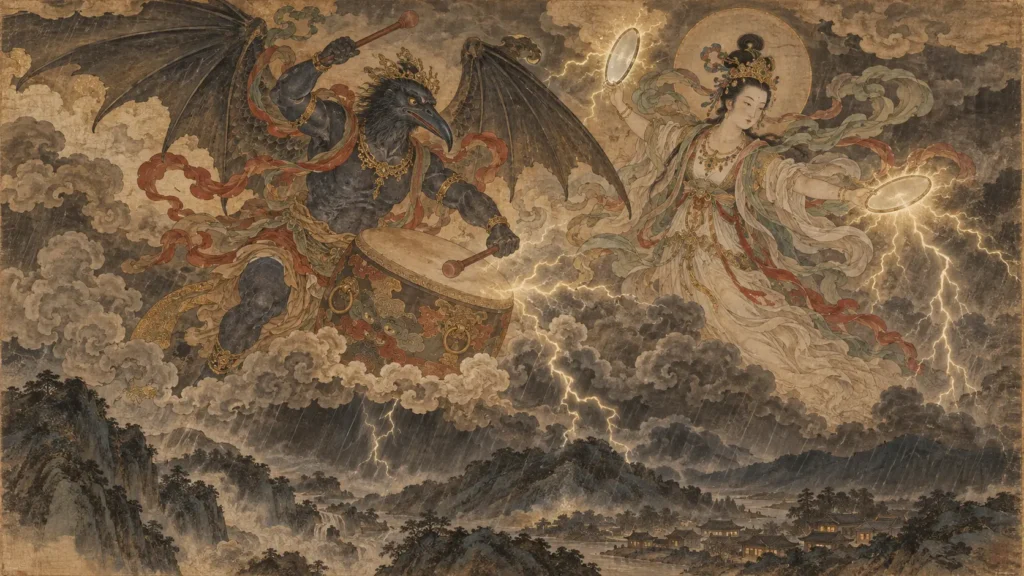
Later Chinese tradition frequently pairs Lei Gong with Dianmu (電母, Diànmǔ) — the “Mother of Lightning.”
Their roles complement each other beautifully.
Lei Gong produces the sound of thunder.
Dianmu produces the flash of lightning, traditionally associated with shining mirrors across the sky. Later traditions variously describe her as Lei Gong’s wife, assistant or celestial partner, so it is safer not to force every version into one relationship.
Together they transform a storm into something almost mechanical:
light reveals.
Thunder judges.
And Heaven responds.
Why Lei Gong Still Matters
Lei Gong could easily have become just another ancient explanation for frightening weather.
Instead, he survived as something much more unsettling.
He represents the idea that visibility and guilt are not the same thing.
Human courts require evidence.
Witnesses can disappear.
Secrets can remain buried.
But the mythology of Lei Gong imagines another level of justice — one in which hiding a crime successfully does not erase it.
That is why thunder fits him so perfectly.
You cannot see where it begins.
You cannot negotiate with it.
And by the time you hear it, the sky has already spoken.
References
Primary / early Chinese sources
- Chu Ci — Far Journey — one of the early textual appearances of Lei Gong as a supernatural guard. Chinese Text Project – Chu Ci Far Journey
- Wang Chong, Lunheng — Thunder: A Baseless Claim — early evidence for the drum-bearing depiction and the belief that thunder punished hidden wrongdoing. Chinese Text Project – Lunheng Lei Xu