Before China had emperors in the historical sense, tradition imagined rulers who stood between myth and memory.
They fought monsters and rival tribes.
They learned secret knowledge from divine beings.
They became ancestors, teachers, inventors and models of kingship.
Among them, none became more influential than the Yellow Emperor — Huangdi (黄帝, Huángdì).
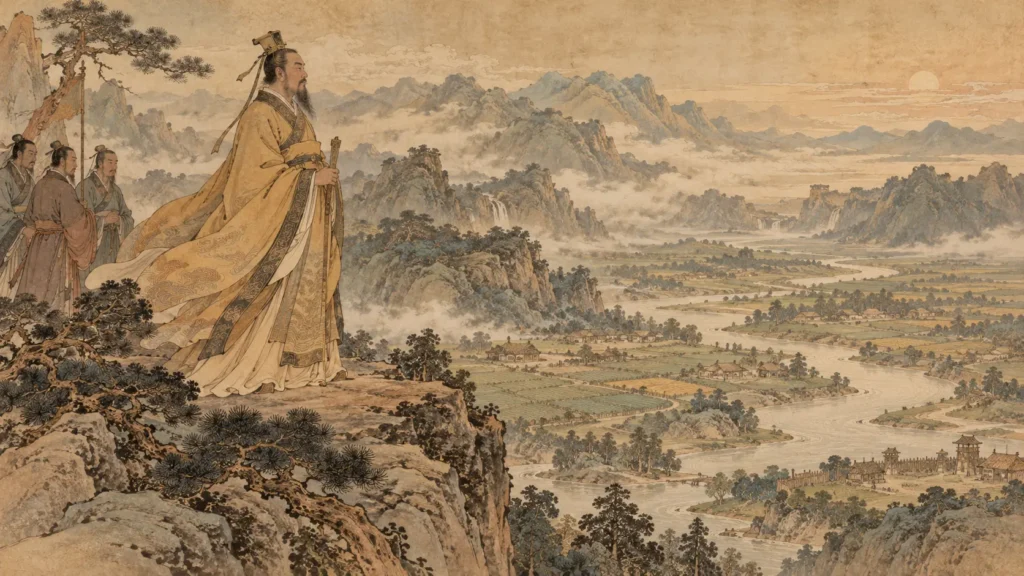
Later Chinese tradition remembered Huangdi as a legendary sovereign, culture hero and ancestral ruler associated with the beginnings of civilization.
But he is difficult to place in a simple category.
Was he a king?
A god?
A mythical ancestor?
A Daoist sage?
The answer changes depending on which period and which text we look at.
And that is exactly what makes the Yellow Emperor so important.
Yellow Emperor Quick Facts
| Chinese | 黄帝 / 黃帝 |
| Pinyin | Huángdì |
| Common English name | Yellow Emperor |
| Traditional personal name | Xuanyuan (轩辕 / 軒轅) |
| Role | Legendary sovereign and culture hero |
| Traditional group | One of the Five Emperors |
| Famous rivals | Yandi and Chiyou |
| Associated traditions | Early kingship, ancestry, warfare, medicine, Huang-Lao and later Daoist traditions |
| Historical status | Legendary; not independently established as a historical ruler |
| Important distinction | Not Qin Shi Huang and not the author of the Huangdi Neijing |
Who Was the Yellow Emperor?
The Yellow Emperor is a legendary ruler and culture hero of ancient Chinese tradition who became associated with ancestry, civilization, kingship and later religious thought.
One of the most influential narratives appears at the very beginning of Sima Qian’s Records of the Grand Historian.
There Huangdi is introduced as the son of Shaodian, with the surname Gongsun and the personal name Xuanyuan. He is described as extraordinarily capable from childhood and later becomes the central ruler in Sima Qian’s sequence of the Five Emperors. Chinese Text Project
But there is an important historical problem.
Sima Qian was writing in the Han period, many centuries after the legendary age in which Huangdi was said to have lived.
Modern scholarship therefore does not simply treat this biography as contemporary historical documentation.
Research on early Huangdi traditions shows that his image developed over time through genealogical, political, religious and mythological layers before becoming the great ancient sovereign familiar from later tradition. ScienceDirect
Why Is He Called the Yellow Emperor?
The name is written:
黄帝 / 黃帝 — Huángdì
The first character, 黄 / 黃, means yellow.
The second, 帝, can refer to a supreme ruler, divine sovereign or exalted lord depending on historical context.
Calling him “the Yellow Emperor” is conventional, but the word di here predates the imperial title later used by historical emperors.
That distinction becomes very important.
The Yellow Emperor is 黄帝.
The ordinary historical title “emperor” used after Qin unification is 皇帝.
They sound similar in Mandarin — both Huángdì — but they are written with different first characters and come from different historical contexts.
When Qin ruler Ying Zheng unified the rival states in 221 BCE, he adopted the new title huangdi (皇帝), from which we get “First Emperor,” Qin Shi Huang. The Metropolitan Museum of Art
So:
Yellow Emperor 黄帝 ≠ Qin Shi Huang 秦始皇帝
They are separated by both mythology and history.
Was Huangdi One of the Five Emperors?
In one influential traditional system, yes.
Later Chinese sources group Huangdi with other primordial sage rulers as the Five Emperors.
A traditional list preserved in the Fengsu Tongyi includes:
- Huangdi
- Zhuanxu
- Emperor Ku
- Yao
- Shun Chinese Text Project
But ancient classification systems were not completely uniform.
Different texts could organize early rulers differently.
So it is safer to say:
Huangdi became one of the most important members of the Five Emperors tradition, rather than implying there was always one fixed canonical list from the beginning.
Huangdi and the Battle Against Yandi
Sima Qian presents Huangdi as rising during a period of disorder.
The power of the Shennong lineage is said to be weakening.
Regional rulers fight among themselves.
Huangdi builds military strength and gains the allegiance of other leaders.
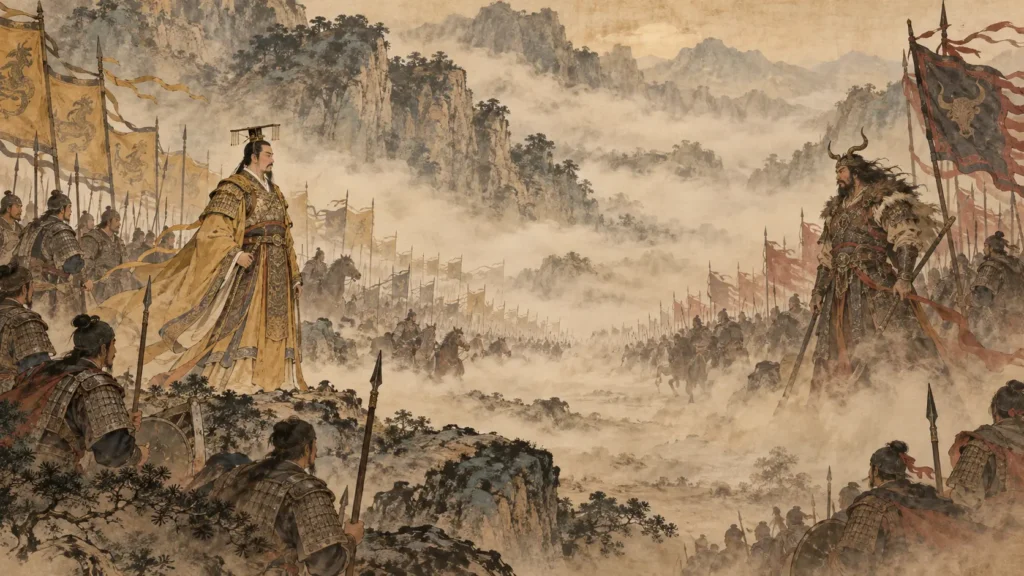
One major episode is the conflict against Yandi, the Flame Emperor.
The Shiji describes Huangdi fighting Yandi at Banquan, eventually defeating him after repeated battles. Chinese Text Project
This episode later became important in narratives about the origins of the Huaxia cultural world.
But again, it should not be treated like a securely dated Bronze Age battle report.
It belongs to the legendary historical framework constructed by later texts.
Huangdi and Chiyou
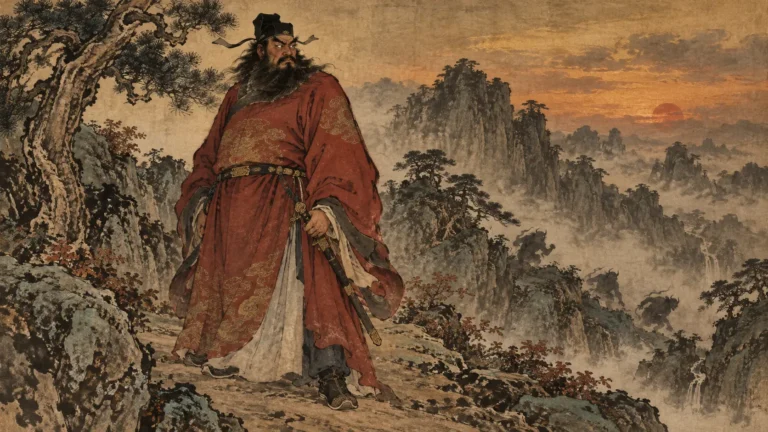
The most famous enemy of the Yellow Emperor is Chiyou (蚩尤).
In Sima Qian’s account, Chiyou is described as exceptionally violent and difficult to defeat.
Huangdi eventually confronts him in the broader sequence of wars that establish Huangdi’s supremacy. Chinese Text Project
Later mythology made the conflict even more dramatic.
Different traditions added fog, divine weapons, supernatural helpers and celestial intervention.
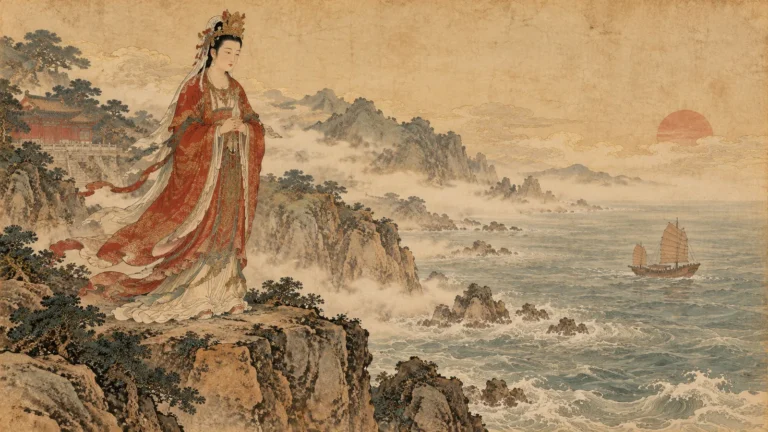
This is where figures such as Jiutian Xuannü became connected with Huangdi.
Our existing Jiutian Xuannü article already owns that goddess and her military-teaching tradition, so this Huangdi page should mention the connection but not retell her entire mythology.
That separation is important:
Huangdi page → owns Huangdi
Jiutian Xuannü page → owns the goddess and her teachings
Future Chiyou page → owns Chiyou
Jiutian Xuannü and the Yellow Emperor
In later Daoist and religious traditions, the Mysterious Woman becomes a heavenly helper of Huangdi.
Research on her development notes that earlier forms of the goddess were linked with rescuing or assisting Huangdi in his conflict with Chiyou, while the fuller title Jiutian Xuannü developed later. Taylor & Francis Online
This matters because it shows how Huangdi’s mythology kept expanding.
He was not only remembered as a ruler.
He became a figure around whom later religious traditions could gather secret knowledge, military techniques and divine instruction.
For the full goddess tradition, see Jiutian Xuannü.
Huangdi and Bai Ze
Another famous later tradition connects the Yellow Emperor with Bai Ze, the supernatural beast said to understand the hidden beings of the world.
In the popular story, Bai Ze reveals knowledge about spirits and strange creatures to Huangdi.
Our existing Bai Ze page already owns that story, which means this article should not become a second Bai Ze article.
Here, the connection has one purpose:
to show how Huangdi gradually became a receiver and organizer of supernatural knowledge.
That pattern becomes even stronger in later medicine, religious and esoteric traditions.
Was the Yellow Emperor a Real Historical Person?
This is one of the most important questions on the page.
There is no secure contemporary evidence proving that Huangdi existed as a single historical ruler exactly as later tradition describes him.
Modern scholarship instead studies how the Yellow Emperor image developed.
One academic study of early textual and archaeological material argues that Huangdi first appears in different roles including genealogical ancestor, predynastic ruler and sacrificial figure, with these layers gradually combining into the familiar culture hero. ScienceDirect
Another study emphasizes how early writings progressively historicized an originally mythic or legendary figure, turning Huangdi into an ancient sage king useful for political and philosophical arguments. ScienceDirect
More recent research similarly describes the pre-Qin and early Han periods as crucial to the construction of Huangdi’s multiple identities as ancestor, ruler, god and immortal figure. xbzs.ecnu.edu.cn
So the safest formulation is:
Huangdi is one of China’s most important legendary ancestral rulers, but his traditional biography should not be treated as verified historical fact.
The Yellow Emperor as a Culture Hero
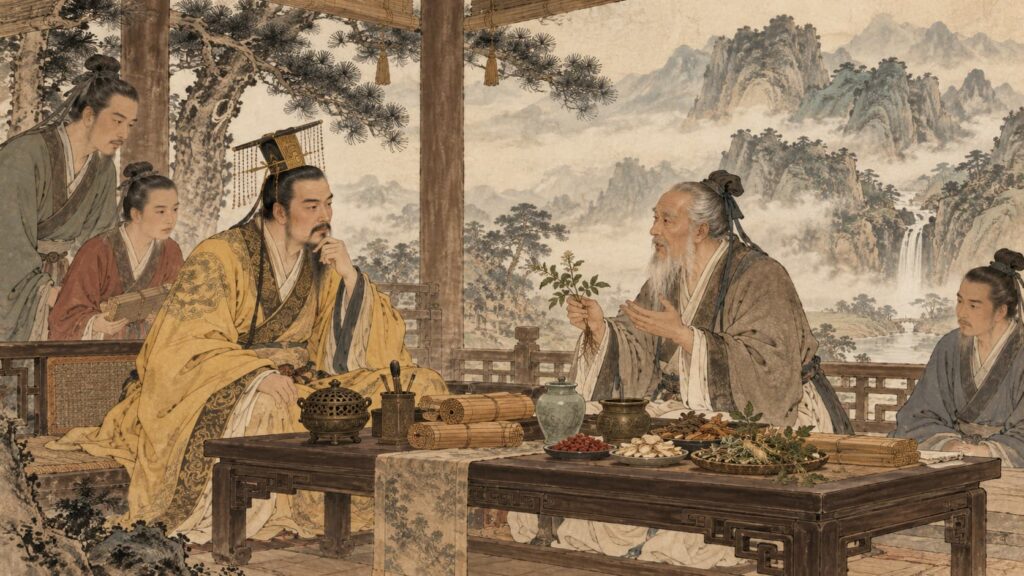
As Huangdi’s image expanded, later traditions credited him and his court with many foundations of civilization.
Different sources attributed developments in:
- government
- warfare
- calendars
- clothing
- transport
- crafts
- ritual
- medicine
- writing and administration
These claims should not be read literally as evidence that one man invented all of them.
They work more like culture-hero attribution.
When later societies wanted to explain where an important institution began, Huangdi became an ideal figure to place at the beginning.
That is why his mythology grows larger over time.
He becomes less one historical personality and more a symbolic beginning point for civilization itself.
Like Fuxi, Huangdi became one of the great legendary figures used to explain the beginnings of Chinese civilization.
Huangdi, Leizu and Legendary Ancestry
Sima Qian also places Huangdi inside a great ancestral genealogy.
The Shiji says Huangdi lived at Xuanyuan Hill and married Leizu, a woman of Xiling, as his principal wife.
Their descendants were then connected with later legendary ruling lines. Chinese Text Project
This genealogical role became extremely important.
Huangdi was not remembered only as someone who ruled.
He became an ancestor from whom later political and cultural lineages could claim descent.
That helps explain why his significance extends far beyond individual myths.
Huangdi and Huang-Lao Thought
By the early Han period, Huangdi became important in another intellectual tradition known as Huang-Lao.
The name combines:
Huang — Yellow Emperor
Lao — Laozi
Stanford’s Encyclopedia of Philosophy describes Huang-Lao as an important early Han current in which Huangdi could be imagined as the ruler who first applied principles associated with Daoist government and self-cultivation. Stanford Encyclopedia of Philosophy
This is another layer added to his identity.
The warrior and ancestor became a model ruler.
The model ruler became associated with philosophical government.
And later traditions further transformed him into a religious and immortal figure.
Was the Huangdi Neijing Written by the Yellow Emperor?
No.
This is probably the most important misconception to correct for modern search intent.
The Huangdi Neijing (黄帝内经), usually translated as The Inner Canon of the Yellow Emperor, is one of the foundational works of Chinese medicine.
But the legendary Huangdi did not personally write it.
The work is structured largely as dialogues between Huangdi and medical advisers such as Qibo.
The Library of Congress notes that the medical corpus was already recorded in Han bibliographic tradition and consists of material associated with the Suwen and Lingshu. The Library of Congress
Modern scholarship places the formation of its material many centuries after the period traditionally assigned to Huangdi and treats it as a layered corpus rather than the work of one legendary emperor. Historia Medica
Why use Huangdi’s name?
Because attaching teachings to the Yellow Emperor gave them ancient authority.
His name had become a symbol of primordial knowledge.
Why the Yellow Emperor Became So Important
Huangdi survived because he could become many things without losing his central identity.
To one tradition, he was an ancestor.
To another, a sage king.
To another, a warrior.
To another, a student of divine beings.
To another, the symbolic speaker of ancient medicine.
To another, a Daoist model ruler.
These versions were not all created at the same time.
That is the key.
The Yellow Emperor is not one frozen myth preserved unchanged for four thousand years.
He is a figure who accumulated meaning.
Each generation placed something new around him.
War.
Government.
Medicine.
Immortality.
Ancestry.
Civilization.
And eventually, Huangdi became less a single legendary king than a symbol of the imagined beginning of Chinese cultural order.
Why Huangdi Still Matters
The most interesting thing about the Yellow Emperor is not whether every traditional story happened exactly as later texts describe.
It is how much Chinese culture chose to place around him.
A society does not make one figure the ancestor of rulers, recipient of divine knowledge, patron of medicine and model of government by accident.
Huangdi became a way to imagine origins.
Where did civilization begin?
Where did proper rule begin?
Where did ancient wisdom come from?
Later traditions repeatedly answered:
with the Yellow Emperor.
That does not turn legend into documented history.
It shows how powerful a legend can become.
References & Sources
Sima Qian — Shiji, Annals of the Five Emperors
Primary traditional source for Huangdi as Xuanyuan, the battles against Yandi and Chiyou, his family and his position among legendary rulers. Chinese Text Project
Chinese Text Project — Annals of the Five Emperors
Xiaowei Su — “Researching the Image of the Yellow Emperor in China’s Early Textual Sources and Archaeological Materials”
Academic analysis of Huangdi as ancestor, legendary ruler and sacrificial/religious figure.