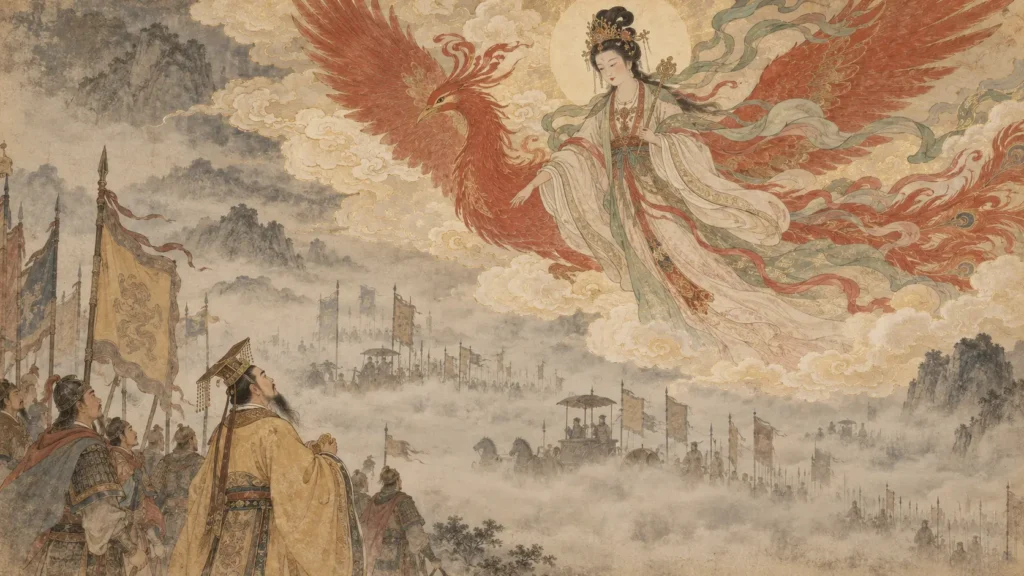
A battlefield disappears beneath a wall of mist.
The Yellow Emperor cannot see his enemy.
His army cannot advance. Chiyou seems impossible to defeat.
Then Heaven sends a teacher.
She does not arrive carrying an army of her own. She brings something more dangerous: knowledge.
Her name is Jiutian Xuannü (九天玄女, Jiǔtiān Xuánnǚ) — the Mysterious Lady of the Nine Heavens.
And across centuries of Chinese religion and literature, she would become one of the most unusual divine strategists in Chinese tradition.
Jiutian Xuannü at a Glance
| Chinese name | 九天玄女 |
| Pinyin | Jiǔtiān Xuánnǚ |
| Meaning | Mysterious Lady of the Nine Heavens |
| Earlier name | Xuannü (玄女) |
| Tradition | Chinese mythology and Daoism |
| Known for | Strategy, sacred knowledge, protection and heavenly instruction |
| Most famous legend | Teaching the Yellow Emperor how to defeat Chiyou |
| Later literary role | Gives Song Jiang heavenly books in Water Margin |
| Associated figure | Xiwangmu in some later Daoist traditions |
Who Is Jiutian Xuannü in Chinese Mythology?
Jiutian Xuannü is a Chinese and Daoist goddess associated above all with hidden knowledge, military strategy and divine assistance. Her most famous legend says she descended from Heaven to teach the Yellow Emperor methods that helped him overcome Chiyou. Later Daoist texts expanded her powers, while popular literature portrayed her as a celestial guide who delivers secret heavenly knowledge.
She is frequently called a goddess of war, but that description can be misleading.
Jiutian Xuannü is rarely the warrior charging first into battle.
She is the one who teaches how the battle should be won.
That distinction is the key to understanding her.
What Does the Name Jiutian Xuannü Mean?
Her name can be translated as the “Mysterious Lady of the Nine Heavens.”
Jiutian (九天) means “Nine Heavens.”
Xuannü (玄女) means “Mysterious Woman” or “Mysterious Lady.” The character xuan (玄) can carry meanings of mystery, depth, darkness or something profound and difficult to perceive.
But there is an important historical detail that many summaries skip.
She was not always called Jiutian Xuannü.
Academic research traces an earlier figure known simply as Xuannü (玄女). The expanded title Jiutian Xuannü developed much later and is associated particularly with late-Tang Daoist tradition.
In other words, the goddess did not appear fully formed with one fixed identity.
Like many Chinese deities, she evolved.
Jiutian Xuannü and the Yellow Emperor
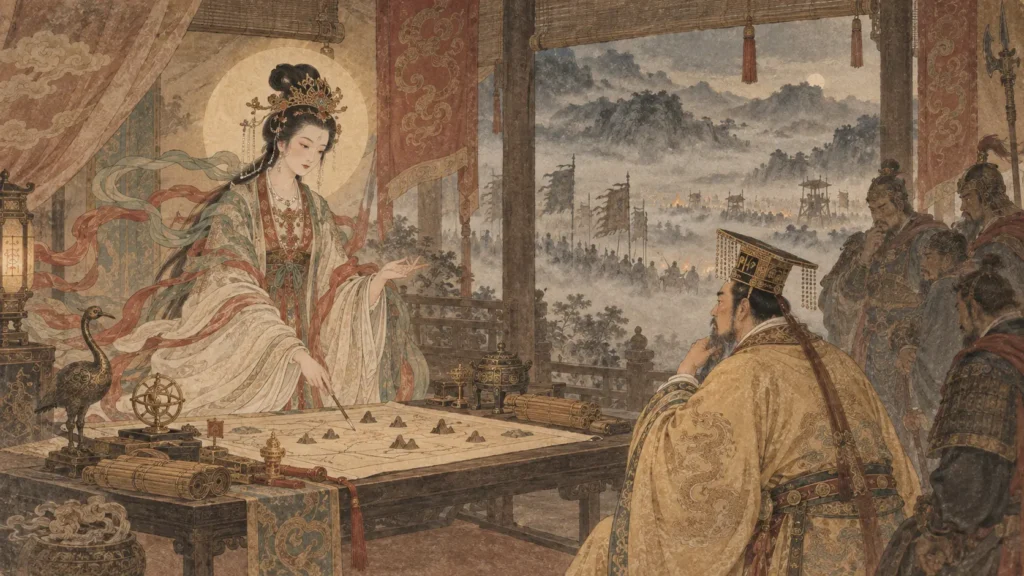
Her defining legend connects her with Huangdi (黃帝, Huángdì) — the Yellow Emperor — and his war against Chiyou (蚩尤, Chīyóu).
One influential version survives in the Daoist collection Yongcheng Jixian Lu (墉城集仙錄), compiled by Du Guangting around the late Tang and Five Dynasties period.
In the story, Huangdi’s army is unable to defeat Chiyou.
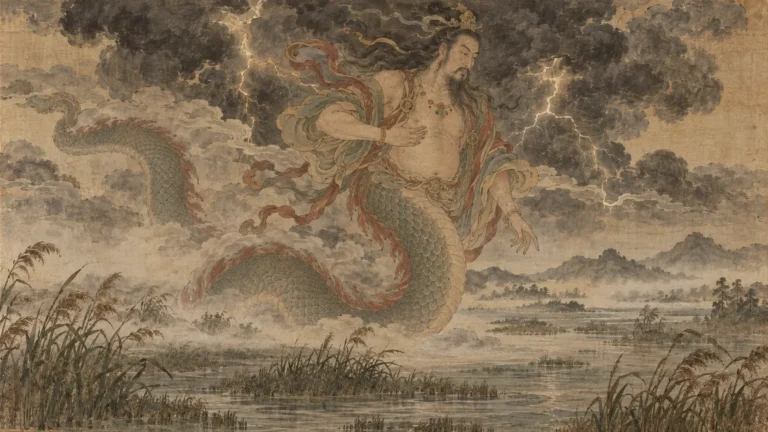
Chiyou covers the battlefield in an enormous supernatural fog. Direction disappears. The emperor’s forces are trapped in confusion.
Huangdi performs rituals and seeks divine help.
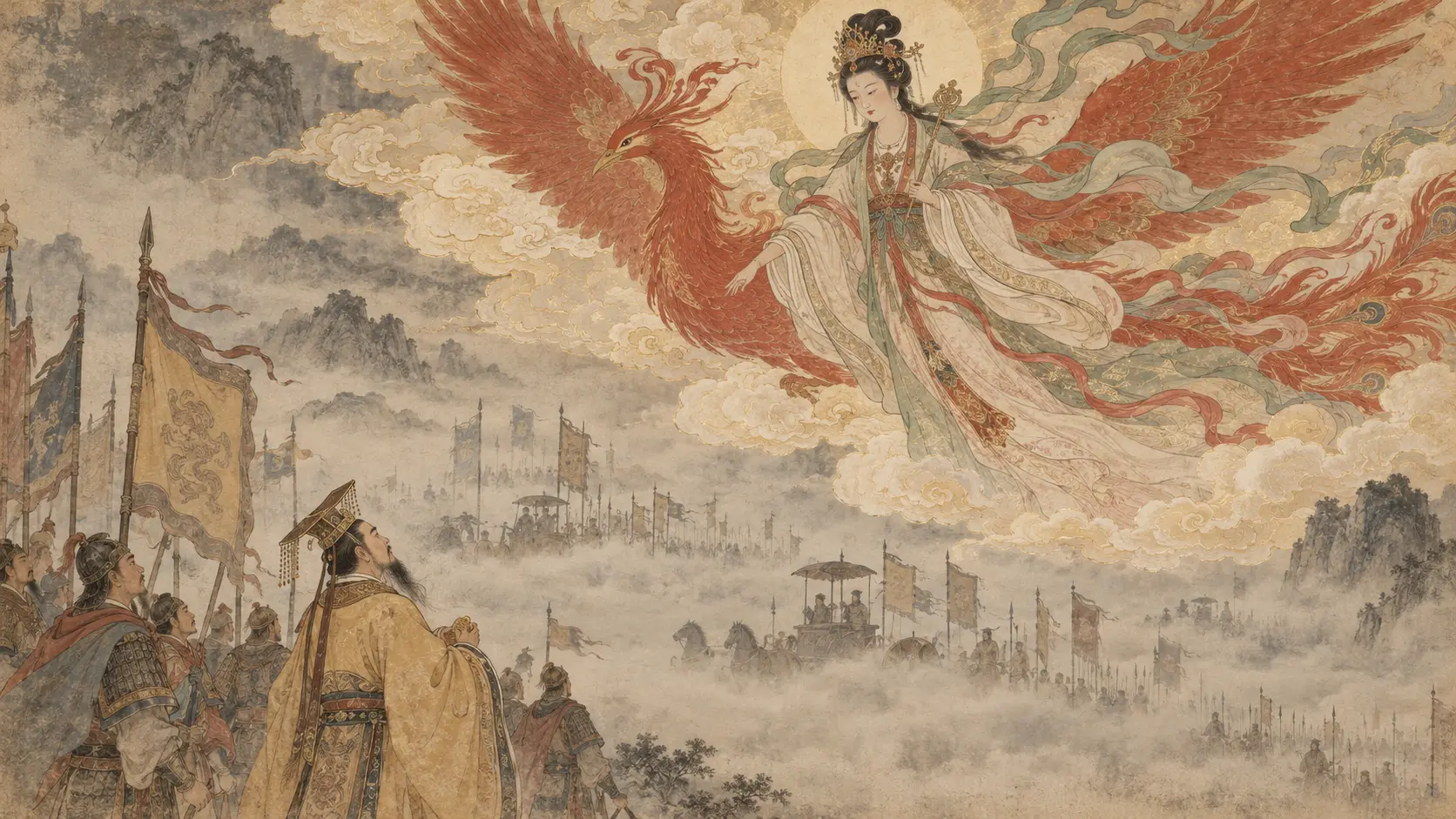
Then Xuannü descends.
The text presents her as a heavenly teacher who gives Huangdi knowledge of military methods, cosmic calculations, talismans and techniques involving yin and yang. With this divine instruction, the balance of the war changes.
This is why Jiutian Xuannü is better understood as a divine strategist than simply a goddess who enjoys warfare.
Her weapon is knowledge.
Did Jiutian Xuannü Really Teach Chinese Military Strategy?
Traditional texts certainly portray her that way.
Several later works attributed strategic, ritual and divinatory teachings to Xuannü. Her name became connected with military manuals and esoteric methods that claimed ancient authority through the Yellow Emperor.
But this does not mean historians can trace an actual military textbook directly back to a supernatural teacher of Huangdi.
That is mythology and religious tradition.
What we can trace historically is the development of texts that used Xuannü as a source of heavenly strategic knowledge.
That distinction matters.
The legend says she taught the Yellow Emperor.
The historical evidence shows generations of Chinese writers and religious specialists believed, repeated or adapted that idea.
Was Jiutian Xuannü Always a War Goddess?
No.
This is where her history becomes much more interesting.
Earlier and medieval traditions attached several kinds of esoteric knowledge to Xuannü. In Daoist contexts she became connected not only with strategy but with ritual, longevity practices and other forms of hidden knowledge.
Scholarship on her development also notes associations between Xuannü and Shangqing Daoist traditions involving sexual cultivation, where her name appears alongside Sunü (素女).
That does not mean Jiutian Xuannü can simply be reduced to a “goddess of sex,” either.
Her identity changed across periods.
The common thread is something broader:
she possesses knowledge ordinary humans do not.
Sometimes that knowledge concerns warfare.
Sometimes ritual.
Sometimes cultivation.
And sometimes the hidden workings of Heaven itself.
What Did Jiutian Xuannü Look Like?
There is no single appearance that belongs to every period.
Some traditions associated Xuannü with an unusual human-headed bird form, while later Daoist and literary representations increasingly presented her as an exalted celestial woman. The historical transformation of her image is significant enough that modern scholarship treats the changing forms of Xuannü as part of the evolution of the goddess herself.
In the Yellow Emperor tradition preserved by Du Guangting, the goddess descends amid extraordinary celestial imagery, associated with a cinnabar phoenix, clouds and brilliantly colored garments.
Centuries later, Water Margin would present her as a majestic heavenly lady.
Same goddess.
Different age.
Different visual language.
Jiutian Xuannü in Water Margin
More than a thousand years after the imagined age of the Yellow Emperor, Jiutian Xuannü entered one of China’s great novels.
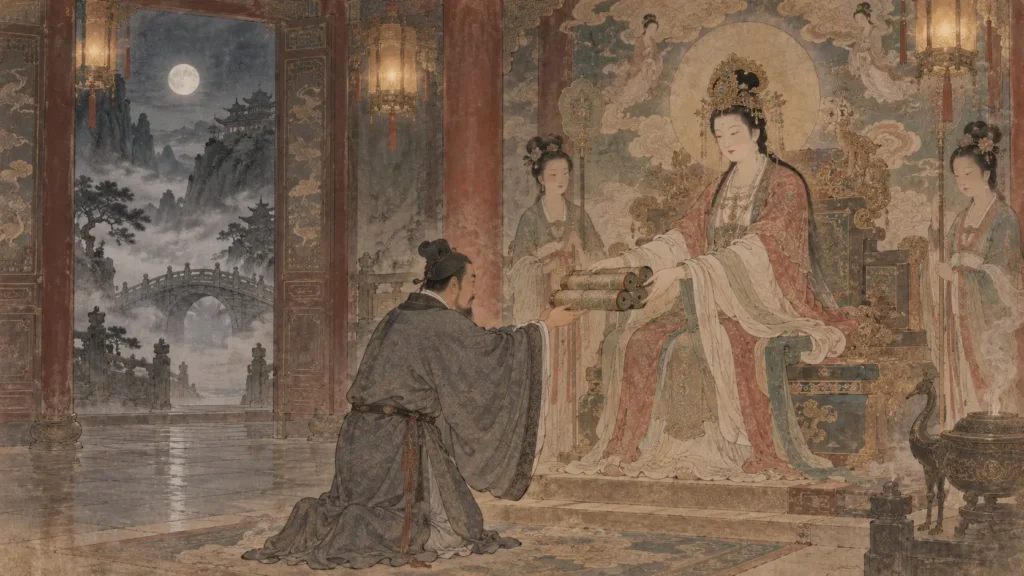
In Water Margin (水滸傳, Shuǐhǔ Zhuàn), the outlaw leader Song Jiang (宋江) takes refuge while being pursued.
He experiences a mysterious encounter with Jiutian Xuannü.
She saves him and gives him three volumes of heavenly writings.
When Song Jiang awakens, the experience appears almost dreamlike — except the books remain with him. He later realizes that the deity he encountered was Jiutian Xuannü.
This scene is more important than it first appears.
In the ancient Huangdi tradition, Xuannü descends to deliver military and sacred knowledge.
In Water Margin, she again appears during a moment of danger and delivers heavenly knowledge to a leader.
The characters change.
The function survives.
An academic study of her evolution describes precisely this enduring pattern: Jiutian Xuannü repeatedly becomes a transmitter of heavenly information into the human world.
Is Jiutian Xuannü Connected to Xiwangmu?
Yes — but the relationship depends on the source.
Later Daoist traditions frequently place Jiutian Xuannü within a larger celestial hierarchy connected with Xiwangmu (西王母), the Queen Mother of the West.
Some accounts portray Xiwangmu as sending Xuannü to assist Huangdi, while other texts describe Jiutian Xuannü through different divine lineages.
So it would be inaccurate to present one relationship as the universal version.
What is clear is that both became immensely important female figures within the expanding Daoist divine world.
Why Jiutian Xuannü Still Stands Out
Jiutian Xuannü does not fit comfortably into the modern idea of a “war goddess.”
She is something stranger.
She appears when force alone has failed.
Huangdi already has soldiers.
Song Jiang already has warriors.
What they lack is the knowledge that turns disorder into direction.
That is what Xuannü brings.
Her mythology suggests that the decisive advantage is not always strength.
Sometimes it is seeing what everyone else cannot.
And that may be the most fitting meaning of a goddess called the Mysterious Lady of the Nine Heavens.
References
За тази статия бих използвал този source stack, който е доста по-силен от стандартните mythology сайтове:
Yongcheng Jixian Lu – Jiutian Xuannü biography — late-Tang/early medieval Daoist account of Xuannü teaching Huangdi.
Yunji Qiqian – Biography of Jiutian Xuannü — Daoist textual tradition preserving the Yellow Emperor narrative.