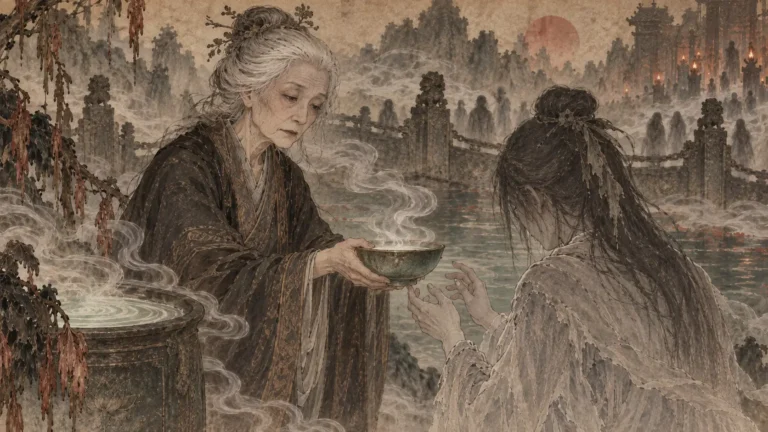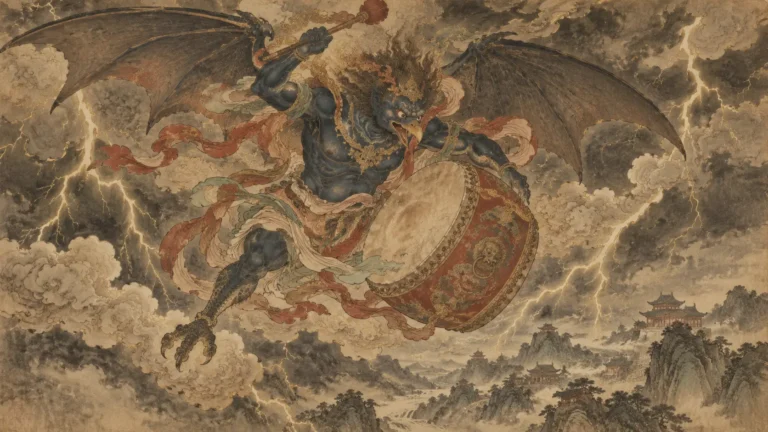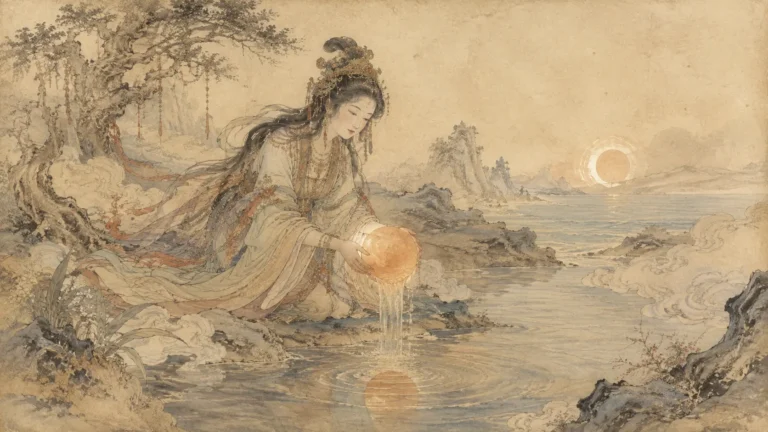
High in the legendary mountains of the West lives one of the oldest and most transformed divine figures in Chinese tradition.
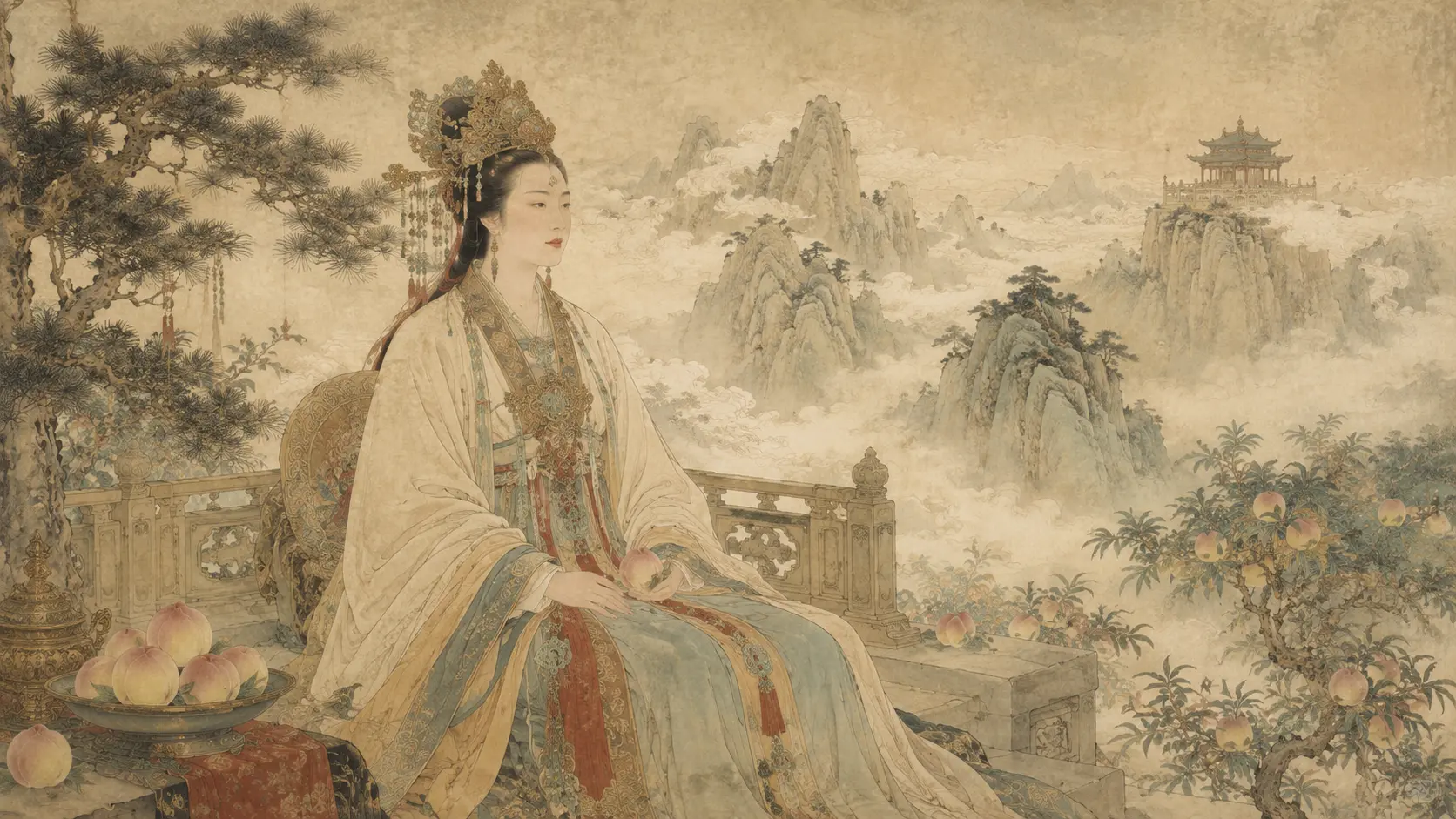
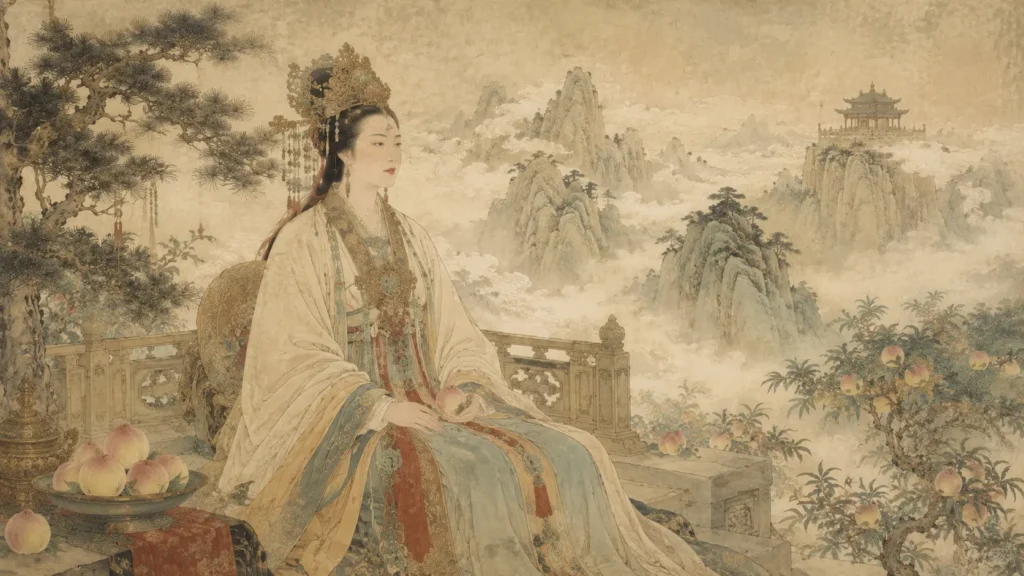
Today she may appear as an elegant celestial queen surrounded by immortals, phoenixes, jade terraces and peaches that grant eternal life.
But that is not how her story begins.
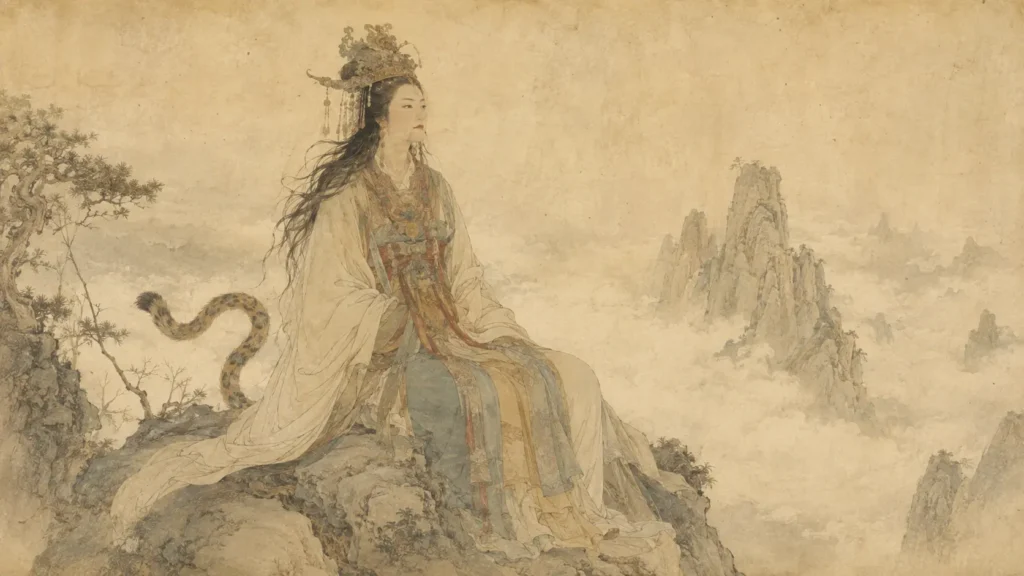
Xiwangmu (西王母, Xīwángmǔ), usually translated as the Queen Mother of the West, is an ancient Chinese divine figure whose identity changed dramatically over time. Early passages in the Shan Hai Jing describe her with human and animal features, including tiger teeth and a leopard tail. Later traditions increasingly present her as a majestic goddess associated with Kunlun, immortality, divine authority and the famous Peaches of Immortality.
Few Chinese goddesses show the evolution of mythology as clearly as Xiwangmu.
Xiwangmu at a Glance
| Chinese | 西王母 |
| Pinyin | Xīwángmǔ |
| English name | Queen Mother of the West |
| Type | Ancient deity; later major Daoist goddess |
| Early association | Western mountains, supernatural authority, calamities |
| Later association | Immortality, Kunlun, divine peaches, immortals |
| Important texts | Shan Hai Jing, Huainanzi, later Daoist and literary works |
| Related figures | Hou Yi, Chang’e, Dongwanggong, Sun Wukong |
Who Is Xiwangmu?
Xiwangmu is one of the oldest powerful female divine figures preserved in Chinese literature.
Her name is conventionally translated as Queen Mother of the West, although the title developed across many centuries and should not be treated as though she always looked or functioned like the later celestial queen.
The earliest surviving traditions are much stranger.
In the Shan Hai Jing, Xiwangmu lives in the western mountains.
One passage places her at Yushan, describing her as:
human-like,
with a leopard’s tail,
tiger teeth,
disheveled hair,
and a distinctive sheng headdress.
The passage also connects her with dangerous heavenly forces and calamities.
Another Shan Hai Jing passage places her within the great western wilderness and again mentions the tiger teeth, leopard tail and head ornament.
This is not yet the graceful peach-garden queen familiar from later paintings.
It is a far more primal image.
What Did the Earliest Xiwangmu Look Like?
Modern depictions usually show Xiwangmu as an elegant noblewoman.
The early textual image is radically different.
The Shan Hai Jing describes her as partly human and partly animal, combining a human form with leopard and tiger features.
That does not necessarily mean every ancient community imagined her identically.
The Shan Hai Jing itself preserves different layers and versions of mythological geography.
What we can say confidently is:
the refined Daoist queen was not the only ancient form of Xiwangmu.
Her early image was wild, powerful and closely associated with the mysterious western landscape.
How Did Xiwangmu Become the Queen Mother of the West?
Over time, her image changed.
By the Han period, Xiwangmu had become an enormously important divine figure connected with immortality, heavenly authority and salvation.
Han-period art gives us especially strong evidence.
A second–third century bronze mirror in the Smithsonian’s National Museum of Asian Art depicts Xiwangmu together with Dongwanggong, the King Father of the East. The museum notes that the imagery may relate to the Han cult of Xiwangmu and to legends of King Mu traveling west to meet her.
This shows that Xiwangmu had already moved far beyond the strange mountain figure of the Shan Hai Jing.
She had become part of a wider celestial and religious system.
Later Daoist traditions would expand her status further, presenting her as a supreme female divine authority associated with immortals and the western paradise.
Xiwangmu and the Elixir of Immortality
One of Xiwangmu’s most important early immortality connections appears in the Huainanzi.
The text says that Hou Yi requested the medicine of immortality from Xiwangmu.
Chang’e then took the medicine and fled to the Moon.
That single passage connects three of the most important figures in our mythology cluster:
Xiwangmu → Hou Yi → Chang’e
It also proves that Xiwangmu’s association with immortality is not merely a late internet invention.
By the Han period, she was already imagined as a source of extraordinary life-extending medicine.
For our site, this becomes a perfect internal cluster:
Xiwangmu
→ Hou Yi
→ Chang’e
→ Jade Rabbit
The Peaches of Immortality
Today Xiwangmu is probably most famous for the Peaches of Immortality.
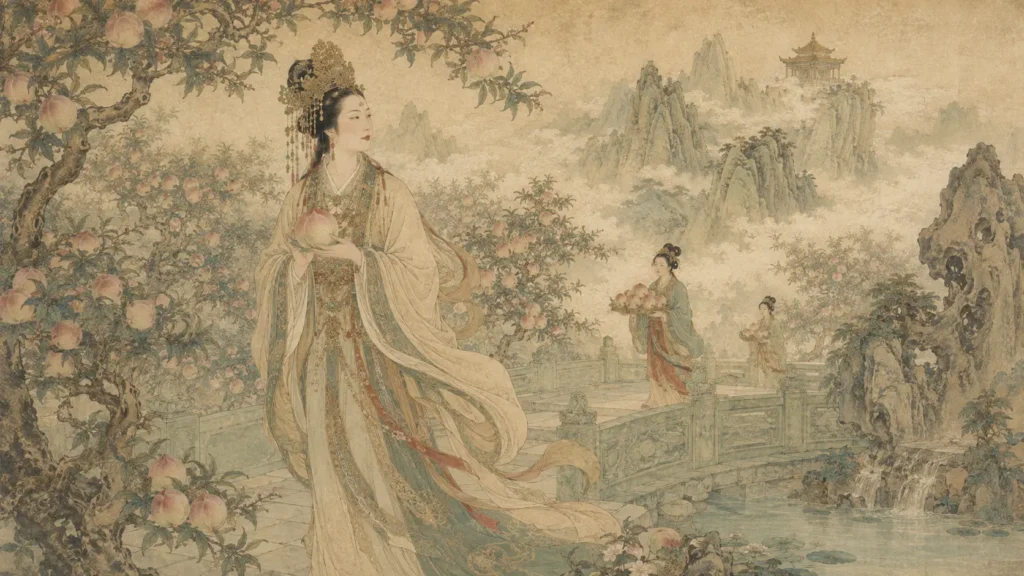
Later Chinese art and literature repeatedly connect her with a celestial orchard whose peaches grant extraordinary longevity or immortality.
The Metropolitan Museum of Art describes Xiwangmu as the owner of the celestial peach orchard and notes that the fruits became powerful symbols of immortality and long life.
In later artistic traditions, immortals attend celebrations connected with Xiwangmu while attendants carry bowls of sacred peaches.
This tradition became so influential that the peach itself developed into one of the most recognizable symbols of longevity in Chinese art.
But there is an important chronology point:
the early Shan Hai Jing description does not begin with a peach banquet.
The famous immortal-peach image belongs to later layers of Xiwangmu’s tradition.
Xiwangmu and Kunlun Mountain
Xiwangmu is deeply associated with the mythical western realm and eventually with Kunlun Mountain.
The Shan Hai Jing preserves multiple western locations and traditions surrounding her. One passage places her at Yushan, while another situates her within the vast western geography associated with Kunlun.
Later art and mythology increasingly make Kunlun her celestial home.
The Met describes later depictions of Xiwangmu as residing in a mythical western paradise associated with Mount Kunlun and immortality.
This matters because modern summaries often write:
“Xiwangmu always lived in one palace on Kunlun.”
The textual tradition is not that simple.
Her western geography developed over time.
Is Xiwangmu the Jade Emperor’s Wife?
It is misleading to present Xiwangmu simply as the Jade Emperor’s wife.
This is one of the biggest corrections we can make compared with many modern mythology websites.
Xiwangmu’s tradition is ancient and independent.
Han-period art often pairs her with Dongwanggong, the King Father of the East, not the Jade Emperor. The Smithsonian preserves an early mirror showing exactly that pairing.
Later popular mythology sometimes places Xiwangmu and the Jade Emperor within the same celestial world, and modern retellings may even describe them as a married couple.
But that should not be projected backward onto her early history.
The more accurate answer is:
Xiwangmu is an independent ancient goddess whose identity predates later popular family relationships involving the Jade Emperor.
Xiwangmu and Journey to the West
Xiwangmu also enters one of China’s most famous literary worlds:
Journey to the West.
In the later novel tradition, her sacred peach orchard becomes part of Sun Wukong’s rebellion against Heaven.
The Monkey King gains access to the peaches and consumes fruit associated with immortality before disrupting the great celestial banquet.
The British Museum notes the famous later Journey to the West tradition in which Sun Wukong consumes Xiwangmu’s magical peaches.
This is an important example of source chronology.
The peach episode is hugely influential.
But it belongs to later literature, not the earliest Xiwangmu material.
Is Xiwangmu a Goddess of Life and Death?
You will sometimes see Xiwangmu described online as a goddess with absolute control over:
life,
death,
creation,
destruction,
fate,
and nearly every cosmic force imaginable.
That wording is too broad.
Her traditions certainly connect her with immortality, supernatural authority, western sacred realms and later Daoist celestial hierarchy.
Her earliest Shan Hai Jing form is also connected with dangerous heavenly calamities.
But it is better to describe the specific roles preserved in individual sources than to give her an invented videogame-style list of universal powers.
Xiwangmu’s Transformation Through Chinese History
This may be the most fascinating part of her mythology.
The early Xiwangmu is:
wild
animal-featured
western
dangerous
The Han-period Xiwangmu becomes increasingly connected with:
immortality
celestial authority
religious worship
Later traditions emphasize:
Kunlun
the Jade Pool
immortal peaches
celestial banquets
female immortals
And later literature connects her directly to figures such as:
Hou Yi
Chang’e
Sun Wukong
The name remains.
The mythology evolves around it.
That is exactly why Xiwangmu is such an important figure for understanding Chinese mythology itself.
Why Xiwangmu Still Matters
Xiwangmu is not memorable because she has one simple story.
She is memorable because she has survived through many different ones.
A strange deity with tiger teeth and a leopard tail becomes a celestial queen.
A dangerous western power becomes a guardian of immortality.
A mysterious figure in mountain mythology becomes the owner of the most famous peaches in Chinese legend.
Her story stretches from the Shan Hai Jing to Han religious imagery, from the immortality legend of Hou Yi and Chang’e to later Daoist mythology and Journey to the West.
Few figures show the layered nature of Chinese mythology more clearly.
Xiwangmu is not one frozen goddess.
She is centuries of Chinese myth, religion and art gathered under one ancient name.
Sources & Further Reading
Primary / Early Texts
Chinese Text Project — Shan Hai Jing, Classic of the Western Mountains
Early description of Xiwangmu with tiger teeth, leopard tail and wild hair. Read the Shan Hai Jing passage
Chinese Text Project — Shan Hai Jing, Western Great Wilderness
Another early Xiwangmu tradition associated with the western mythological landscape. Read the Western Great Wilderness passage
Chinese Text Project — Huainanzi, Lan Ming Xun
Preserves the story in which Hou Yi obtains immortality medicine from Xiwangmu before Chang’e flees to the Moon. Read the Huainanzi passage