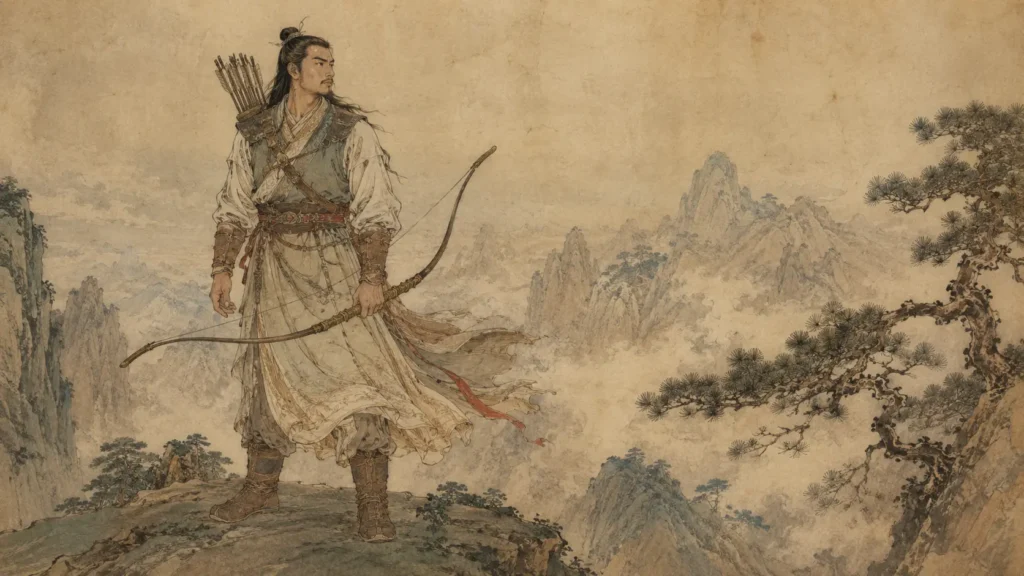
Everyone remembers the nine arrows.
But Hou Yi’s legend did not begin and end beneath ten burning suns.
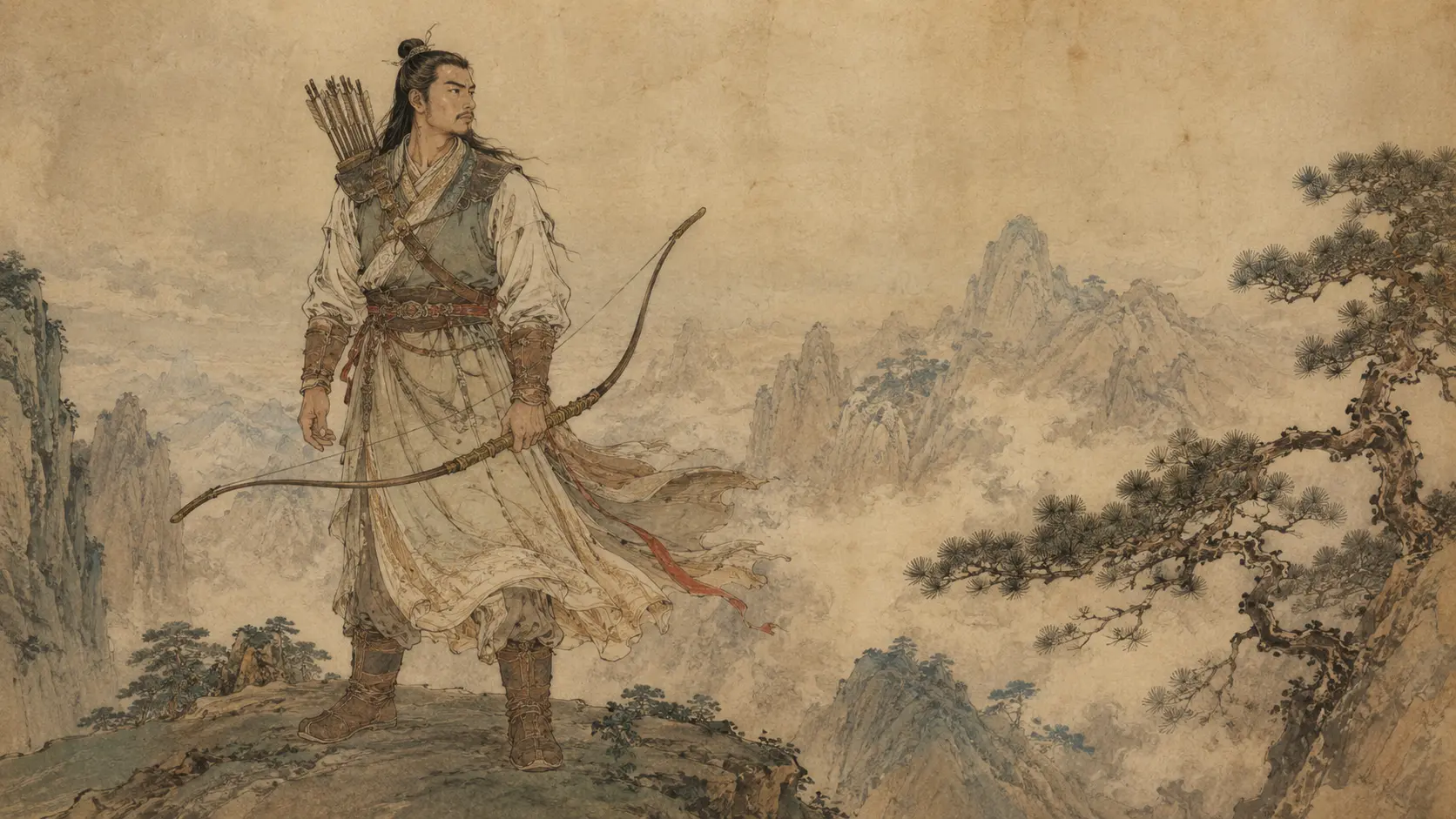
Hou Yi (后羿), usually called simply Yi in early Chinese texts, is the legendary archer of Chinese mythology. He is best known for saving humanity from the Ten Suns, but ancient traditions also remember him as a hunter of monsters, the husband of Chang’e, a teacher of archery, and a hero whose extraordinary skill eventually became part of his tragedy.
Who Was Hou Yi?
Hou Yi is often introduced as the greatest archer in Chinese mythology.
That description is accurate, but it hides how complex his story really is.
Early Chinese sources usually call him Yi (羿). Later traditions increasingly use the name Hou Yi (后羿) and connect stories that may once have belonged to different figures.
In some versions, Yi is a divine archer sent to restore order on Earth. In others, he appears more like a mortal hero serving the legendary ruler Yao. There is no single ancient text containing his entire life from beginning to end.
Instead, his identity was built across philosophical works, poetry, mythology, commentary, folklore, and later retellings.
The details change, but one image remains constant:
A man holding a bow, facing something no one else can stop.
The Ten Suns Were Only One Part of His Story
Hou Yi’s most famous achievement came when multiple suns appeared together and scorched the world.
The earth burned. Crops died. Humanity could no longer survive beneath the unbearable heat. Yi raised his bow and brought the heavens back under control.
That complete story already belongs in our dedicated article about the Ten Suns of Chinese mythology.
What matters here is what the event reveals about Hou Yi.
He was not remembered simply because he could hit an impossible target. His strength mattered because he used it when the natural order had collapsed.
Hou Yi did not shoot for sport.
He shot because the world needed balance restored.
The Archer Who Hunted Monsters
The suns were not the only threat facing humanity during the age of Yao.
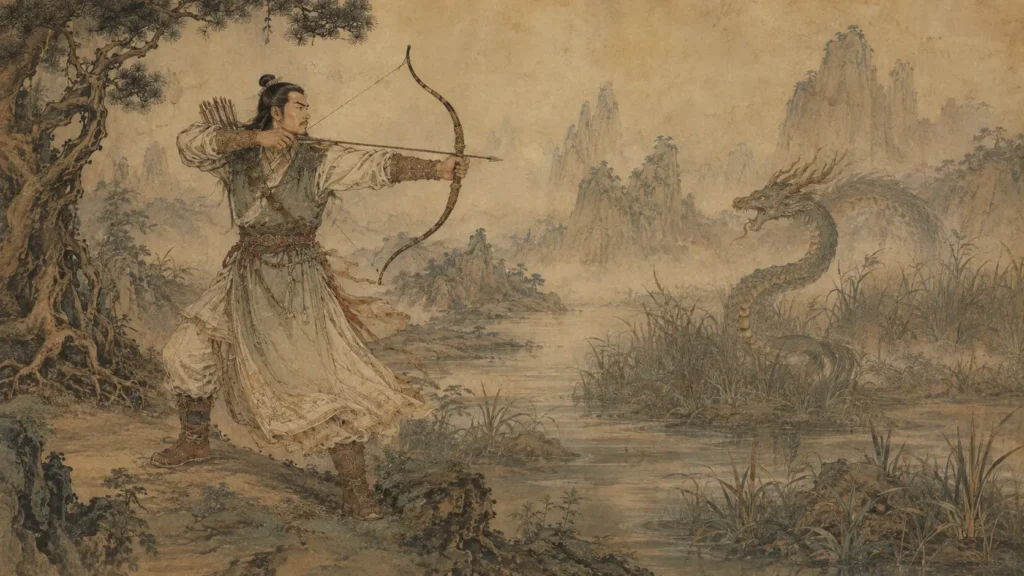
The Huainanzi describes a world overrun by dangerous creatures. Among them were Zaochi, Jiuying, Dafeng, Yayu, Xiushe, and Fengxi.
Yao sent Yi against them.
The ancient passage records Yi defeating these threats across different landscapes: marshes, wilderness, rivers, forests, and the region around Dongting. He fought creatures on the ground while also turning his arrows toward the burning sky above.
The text does not provide a long cinematic battle for every monster. It records the victories quickly, almost as if listing a series of impossible assignments that only one person could complete.
That makes Hou Yi more than the man who shot the suns.
He becomes a protector moving through a broken world, eliminating one danger after another until ordinary people can live safely again.
Hou Yi and Chang’e
Hou Yi’s greatest victories could protect humanity, but they could not protect his own happiness.
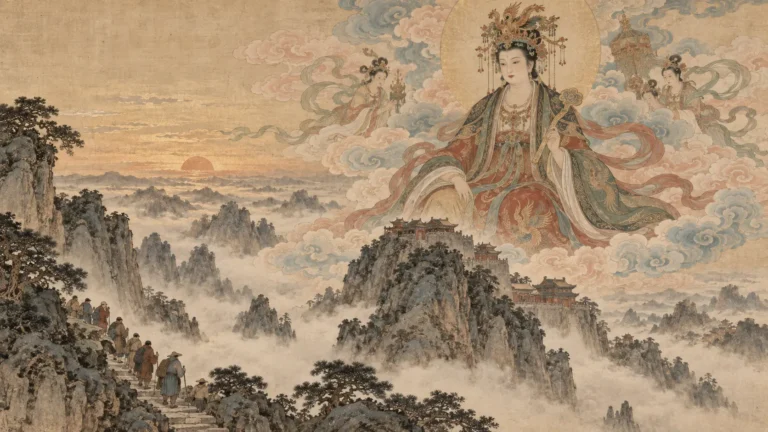
An ancient tradition associated with the Huainanzi says that Yi obtained the medicine of immortality from Xiwangmu, the Queen Mother of the West.
Chang’e took the medicine and fled to the moon.
The early account is extremely short. It does not explain her motives in detail, and it does not yet contain the complete romantic story familiar today.
Later retellings transformed the event. Sometimes Chang’e steals the elixir for herself. Sometimes she drinks it to keep it away from a dangerous man. In more romantic versions, Hou Yi refuses immortality because he does not want to live forever without her.
Those different traditions belong more fully in our article about Chang’e, theChinese Moon Goddess.
For Hou Yi, the central image is simple and painful:
The man who could reach the suns with his arrows could not reach the woman who had risen to the moon.
The Student Who Killed the Master
One of the darkest traditions about Yi appears in the Mengzi.
A man named Pang Meng learned archery from him. After mastering Yi’s methods, Pang Meng realized that only his teacher remained superior to him.
He killed Yi.
The passage is not written as a dramatic final battle. Mencius uses the story while discussing responsibility, character, and the relationship between teachers and students.
Yet the legend creates a powerful ending.
Hou Yi survived monsters, burning suns, and threats that terrified entire kingdoms. But his skill was passed to another person, and that person turned it against him.
The greatest archer was not defeated by a creature from the wilderness.
He was betrayed by someone he had taught.
Were Yi and Hou Yi the Same Person?
This question does not have one universally accepted answer.
Some researchers treat Yi and Hou Yi as different versions of the same legendary archer. Others argue that stories about the mythological sun-shooter became mixed with traditions about another Yi associated with the Xia dynasty.
This may explain why Hou Yi can appear as a divine savior in one story, a political or military figure in another, and a tragic archery master elsewhere.
Trying to force every tradition into one perfectly consistent biography would make the mythology less accurate, not more.
Hou Yi survived because generations kept retelling him.
Different eras preserved different parts of the man behind the bow.
Why Hou Yi Still Matters
Hou Yi is usually remembered for accuracy.
But accuracy alone is not what makes him a hero.
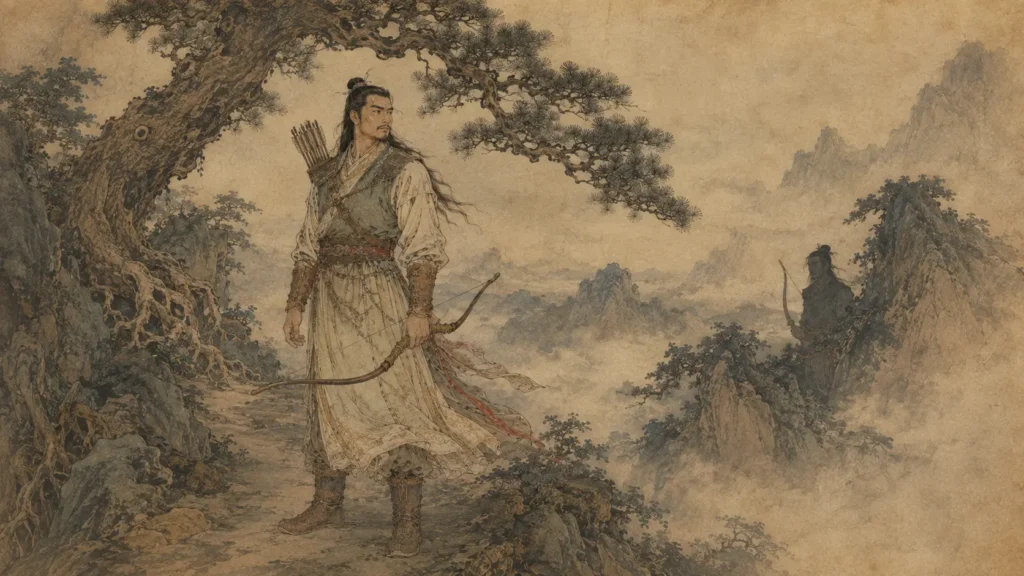
His arrows carried responsibility. Every target represented something that had grown dangerous: uncontrolled power, a monster threatening human life, or chaos spreading across the world.
Yet his story also shows that even mastery has limits.
He could restore the sky but not control the choices of Chang’e. He could defeat monsters but not recognize the danger growing within his own student. He possessed almost perfect skill, but perfect skill could not protect him from loss.
That is why Hou Yi remains more than a legendary bowman.
His story is about developing the strength to face what others cannot—and understanding that strength will never give us control over everything.
Anyone can admire the arrow.
The harder lesson is knowing when to release it, what deserves to be targeted, and what no weapon can save.
References:
- Chinese Text Project — Huainanzi: Benjing Xun — early account of Yi confronting the Ten Suns and the creatures threatening humanity.
- Chinese Text Project — Mengzi: Li Lou II — ancient account of Pang Meng learning archery from Yi and later killing him.