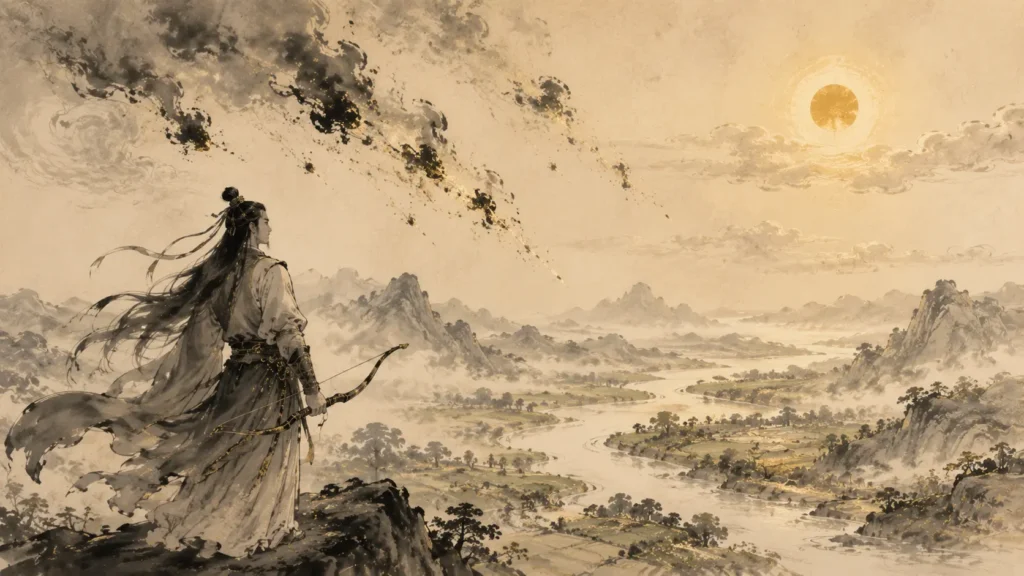
Imagine waking beneath a sky with ten suns.
There is no cool morning air. No shadow deep enough to hide inside. Rivers shrink beneath the heat, plants turn brown, and the ground cracks open as if the earth itself is burning.
In one of the most powerful stories from Chinese mythology, this was the world faced by humanity.
The ten suns had risen together.
And only one man possessed the skill to stop them.
His name was Hou Yi.
Before There Was Only One Sun
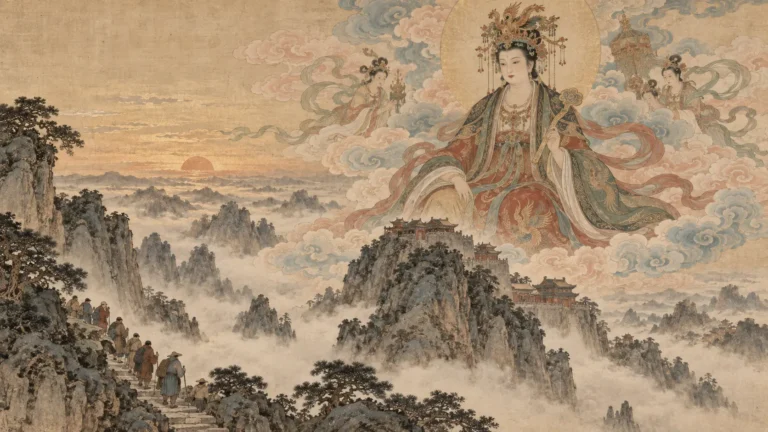
According to the Classic of Mountains and Seas, the solar deity Xihe gave birth to ten suns. This ancient text does not tell the complete dramatic story familiar today, but it preserves one of its oldest foundations: the idea that the heavens once contained not one sun, but ten.
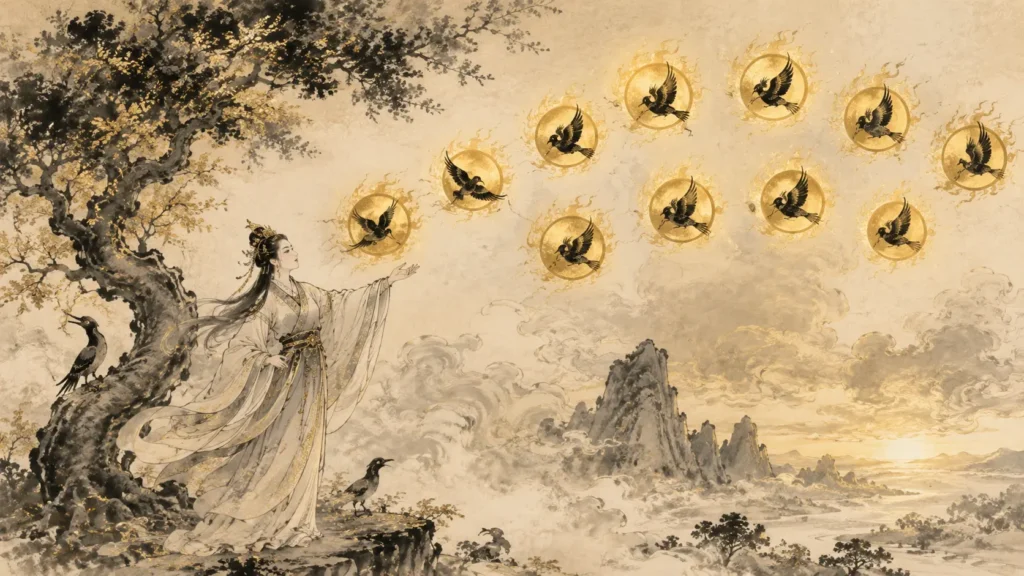
In later traditions, the suns were imagined as celestial birds, often described as crows, connected with the great Fusang tree in the east.
Each sun was supposed to cross the sky on a different day.
While one travelled above the earth, the other nine waited for their turn. In this way, light followed darkness, heat was held in balance, and the world continued as it should.
The suns were powerful, but power was not the problem.
The problem began when they abandoned the order that kept their power under control.
The Day All Ten Suns Rose
One day, all ten suns appeared in the sky at the same time.
Ancient accounts do not always explain why. The familiar idea that the suns wanted to travel or play together comes mainly from later retellings rather than from the earliest surviving texts.
What the old sources describe clearly is the result.
The Huainanzi, a work compiled during the early Han dynasty, places the disaster in the age of the legendary ruler Yao. The ten suns appeared together, scorching crops and vegetation until the people had almost nothing left to eat. The same passage connects the burning sky with other monsters and dangers tormenting the world.
This was not simply a hot summer.
It was the collapse of the natural order.
Fields died. Water disappeared. Human beings and animals could no longer live beneath the unbearable light.
The sky, which had once protected life through rhythm and balance, had become its greatest threat.
That was when Yao called upon Yi.
Hou Yi, the Divine Archer
Hou Yi—often called simply Yi in early texts—was the greatest archer of Chinese mythology.
Some later stories present him as a heroic mortal. Others describe him as a divine figure sent down from Heaven. Over centuries, his mythology also became mixed with stories about another figure named Yi associated with the Xia dynasty.
Because of this, there is no single version of his life that fits every source.
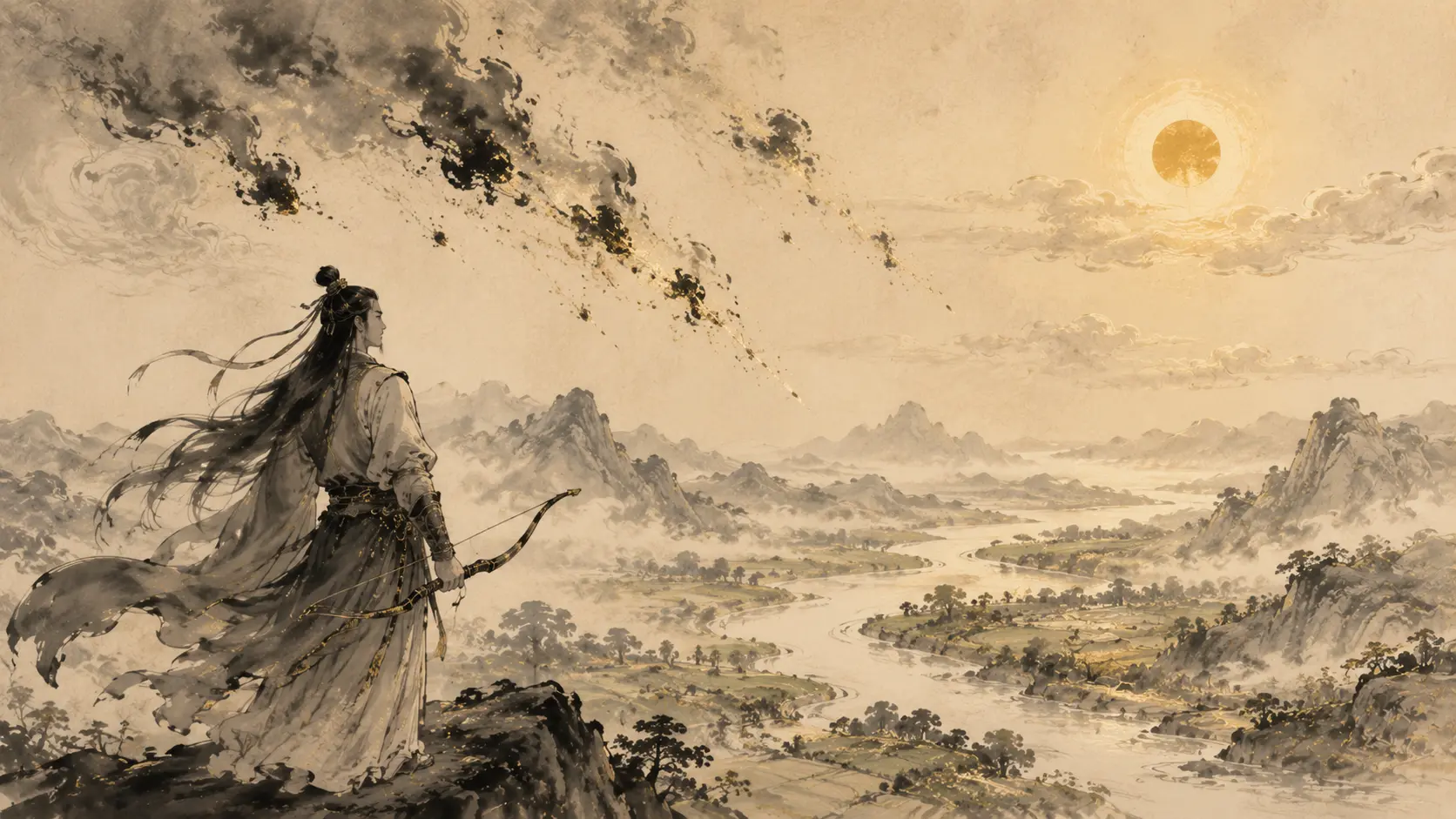
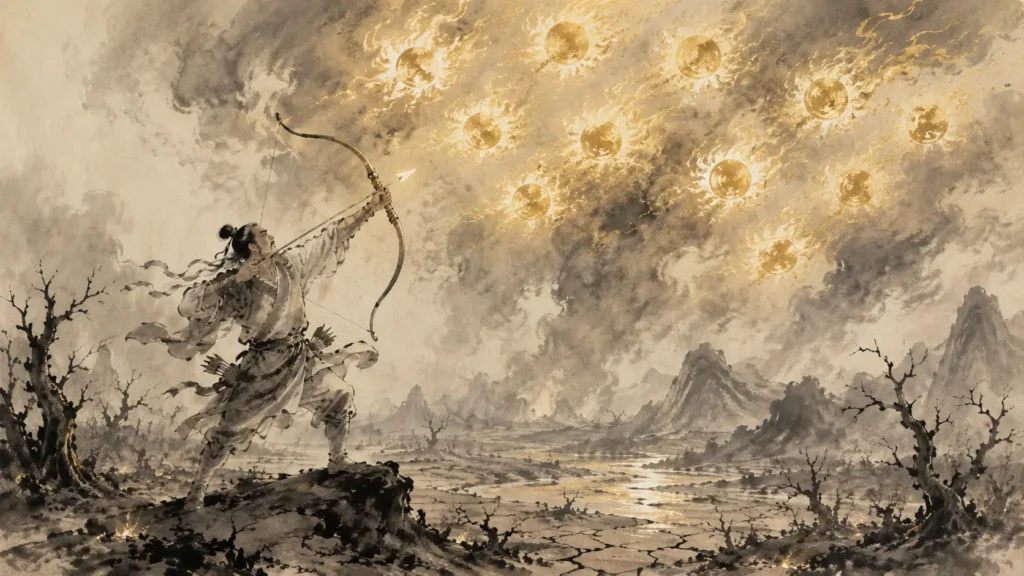
But one image remains constant: Hou Yi standing beneath the burning sky with a bow in his hands.
He aimed upward.
Then he released an arrow.
One sun fell.
Hou Yi drew the bow again, and another disappeared from the sky.
According to later accounts preserved in Chinese textual collections, nine suns were struck down, and nine solar crows fell with them.
One after another, the unbearable lights vanished.
When Hou Yi prepared to destroy the final sun, he was stopped. The world could not survive beneath ten suns, but neither could it survive without any.
One sun had to remain.
The Sun That Was Spared
The last sun returned to its journey across the sky.
Warmth reached the earth without destroying it. Rivers flowed again. Plants returned, and the people could step outside without fear.
Hou Yi had saved the world not by defeating darkness, but by restoring balance.
That difference is important.
The sun is not evil in this story. Without it, there can be no harvest, warmth or life. Yet even something necessary becomes dangerous when it grows beyond its proper place.
The ten suns were not destroyed because light was unwanted.
Nine were destroyed because too much light had become a form of darkness.
An Ancient Story Told in Different Ways
Like many myths from ancient China, the story of Hou Yi and the ten suns was not written once in a single definitive book.
Different parts of it appear in different works.
The Classic of Mountains and Seas connects Xihe with the birth of ten suns. The Huainanzi describes ten suns appearing during the reign of Yao and the devastation that follows. Later commentaries and folklore develop the image of the solar crows, the Fusang tree and Hou Yi shooting nine suns from the sky.
Even Hou Yi himself changes between traditions.
This does not make the story false or incomplete. It shows how mythology lives. Each generation preserves something, changes something and gives new meaning to what came before.
The central truth of the story remains unchanged.
When the order of the world was broken, someone had to act.
Why the Ten Suns Still Matter
It is easy to see Hou Yi only as a warrior.
Yet his greatest achievement was not that he could shoot farther or more accurately than anyone else. It was that his strength served a purpose beyond himself.
He did not climb toward the heavens in search of glory.
He stood on the wounded earth and protected the people living upon it.
Perhaps that is why the legend has survived for so long.
The story reminds us that strength without control can destroy everything around it. It reminds us that more is not always better, even when the thing we desire appears to be good.
More light can blind us.
More heat can burn the harvest.
More power can become chaos.
Sometimes saving the world does not mean creating something new.
Sometimes it means having the courage to remove what has become too much—and the wisdom to know what must remain.
References and Sources
- Chinese Text Project. Classic of Mountains and Seas (Shan Hai Jing) – passages concerning Xihe and the Ten Suns.
- https://ctext.org/shan-hai-jing Chinese Text Project. Huainanzi – early account of the Ten Suns and the reign of Emperor Yao.
- https://ctext.org/huainanzi The Metropolitan Museum of Art. Mirror with the Archer Yi Shooting the Suns.
- https://www.metmuseum.org/art/collection/search/61405 Anne Birrell. Chinese Mythology: An Introduction. Baltimore: Johns Hopkins University Press, 1993. Chen Lianshan. Chinese Myths and Legends: Legends of the Universe, Deities and Heroes. Beijing: China Intercontinental Press.