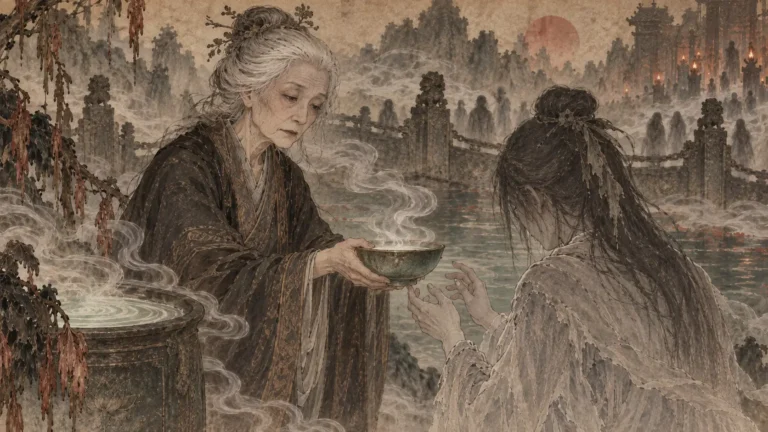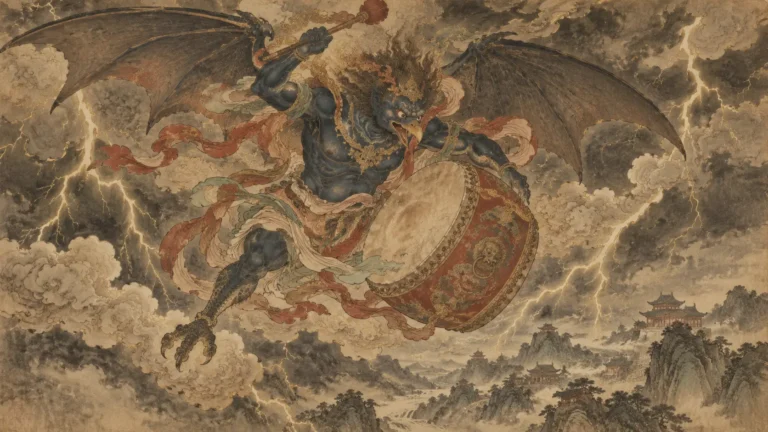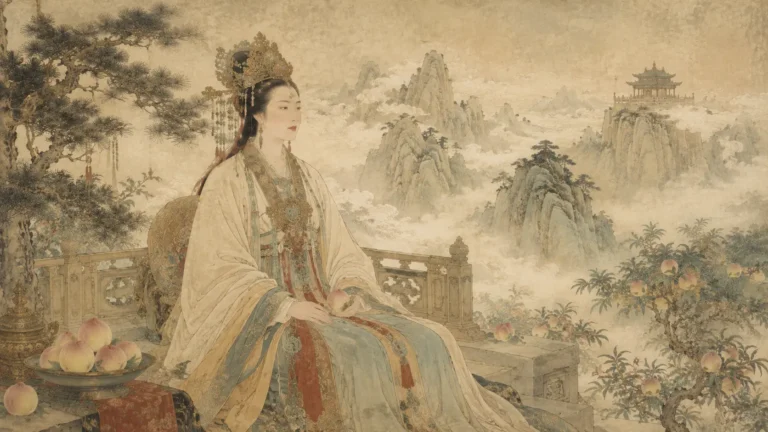
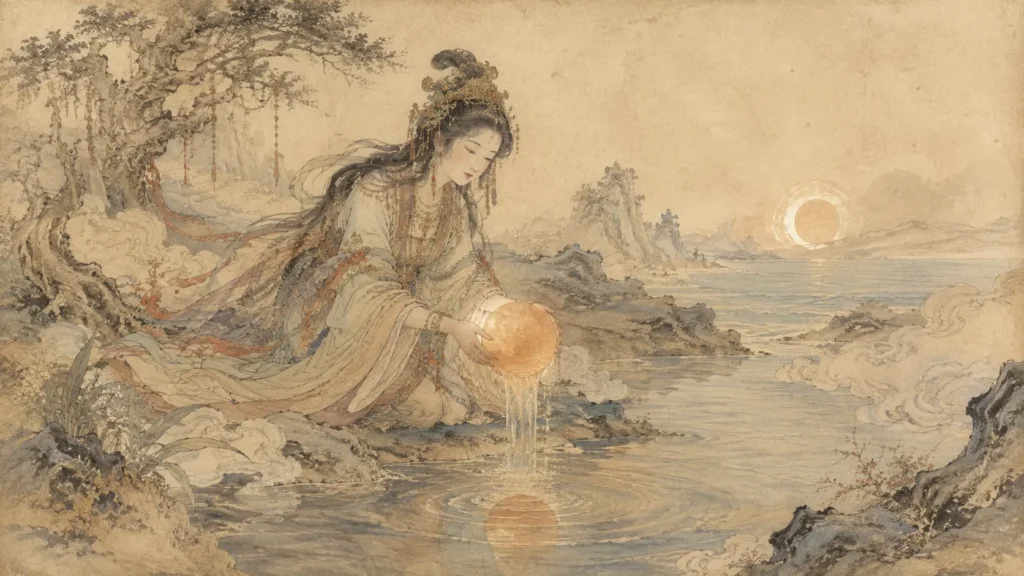
Far beyond the southeastern sea, ancient Chinese imagination placed a strange solar realm.
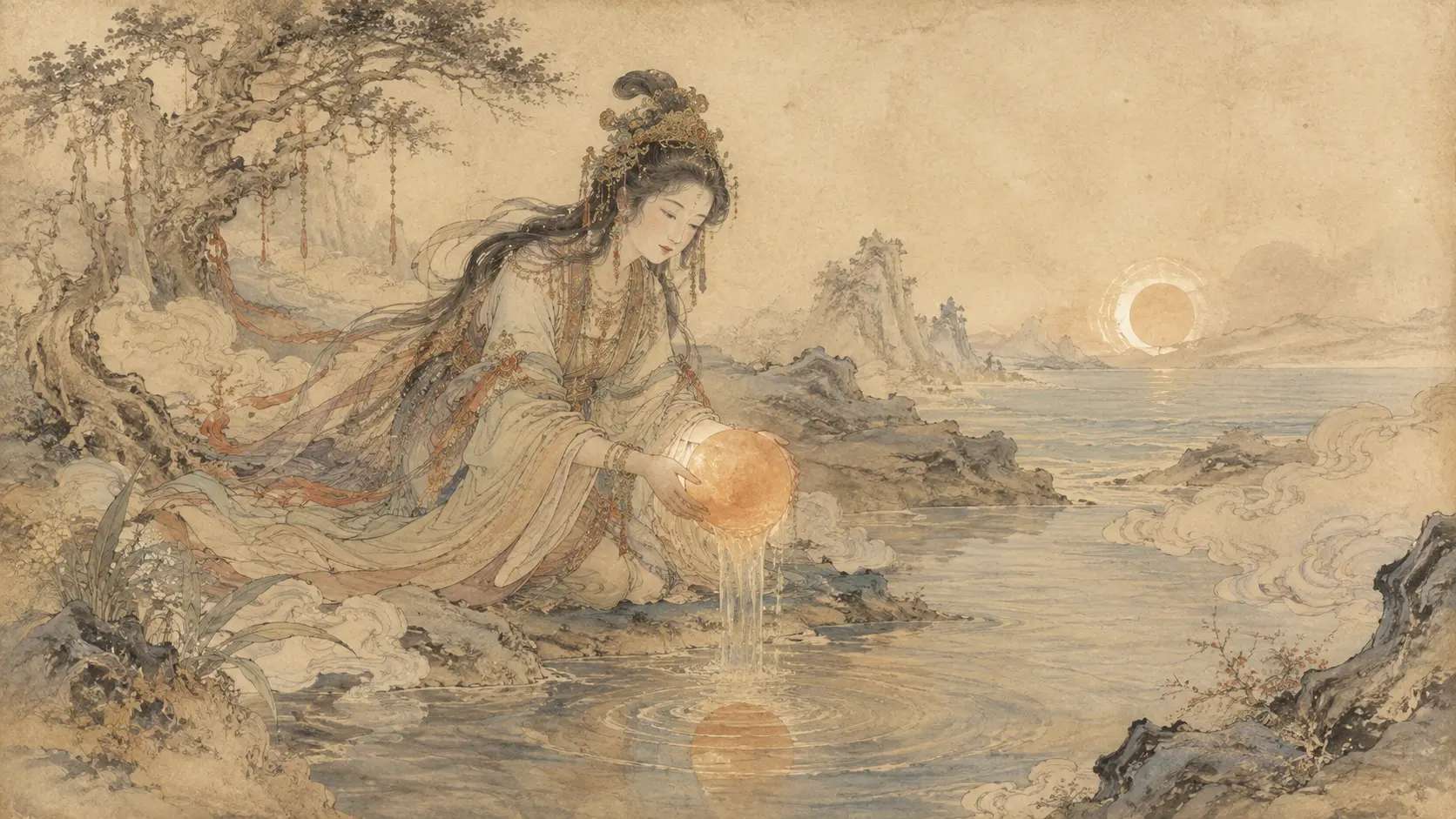
There, beside the waters of Gan Yuan, a woman bathed the sun.
Her name was Xihe.
Xihe (羲和, Xīhé) is an ancient Chinese mythological figure best known from the Shan Hai Jing as the wife of Di Jun and the mother of ten suns. The text describes her bathing the sun at Gan Yuan. Later poetry and commentary increasingly connect Xihe with the movement of the sun across the sky, which helped produce the familiar modern image of her as a Chinese sun goddess or solar charioteer.
But, as with many figures in Chinese mythology, the oldest surviving source is more specific—and stranger—than the simplified version repeated online.
Xihe at a Glance
| Chinese | 羲和 |
| Pinyin | Xīhé |
| Common English description | Chinese sun goddess / solar deity |
| Best known for | Mother of the ten suns |
| Consort | Di Jun (帝俊) |
| Early source | Shan Hai Jing |
| Associated places | Gan Yuan, eastern solar realms |
| Related myths | Ten Suns, Hou Yi |
| Later association | Solar movement / sun chariot tradition |
Who Is Xihe in Chinese Mythology?
One of the clearest surviving descriptions comes from the Shan Hai Jing — Classic of the Southern Great Wilderness.
The text says:
羲和者,帝俊之妻,生十日
In straightforward English:
Xihe was the wife of Di Jun and gave birth to ten suns.
Immediately before this, the text describes a woman named Xihe bathing the sun at Gan Yuan.
That gives us Xihe’s earliest important mythological identity:
a female solar figure,
wife of Di Jun,
mother of ten suns,
and a figure intimately connected with the care or bathing of the sun.
Notice what the passage does not tell us.
It does not give Xihe a long biography.
It does not list magical powers.
And it does not yet describe the elaborate celestial chariot found in many modern retellings.
Xihe and the Ten Suns
The idea of ten suns is one of the most remarkable parts of early Chinese mythology.
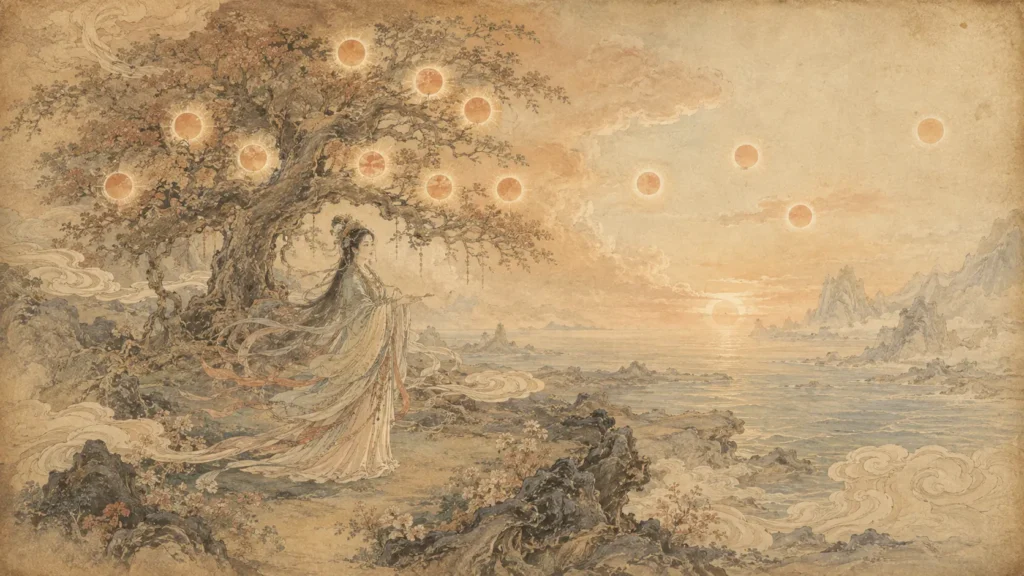
Elsewhere in the Shan Hai Jing tradition, the ten suns appear in the eastern world around the great Fusang tree.
One sun could occupy the upper branches while others rested below, creating an image of multiple solar beings belonging to an ordered cosmic cycle. Later textual collections preserve Shan Hai Jing passages describing ten suns bathing near Fusang and associating them with birds.
The Xihe passage gives those suns a mother.
She is therefore not simply “the physical Sun turned into a woman.”
She belongs to a mythology in which the suns themselves form a divine family.
Their father is Di Jun.
Their mother is Xihe.
And there are ten of them.
Are Xihe’s Suns the Same Ten Suns Hou Yi Shot?
They belong to the same broad mythological complex—but the surviving texts should be kept separate.
The Shan Hai Jing tells us that Xihe gave birth to ten suns.
The Huainanzi preserves another famous tradition.
During the age of Yao:
ten suns appeared at the same time.
Their heat scorched crops and killed vegetation.
Yao then ordered Yi to deal with the disasters threatening the world, and the text includes Yi shooting at the suns.
Later retellings fuse these pieces into the familiar story:
Xihe’s ten sun-children rise together → Earth burns → Hou Yi shoots down nine.
That is a perfectly understandable mythological synthesis.
But the Huainanzi passage itself does not stop to identify the ten suns as “Xihe’s children.”
That relationship comes from reading several ancient traditions together.
This distinction matters because it allows us to enjoy the famous story without pretending every detail appears in one original source.
For the full catastrophe and the archer who stopped it, read our article about Hou Yi and the Ten Suns.
Did Xihe Drive the Sun Chariot?
This is one of the most repeated claims about Xihe online.
The answer is:
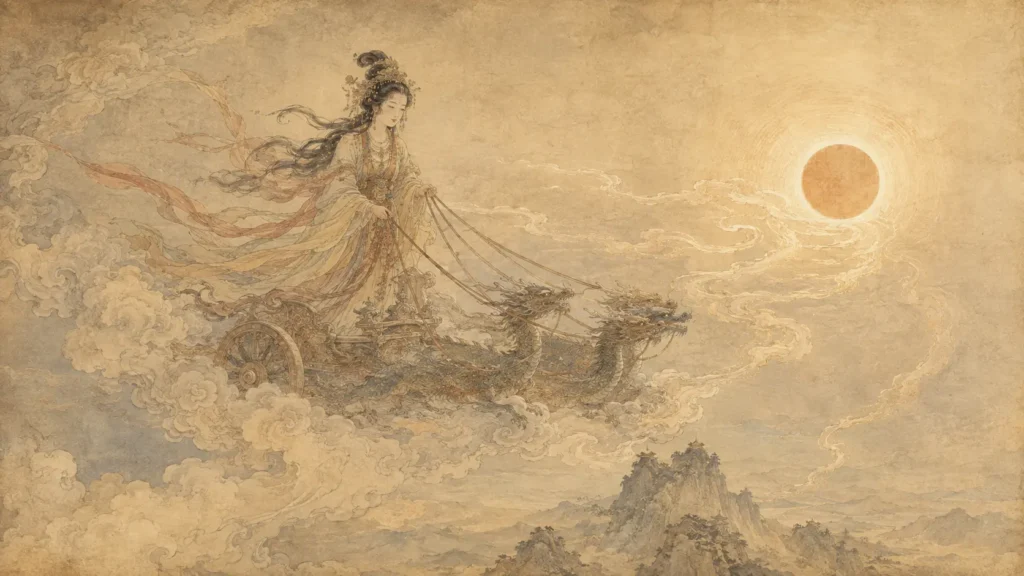
Later tradition strongly associates Xihe with the sun’s journey, but the earliest Shan Hai Jing passage does not describe her driving a chariot.
The important evidence comes from the Li Sao.
During the poet’s supernatural journey, he says that he commands Xihe to slow down as the sun approaches the western mountain Yanzi.
This passage became extremely influential.
Later lexicographical and commentarial traditions explicitly identify Xihe as the sun’s driver, sometimes imagining the solar vehicle as drawn by dragons.
But there is an important scholarly complication.
A study published in Early China notes that while the Shan Hai Jing clearly describes Xihe as female and mother of the ten suns, it does not describe her as their charioteer. The article also points out that in other early texts, the name Xihe or the related Xi/He figures could be interpreted as calendar officials rather than a single female solar goddess.
So the clean chronology is:
Shan Hai Jing → mother of ten suns, bathing the sun
↓
Li Sao → Xihe associated with controlling/slowing the solar journey
↓
Later commentary → increasingly explicit solar charioteer
That is much more accurate than simply saying:
“Ancient Chinese people believed Xihe drove ten sun chariots every day.”
Is Xihe the Chinese Sun Goddess?
Calling Xihe a Chinese sun goddess is useful, but it is a modern simplification of a more complicated tradition.
Her association with the sun is undeniable.
She:
- gives birth to ten suns;
- bathes the sun;
- appears in solar poetry;
- later becomes associated with the sun’s movement.
But Chinese tradition did not have one universal solar deity with a fixed biography comparable to a Greek god such as Helios.
Even the interpretation of Xihe changes depending on the text and historical period.
So the best description is:
Xihe is an ancient Chinese solar figure and mother of the ten suns who later became widely understood as a sun goddess and solar charioteer.
That phrasing preserves both the searcher’s expectation and the historical evidence.
Xihe, Fusang and the Eastern Solar World
Solar mythology in ancient China repeatedly points toward the East.
The Shan Hai Jing places Xihe’s realm beyond the southeastern sea.
Other passages describe Fusang, the enormous sacred tree associated with the suns and their daily emergence.
These traditions create an extraordinary visual cosmology.
Imagine:
a distant eastern sea,
a vast sacred tree,
multiple suns waiting their turn,
and Xihe beside the waters where the solar cycle begins.
This is far more interesting than reducing her to:
“Chinese goddess of sunlight.”
She belongs to an entire imagined geography of the Sun.
Xihe and Di Jun
The Shan Hai Jing explicitly identifies Xihe as the wife of:
Di Jun — 帝俊
Di Jun is one of the most intriguing divine figures in the text.
Another parallel tradition gives him a second important celestial partner:
Changxi (常羲), associated with the birth of twelve moons.
The symmetry is striking:
Xihe → ten suns
Changxi → twelve moons
Both belong to the wider divine family surrounding Di Jun.
This structure suggests a mythological attempt to understand recurring celestial cycles through family relationships.
The Sun is not merely an object.
The Moon is not merely an object.
They belong to divine genealogies.
Is Xihe the Same as Changxi?
No surviving source simply tells us:
Xihe and Changxi are the same goddess.
The Shan Hai Jing presents them separately:
Xihe is associated with ten suns.
Changxi is associated with twelve moons.
Modern scholarship has explored relationships between these traditions, and ancient names and roles sometimes overlap with historical or calendrical figures.
But for a mythology article, the safest treatment is:
Xihe and Changxi are distinct figures in the surviving Shan Hai Jing traditions, even if their parallel structures suggest closely related celestial myth-making.
We should not merge them without evidence.
What Does the Name Xihe Mean?
This is another place where mythology websites often become too confident.
The characters are:
羲和
Modern writers sometimes produce poetic translations such as:
“harmonious sunlight”
or
“circling radiance.”
Those can sound beautiful.
But they should not be presented as a certain ancient etymology.
The name Xihe also appears in traditions concerning astronomical or calendrical officials, and its historical development is more complicated than simply translating two modern character meanings.
For Becoming Konstantin, the responsible approach is simple:
use the established name Xihe rather than inventing a dramatic literal translation.
Xihe and the Myth of Cosmic Order
The ten suns are not frightening merely because there are ten of them.
The problem begins when all ten appear together.
The Huainanzi describes the resulting world:
crops burn,
plants die,
and humanity loses its food.
That contrast is important.
Ten suns existing within an ordered cycle are part of the cosmos.
Ten suns appearing simultaneously become catastrophe.
Xihe’s mythology therefore sits at the intersection of:
sunlight,
time,
celestial rhythm,
and cosmic order.
That may help explain why later tradition so naturally developed her into a regulator or driver of the solar journey.
Why Xihe Matters in Chinese Mythology
Xihe rarely receives the attention given to Chang’e, Nüwa or the Jade Emperor.
Yet she sits behind one of the most famous stories in all Chinese mythology.
Without Xihe, the Ten Suns are merely celestial objects.
The Shan Hai Jing gives them a mother.
It gives them a family.
It places them inside a strange solar landscape beyond the sea.
Later poetry turns Xihe toward the journey of the setting sun.
Later commentators turn that association into the image of a celestial driver.
And the Hou Yi tradition transforms the ten suns into a catastrophe that threatens the world.
Xihe is therefore more than simply “China’s sun goddess.”
She is one of the ancient figures through whom Chinese mythology imagined the Sun as family, cycle, landscape and cosmic order.
Sources & Further Reading
Primary / Early Texts
Chinese Text Project — Shan Hai Jing, Classic of the Southern Great Wilderness
The core Xihe passage: she bathes the sun, is the wife of Di Jun and gives birth to ten suns.
Chinese Text Project — Chu Ci, Li Sao
Important early poetic evidence associating Xihe with the movement of the sun across the sky.
Chinese Text Project — Huainanzi, Fundamental Norm
Preserves the catastrophe in which ten suns appear simultaneously during Yao’s age and Yi shoots at them.