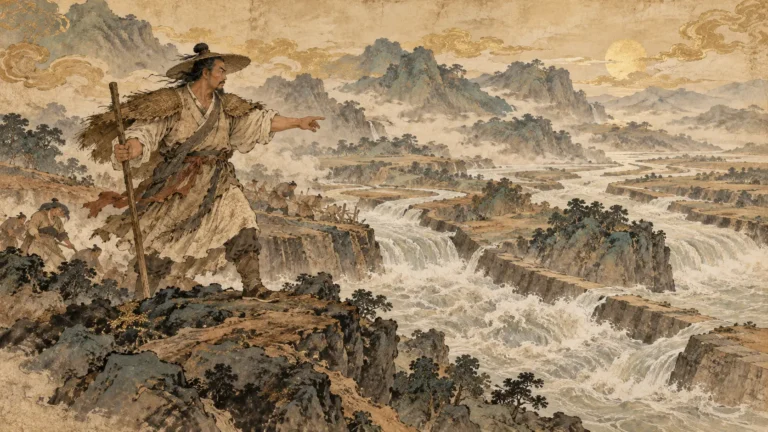
Before agriculture, Chinese tradition imagined humanity living much closer to hunger.
People gathered what they could find. Plants could nourish them—or poison them. The earth offered abundance, but someone first had to learn how to use it.
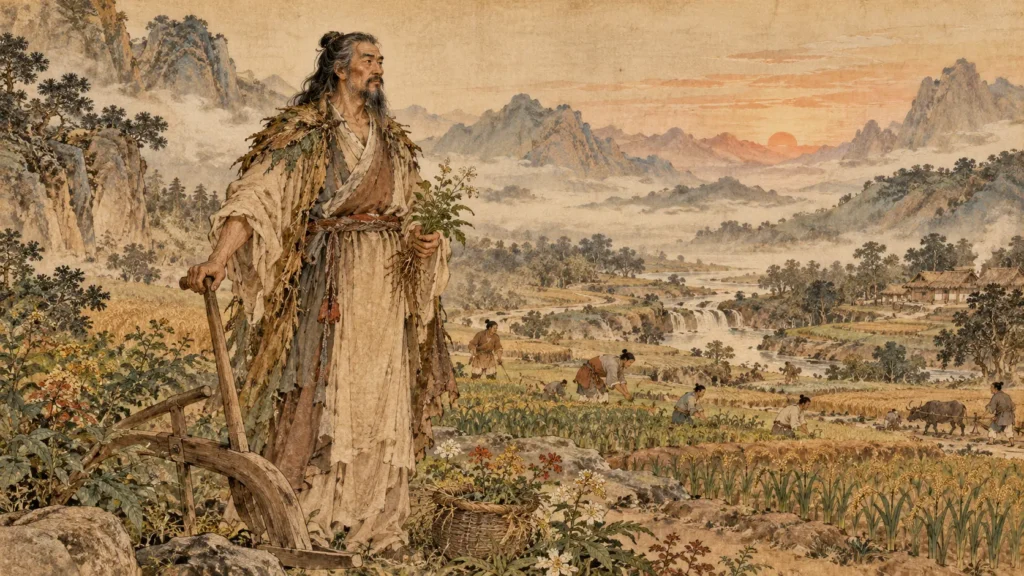
That civilizing figure became Shennong (神农 / 神農, Shénnóng), the “Divine Farmer.”
Chinese tradition remembers him as a legendary ruler, culture hero and later deity associated with agriculture, grain cultivation and medicinal plants. In one of his most famous stories, Shennong personally tastes hundreds of plants so that ordinary people can learn which are useful and which are dangerous.
But like many figures from China’s legendary past, his story was not created all at once.
Different texts turned Shennong into farmer, sage, ruler, healer—and eventually linked him closely with Yandi, the Yan or Flame Emperor.
Shennong Quick Facts
| Chinese | 神农 / 神農 |
| Pinyin | Shénnóng |
| Name meaning | Divine Farmer / Divine Husbandman |
| Role | Culture hero, legendary ruler and later deity |
| Associated with | Agriculture, grain, medicinal plants |
| Famous legend | Tasting hundreds of herbs |
| Often linked with | Yandi, the Yan or Flame Emperor |
| Traditional group | Sometimes included among the Three Sovereigns |
| Historical status | Legendary rather than independently verified as a historical ruler |
Who Is Shennong?
Shennong is the legendary “Divine Farmer” of Chinese tradition, remembered for teaching agriculture and testing plants for food and medicine.
His name explains his identity immediately:
神 — shén: divine, spirit, supernatural
农 / 農 — nóng: agriculture, farming, farmer
Together, Shénnóng can be translated as Divine Farmer or Divine Husbandman.
The Chinese Text Project describes him as a mythical sage ruler associated with both agriculture and herbal knowledge and notes that he appears in some traditions among the Three Sovereigns, the primordial culture heroes placed before China’s legendary dynastic age. Chinese Text Project
But Shennong is more important as a cultural role than as a fixed biography.
Like Fuxi, Shennong became a culture hero through whom later tradition explained the origins of essential human knowledge.
He represents the moment when humans stop merely taking food from nature and begin understanding, cultivating and organizing it.
Shennong and the Beginning of Agriculture
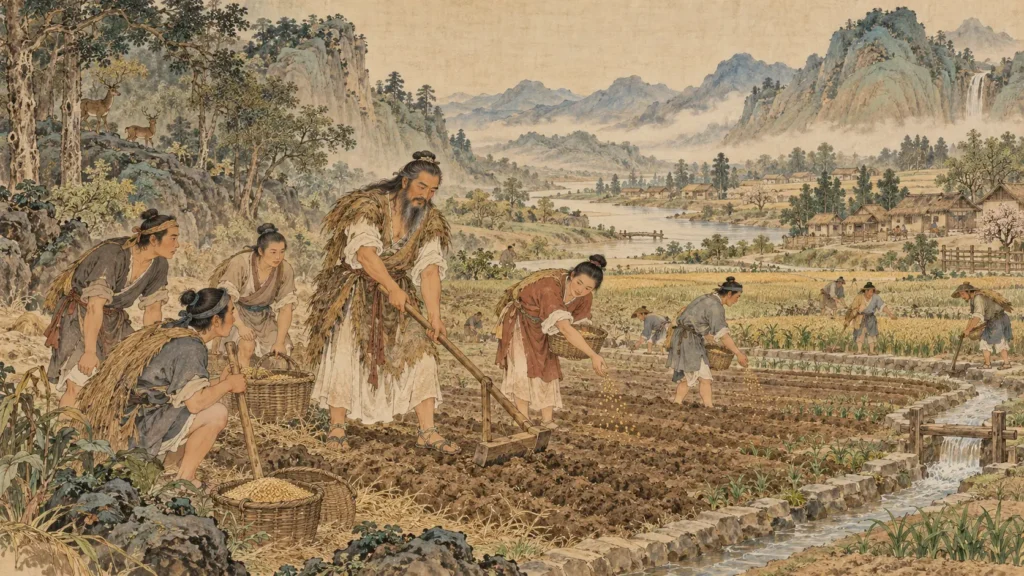
Agriculture is the center of Shennong’s identity.
Later agricultural literature preserves traditions in which Shennong teaches people to cultivate the land, distinguish grains and use farming tools.
The Qimin Yaoshu, an important sixth-century agricultural work, quotes earlier traditions describing Shennong’s age as a time when grain was sown and agricultural tools such as the lei and si, early plowing implements, were used to open uncultivated ground. Chinese Text Project
Another tradition preserved in later agricultural writing says Shennong understood the seasons, the qualities of the land and the use of agricultural tools, teaching people how to farm. Chinese Text Project
These stories should not be read as proof that one prehistoric individual literally invented Chinese agriculture.
They are culture-hero traditions.
Complex developments that happened across generations are concentrated into one remembered founder.
In Shennong’s case, farming becomes personal:
civilization learned to cultivate because the Divine Farmer taught it how.

The Legend of Shennong Tasting Hundreds of Herbs
Shennong’s most famous story is not about a plow.
It is about his own body.
The Huainanzi, compiled during the Western Han period, describes an earlier world in which people suffered from disease and poisoning. Shennong responds by teaching the cultivation of the five grains and examining different kinds of land.
Then he does something dangerous.
He tastes the flavors of many plants and the qualities of water sources so that people can understand what they should seek and what they should avoid.
The text famously says that during this process Shennong encountered seventy poisons in a single day. Chinese Text Project
This is much more interesting than the simplified claim that “Shennong invented herbal medicine.”
The story presents knowledge as something acquired through risk, observation and testing.
Shennong suffers so other people do not have to.
That theme became central to his later identity.
Did Shennong Really Taste 100 Herbs?
Not as a historically verifiable experiment.
The herb-tasting episode belongs to legendary tradition.
The Huainanzi is valuable because it shows that this association was already established by the Western Han period, but it was written long after the primordial age in which Shennong was traditionally placed. Chinese Text Project
Later sources expanded the legend even further.
Some versions describe different numbers of poisons, increasingly miraculous recoveries or elaborate stories about how Shennong identified medicines.
This is why source chronology matters.
The earliest surviving textual layer we can examine is not identical to every later folk retelling.
Did Shennong Write the Shennong Bencao Jing?
No—not in the historical sense.
The Shennong Bencao Jing (神农本草经 / 神農本草經), often translated as the Divine Farmer’s Classic of Materia Medica, became one of the foundational works of Chinese materia medica.
But attaching Shennong’s name to the text does not mean the legendary Divine Farmer personally wrote it.
Modern scholarship identifies the work as a much later compilation.
A scholarly review of Chinese materia medica describes the Shennong Bencao Jing as the earliest extant major bencao text and places its compilation in the Eastern Han period, centuries after the age assigned to Shennong in legend. It records 365 medicinal substances, organized into categories according to their qualities and uses. PubMed Central (PMC)
Historical research on the title itself also argues against treating it as a prehistoric book personally authored by Shennong. PubMed
His name served another purpose:
authority.
By associating accumulated medical knowledge with the ancient Divine Farmer, later tradition connected that knowledge to the primordial origins of civilization.
Is Shennong the Same as Yandi?
This is where the mythology becomes more complicated.
Shennong and Yandi are often identified with one another in later Chinese tradition, but they should not automatically be treated as one completely fixed figure in every textual period.
Yandi (炎帝, Yándì) means the Yan Emperor or Flame Emperor.
Later compilations preserve traditions explicitly calling the figure Yandi Shennong, showing that the two identities had become closely combined. The Yiwen Leiju, for example, preserves material under a section devoted to Yandi Shennong Shi and cites traditions identifying Shennong with the Yan Emperor lineage. Chinese Text Project
But ancient traditions developed through different genealogies and textual systems.
That means the safest explanation is:
Shennong is the Divine Farmer culture hero. Yandi is the Yan/Flame Emperor identity. Later tradition frequently merges them, but their relationship has a textual history rather than one universally consistent ancient biography.
That distinction is especially important because Huangdi—the Yellow Emperor—is famously connected with Yandi in legendary accounts of early conflict and political order.
For that tradition, see our Yellow Emperor article.
Shennong and the Yellow Emperor
Shennong and Huangdi occupy neighboring spaces in China’s legendary past.
In later traditional sequences, the order associated with Shennong eventually gives way to the age of Huangdi.
Sima Qian’s Records of the Grand Historian, for example, begins Huangdi’s rise during a period when the power associated with the descendants of Shennong had declined.
That does not make Shennong and Huangdi securely documented prehistoric monarchs.
Instead, the tradition places them at different stages in an imagined development of civilization:
Shennong → agriculture, food and practical knowledge
Huangdi → political order, rulership and a much broader civilizing legacy
This makes them natural internal companions in our early-China mythology cluster.
Shennong as the Model of the Working Sage
Shennong is not usually imagined as a ruler who simply gives orders from a palace.
His mythology values direct labor.
The Huainanzi describes Shennong alongside Yao, Shun and Yu as sages who physically exhausted themselves for the benefit of ordinary people. Shennong is described as worn and haggard—a symbol of a ruler who works rather than merely commands. Chinese Text Project
That idea fits perfectly with the agricultural side of his legend.
The farmer cannot command grain to grow.
He has to observe soil, season, rain and plant.
Knowledge comes from engagement with the world.
Was Shennong a God or an Emperor?
Both descriptions appear in different contexts, but neither tells the entire story.
Shennong can be understood as:
- a primordial ruler
- a culture hero
- a legendary ancestor
- a patron of agriculture
- a figure connected with medicine and medicinal plants
- a deity within later religious tradition
That flexibility is normal in Chinese mythology.
Figures do not always remain neatly inside Western categories such as “god,” “king” or “hero.”
Shennong accumulated identities because later communities continued to reinterpret what he represented.
His oldest importance was not that he belonged to one precise divine bureaucracy.
It was that he explained where essential human knowledge came from.
Why Shennong Still Matters
Shennong’s legend is ultimately about learning how to survive.
He does not defeat a cosmic monster.
He does not steal immortality.
He does not conquer Heaven.
He learns which soil can support grain.
Which plant can nourish.
Which plant can poison.
Which knowledge must be tested before it can be trusted.
That makes Shennong unusual among legendary rulers.
His great gift is not domination.
It is useful knowledge.
And perhaps that is why later generations placed both agriculture and medicine under his shadow.
The Divine Farmer became a symbol of the moment when humanity stopped simply enduring nature—and began learning from it.
References & Sources
Huainanzi — Xiuwu Xun
One of the most important early sources for Shennong’s agricultural role and the famous episode in which he tastes plants and encounters numerous poisons. Chinese Text Project
Chinese Text Project — Huainanzi, Xiuwu Xun
Chinese Text Project — Shennong dictionary entry
Useful overview of the name “Divine Farmer,” traditional culture-hero status and agriculture/herbal associations. Chinese Text Project
Chinese Text Project — Shennong