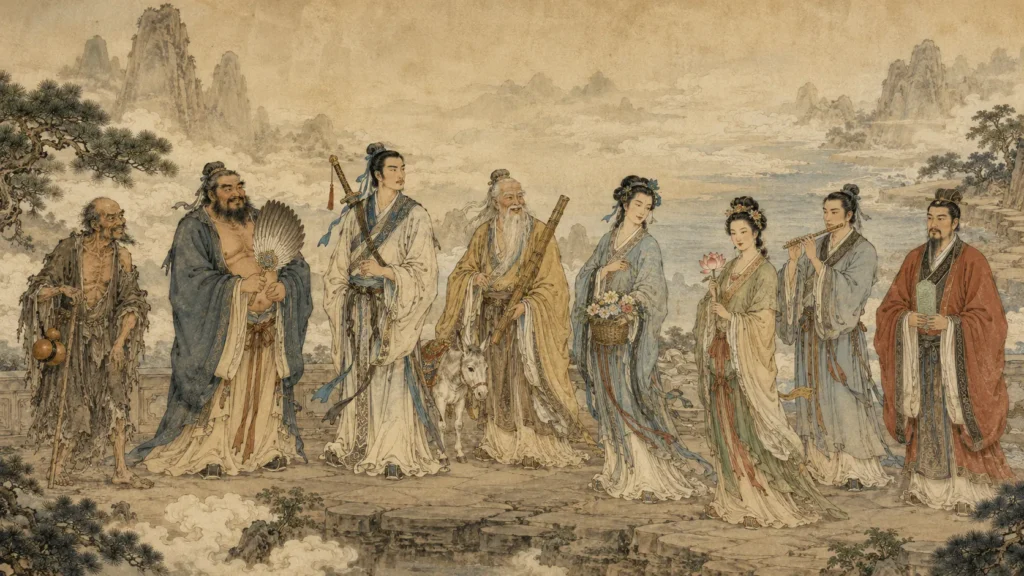
Eight figures stand before a violent sea.
None of them searches for a boat.
One throws down an iron crutch. Another steps onto a flower basket. A musician trusts his flute, while an elderly immortal prepares a magical donkey that can be folded away like paper.
Each possesses a different object.
Each has followed a different path.
Yet all eight intend to reach the opposite shore.
They are the Eight Immortals of Chinese mythology—a mismatched group of wanderers, scholars, musicians, officials and outsiders who achieved what emperors spent fortunes trying to obtain:
Immortality.
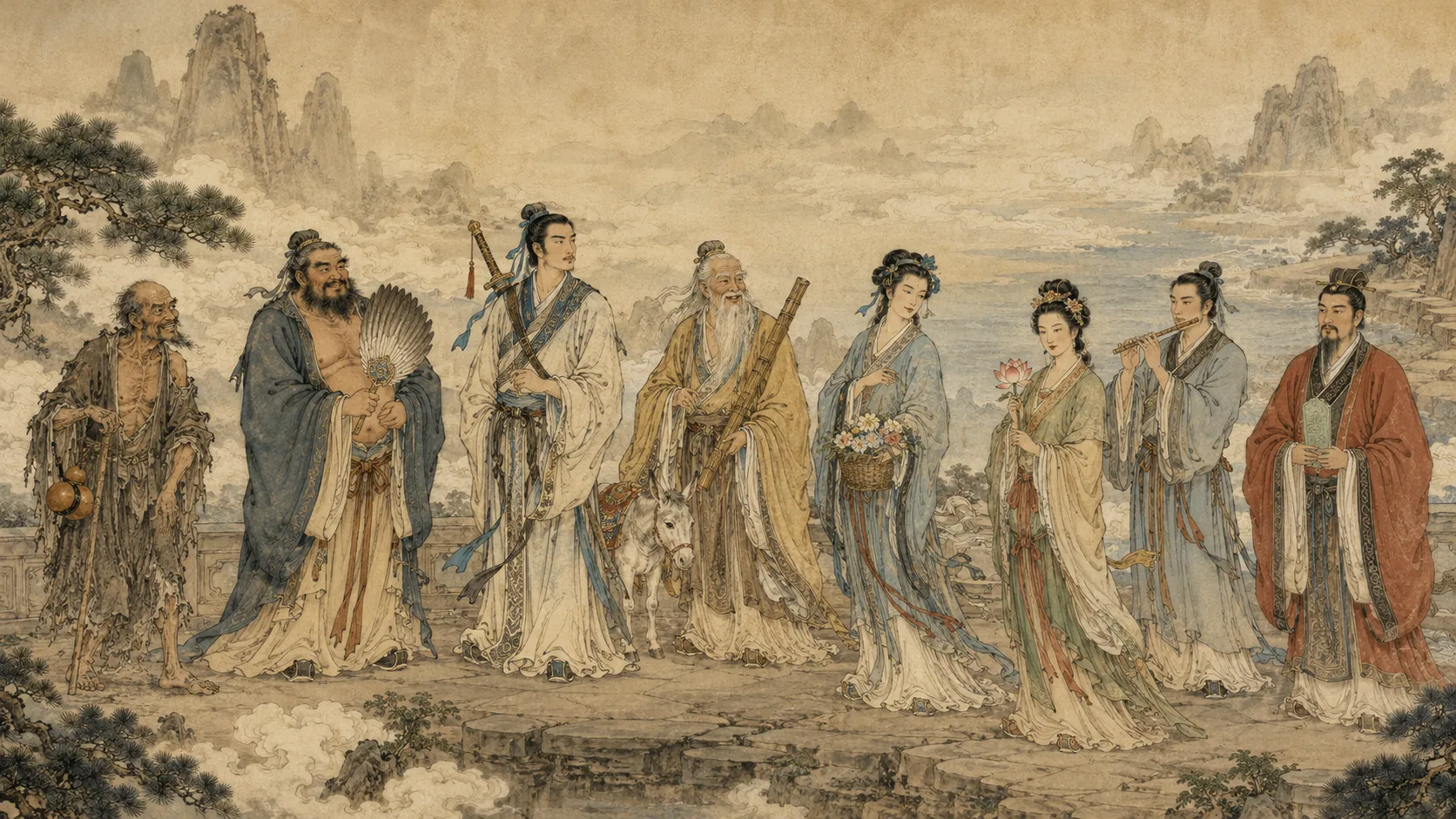
The Eight Immortals, known in Chinese as Bāxiān (八仙), are Li Tieguai, Zhongli Quan, Lü Dongbin, Zhang Guolao, Lan Caihe, He Xiangu, Han Xiangzi and Cao Guojiu. Each is recognised by a distinctive magical object and represents a different path toward transcendence.
Who Are the Eight Immortals?
The Eight Immortals are among the most recognisable figures connected with Chinese Daoist religion, mythology and folk culture.
They were not born as one divine family.
Most were remembered as human beings who overcame the limits of ordinary life through spiritual cultivation, divine intervention or extraordinary experiences. Their legends developed at different times before storytellers, artists and playwrights brought them together as one group.
A recognisable group of seven men and one woman had formed by the early thirteenth century. Their familiar identities and collective adventures became even more firmly established through later theatre, folk tradition and Ming-dynasty literature.
Unlike distant celestial rulers, the Eight Immortals come from radically different backgrounds.
One looks like a homeless beggar.
Another resembles a wealthy court official.
There is a wandering musician, an elderly eccentric, a sword-carrying scholar and the group’s only woman.
Together, they suggest that no single appearance, profession or social rank determines who can pursue wisdom.
Meet the Eight Immortals
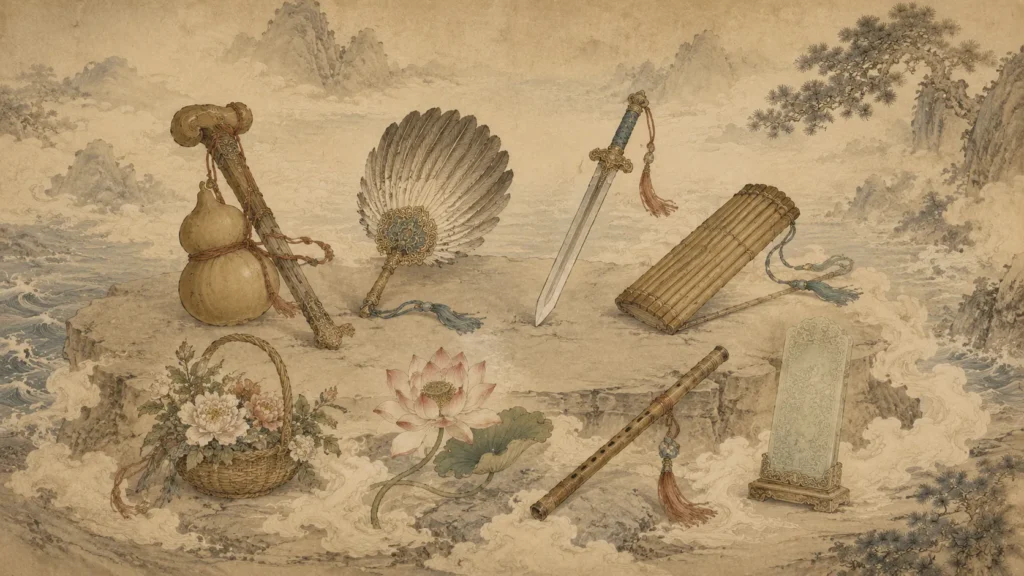
The objects carried by the immortals are so distinctive that Chinese art can represent the entire group without showing their bodies at all. These objects are collectively known as the Hidden Eight Immortals, or An Baxian.
Their exact attributes occasionally vary between artworks and regional traditions, but each member possesses a widely recognised identity.
Li Tieguai — The Beggar with the Iron Crutch
Li Tieguai is usually depicted as an unkempt, thin man leaning upon an iron crutch.
A double gourd hangs beside him, often releasing magical vapour or containing medicine and the elixir of immortality. According to his best-known legend, his spirit temporarily left his body. When he returned, he discovered that the body had been destroyed and was forced to enter the body of a recently deceased beggar.
His damaged appearance concealed enormous spiritual power.
Li Tieguai became associated with helping the sick, poor and distressed—a reminder that outward perfection and inner worth are not the same thing.
Zhongli Quan — The Immortal with the Fan
Zhongli Quan appears as a broad, bearded man whose loose robes often expose his stomach.
He commonly carries a large fan, sometimes believed capable of reviving the dead or transforming matter. He is frequently presented as an elder of the group and as the teacher who guided Lü Dongbin toward immortality.
His appearance feels relaxed, almost humorous, but his fan represents transformation: the power to restore life and change what appears fixed.
Lü Dongbin — The Scholar with the Demon-Slaying Sword
Lü Dongbin is one of the most prominent members of the Eight Immortals.
He is usually shown as an elegant scholar carrying a sword across his back. The weapon is not simply a soldier’s blade. It represents the ability to cut through deception, ignorance and destructive spiritual forces.
Many legends portray him wandering through the human world, testing people, helping those with good intentions and confronting demons.
His disciplined appearance makes him the warrior-scholar of the group: educated enough to understand the world, but strong enough to resist its corruption.
Zhang Guolao — The Elder Who Rode Backwards
Zhang Guolao is an eccentric old immortal traditionally connected with a magical white donkey.
He is often said to have ridden the animal backwards. When the journey ended, he could fold it like paper and store it away, restoring it by sprinkling water upon it.
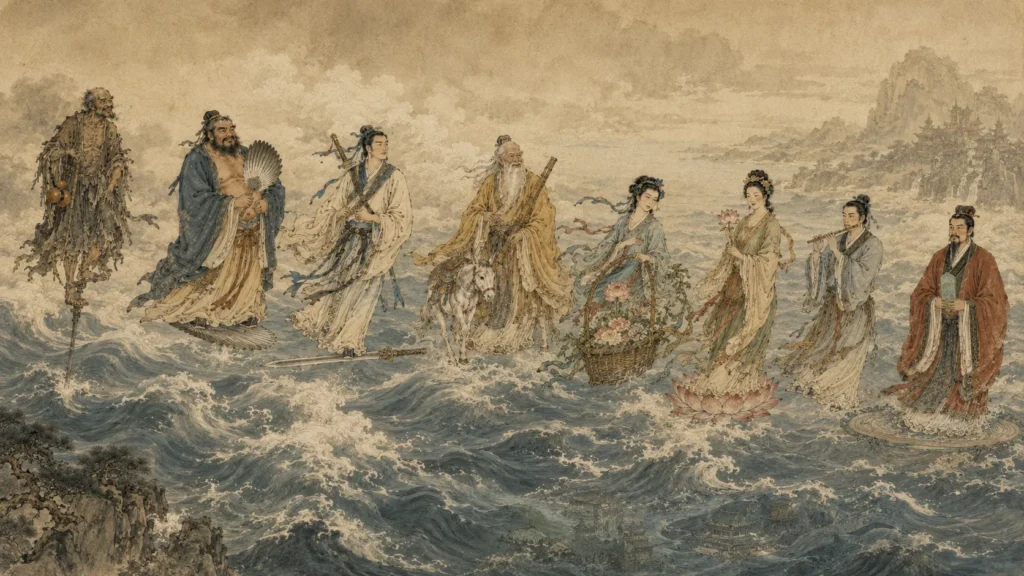
In art, he may carry a bamboo instrument called a yugu, while scenes of the immortals crossing the sea frequently show him travelling on his paper donkey.
Zhang Guolao represents age without weakness and wisdom that refuses to behave according to ordinary expectations.
Lan Caihe — The Wandering Musician
Lan Caihe is among the most mysterious members of the group.
Different traditions portray Lan as male, female or deliberately androgynous. The immortal is often shown wearing unusual clothing, carrying a basket of flowers or playing wooden clappers while wandering through markets and streets.
Lan’s unstable identity is part of the character’s meaning.
Social categories, wealth and conventional respectability no longer matter to someone who has stepped beyond ordinary life. The basket of flowers also connects Lan Caihe with beauty, impermanence and the natural world.
He Xiangu — The Immortal Woman
He Xiangu is traditionally the only woman among the Eight Immortals.
She is commonly represented carrying a lotus flower, peach, basket or magical mushroom—objects associated with purity, spiritual awakening and longevity.
Her legends differ, but many describe a young woman who withdrew from ordinary expectations and achieved immortality through spiritual discipline or supernatural nourishment.
In a group filled with loud eccentrics and wandering men, He Xiangu often appears calm and composed. Her strength is not aggressive. It comes through clarity, restraint and independence.
Han Xiangzi — The Immortal Flutist
Han Xiangzi is recognised by his flute.
He is traditionally portrayed as a youthful musician whose playing could cause flowers to bloom or bring harmony to the natural world. Artworks sometimes show him walking upon turbulent water as if the waves were solid ground.
His power comes not from physical force but from mastery, rhythm and creative expression.
Han Xiangzi demonstrates that discipline does not always produce a warrior. Sometimes it produces an artist capable of changing the atmosphere around him.
Cao Guojiu — The Immortal of the Royal Court
Cao Guojiu is usually depicted wearing formal court clothing.
He may carry a jade court tablet or a pair of clappers associated with official ceremony and theatrical performance. Legends often connect him with the imperial family, but also with his decision to withdraw from status after witnessing corruption and wrongdoing.
His presence completes the social range of the group.
The Eight Immortals include both the beggar and the aristocrat. Immortality does not automatically belong to either poverty or privilege. What matters is what the individual becomes willing to leave behind.
The Eight Immortals Crossing the Sea
Their most famous collective adventure is The Eight Immortals Crossing the Sea.
In the popular later story, the immortals reach the Eastern Sea after attending a divine celebration. Rather than travel across the sky in the usual way, Lü Dongbin proposes a challenge:
Each immortal must cross using their own magical object and ability.
Li Tieguai places his crutch upon the waves.
Zhang Guolao uses his paper donkey.
Lan Caihe trusts the wooden clappers, while Cao Guojiu relies upon his jade tablet. Other versions assign a flute, flower basket, fan, drum or bamboo cover to the remaining immortals.
The objects differ slightly between retellings, but the meaning remains consistent.
None of them copies another.
Each transforms what they already carry into a path across the impossible sea.
The story produced the famous expression:
“The Eight Immortals cross the sea—each displaying their own special power.”
Today, the phrase can describe a group of people solving the same challenge through different talents, methods or areas of expertise.
The Eight Immortals succeed together precisely because they are not identical.
Did They Fight the Dragon King?
Some later versions turn the crossing into a larger conflict.
The immortals disturb the Eastern Sea, lose one of their companions or become involved in a confrontation with the Dragon King and his forces. Other versions focus only on the crossing and never include a battle.
This variation is normal in Chinese folk mythology.
The Eight Immortals did not emerge from one fixed sacred book containing a single official storyline. Their adventures passed through oral tradition, theatre, novels, paintings and local religious practice.
The story changed while the central image survived:
Eight completely different people standing together before the same obstacle.
Why the Eight Immortals Became So Popular
The Eight Immortals appeared across paintings, porcelain, lacquerware, carvings, household decorations and religious objects.
Their popularity was not based only on supernatural power. They were also associated with longevity, protection, prosperity and the hope that ordinary limitations might be overcome. Images of the group were sometimes displayed in homes as protective and auspicious symbols.
Their diversity also made them unusually accessible.
A scholar could recognise Lü Dongbin.
A musician could look toward Han Xiangzi.
The poor and sick could seek hope in Li Tieguai, while officials might understand Cao Guojiu’s struggle with status and responsibility.
The Eight Immortals were divine without becoming completely unreachable.
They still looked like people who had lived, failed, travelled and changed.
The Lesson of the Eight Immortals
Most groups attempt to create strength through uniformity.
Everyone follows the same method.
Everyone trains the same way.
Everyone is expected to possess the same personality.
The Eight Immortals offer a different model.
Li Tieguai’s broken body does not prevent him from helping others.
Han Xiangzi’s flute is no less valuable than Lü Dongbin’s sword.
He Xiangu does not need to imitate the warriors around her, and Zhang Guolao does not become wiser by behaving conventionally.
When the sea blocks their path, none of them waits to receive the perfect tool.
They use what years of experience have already placed in their hands.
Training should not turn every person into the same warrior.
It should reveal what each person can contribute when the group reaches a challenge too large for one individual.
The Eight Immortals crossed the sea together.
But each of them earned the crossing differently.
That is not a weakness in the team.
That is the reason the team survives.
Reference:
- The Metropolitan Museum of Art — Cup with Eight Daoist Immortals
Museum overview of the group, its formation and the identifying objects carried by its members. - British Museum — Table Screen Depicting the Eight Immortals
Identifies the immortals and their attributes, including the gourd, peach, sword, flute and court objects. - British Museum — Painting of the Eight Immortals
Detailed identification of all eight figures and their traditional symbols. - National Palace Museum — Group of Immortals Offering Blessings
Explains the story of the immortals returning from a divine gathering and crossing the sea using their individual objects.