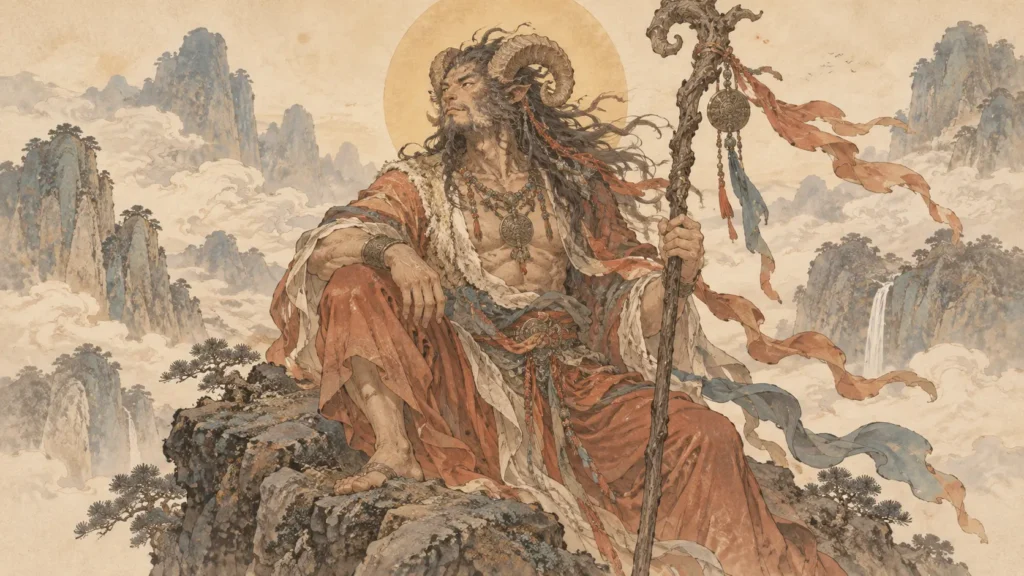
Who Are the Human-Bodied Sheep-Horned Gods?
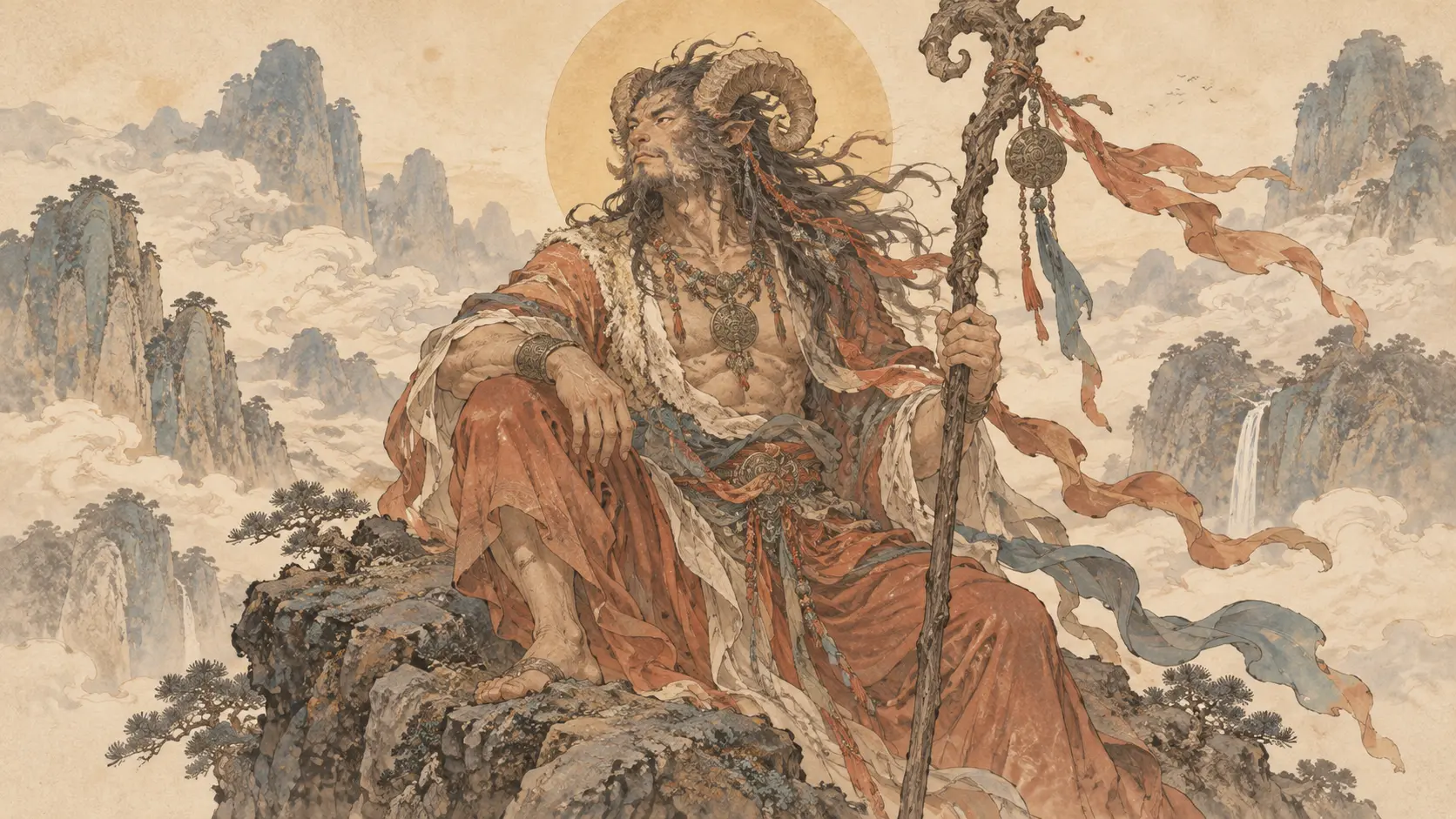
The human-bodied sheep-horned gods are a group of mountain deities described in the Eastern Mountain Classic of the Shan Hai Jing. Rather than receiving individual names, they are identified by a shared appearance: human bodies with sheep horns. Their ritual required a male sheep and millet, while their appearance was associated with destructive wind, rain and water.
The mountains are quiet.
Then something appears between the ridges.
That makes them very different from famous Chinese gods such as the Jade Emperor or Lei Gong.
The text gives us no biography.
No family.
No personal name.
Instead, these beings belong to a landscape.
Their identity comes from the mountains they inhabit.
It walks upright like a human, but two curved horns rise from its head.
And it is not alone.
According to the Shan Hai Jing, an entire chain of eastern mountains was guarded by gods who shared the same unsettling form — human bodies crowned with the horns of sheep.
They were not described as monsters to be hunted.
They were gods to be worshipped.
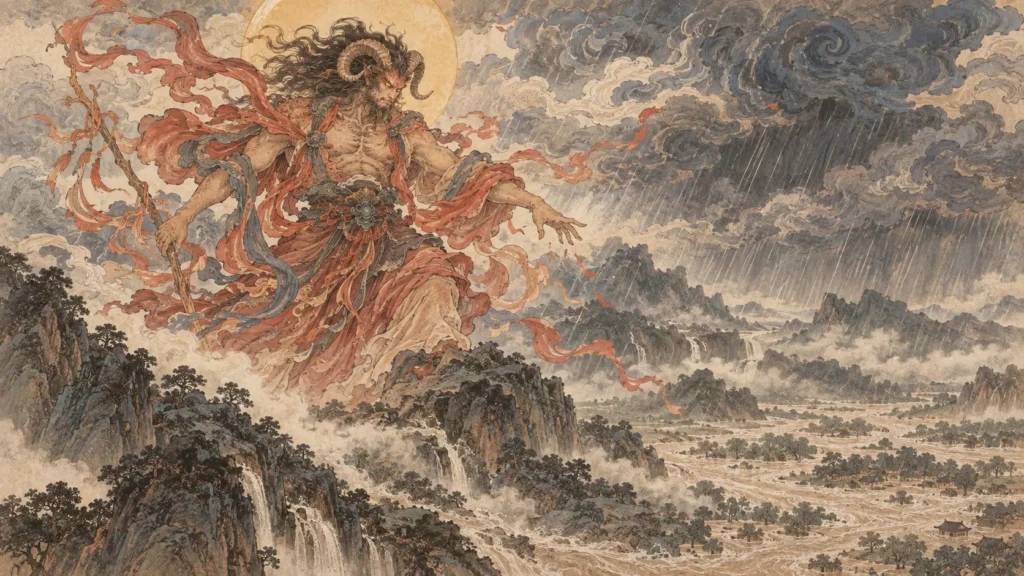
And when they appeared, the weather itself could turn destructive.
The Sheep-Horned Gods at a Glance
| Chinese description | 人身而羊角 |
| Meaning | Human-bodied with sheep horns |
| Source | Shan Hai Jing 山海經 |
| Section | Eastern Mountain Classic 東山經 |
| Mountain chain | Third Eastern Mountain sequence |
| Range | Shihu Mountain 尸胡之山 to Wugao Mountain 無皋之山 |
| Appearance | Human body with sheep horns |
| Offering | One male sheep/ram |
| Grain offering | Millet |
| Associated omen | Destructive wind, rain and water |
What Does the Shan Hai Jing Actually Say?
At the end of the Third Eastern Mountain sequence, the text summarizes the entire route.
It runs from Shihu Mountain (尸胡之山) to Wugao Mountain (無皋之山) and stretches for 6,900 li.
Then comes the strange description:
其神状皆人身而羊角
In straightforward English:
“The gods all have human bodies and sheep horns.”
The passage then explains how they should be worshipped:
其祠:用一牡羊,米用黍。
The offering consists of one male sheep and millet.
That detail matters.
These beings were not simply catalogued because they looked strange.
The text also preserves a ritual relationship between humans and the gods of the mountains.
Nine Mountains — or Nineteen?
There is an interesting textual problem here.
The route itself describes nine mountains, and many modern Chinese editions summarize the chain as 九山 — nine mountains.
However, some transmitted versions contain 十九山 — nineteen mountains. The Chinese Text Project’s parallel text preserves that reading in one edition.
The actual sequence preceding the summary supports nine, because nine named mountain stages are listed.
For Becoming Konstantin, I would therefore use nine mountains in the main narrative while noting that some textual editions preserve a variant reading of nineteen.
That is much stronger than silently pretending every surviving edition is identical.
Why Do They Have Sheep Horns?
The Shan Hai Jing does not tell us.
And that is important.
It would be tempting to say the horns symbolize fertility, masculinity, sacrifice or the power of mountain animals.
But the ancient passage never explains their meaning.
We know only two things with certainty:
the gods possess sheep horns, and the ritual offered to them includes a male sheep.
The visual similarity between deity and sacrifice is fascinating, but any deeper explanation would be interpretation rather than something stated by the source.
This is one of the recurring challenges of reading the Shan Hai Jing.
It gives us extraordinary images.
Then it refuses to explain them.
Were These Gods Mountain Guardians?
Calling them mountain gods is reasonable because the description appears as the ritual summary for the deities of an entire mountain sequence.
But “guardian” can imply more than the text actually says.
The Shan Hai Jing repeatedly describes mountains not only through geography, minerals, plants and animals, but also through the supernatural beings associated with them and the rituals appropriate to those beings.
The sheep-horned gods belong to that system.
They represent the sacred dimension of the landscape.
People did not simply cross these mountains.
According to the world imagined by the text, they crossed territory that belonged to gods.
Why Were a Ram and Millet Offered?
The ritual instruction is unusually specific.
A 牡羊 (mǔyáng) — a male sheep or ram — was used as the animal offering.
The grain was 黍 (shǔ), usually translated as millet.
The Shan Hai Jing contains many similar ritual summaries in which different mountain chains require different animals, grains, jades or forms of sacrifice.
This means the book is not only a bestiary.
It also preserves something resembling a ritual geography.
Different landscapes demand different forms of respect.
For these eastern mountains, sheep and millet were the correct offerings.
What Happens When the Gods Appear?
The final line is ominous:
是神也,见则风雨水为败。
The wording is difficult to render perfectly, but its basic sense is destructive: when these gods appear, wind, rain and water bring damage or ruin.
We should be careful here.
The text does not clearly say that the gods deliberately summon storms.
It links their manifestation with damaging weather and water.
That makes them closer to an omen of environmental disorder than to a later fantasy-style storm god throwing lightning from the sky.
And that distinction is exactly the kind of detail worth preserving.
They Are Not the Only Sheep-Horned Gods in the Shan Hai Jing
Elsewhere in the Shan Hai Jing, another deity called Weiwei / 𧕛圍 is described with a human face, sheep horns and tiger claws.
That god lives around the waters of Jiao Mountain and shines when entering or leaving the depths.
But this is not the same entry.
The sheep-horned gods of the Third Eastern Mountain chain are an unnamed collective with human bodies and sheep horns.
Weiwei is a specific deity with its own location and additional features.
Keeping those entities separate matters, especially when modern websites often merge creatures simply because they share one visual trait.
Why These Forgotten Gods Matter
They occupy only a few lines.
Yet those lines reveal something important about the world of the Shan Hai Jing.
Mountains were not empty scenery.
They had animals.
They had strange resources.
They had dangers.
And they had gods.
The traveler who crossed from Shihu Mountain toward Wugao Mountain was not merely moving through geography.
He was moving through sacred territory where the correct offering mattered — and where the appearance of a horned figure on the ridge could mean that wind, rain and floodwater were about to turn against the land.
Sometimes the strangest beings in Chinese mythology are not the monsters with elaborate legends.
They are the gods whose stories were never explained at all.
References
Primary text — Shan Hai Jing, Eastern Mountain Classic. The passage records the mountain sequence, human bodies with sheep horns, ram and millet offerings, and the weather/water omen.