The battle should have ended the moment his head hit the ground.
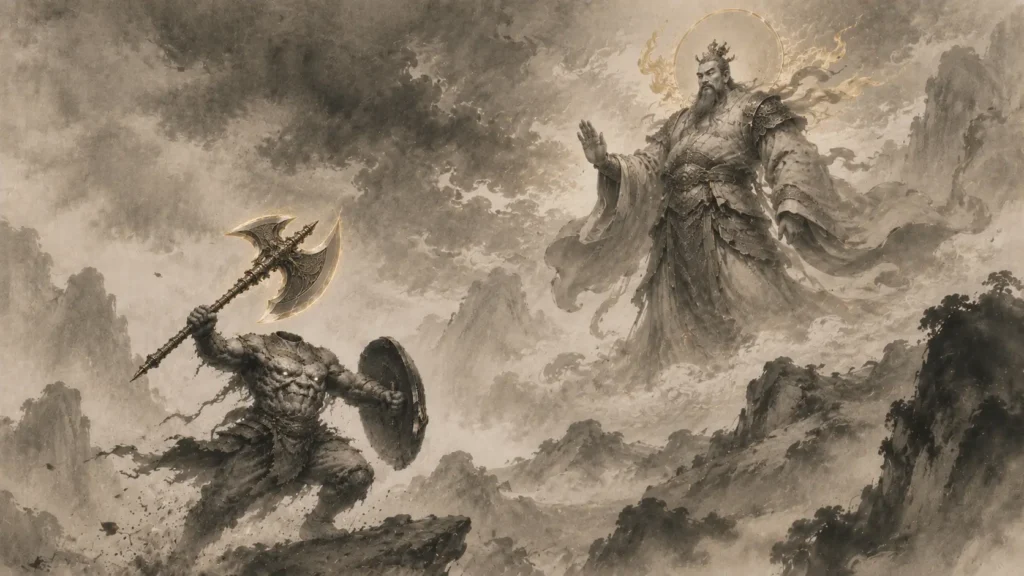
Xing Tian had challenged a divine ruler and lost. His enemy cut off his head and buried it beneath a mountain, leaving the warrior without eyes, a mouth, or any possible way to continue.
But Xing Tian did not accept that the fight was over.
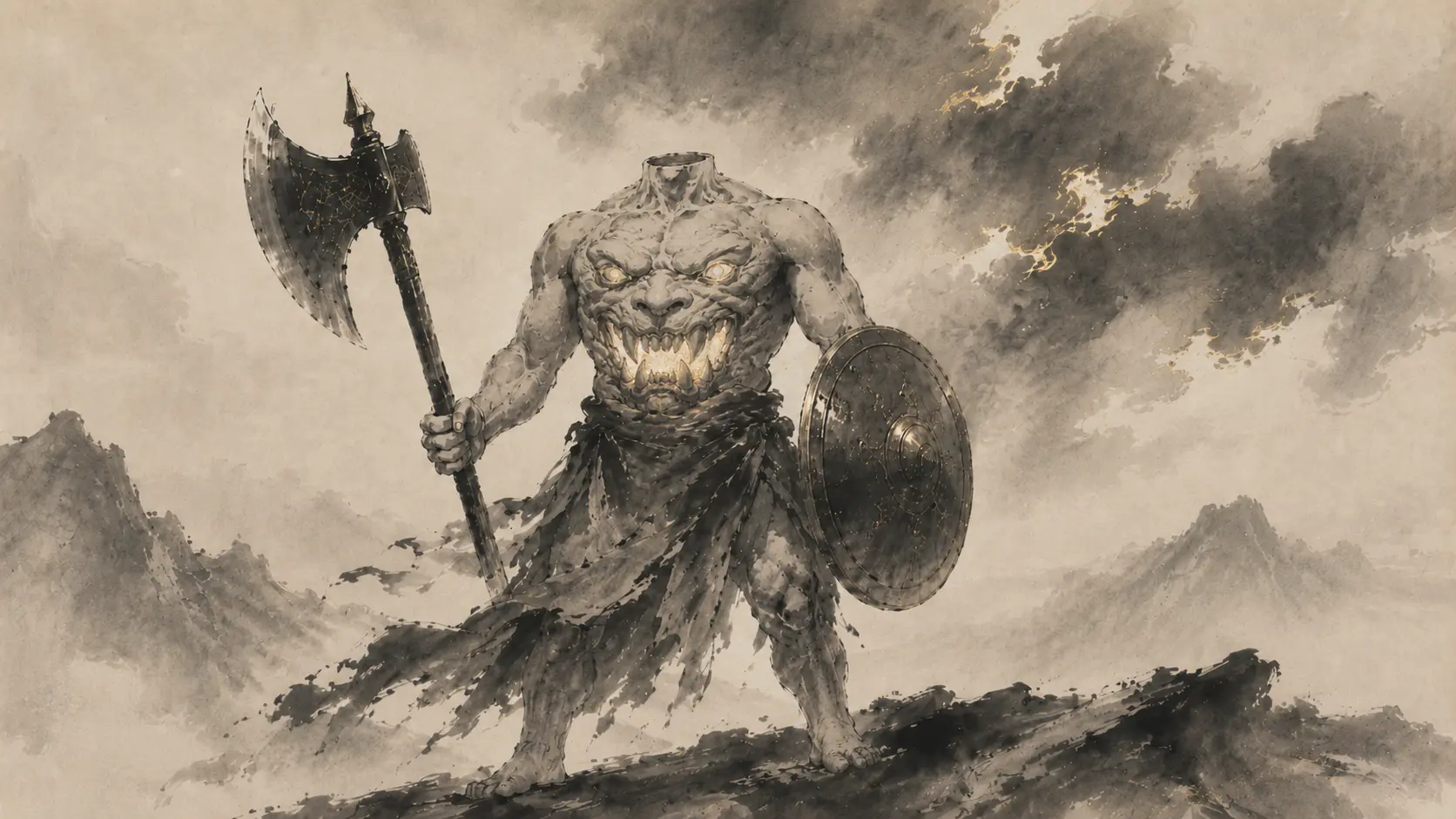
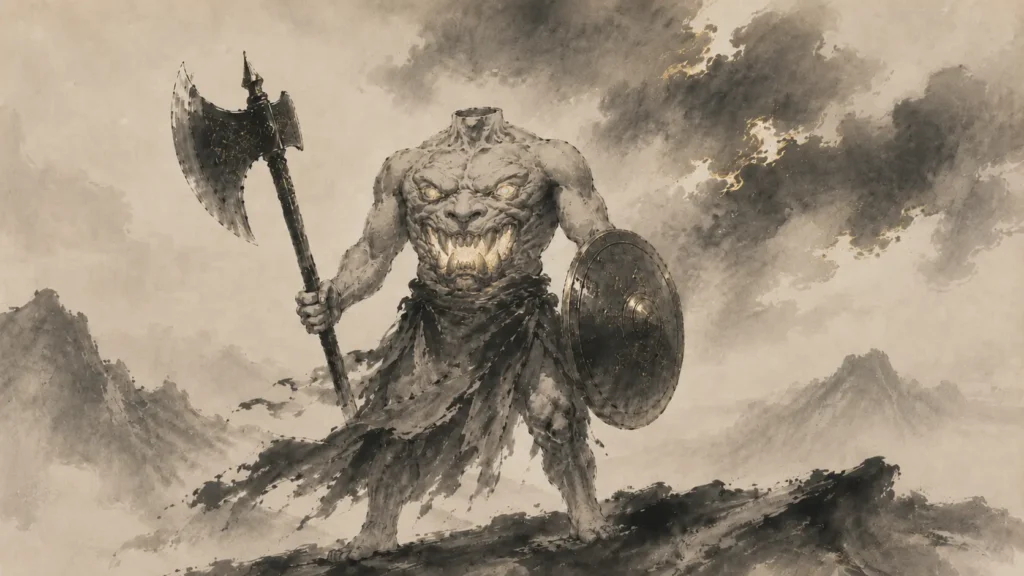
His chest became his new face. His nipples became eyes. His navel became a mouth.
Then the headless warrior raised his shield and axe—and continued to move.
Some figures in Chinese mythology are remembered because they won.
Xing Tian became unforgettable because even total defeat could not make him surrender.
Who Is Xing Tian in Chinese Mythology?
Xing Tian, also written as Xingtian, is a headless warrior from ancient Chinese mythology.
His most famous story appears in the Classic of Mountains and Seas, or Shanhaijing. The text says that Xing Tian competed with a divine emperor for supremacy. The emperor defeated him, removed his head, and buried it on Changyang Mountain.
Xing Tian then used his chest as a new face: his breasts became eyes and his navel became a mouth. Armed with a shield and battle axe, he continued his martial dance.
The surviving passage is extremely short.
It does not describe a long war, give Xing Tian a detailed childhood, or explain precisely why he challenged the ruler.
Yet the image it creates is more powerful than many complete legends.
A warrior has lost everything that should make resistance possible—and still refuses to stop.
Who Cut Off Xing Tian’s Head?
Modern retellings usually say that Xing Tian fought the Yellow Emperor, also known as Huangdi.
However, the earliest surviving passage is less specific. It refers only to Xing Tian fighting Di, a word that can mean a divine ruler, emperor, or supreme deity. The original passage does not directly name Huangdi.
Later scholars and storytellers connected Xing Tian to the wider conflict between the Yellow Emperor and the forces associated with the Yan Emperor. In that interpretation, Xing Tian becomes a follower or minister of the defeated Yan Emperor who continues the struggle after others have fallen.
This distinction matters.
It is reasonable to mention the Yellow Emperor version, because it became deeply connected with the legend. But it should be presented as a later interpretation rather than an unquestionable detail from the earliest text.
The safest conclusion is that Xing Tian challenged a supreme divine authority—and paid for that challenge with his head.
The Warrior Who Created a New Face
Xing Tian’s transformation is not described as healing.
His head does not grow back. His defeat is not erased.
Instead, his body adapts to the loss.
The places that once served ordinary human functions become something new. His chest sees. His stomach speaks. His entire body becomes an instrument of resistance.
That is what makes the legend different from a simple resurrection story.
Xing Tian does not return to who he was before.
He continues as something permanently changed by defeat.
There is something unsettling about that image, but also something deeply human.
After a serious failure, loss, or injury, we rarely return to exactly the person we were. The real question is whether we can still move forward with what remains.
Why Does Xing Tian Dance With an Axe and Shield?
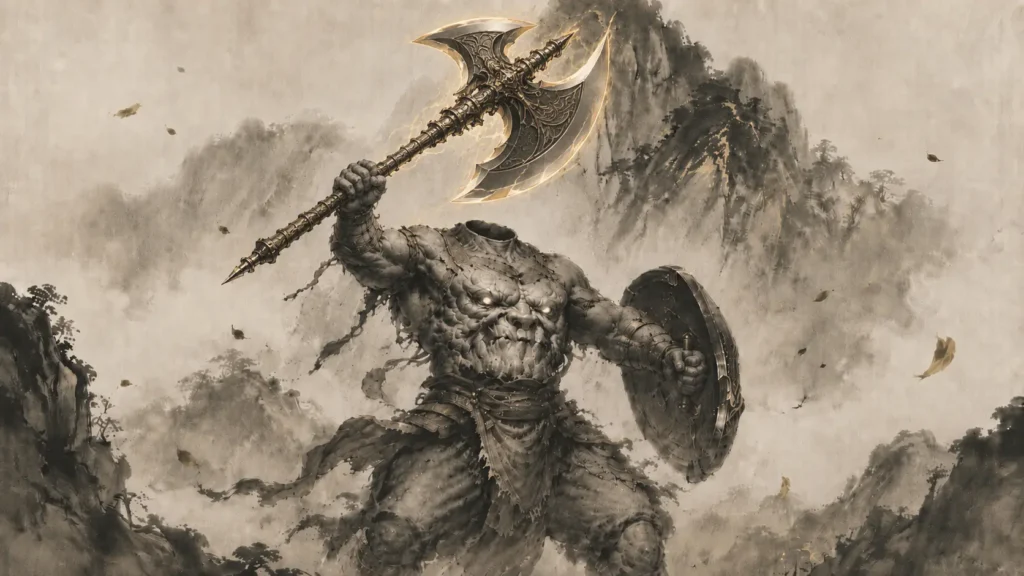
The Shanhaijing says that Xing Tian continued to dance while holding gan and qi—a shield and a battle axe.
This is not a peaceful dance performed in celebration.
It is usually understood as a martial movement: an endless display of combat, defiance, and readiness to continue the struggle.
The weapons matter.
The axe represents his ability to strike back.
The shield shows that resistance is not only aggression. It also requires endurance—the ability to remain standing while the world strikes you again.
Xing Tian therefore becomes more than a headless monster.
He is the image of a warrior whose body continues the battle even after ordinary logic says that the battle is impossible.
From Defeated Rebel to Symbol of Persistence
Xing Tian’s reputation grew far beyond the short ancient passage.
The poet Tao Yuanming later placed him beside Jingwei, the small bird that endlessly carries stones and branches in an attempt to fill the sea.
His poem praises Xing Tian’s martial dance and declares that his fierce resolve remains.
The pairing is perfect.
Jingwei faces a sea too vast to fill.
Xing Tian fights after losing the head required to see, speak, and command his body.
Neither figure is remembered because success was guaranteed.
They are remembered because impossibility did not remove their will to act.
Over time, Xing Tian became a symbol of determination, rebellion, and an indomitable spirit. Modern descriptions often call him a warrior deity or god of persistence, although those labels are broader interpretations of the older myth rather than exact titles used in the original passage. Academic collections of Chinese mythology emphasize that these traditions developed across scattered texts and changed as they were retold.
Was Xing Tian Brave—or Unable to Let Go?
It is easy to read the story as pure motivation:
Never surrender. Keep fighting. Refuse to stay down.
But there is another question hiding beneath the legend.
Should every battle continue forever?
Xing Tian’s determination is extraordinary, but the story never tells us that he eventually wins. His resistance survives, yet his destination remains uncertain.
That gives the myth more depth.
Persistence can be heroic when it protects something valuable.
It can also become destructive when pride makes us incapable of accepting reality, changing direction, or choosing a better fight.
Xing Tian represents the power of refusing to be defined by defeat.
But he may also remind us that determination needs purpose.
What We Can Take From Xing Tian
Everyone eventually experiences a defeat that changes them.
A plan collapses. A relationship ends. A body becomes injured. A career fails. A version of the future disappears.
The first instinct is often to wait until we feel complete again.
Xing Tian offers a harsher lesson.A warrior lesson.
You may never return to the person you were before the loss.
You may have to build a new way of seeing, speaking, and moving forward.
That does not mean pretending the damage never happened. Xing Tian carries his defeat openly. His missing head becomes the central part of his identity.
Yet he still raises his weapons.
This is where the story connects naturally with Warrior Training.
Training is not about believing you can never be broken. Everyone can be broken.
It is about developing the discipline to decide what happens after.
Real strength is not the absence of defeat.
It is the ability to transform defeat into a new form of movement.
Xing Tian lost the battle, his body, and the future he expected.
But he did not lose the right to take another step.
Reference and Source:
- Chinese Text Project — Classic of Mountains and Seas: Western Classic of the Overseas Regions
The primary passage describing Xing Tian’s conflict with the divine emperor, his decapitation, burial on Changyang Mountain, and continued dance with a shield and axe. - Chinese Text Project — Tao Yuanming, Thirteen Poems on Reading the Classic of Mountains and Seas, Poem 10
The later poem pairing Xing Tian with Jingwei and celebrating the fierce determination that survives defeat. - Chinese Text Project — Yuan Ke’s Commentary on the Xing Tian Tradition