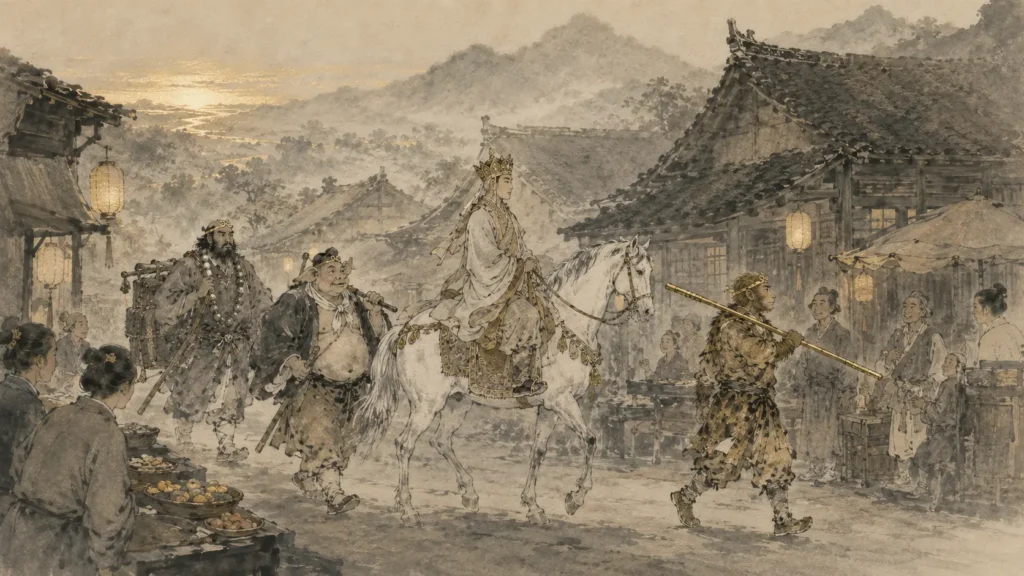
A monk walks toward India with no army, no kingdom, and no guarantee that he will survive the road.
Beside him travels a monkey who once fought Heaven, a pig warrior who cannot control his appetites, a quiet former celestial general, and a dragon prince transformed into a horse.
That sounds like the beginning of a chaotic fantasy adventure. It is.
But Journey to the West is also a story about something much harder than defeating monsters: changing who you are while continuing to move forward.
What Is Journey to the West?
Journey to the West, known in Chinese as Xiyouji, is a sixteenth-century Chinese novel traditionally attributed to Wu Cheng’en.
Across 100 chapters, it transforms the historical pilgrimage of the Buddhist monk Xuanzang into an enormous adventure filled with demons, gods, magical weapons, heavenly officials, comedy, religious symbolism, and danger.
The central mission is simple: travel west, obtain Buddhist scriptures, and bring them back to China.
Almost nothing about the road is simple.
The pilgrims must survive eighty-one trials before completing their journey. Some enemies attack with raw strength. Others use beauty, fear, hunger, pride, or illusion.
The road tests more than their ability to fight. It reveals the weakness each traveller carries inside himself.
The Real Journey Behind the Legend
The fantasy begins with a real person.
Xuanzang was a seventh-century Buddhist monk who travelled from China toward India in search of more complete Buddhist texts.
His journey carried him across dangerous deserts, Central Asian kingdoms, and mountain routes. He studied in India before returning to China with hundreds of Buddhist works that he spent the rest of his life translating and studying.
Over centuries, storytellers transformed that difficult historical pilgrimage into the legendary adventure we know today.
The fictional monk is generally called Tang Sanzang, or Tripitaka in many English adaptations.
He keeps the historical destination and religious purpose, but the world around him becomes mythic. The deserts contain demons. Mountains burn. Spirits disguise themselves as humans, and the powers of Heaven become involved in the mission.
The result is not merely history covered in fantasy.
It is a real human journey expanded into a spiritual test.
Why the Pilgrimage Begins
In the novel, sacred Buddhist scriptures are needed in the East, and Tang Sanzang is chosen to retrieve them from the West.
He is also the most physically vulnerable member of the group.
He cannot overpower the creatures hunting him. His compassion sometimes makes him dangerously easy to deceive, and he regularly depends on his disciples to rescue him.
Yet he is the one carrying the mission.
This creates one of the story’s most interesting tensions: the strongest traveller is not the leader, while the leader cannot survive without the people he is supposed to guide.
The pilgrimage succeeds only when completely different personalities learn to move in the same direction.
The Travellers Who Must Change
Tang Sanzang
Tang Sanzang represents faith, purpose, and moral discipline.
He continues travelling when he is frightened, captured, confused, or betrayed by appearances. His belief in the mission gives the group a destination larger than their personal desires.
But he is not presented as a flawless leader.
His compassion can become naïveté. He sometimes trusts obvious deceptions and misunderstands the actions of Sun Wukong.
His goodness gives the group direction, but goodness without judgement can still create danger.
Sun Wukong
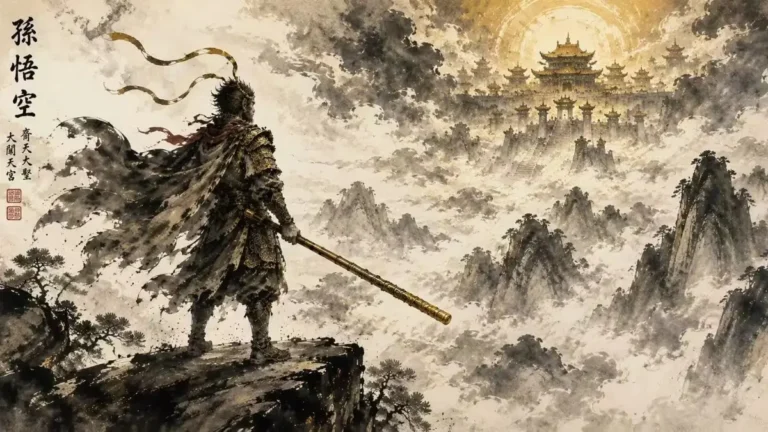
Sun Wukong is the group’s greatest weapon and its greatest source of chaos.
Born from stone and trained in supernatural arts, the Monkey King begins his story by searching for freedom, power, and immortality. His ambition eventually leads him into rebellion against Heaven before the Buddha traps him beneath a mountain.
Joining the pilgrimage gives him a path back into the world.
Wukong does not need to discover how to become stronger. He needs to learn when strength should be controlled, whom it should protect, and why freedom without responsibility can become another kind of prison.
The British Museum identifies him as the immortal monkey who accompanies Xuanzang on the journey to India described in Journey to the West.
Zhu Bajie
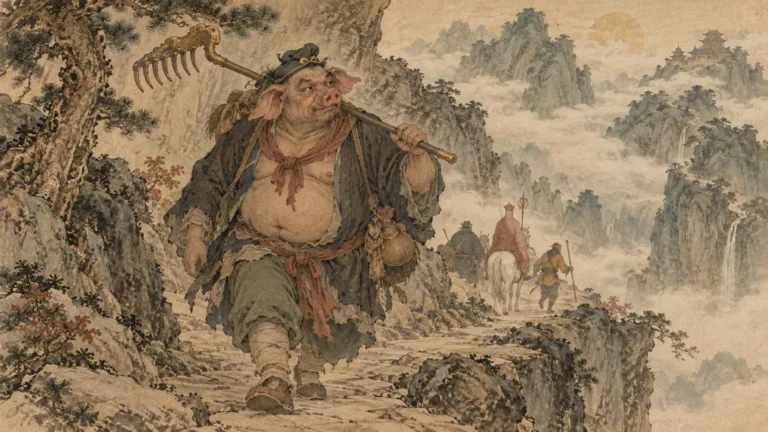
Zhu Bajie is powerful, funny, jealous, lazy, hungry, and easily distracted.
He wants comfort more than enlightenment. He complains when the road becomes difficult and repeatedly allows desire to overtake judgement.
That is exactly why he matters.
Bajie is not the perfect hero we imagine ourselves becoming. He is the part of us that wants the reward while avoiding the work.
His presence makes the group less noble, but far more human.
Sha Wujing and the White Dragon Horse
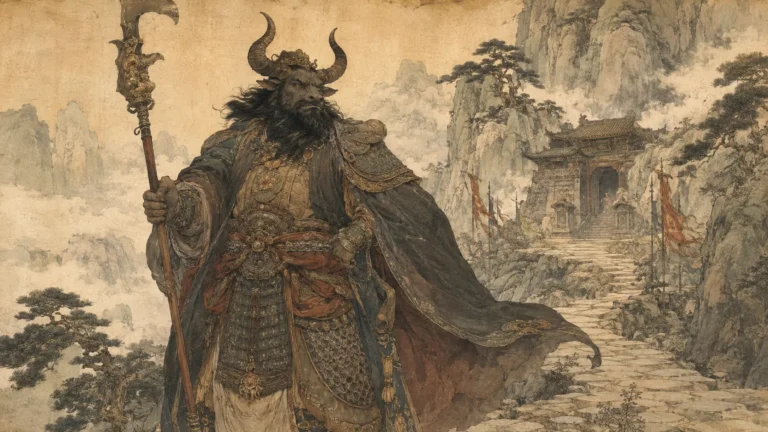
Sha Wujing speaks less and carries more.
He is steady where Wukong is explosive and disciplined where Bajie is unreliable. He rarely controls the story, but the group depends on his patience and loyalty.
The White Dragon Horse, a dragon prince serving as Tang Sanzang’s mount, completes the travelling party.
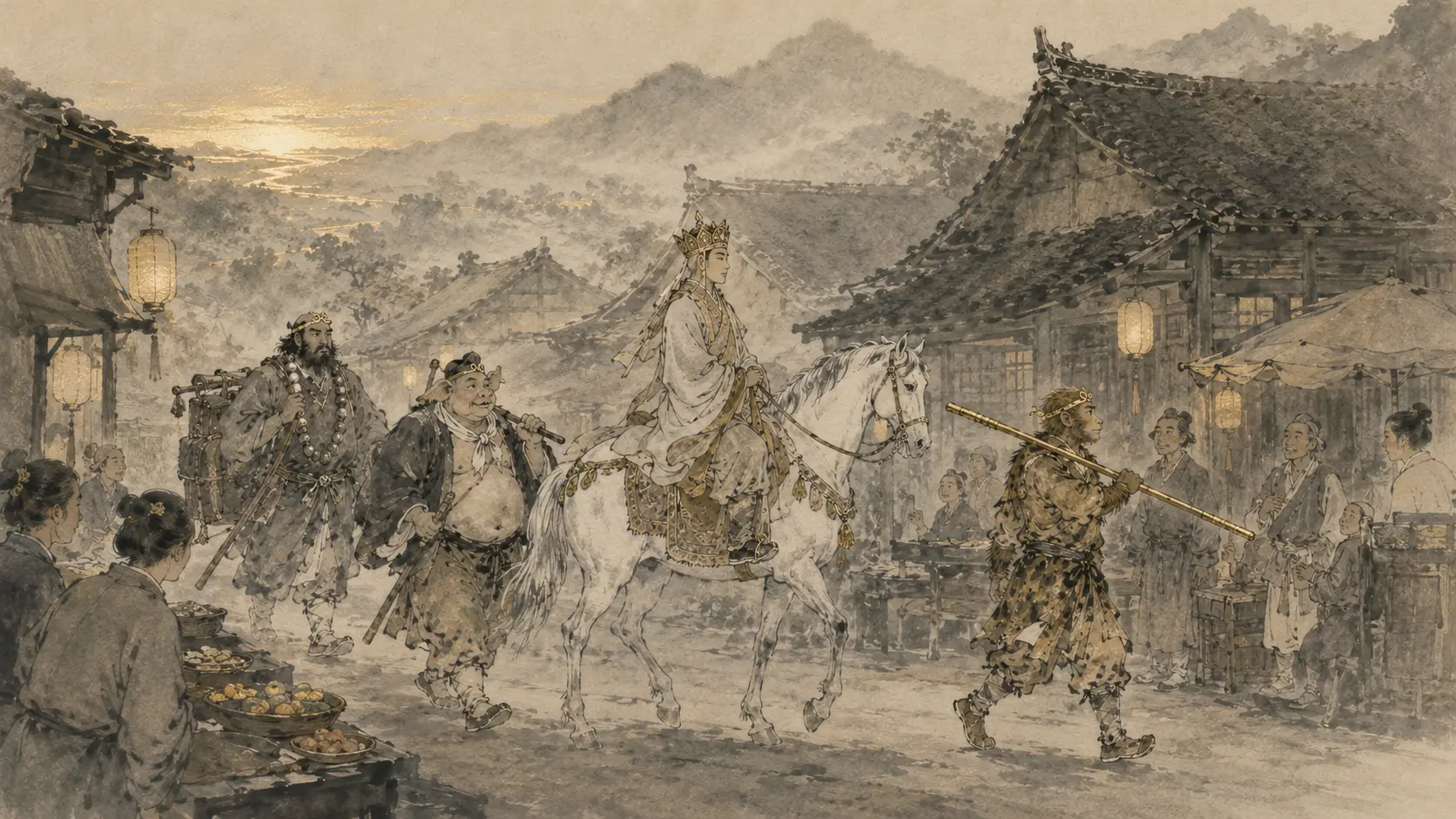
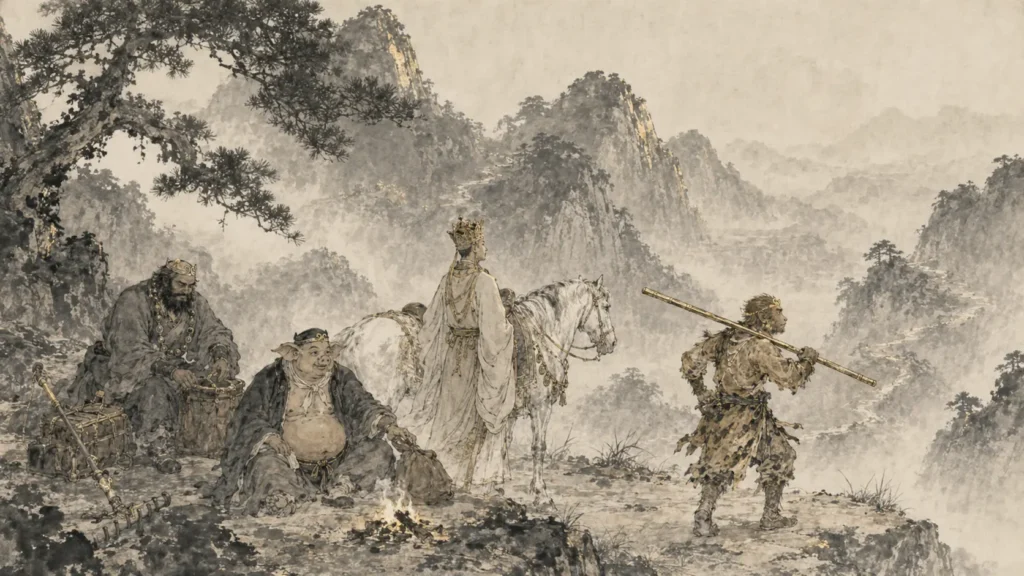
Each companion enters the pilgrimage after an earlier failure. The journey is not only a mission—it is also their opportunity to change. Historical artworks commonly depict Xuanzang on the white horse accompanied by Sun Wukong, Zhu Bajie, and Sha Wujing.
The Road of Eighty-One Trials
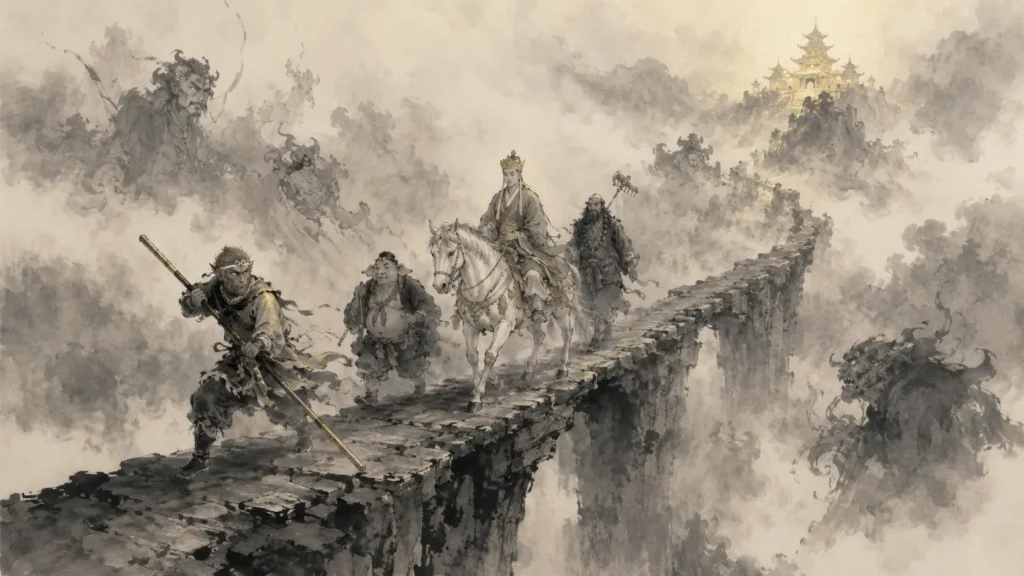
The pilgrims cross kingdoms, rivers, monasteries, mountains, caves, and supernatural territories.
Again and again, Tang Sanzang is captured by demons who wish to consume him. But the trials are not simply repeated battles against increasingly powerful enemies.
The White Bone Demon attacks through deception.
Red Boy relies on supernatural fire.
Princess Iron Fan stands between the pilgrims and the Flaming Mountains.
The Six-Eared Macaque turns identity itself into the centre of the conflict.
Each of these encounters deserves its own story. Within the larger novel, however, they form part of the same pattern:
Progress is followed by disruption. Victory is followed by another test. Confidence is followed by another reason to remain humble.
The destination matters, but the travellers are shaped by everything that delays them.
More Than a Story About Fighting Demons
Journey to the West can be read as fantasy, comedy, religious allegory, satire, and historical fiction.
Its monsters are entertaining, but many of them also reflect recognisable human problems.
Pride can make a powerful person foolish.
Desire can redirect an entire life.
Fear can make compassion disappear.
Even spiritual institutions can become corrupt, performative, or empty.
The novel refuses to divide everyone neatly into strong heroes and weak villains.
Wukong’s violence can save the group, but it can also grow from arrogance. Tang Sanzang’s mercy can be admirable, but it can also blind him. Bajie can behave selfishly in one moment and courageously in the next.
The journey continues because none of them is complete alone.
What Does Journey to the West Mean?
At its centre, Journey to the West is about transformation through discipline.
The scriptures are the visible goal, but the pilgrims themselves are the unfinished work.
Sun Wukong must direct his power.
Zhu Bajie must confront his appetites.
Sha Wujing must continue serving without recognition.
Tang Sanzang must preserve compassion without abandoning judgement.
They do not become flawless. They gradually become capable of completing the journey together.
That distinction matters.
Growth does not always mean destroying every weakness before taking the next step. Sometimes it means recognising the weakness, controlling it more often, and continuing anyway.
What We Can Take From This Story
Most people want transformation without the road that creates it.
We want confidence without repeated failure, discipline without temptation, strength without restraint, and a destination without the eighty-one trials in between.
Journey to the West offers a less comfortable idea.
The obstacle is not always proof that we are moving in the wrong direction. Sometimes the obstacle is the part of the journey that makes us capable of reaching the end.
Every pilgrim carries a weakness onto the road. None of them completes the mission alone. Their progress comes through purpose, correction, loyalty, discipline, and the decision to continue after failure.
That is also the foundation of Warrior Training.
Training is not only about becoming more powerful. It is about becoming someone who can carry power without being controlled by ego, fear, comfort, or impulse.
The road west may be filled with demons, but the hardest opponent is often the one travelling inside us.
University of Chicago Press — The Journey to the West, Revised Edition, Volume 1
Overview of Anthony C. Yu’s complete English translation, the pilgrimage, the novel’s supernatural disciples, and its literary character as fantasy, satire, and allegory. Project Gutenberg — Xiyouji by Wu Cheng’en
Public-domain Chinese edition of the novel and bibliographic information concerning its title, period, subject, and traditional authorship. Association for Asian Studies — The Journey to the West: A Platform for Learning About China Past and Present