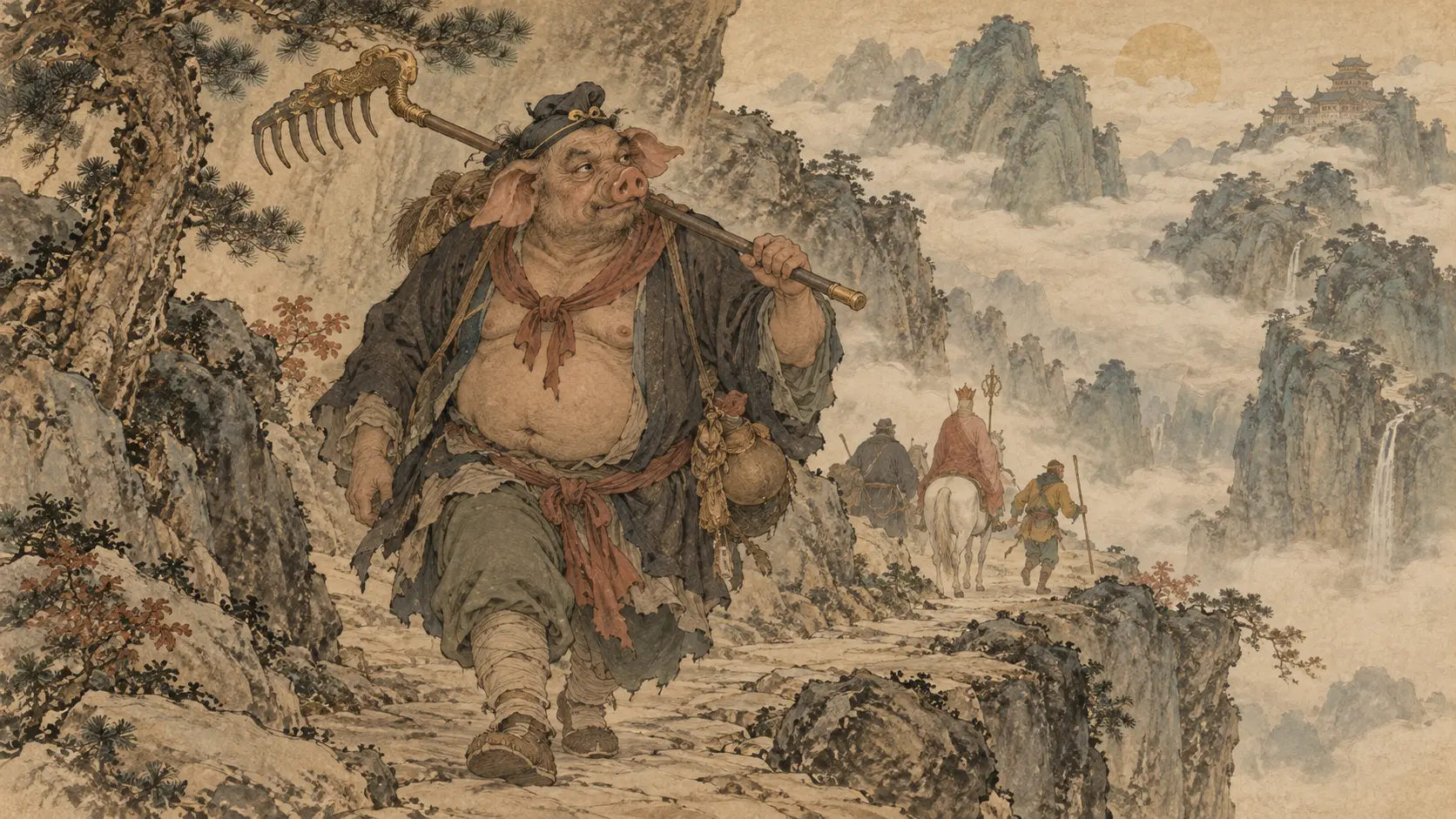
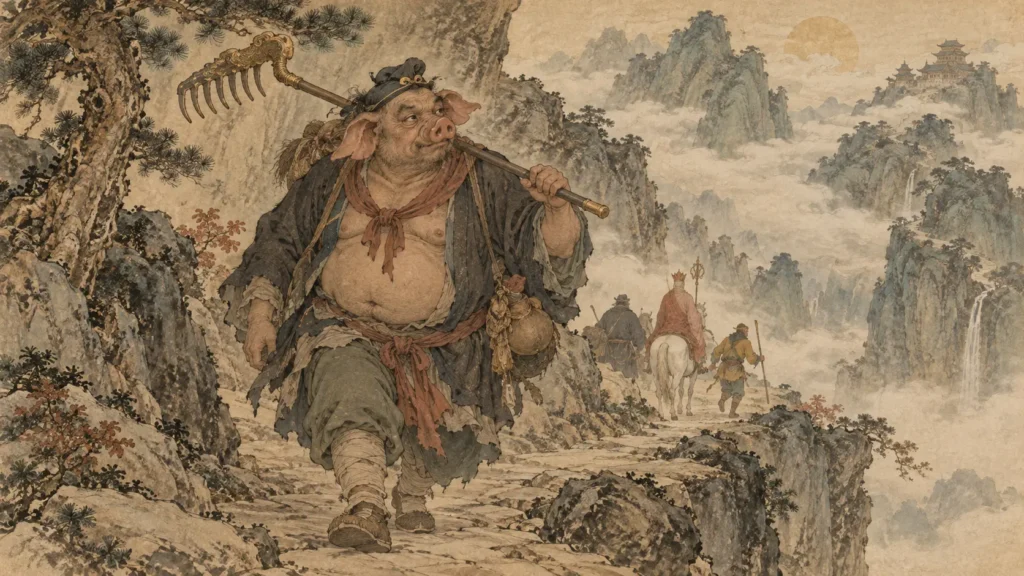
A commander who once led soldiers in Heaven now walks a dusty road carrying luggage and a nine-toothed rake.
He can fight demons.
He can transform his body.
He once held celestial rank.
Yet food, comfort, fear and desire can still pull him away from the mission.
This is Zhu Bajie (猪八戒, Zhū Bājiè) — better known to many English readers as Pigsy.
Among the pilgrims of Journey to the West, nobody makes the distance between power and self-control more obvious.
Zhu Bajie at a Glance
| Chinese name | 猪八戒 |
| Pinyin | Zhū Bājiè |
| English name | Pigsy / Pig |
| Other name | Zhu Wuneng 猪悟能 |
| Former title | Marshal Tianpeng 天蓬元帅 |
| Story | Journey to the West 西游记 |
| Master | Tang Sanzang |
| Companions | Sun Wukong, Sha Wujing, White Dragon Horse |
| Weapon | Nine-Toothed Rake 九齿钉耙 |
| Transformations | Thirty-six transformations |
| Final title | Jing Tan Shizhe 净坛使者 — Cleanser of the Altars |
Who Is Zhu Bajie?
Zhu Bajie is one of Tang Sanzang’s supernatural disciples in the Chinese novel Journey to the West. Formerly the heavenly Marshal Tianpeng, he is exiled to the mortal world and reborn with a pig-like form. Guanyin recruits him for the pilgrimage, where he fights alongside Sun Wukong while struggling repeatedly with gluttony, lust, laziness and fear.
He is comic, but he is not merely comic relief.
Bajie can fight dangerous monsters, perform transformations and survive supernatural battles.
The problem is rarely whether he can do something.
The problem is whether he wants to do it badly enough.
What Does the Name Zhu Bajie Mean?
Before joining Tang Sanzang, Guanyin gives him the Buddhist name Zhu Wuneng (猪悟能).
Later, Tang Sanzang calls him Zhu Bajie.
Zhu (猪) means pig.
Bajie (八戒) refers to the Eight Precepts / Eight Prohibitions, linking his name directly with restraint and religious discipline.
That creates one of the novel’s best jokes.
The disciple whose name represents restraint is the disciple who struggles most visibly to restrain himself.
Food tempts him.
Women tempt him.
Comfort tempts him.
The possibility of abandoning the pilgrimage tempts him.
His name describes the standard he is supposed to reach rather than the person he already is.
Why Did Zhu Bajie Become a Pig?
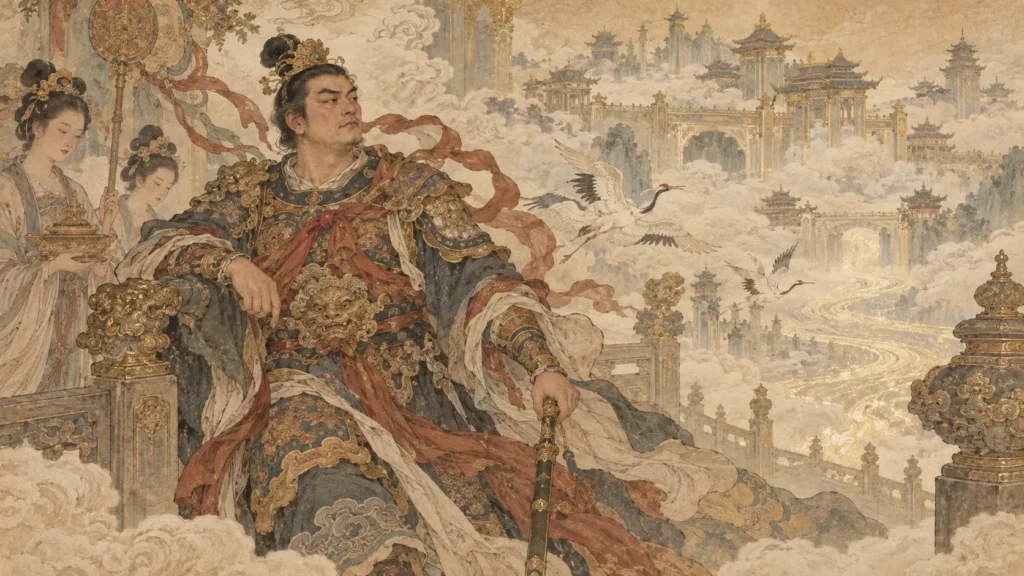
Before becoming Zhu Bajie, he was Marshal Tianpeng, a celestial commander associated with the Heavenly River.
In Chapter 8, Bajie tells Guanyin that he was punished after getting drunk and behaving improperly toward Chang’e. The Jade Emperor had him beaten and expelled from Heaven.
During rebirth, something went wrong.
Instead of entering a human body, his spirit entered the womb of a sow.
He emerged in the pig-like form that defines him throughout the novel.
But this is where reading the actual novel becomes more interesting than reading a simple character summary.
The novel gives more than one version of his past
In Chapter 85, Bajie boasts about his own history again.
This version still presents him as Marshal Tianpeng and still connects his fall with drunken misconduct, but it adds other details — including eating the Queen Mother’s lingzhi and causing havoc in Heaven.
These accounts should not be forced into one perfectly consistent biography.
Journey to the West contains songs, boasts, comic exaggeration and overlapping traditions.
The safest reconstruction is:
Marshal Tianpeng → misconduct in Heaven → punishment and exile → abnormal rebirth → pig-like demon → Buddhist disciple.
That is much more accurate than pretending every chapter gives an identical account.
What Did Zhu Bajie Do Before Joining the Pilgrimage?
His fall from Heaven did not immediately make him virtuous.
Chapter 8 openly describes him living at Cloud-Stack Cave on Mount Fuling, where he admits that he has been eating humans.
Guanyin offers him another path.
Instead of continuing as a monster, he can wait for the scripture pilgrim and earn redemption by protecting him on the journey west.
Later, Tang Sanzang and Sun Wukong encounter him near the Gao family estate.
Bajie has become involved with the Gao family and their daughter, and Wukong eventually confronts him.
Once Bajie realizes that this is the pilgrimage Guanyin told him to await, his old life finally begins to give way to a new one.
Not completely.
But enough to start walking.
How Powerful Is Zhu Bajie?
Bajie is significantly stronger than his comic reputation suggests.
He possesses superhuman strength, transformation magic and extensive combat experience from his earlier celestial life.
He knows thirty-six transformations and can change his form for practical or deceptive purposes.
He is also particularly useful in situations requiring brute strength, endurance or fighting in water.
His main weakness is therefore not a lack of supernatural ability.
It is inconsistency.
He may fight fiercely in one episode and complain endlessly in another.
That contrast is the character.
Zhu Bajie’s Nine-Toothed Rake
Bajie’s most famous weapon is the Nine-Toothed Rake (九齿钉耙, Jiǔchǐ Dīngpá).
Calling it an ordinary farm rake badly undersells it.
In Chapter 19, Bajie describes the weapon as a celestial object forged through divine craftsmanship and later presented to him when he held the rank of Marshal Tianpeng. The poem surrounding the weapon places its manufacture among heavenly powers and treats it as a formidable supernatural armament.
The contrast is perfect for Bajie.
Sun Wukong carries the famous Ruyi Jingu Bang.
Bajie carries something that looks almost agricultural.
Yet his rake belongs to Heaven.
Like its owner, it is far more dangerous than its appearance suggests.
Zhu Bajie and Sun Wukong
Zhu Bajie and Sun Wukong are disciples of the same master, not biological brothers.
Their relationship constantly moves between rivalry and cooperation.
Wukong mocks Bajie.
Bajie complains about Wukong.
They argue, trick one another and sometimes undermine each other.
But when the pilgrimage becomes dangerous, they repeatedly fight on the same side.
The contrast is one of the reasons the pair works so well.
Wukong is restless intelligence, speed and supernatural audacity.
Bajie is appetite, physicality, hesitation and ordinary human weakness exaggerated to mythic proportions.
Wukong often knows what must be done.
Bajie reminds the story that knowing is not the same as wanting to do it.
One of Bajie’s Best Moments Is Not a Battle
Chapter 67 gives him one of his most revealing tasks.
The pilgrims encounter a road blocked by an enormous accumulation of rotten persimmons.
The solution is not glamorous.
Bajie transforms into a gigantic pig and forces a path through the mess.
He complains.
He needs food.
He does the disgusting work anyway.
That episode captures the useful side of a character who is easy to dismiss as lazy.
Bajie is often reluctant.
But reluctance and uselessness are not the same thing.
Is Zhu Bajie Just Greedy and Lazy?
No.
Those traits are central to his comedy, but reducing him to them makes the character much flatter than the novel does.
He is lustful.
He is gluttonous.
He becomes frightened.
He complains about work.
He repeatedly imagines easier alternatives.
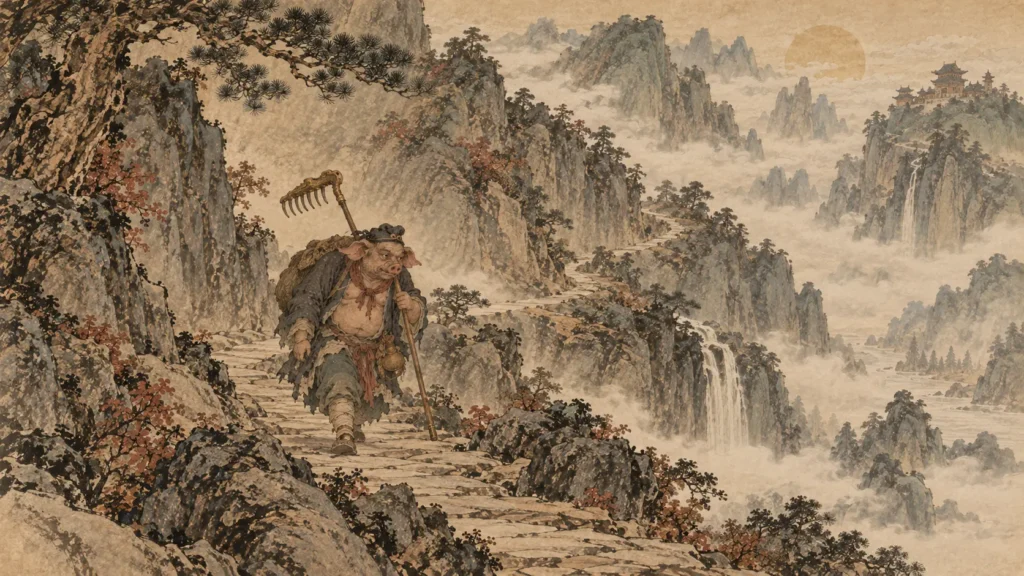
But he also continues west.
He carries luggage.
He enters battles.
He protects Tang Sanzang.
He performs exhausting tasks that the pilgrimage genuinely needs.
Zhu Bajie is compelling because his virtues never completely destroy his flaws — and his flaws never completely destroy his usefulness.
He remains unfinished.
Does Zhu Bajie Become a Buddha?
No. Zhu Bajie does not become a Buddha at the end of Journey to the West.
Tang Sanzang and Sun Wukong receive Buddhahood.
Bajie instead becomes Jing Tan Shizhe (净坛使者), usually translated as Cleanser of the Altars.
The ending is deliberately fitting.
The Buddha recognizes Bajie’s contributions to the pilgrimage but points out that his desires remain unresolved. Bajie immediately complains that the others became Buddhas while he did not.
The Buddha answers by noting his enormous appetite and explains that his new position allows him to receive offerings from Buddhist ceremonies.
Even his spiritual reward accommodates his hunger.
It is funny.
But it also says something serious.
Bajie has changed enough to earn recognition.
He has not changed enough to become someone entirely different.
What Zhu Bajie Represents
Sun Wukong often feels larger than life.
Zhu Bajie feels painfully familiar.
He has talent without perfect discipline.
He understands what he should do while wanting something easier.
He can perform difficult work while complaining about every moment of it.
That makes his pilgrimage unusually human.
Bajie never becomes the image of flawless self-mastery.
He becomes evidence that progress can happen even while weakness remains.
His story is not about suddenly eliminating every bad habit.
It is about continuing down the road despite them.
And for a former heavenly commander who once fell because he could not control himself, simply continuing may be one of the most meaningful victories he achieves.
References
Primary text — Journey to the West, Chapter 8
Guanyin meets the future Zhu Bajie; he explains his fall, pig rebirth and life as a man-eating monster before agreeing to join the pilgrimage.
Chapter 19
Contains Bajie’s heavenly identity, Nine-Toothed Rake material and the transition into Tang Sanzang’s disciple.