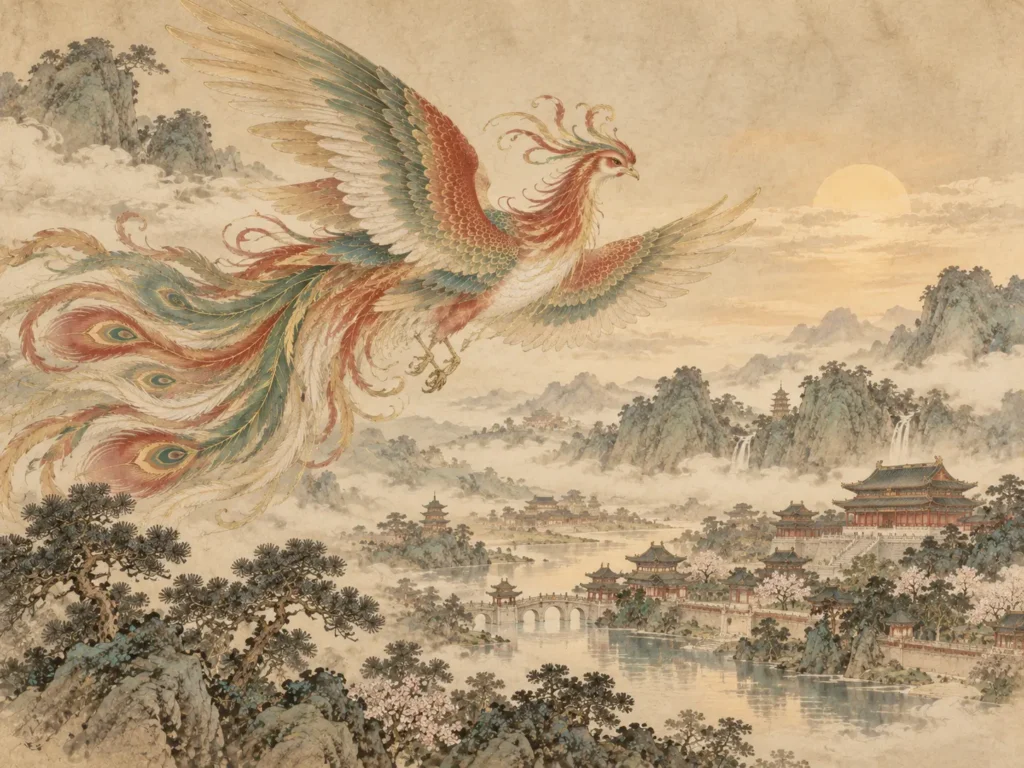
A magnificent bird appears above the mountains.
Its feathers carry five colors.
Its body is marked with the language of virtue.
And when it is seen, the world is at peace.
This is the Fenghuang (凤凰 / 鳳凰, Fènghuáng), one of the most important mythical birds in Chinese tradition.
In English, it is usually called the Chinese phoenix.
That translation is convenient.
It is also misleading.
The Fenghuang does not belong to the familiar Western story of a bird burning itself and rising again from its ashes. Its oldest Chinese traditions are instead connected with virtue, harmony, good government and the arrival of peace. The Metropolitan Museum of Art similarly describes the Fenghuang as a distinct mythical species rather than simply the Chinese version of the Western phoenix. The Metropolitan Museum of Art
Fenghuang Quick Facts
- Chinese: 凤凰 / 鳳凰
- Pinyin: Fènghuáng
- Common English name: Chinese phoenix
- Type: Mythical auspicious bird
- Early source: Shan Hai Jing
- Appearance: Five-colored supernatural bird
- Main symbolism: Virtue, peace, harmony and auspicious rule
- Later imperial association: The empress
- Common pairing: The Chinese dragon
- Important distinction: Not the same as the Western phoenix or Zhuque
What Is the Fenghuang?
The Fenghuang is a sacred bird of Chinese mythology and symbolism whose appearance traditionally signals an exceptionally harmonious world.
An early description preserved from the Shan Hai Jing places the bird on Mount Danxue.
The text describes a bird shaped like a chicken and patterned in five colors.
But those patterns are not merely decoration.
Different parts of the bird’s body represent moral qualities:
virtue, righteousness, ritual propriety, benevolence and trustworthiness.
The bird sings and dances naturally.
Most importantly, the text ends with a remarkable idea:
when the Fenghuang appears, the world is at peace. Chinese Text Project
That tells us something fundamental.
The Fenghuang was never simply a beautiful monster.
Its body represented an ideal moral order.
What Does the Fenghuang Look Like?
There is no single description that remained unchanged across all Chinese history.
The Shan Hai Jing emphasizes a bird-like body with five-colored patterns.
Later descriptions become more elaborate.
Commentarial traditions describe features such as a chicken’s head, snake-like neck, swallow’s jaw, tortoise-like back and fish-like tail, together with five-colored plumage. Chinese Text Project
This creates a creature similar to the Chinese dragon in one important way:
both can combine features that do not belong to one ordinary animal.
But the purpose is different.
The Fenghuang is not designed to look terrifying.
Its appearance expresses balance.
Its colors, body and behavior make it a visual symbol of order and refinement.
Feng and Huang – Were There Originally Two Birds?
The name itself has a history.
An old explanation preserved in the Erya tradition distinguishes Feng (鳳) as the male and Huang (凰) as the female. Chinese Text Project
Over time, however, Fenghuang became a compound name for the mythological bird.
This matters because modern explanations sometimes claim that the Fenghuang has always been purely female.
That is too simple.
The gender symbolism changed.
In later imperial culture, particularly when paired with the dragon, the Fenghuang increasingly became associated with the empress and feminine authority, while the dragon represented the emperor. The British Museum documents this dragon-emperor and phoenix-empress symbolism in Ming material culture. British Museum
The ancient language and the later symbolism therefore belong to different historical layers.
Is the Fenghuang Really a Chinese Phoenix?
Only if we understand “Chinese phoenix” as a convenient English label.
The classical Fenghuang does not have the Western phoenix’s defining cycle of burning, dying and being reborn from ashes.
That story should not automatically be imported into Chinese mythology.
The two mythical birds share obvious visual similarities:
they are extraordinary birds,
they became powerful cultural symbols,
and both can be associated with rarity and greatness.
But their central stories are different.
The Western phoenix became famous for rebirth.
The Fenghuang became famous for virtue and harmony.
That is why Fenghuang is the more accurate name.
Why Does the Fenghuang Represent Peace?
Classical descriptions repeatedly connect the bird with the condition of the world around it.
The Fenghuang does not simply arrive anywhere.
Its appearance becomes a sign that something is right.
The Shan Hai Jing connects its appearance with peace.
Later textual traditions likewise describe Fenghuang appearing when rulers govern well and when virtue reaches the natural world. Chinese Text Project
This idea survived for centuries.
The Metropolitan Museum notes that the Fenghuang was believed to appear in times of peace and prosperity, which helped make the bird especially suitable for imperial art. The Metropolitan Museum of Art
Its beauty therefore represents more than beauty.
It represents a world functioning as it should.
Fenghuang and the Chinese Dragon
One of the most famous combinations in Chinese visual culture is the dragon and Fenghuang.
The two are not enemies.
They often appear together as complementary symbols.
In later imperial symbolism, the dragon could represent the emperor while the Fenghuang represented the empress.
The pairing also entered marriage symbolism.
British Museum examples from the Qing period show dragon-and-phoenix imagery used to wish married couples harmony and happiness, with the dragon representing the man and the phoenix the woman. British Museum
That makes the pair one of the most recognizable symbolic combinations in Chinese art.
Strength beside grace.
Authority beside harmony.
Two different powers forming one balanced image.

Fenghuang vs Zhuque – Are They the Same?
No.
This is an important distinction.
The Fenghuang is the auspicious mythological bird associated with virtue, peace and later imperial symbolism.
Zhuque, the Vermilion Bird, belongs to the Four Symbols and represents the southern direction within a celestial and cosmological system.
They can look similar in modern artwork.
Both are magnificent supernatural birds.
Both may appear with red coloration.
But they come from different mythological frameworks.
Calling every Chinese sacred bird a “phoenix” hides those differences.
The Fenghuang deserves its own identity.
Why the Fenghuang Still Matters
The Fenghuang has survived because it can represent something that is difficult to show directly.
A good society.
A wise ruler.
A harmonious marriage.
Virtue made visible.
Unlike many mythological creatures, its greatness does not come from destroying enemies.
The Fenghuang does not need to conquer the world.
Its appearance means the world has become worthy of it.
That gives the creature a very different kind of power.
The dragon often represents strength and authority.
The Fenghuang represents what that power should ultimately create:
order, harmony and peace.
Like the Qilin, the Fenghuang became an auspicious being whose appearance could signal an ideal age.
References & Sources
Chinese Text Project — Classical Fenghuang passages
Preserves early textual material associated with the Shan Hai Jing, including the five-colored Fenghuang, its virtue markings and its connection with peace. Chinese Text Project
Chinese Text Project — Fenghuang passages
Chinese Text Project — Erya Commentary
Useful for the older Feng/Huang male-female distinction and later descriptions of the bird’s composite appearance. Chinese Text Project
Chinese Text Project — Erya Zhu Shu