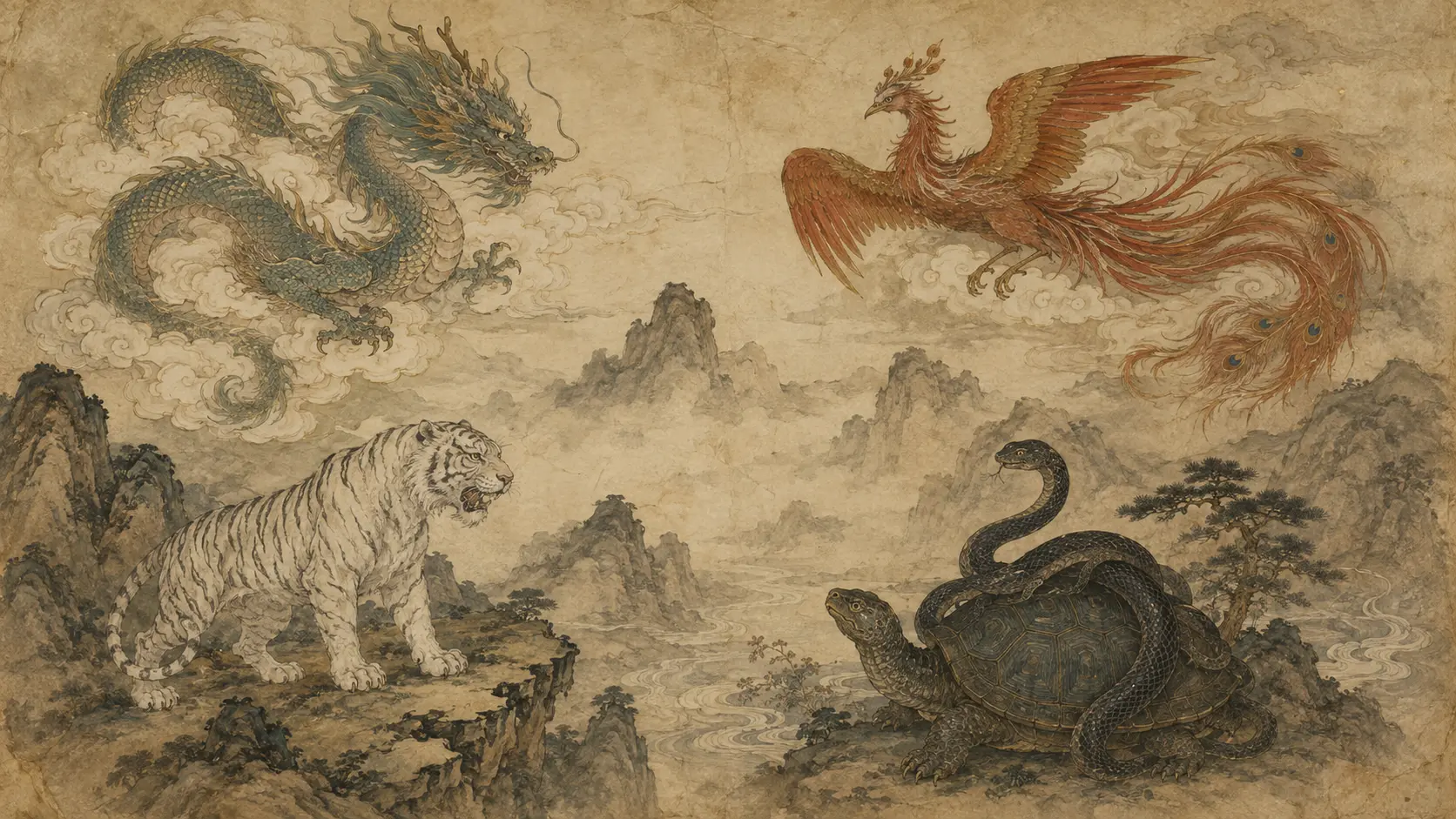
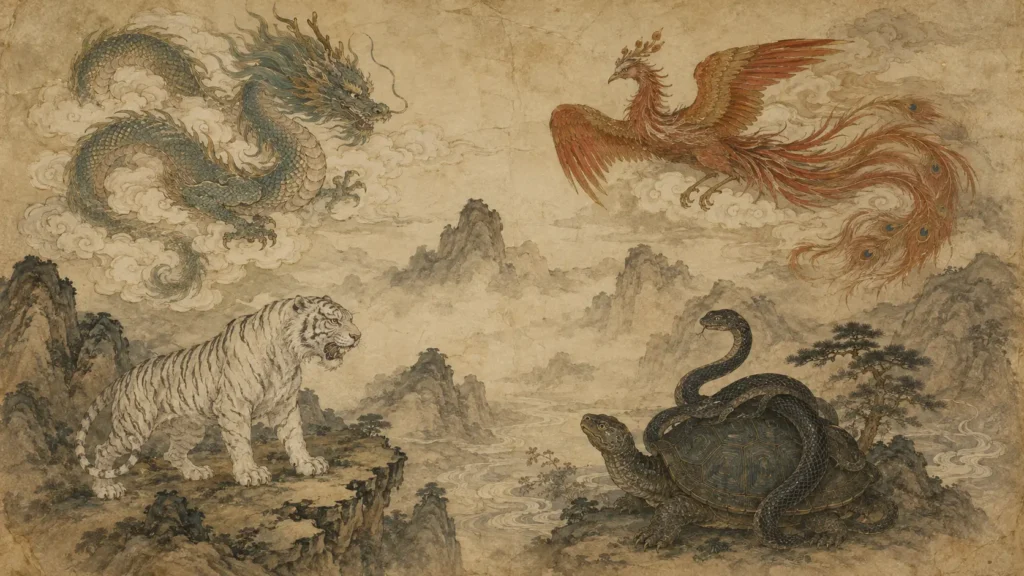
Look into the ancient Chinese sky and you do not find a single mythical creature ruling above everything.
You find four.
A dragon stretches across the East.
A white tiger guards the West.
A brilliant bird rises in the South.
And in the North waits something stranger—a dark tortoise entwined with a snake.
Together, they formed a map of the heavens.
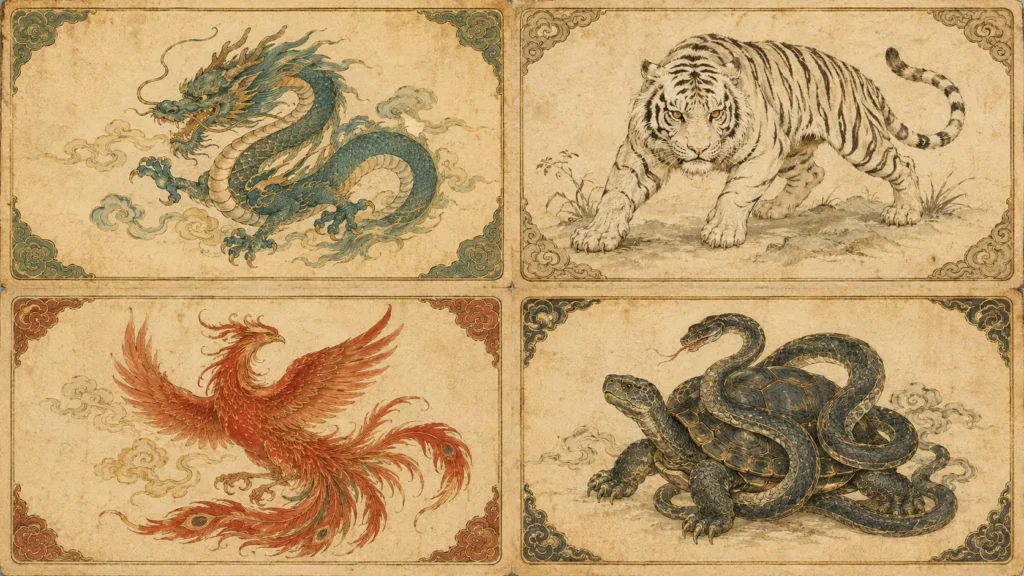
The Four Symbols (四象, Sìxiàng) are four celestial creatures associated with the cardinal directions in traditional Chinese astronomy and cosmology: the Azure Dragon (Qinglong) of the East, White Tiger (Baihu) of the West, Vermilion Bird (Zhuque) of the South, and Black Tortoise or Dark Warrior (Xuanwu) of the North. Each corresponds to seven of the Twenty-Eight Lunar Mansions and later became associated with a season and one of the Five Phases.
These were not simply four impressive animals chosen to decorate temples.
They helped ancient China give direction, pattern, and symbolic form to the sky itself.
Four Symbols Quick Facts
| Symbol | Chinese | Direction | Season | Phase |
|---|---|---|---|---|
| Azure Dragon | 青龍 Qīnglóng | East | Spring | Wood |
| Vermilion Bird | 朱雀 Zhūquè | South | Summer | Fire |
| White Tiger | 白虎 Báihǔ | West | Autumn | Metal |
| Black Tortoise / Xuanwu | 玄武 Xuánwǔ | North | Winter | Water |
The Lunheng states this correspondence clearly: East with Wood and the Azure Dragon, West with Metal and the White Tiger, South with Fire and the Vermilion Bird, and North with Water and Xuanwu.
What Are the Four Symbols?
At their core, the Four Symbols organize space.
An ancient passage connected with the Book of Rites describes a formation with:
Vermilion Bird in front
Black Tortoise behind
Azure Dragon on the left
White Tiger on the right
Traditional commentary explains these as names associated with the celestial lodges of the four directions.
If the observer faces south, the arrangement makes sense:
front → South → Vermilion Bird
behind → North → Xuanwu
left → East → Azure Dragon
right → West → White Tiger
This was more than mythology.
The creatures could organize astronomical space, ritual imagery, military formations, funerary art and later religious symbolism.
A Han dynasty bronze mirror in The Metropolitan Museum of Art shows exactly this kind of cosmic system: a square earthly world aligned with the four directions, surrounded by the circular heavens and the animals representing each quarter.
The Four Symbols and the Twenty-Eight Lunar Mansions
The Four Symbols were also written across the stars.
Traditional Chinese astronomy divided a large portion of the sky into Twenty-Eight Lunar Mansions — 二十八宿.
These were arranged into four groups of seven.
Each group formed one of the celestial creatures.
Azure Dragon — Eastern Mansions
角 — Jiao — Horn
亢 — Kang — Neck
氐 — Di — Root
房 — Fang — Room
心 — Xin — Heart
尾 — Wei — Tail
箕 — Ji — Winnowing Basket
Together they formed the body of the Azure Dragon of the East.
Read our complete guide to Azure Dragon / Qinglong in Chinese mythology.
Black Tortoise — Northern Mansions
The northern group consisted of:
斗 — Dou
牛 — Niu
女 — Nü
虛 — Xu
危 — Wei
室 — Shi
壁 — Bi
These formed Xuanwu, traditionally represented not merely as a tortoise but as a tortoise entwined with a snake.
White Tiger — Western Mansions
The seven western mansions were:
奎 — Kui
婁 — Lou
胃 — Wei
昴 — Mao
畢 — Bi
觜 — Zi
參 — Shen
Together they became the celestial White Tiger — Baihu.
Vermilion Bird — Southern Mansions
The southern group contained:
井 — Jing
鬼 — Gui
柳 — Liu
星 — Xing
張 — Zhang
翼 — Yi
軫 — Zhen
These formed the Vermilion Bird — Zhuque.
Later Chinese writing explicitly explains these four seven-mansion groups as dragon, tortoise, tiger and bird forms across the heavens.
Twenty-eight mansions.
Four quarters.
Seven mansions each.
The mythology was built into astronomy.
Azure Dragon — Qinglong, Guardian of the East
Qinglong (青龍) represents the eastern quarter.
It is associated with:
East
Spring
Wood
blue-green / azure
The Azure Dragon is therefore not simply another species of Chinese dragon.
It is a celestial identity.
Its body is connected with stars, its direction with the East, and its seasonal correspondence with spring.
That makes Qinglong fundamentally different from aquatic dragons such as Jiaolong or divine rulers such as the Dragon Kings.
For the larger dragon tradition, explore our Chinese Dragon mythology pillar.
White Tiger — Baihu, Guardian of the West
Across the sky from Qinglong waits the White Tiger — 白虎, Báihǔ.
Its traditional correspondences are:
West
Autumn
Metal
White
The Lunheng directly pairs the White Tiger with the western direction and Metal.
That gives the two creatures a striking opposition:
Azure Dragon → East → Wood → Spring
versus
White Tiger → West → Metal → Autumn
But they should not be reduced to videogame-style elemental enemies.
They belong to a wider system of correspondences designed to describe different parts of one ordered cosmos.
Our dedicated White Tiger / Baihu article will explore its own history and later symbolism separately.
Vermilion Bird — Zhuque, Guardian of the South
The southern creature is the Vermilion Bird — 朱雀, Zhūquè.
It corresponds to:
South
Summer
Fire
red / vermilion
Its fiery appearance makes one modern mistake especially common.
The Vermilion Bird Is Not the Chinese Phoenix
Zhuque and Fenghuang are not simply two names for the same creature.
The Vermilion Bird belongs specifically to the celestial system of the Four Symbols.
The Fenghuang, often called the Chinese phoenix in English, has its own mythology, symbolic development and artistic history.
They can resemble each other visually.
That does not make them identical.
This distinction will become important when we build our future Fenghuang / Chinese Phoenix page.
Black Tortoise — Xuanwu, Guardian of the North
The northern guardian is arguably the strangest member of the group.
Xuanwu (玄武) corresponds to:
North
Winter
Water
dark / black
But calling it simply the Black Tortoise hides part of the story.
Its traditional image is usually a tortoise entwined with a snake.
The Met’s description of the Four Directions mirror similarly identifies the northern symbol as an entwined black snake and tortoise.
And its name, Xuanwu, is better understood as something like Dark Warrior / Mysterious Warrior, rather than literally being the Chinese words for “black tortoise.”
Later religious traditions would develop Xuanwu further and connect it with the powerful deity Zhenwu.
But that later divine identity should not simply be projected backward onto every early astronomical representation.
Were the Four Symbols Gods?
Not originally in the simple sense of four individual gods with fixed biographies.
Their early significance is deeply connected with:
astronomy,
directions,
celestial space,
and cosmological correspondence.
Historical art confirms that they functioned as symbols of the cardinal directions centuries ago. The Met dates a Han mirror containing all four directional animals to the first or second century CE, while another seventh-century mirror shows the same established system.
Later religious traditions increasingly personified and sacralized them.
A Daoist text, for example, explicitly identifies:
Qinglong
Baihu
Zhuque
Xuanwu
as the Four Symbols within an alchemical and cosmological system.
So the accurate answer is:
The Four Symbols began primarily as celestial and directional symbols, while later Chinese religious traditions could treat them in increasingly divine and personified ways.
Is There a Fifth Symbol?
This is where Chinese cosmology gets interesting.
The Four Symbols use four of the Five Phases:
Wood
Fire
Metal
Water
So what happened to:
Earth?
Earth belongs to the center.
The Huainanzi preserves a five-direction cosmological system in which the center corresponds to:
Earth
and its beast is the:
Yellow Dragon.
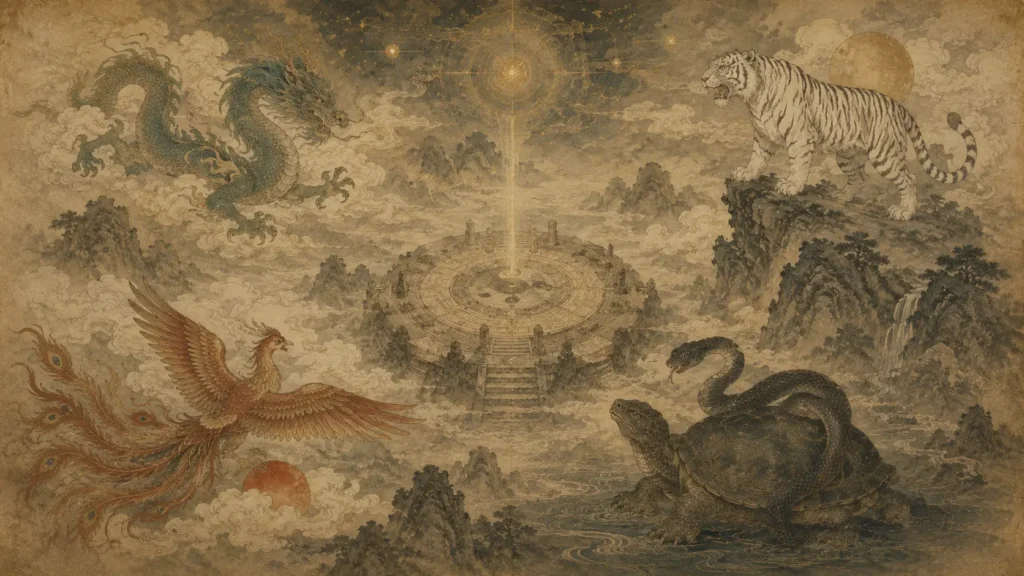
That is why modern diagrams sometimes show a Yellow Dragon in the center surrounded by the Four Symbols.
But the Yellow Dragon is not simply a fifth member of the four seven-mansion celestial groups.
The Twenty-Eight Mansions divide cleanly into:
7 + 7 + 7 + 7 = 28
There is no fifth group of seven mansions occupying the center.
So we should distinguish:
Four Symbols → four celestial quarters
from:
Five-direction cosmology → four directions + center
Related systems overlap, but they are not identical.
Does “Four Symbols” Always Mean These Four Animals?
No.
Another useful distinction.
The Chinese expression:
四象 — Sìxiàng
has a broader history in Chinese cosmology and philosophy.
In Yijing-related traditions, the term can refer to four configurations emerging from yin and yang, rather than specifically to four animals.
Later explanations connect the sequence:
Taiji → Two Modes → Four Images → Eight Trigrams.
So whenever we see 四象, context matters.
For this article, Four Symbols refers specifically to the astronomical and mythological system of:
Qinglong, Baihu, Zhuque and Xuanwu.
That distinction keeps us from forcing every historical use of Sixiang into one definition.
What Do the Four Symbols Represent?
The easiest way to understand them is not as four isolated monsters.
They are relationships.
| Symbol | Direction | Season | Phase | Celestial role |
|---|---|---|---|---|
| Azure Dragon | East | Spring | Wood | Eastern seven mansions |
| Vermilion Bird | South | Summer | Fire | Southern seven mansions |
| White Tiger | West | Autumn | Metal | Western seven mansions |
| Xuanwu | North | Winter | Water | Northern seven mansions |
They connect:
Earth to sky
direction to season
animal to star
space to time
That is what makes the system remarkable.
The animals are memorable.
But the relationships between them are the real structure.
What the Four Symbols Can Teach Us
This next part is a modern reflection, not something an ancient Chinese text explicitly tells us to use as a workout philosophy.
But there is something worth taking from the system.
No single guardian owns the entire sky.
Each has its direction.
Its season.
Its place.
And the complete structure exists only when all four are present.
Training works surprisingly similarly.
Strength without endurance leaves a weakness.
Intensity without recovery eventually destroys performance.
Discipline without direction wastes effort.
Mindset without action becomes imagination.
You do not become complete by developing one quality until everything else disappears.
Build strength.
Build endurance.
Build discipline.
Build control.
Different qualities.
One system.
The Four Symbols offer an image of something Becoming Konstantin is ultimately about:
power becomes more useful when it is balanced and given direction.
Why the Four Symbols Still Matter
For more than two thousand years, dragon, tiger, bird and tortoise-serpent have appeared across Chinese celestial imagery, art and symbolic systems.
They survived because they do something mythology does exceptionally well.
They turn an invisible idea into something you can see.
East becomes a dragon.
West becomes a tiger.
South becomes a bird.
North becomes a dark creature wrapped in a serpent.
The sky becomes a story.
And a complicated system of stars, directions and seasons suddenly becomes memorable.
That is the true power of the Four Symbols.
They are not simply four legendary animals.
They are an ancient Chinese map of order—drawn across the heavens in the bodies of mythical beasts.
References & Sources
Chinese Text Project — Lunheng, Momentum of Things
Direct classical correspondence between East/Wood/Azure Dragon, West/Metal/White Tiger, South/Fire/Vermilion Bird and North/Water/Xuanwu.
Read the Lunheng passage
Chinese Text Project — Huainanzi, Astronomical Teachings
Important source for directional and Five Phase cosmology, including the Yellow Dragon of the center.