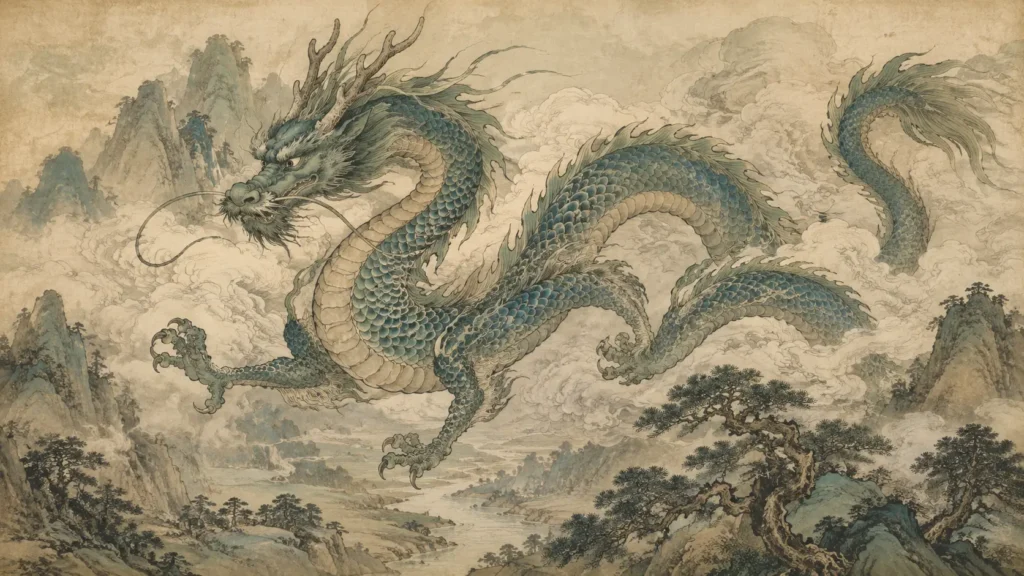
Before the Azure Dragon guarded temples, appeared in paintings, or became a familiar creature in games and fantasy, it stretched across something far larger than any earthly kingdom.
The night sky.
Ancient Chinese observers divided the heavens into celestial regions and imagined one great dragon occupying the eastern quarter.
Its name was Qinglong.
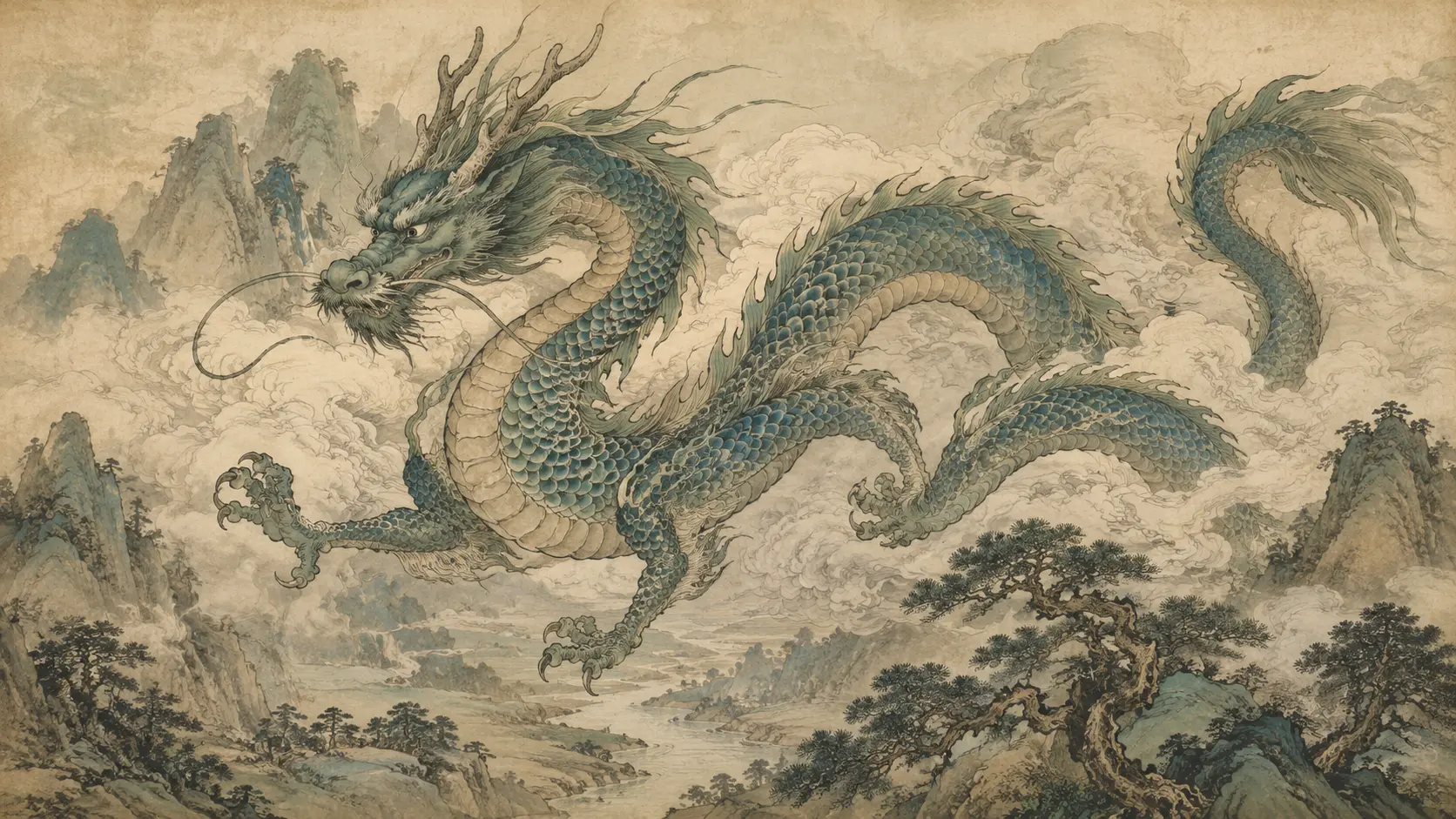
The Azure Dragon (青龍 / 青龙, Qīnglóng), also translated as the Blue-Green Dragon, is one of the Four Symbols of traditional Chinese cosmology. It represents the eastern quarter of the sky and is associated with spring and the Wood phase. In Chinese astronomy, the Azure Dragon corresponds to seven of the Twenty-Eight Lunar Mansions, while later religious and artistic traditions developed it into a powerful celestial guardian.
But Qinglong is not simply “a blue Chinese dragon.”
Its oldest identity is written across the stars.
Azure Dragon Quick Facts
| Name | Azure Dragon |
| Chinese | 青龍 / 青龙 |
| Pinyin | Qīnglóng |
| Also translated as | Blue Dragon, Blue-Green Dragon, Green Dragon |
| Type | Celestial symbol / mythological dragon |
| Direction | East |
| Season | Spring |
| Five Phases | Wood |
| Celestial group | Seven eastern lunar mansions |
| Four Symbols | Azure Dragon, White Tiger, Vermilion Bird, Black Tortoise |
What Is the Azure Dragon in Chinese Mythology?
The Azure Dragon is one of the Four Symbols — 四象 (Sìxiàng).
The traditional group consists of:
Azure Dragon — East
White Tiger — West
Vermilion Bird — South
Black Tortoise — North
A seventh-century Chinese bronze mirror preserved by The Metropolitan Museum of Art depicts all four creatures as symbols of the cardinal directions. The museum notes that these associations emerged in Chinese cosmology around the third century BCE and became firmly established afterward.
That makes Qinglong fundamentally different from dragons such as Jiaolong.
Jiaolong is an aquatic dragon-being.
Qinglong is also a cosmic direction, celestial image, and astronomical system.
For the broader dragon tradition, read our guide to Chinese Dragon mythology, meaning, powers and types.
Why Is Qinglong the Dragon of the East?
Ancient Chinese cosmology connected directions with colors, seasons, celestial bodies, and the Five Phases.
The Huainanzi gives an unusually clear example.
For the East it lists:
Wood as the phase,
Taihao as its emperor,
spring as its seasonal domain,
and Canglong — the Azure Dragon — as its animal.
The complete pattern was:
East → Wood → Azure Dragon
South → Fire → Vermilion Bird
West → Metal → White Tiger
North → Water → Black Tortoise
Earth occupied the center in the five-direction system rather than forming another group of seven eastern-style mansions.
This is why calling Qinglong simply “the water dragon of the East” would be misleading.
Chinese dragons are often strongly associated with water and rain, but the Azure Dragon’s cosmological phase is Wood.
Why Is the Azure Dragon Connected to Spring?
Because the East, Wood, and spring belonged to the same correspondence system.
The Huainanzi repeatedly associates the eastern direction with the spring season and blue-green ceremonial imagery. In its description of the second month of spring, the ruler wears blue-green clothing and is symbolically connected with the Azure Dragon.
Spring meant the return of visible growth.
Plants emerge.
Days lengthen.
Agricultural life becomes active again.
Within that cosmological framework, the Azure Dragon came to stand on the side of the universe associated with renewal and rising life.
But we should make an important distinction.
It is reasonable today to interpret Qinglong as a symbol of growth and renewal because of its associations with spring and Wood.
It would be too strong to claim that every ancient text explicitly says:
“The Azure Dragon represents personal growth.”
That is a modern interpretation built from authentic traditional associations.
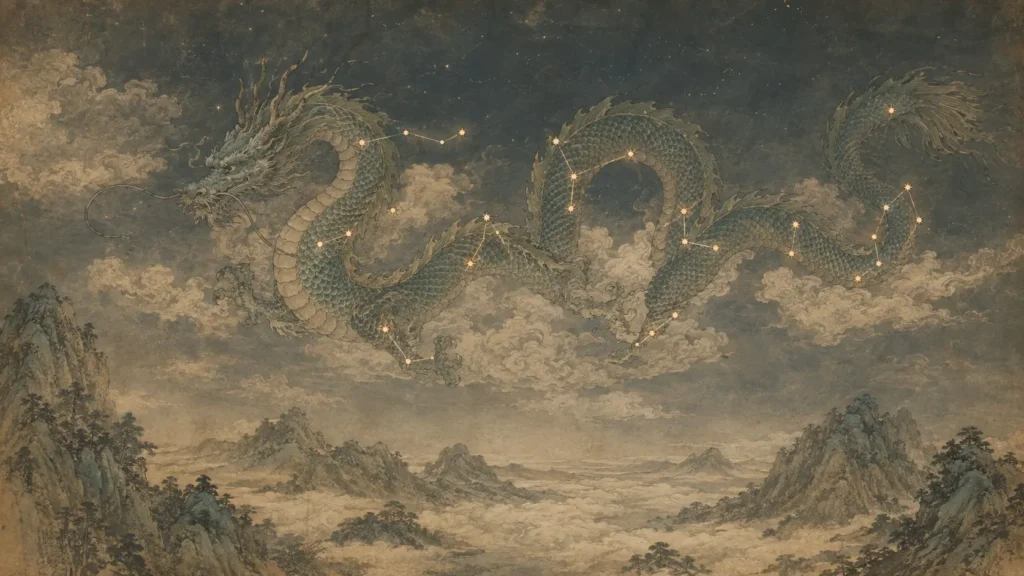
The Azure Dragon in the Stars
This is where Qinglong becomes especially fascinating.
The Azure Dragon was not merely imagined somewhere in heaven.
Ancient Chinese astronomy organized the sky into Twenty-Eight Lunar Mansions — 二十八宿.
These were divided into four groups of seven.
The seven mansions of the eastern quarter formed the Azure Dragon. Modern Chinese cultural sources describe the Twenty-Eight Mansions as groups of stars used as coordinates for observing the Sun, Moon, and planets, with each group of seven associated with one of the Four Symbols.
The seven eastern mansions are:
角 — Jiǎo — Horn
亢 — Kàng — Neck
氐 — Dī — Root
房 — Fáng — Room
心 — Xīn — Heart
尾 — Wěi — Tail
箕 — Jī — Winnowing Basket
A later astronomical text explains that these seven eastern mansions were understood as resembling the form of a dragon and therefore formed the Canglong of the Eastern Palace.
Even the Records of the Grand Historian describes the eastern celestial palace as the Canglong, identifying important mansions such as Fang and Xin within it.
So Qinglong was not simply a mythical animal projected onto the sky after the fact.
Its identity became deeply entangled with how ancient China organized the heavens themselves.
Is Qinglong Blue or Green?
Both translations can be misleading if taken too literally.
The Chinese character:
青 — qīng
covers a historical range of blue, green, and blue-green shades that does not map perfectly onto modern English color categories.
That is why 青龍 appears in English as:
Azure Dragon
Blue Dragon
Green Dragon
or sometimes:
Blue-Green Dragon
For our article, Azure Dragon is the cleanest established English name.
But Qinglong does not need to look like a neon-blue fantasy dragon.
Historically inspired artwork can reasonably use muted blue-green, jade, gray-green, or dark verdigris tones.
Is the Azure Dragon a God?
Originally, it is more accurate to describe Qinglong as a celestial symbol and mythological beast than simply as one individual god.
Its early cosmological role is tied to:
the eastern direction,
the stars,
the seasons,
and the larger Four Symbols system.
However, Chinese religious traditions developed these celestial symbols further.
Later Daoist texts could treat the Four Symbols within increasingly personified and sacred frameworks. One Daoist text explicitly names the Four Symbols as Qinglong, Baihu, Zhuque and Xuanwu and associates Qinglong with the eastern Wood correspondence.
So both ideas appear over Chinese history:
Qinglong as celestial beast
and
Qinglong within religious/divine systems.
What we should avoid is pretending that there was one fixed biography of a god called “Azure Dragon” from the beginning of Chinese history.
There wasn’t.
Is the Azure Dragon the Same as a Normal Chinese Dragon?
No.
Qinglong belongs to Chinese dragon imagery, but it has a much more specific cosmological identity.
The broad Chinese dragon — 龍 / 龙, Lóng — appears across mythology, religion, political symbolism, art, water traditions, and folklore.
Qinglong specifically belongs to the eastern celestial quadrant and the Four Symbols.
The distinction is similar to this:
Chinese Dragon → the broad dragon tradition
Jiaolong → ancient aquatic/scaled dragon tradition
Yinglong → winged dragon
Dragon Kings → divine rulers associated with seas, rivers, and rain
Azure Dragon / Qinglong → celestial dragon of the East and one of the Four Symbols
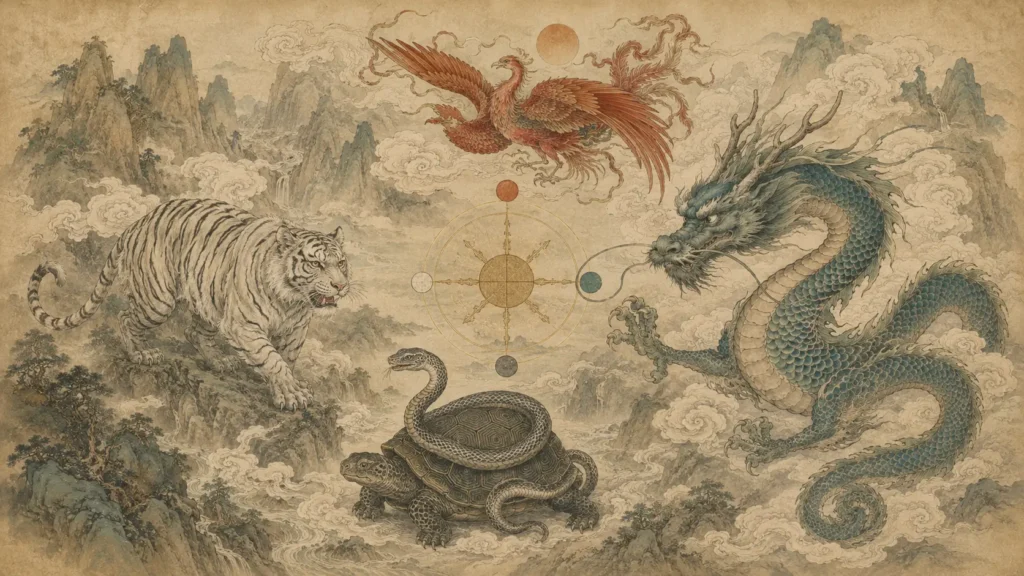
Azure Dragon vs the Other Four Symbols
Qinglong only makes complete sense when we see the larger system.
Its counterpart in the West is the White Tiger — Baihu.
South belongs to the Vermilion Bird — Zhuque.
North belongs to Xuanwu, usually represented as a tortoise entwined with a snake.
A Han-period passage in the Lunheng states the pattern directly: the East corresponds to Wood and the Azure Dragon, the West to Metal and the White Tiger, the South to Fire and the Vermilion Bird, and the North to Water and Xuanwu.
These are not four random fantasy animals placed together because they looked impressive.
They formed part of a structured map of the cosmos.
What the Azure Dragon Can Teach Us
The original Qinglong tradition was not written as a modern self-improvement lesson.
But the symbolism surrounding it gives us something worth taking away.
Qinglong belongs to spring.
Spring does not begin with a finished forest.
It begins with movement that is almost invisible.
A seed breaks.
A root pushes deeper.
A new shoot reaches upward.
Training works the same way.
Building a business works the same way.
Learning works the same way.
At first, progress can be almost impossible to see.
Then enough small changes accumulate that the whole landscape looks different.
The useful lesson is not:
“Become powerful like a dragon.”
That is too easy.
It is:
Build during the season when nobody can yet see what you are becoming.
Growth often starts underground.
Why the Azure Dragon Still Matters
Qinglong survives because it represents something far larger than a single legendary animal.
It connects:
mythology,
astronomy,
direction,
season,
color,
ritual,
and Chinese dragon imagery
inside one symbol.
Look east.
Spring returns.
The Wood phase rises.
Seven groups of stars form the body of a dragon across the ancient sky.
That is Qinglong.
Not simply a blue dragon.
A map of the cosmos given the shape of one.
References & Sources
Chinese Text Project — Huainanzi, Astronomical Teachings
Excellent primary textual evidence connecting the East with Wood, spring-related cosmology, and the Azure Dragon.
Huainanzi — Astronomical Teachings
Chinese Text Project — Huainanzi, Seasonal Laws
Evidence for the spring/eastern correspondence and blue-green/Azure Dragon ceremonial imagery.
Huainanzi — Seasonal Laws
Chinese Text Project — Records of the Grand Historian, Celestial Officials
Early astronomical material describing the eastern celestial palace as Canglong.
Shiji — Celestial Officials Treatise