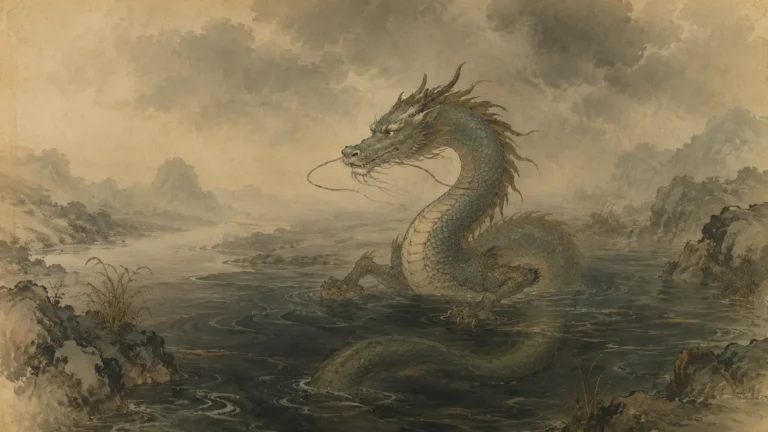
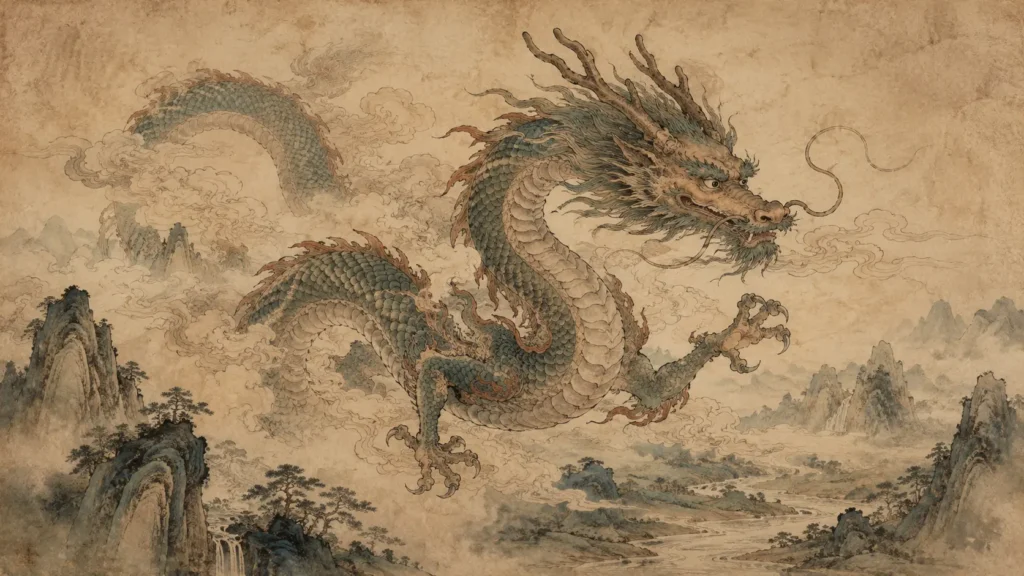
A dragon rises from black water.
There are no enormous leather wings.
No knight waits with a sword.
No treasure cave burns behind it.
Clouds gather instead.
Rain begins to fall.
For thousands of years, the Chinese dragon has belonged to a very different mythological world from the fire-breathing monster familiar in much of Western fantasy.
It could live beneath rivers and seas, rise into the clouds, change its form, bring life-giving rain, appear as an omen of power, and eventually become one of the greatest symbols of imperial China.
Yet there is no single Chinese dragon.
There are winged dragons and hornless dragons. Dragons associated with rivers, rain, directions, emperors, warfare and cosmic order. There are Dragon Kings ruling underwater courts and ancient dragons whose stories reach back into the Shan Hai Jing.
The Chinese dragon (龙 / 龍, lóng) is one of the most important supernatural beings in Chinese mythology. Traditionally associated with water, rain, clouds, transformation and auspicious power, dragons also became symbols of protection, fertility, imperial authority and success. Ancient Chinese texts describe multiple kinds of dragons rather than one fixed species, including Yinglong, Jiaolong, Qiulong and Chilong, while later traditions include Dragon Kings and the Azure Dragon of the East.
What Is a Chinese Dragon?
The normal Chinese word for dragon is:
龙 — Lóng
Traditional: 龍
But lóng is not simply the Chinese translation of a European dragon.
It represents a supernatural tradition that developed within China over an extraordinarily long period.
Dragon forms appear in Chinese material culture thousands of years ago. The Smithsonian preserves Shang-period jade dragons from around the second millennium BCE, while some later dragon designs were themselves based on even earlier Neolithic prototypes.
By the time classical texts began describing dragons in greater detail, the creature was already connected with water, Heaven and transformation.
The Shuowen Jiezi gives one of the most useful ancient descriptions:
龍:鱗蟲之長。能幽,能明,能細,能巨,能短,能長;春分而登天,秋分而潛淵。
In natural English:
The dragon is the chief of scaled creatures. It can become hidden or visible, small or enormous, short or long. At the spring equinox it ascends to Heaven; at the autumn equinox it descends into the depths.
That short passage already contains much of what makes Chinese dragon mythology different.
The dragon is not merely an animal.
It changes.
It moves between water and sky.
Its size is unstable.
Its visibility is unstable.
Even its place in the world changes with the seasons.
What Does a Chinese Dragon Look Like?
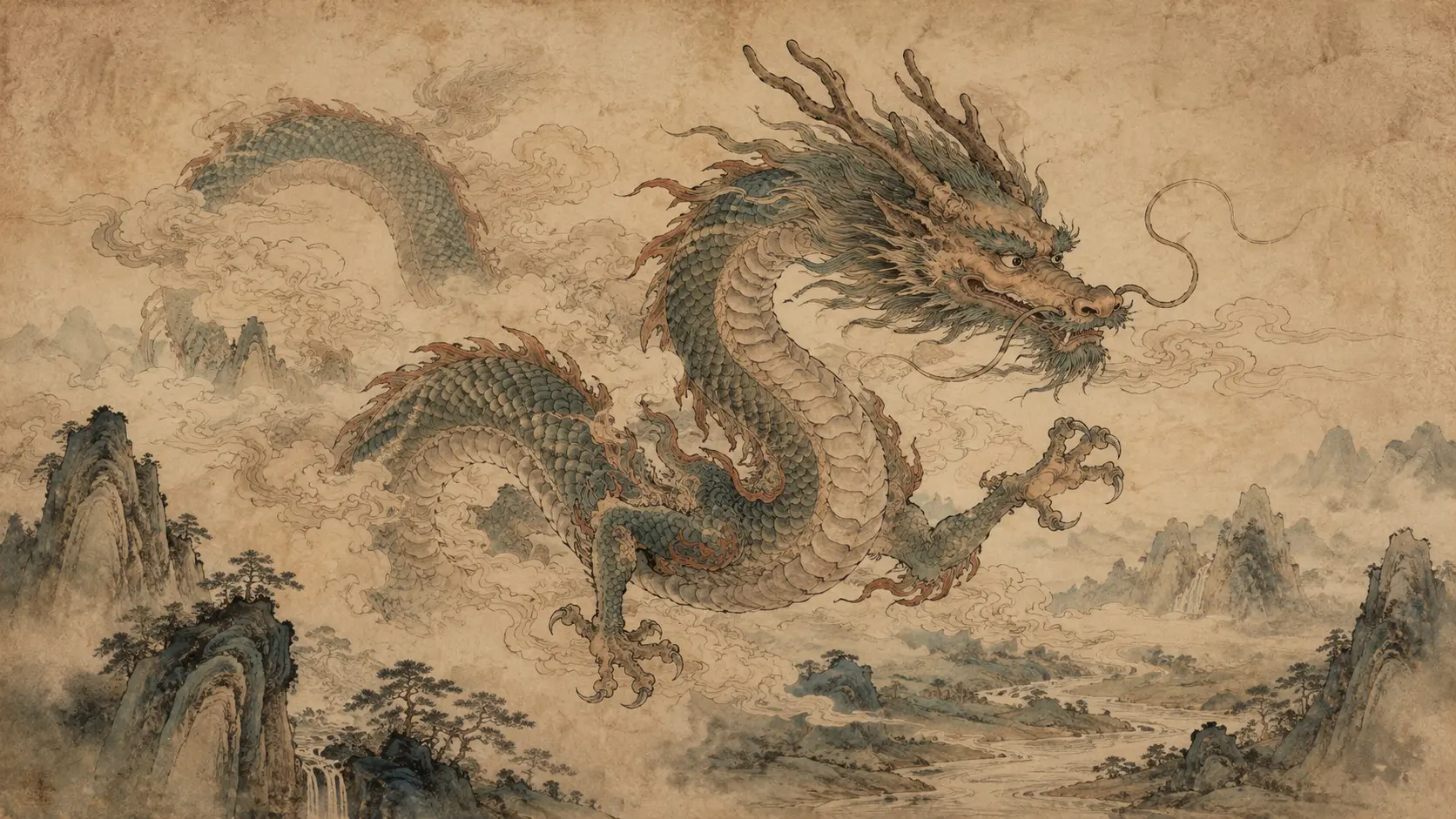
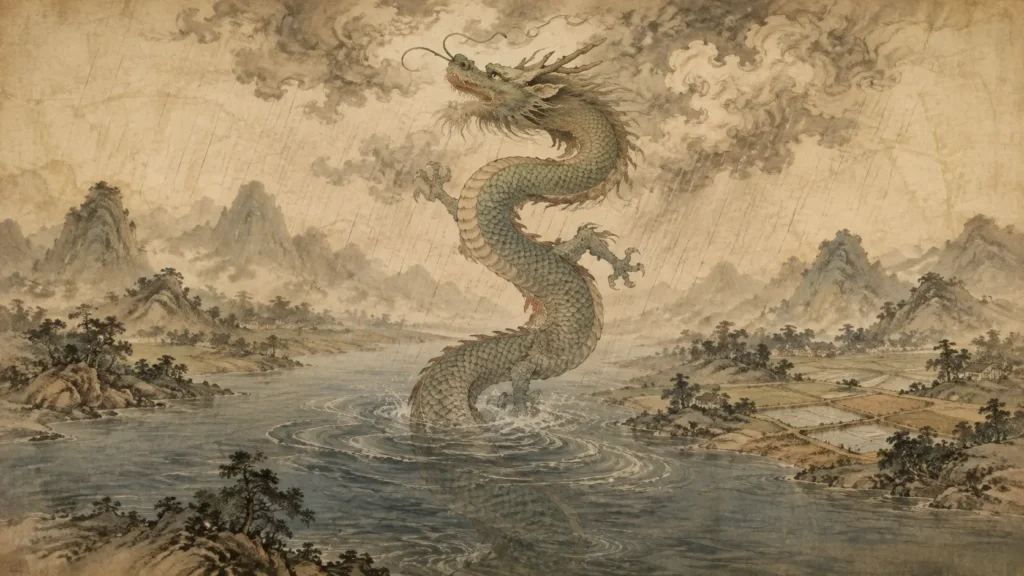
The Chinese dragon is usually imagined with an elongated, serpentine body covered in scales, four legs and a powerful head.
But there was never one perfectly fixed anatomical blueprint.
Later Chinese writers preserved the famous idea of the dragon possessing “nine resemblances” to other animals.
Different versions vary slightly, but one influential tradition compares its horns to those of a deer, its head to a camel, its neck to a snake, its scales to a fish, its claws to an eagle, its paws to a tiger and its ears to an ox.
That composite anatomy helps explain why traditional dragons can look so different from one painting to another.
More importantly, most Chinese dragons do not need wings to fly.
Flight is part of their supernatural nature.
There are exceptions—Yinglong is specifically distinguished by having wings—but wings are not required for the standard lóng to rise through clouds or travel between Heaven and water. Ancient classification texts explicitly separate winged Yinglong from other forms.
What Does the Chinese Dragon Mean?
There is no single Chinese dragon meaning.
The symbol accumulated layers over thousands of years.
But several associations appear again and again.
Water, Rain and Life
The strongest is water.
Chinese dragons are deeply connected with rivers, lakes, seas, clouds and rain.
The Metropolitan Museum of Art notes that dragons have long been associated with water, particularly rivers and lakes, while the British Museum describes them as controllers of the water supply.
This mattered enormously in an agricultural society.
Rain could mean crops.
Drought could mean hunger.
Flooding could destroy entire communities.
A creature capable of influencing water therefore represented far more than magical spectacle.
It represented one of the forces upon which human survival depended.
The connection was strong enough that Chinese rulers and communities performed rituals seeking rain from dragon powers. The Norton Museum notes that Chinese dragons were petitioned for life-giving rain and connects these practices with traditions stretching back to ancient royal divination for rainfall.
Power and Good Fortune
The Chinese dragon also became an auspicious creature.
Museum collections associate dragon imagery with protection, happiness, fertility, success and good fortune.
That does not mean every dragon in every Chinese story is gentle.
The Spiritual Meaning of the Chinese Dragon
Water itself can save or destroy.
A dragon can bring rain, but a supernatural water being can also belong to a world of storms, floods and danger.
The better distinction is this:
The Chinese dragon is not fundamentally a monster that must be killed.
It is a powerful supernatural being whose relationship with humans depends on the story.
Chinese Dragon Powers
If we stay with traditional sources rather than modern fantasy lists, the Chinese dragon has an extraordinary set of abilities.
Transformation
The Shuowen Jiezi says the dragon can become small or enormous, short or long, hidden or visible.
Transformation is therefore not an optional modern addition.
It belongs to an old understanding of the creature.
A dragon is difficult to define physically because changing form is part of what a dragon does.
Control Over Rain and Water
Rain is perhaps the most important Chinese dragon power.
Dragon traditions became deeply tied to water management, rainfall rituals and agricultural fertility. Museums preserve dragon images specifically connected with clouds, waves and petitions for rain.
Later Dragon Kings make this relationship even more explicit, ruling seas and participating in a celestial system that controls rainfall.
Flight
Chinese dragons commonly travel through the sky without visible wings.
Ancient texts imagine the dragon moving between deep water and Heaven itself.
Yinglong provides the unusual exception: his name belongs to a specifically winged dragon tradition.
Clouds and Storms
The dragon’s arrival is repeatedly connected with clouds and rain.
In later artistic tradition, the rising dragon itself becomes an image of clouds gathering around supernatural power.
But this is another place where modern articles often go too far.
There is no reason to give every Chinese dragon an identical videogame-style spell list of lightning, fire, teleportation and elemental attacks.
Different dragons have different traditions.
Types of Chinese Dragons
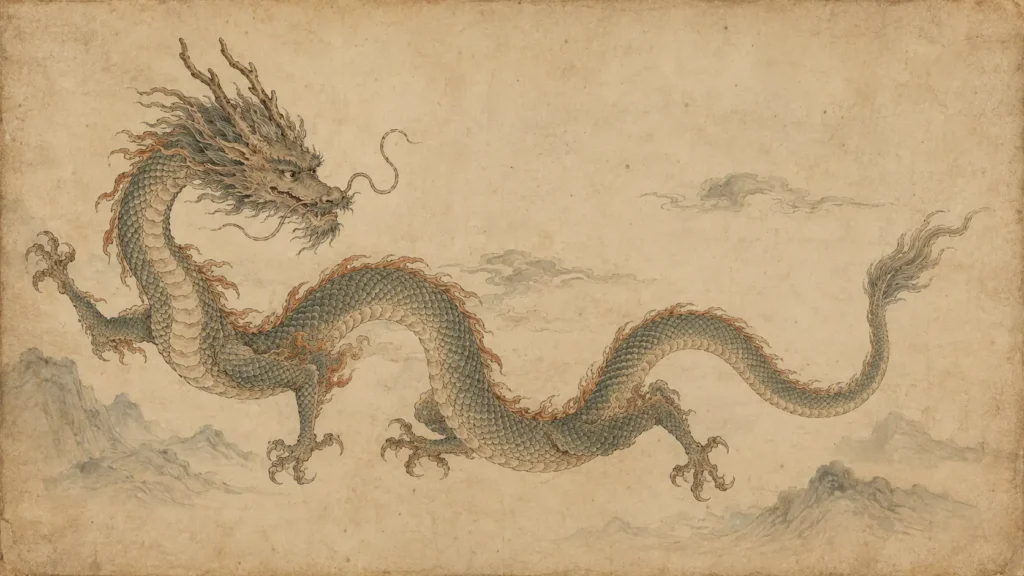
Search online and you will often find lists claiming there are exactly nine types of Chinese dragons.
Ancient Chinese tradition is more complicated.
There is no single universal taxonomy used by every classical source.
Different texts classify dragons according to different characteristics.
One influential classification preserved from the Guangya says:
有鳞曰蛟龙,有翼曰应龙,有角曰虬龙,无角曰螭龙。
In simplified terms:
Jiaolong (蛟龙) — a scaled dragon or dragon-like aquatic being.
Yinglong (应龙 / 應龍) — the winged dragon.
Qiulong (虬龙 / 虯龍) — described in this tradition as a horned dragon.
Chilong (螭龙 / 螭龍) — a hornless dragon.
Other textual traditions sometimes define these terms differently, which is exactly why we should be suspicious of any modern chart claiming to present the one official classification of Chinese dragons.
There are also dragon figures that belong to different kinds of classification entirely.
Yinglong — The Winged Dragon
Yinglong (应龙 / 應龍) is one of the most important individual dragons in ancient Chinese mythology.
The Shan Hai Jing tells how Yinglong killed Chiyou and later Kuafu. Afterward he remained in the south, and the text connects his presence there with abundant rain.
Yinglong deserves his own future article because he is not simply “a dragon with wings.”
He has an actual mythological history.
Qinglong — The Azure Dragon
The Azure Dragon (青龙 / 青龍, Qīnglóng) belongs to another system.
It is the guardian and celestial symbol of the East, forming one of the Four Symbols alongside the Vermilion Bird, White Tiger and Black Warrior/Tortoise.
The Book of Rites already places the Azure Dragon on the eastern/left side in ritual orientation.
So Qinglong is not just a blue-colored version of a normal dragon.
It belongs to Chinese cosmology, astronomy and directional symbolism.
Dragon Kings
Then there are the Dragon Kings — Longwang (龙王 / 龍王).
These are divine rulers associated with seas, water and rain rather than merely another anatomical “species” of dragon.
One of the best known is Ao Guang, Dragon King of the Eastern Sea.
On Becoming Konstantin, his story already has a dedicated page, because his individual mythology—from the underwater Dragon Palace to conflicts with Sun Wukong and Nezha—is far larger than a paragraph inside this pillar.
Read next: Ao Guang: The Dragon King of the Eastern Sea.
This distinction protects the structure of our dragon cluster:
Chinese Dragon = the broad tradition.
Dragon Kings = a divine water-ruler tradition within that larger world.
Ao Guang = one individual Dragon King.
Chinese Dragon vs Western Dragon
The easiest comparison is often summarized as:
Western dragon = monster.
Chinese dragon = benevolent spirit.
Reality is more interesting than that.
Many later European dragons are depicted as winged, fire-associated monsters guarding treasure or confronting heroes.
Chinese dragons are usually more serpentine and are far more strongly associated with water, clouds and rain.
They are also traditionally treated as auspicious creatures rather than beings whose natural role is to be slain. The British Museum explicitly contrasts the positive Chinese dragon tradition with common Western dragon imagery.
But Chinese dragons are not harmless mascots.
They belong to forces of nature.
And nature is not always kind.
The most useful distinction is therefore not good dragon versus evil dragon.
It is:
conquest versus relationship.
In many European heroic stories, defeating the dragon proves the hero’s strength.
In Chinese traditions, humans more often seek the dragon’s rain, respect its authority, negotiate with its rulers, or suffer when the balance between supernatural water and human society collapses.
Why Is the Dragon a Symbol of the Chinese Emperor?
Over time, the dragon became inseparable from imperial authority.
The connection was visible in palaces, porcelain, court robes and official symbolism.
The Metropolitan Museum notes the dragon’s role as a symbol of imperial rule, while surviving Qing court regulations used differences in claws, colors and dragon designs to communicate rank.
The famous five-clawed dragon became particularly associated with the highest ranks of imperial power.
The emperor ruled from the Dragon Throne.
Imperial garments became dragon robes.
The symbolism worked because the dragon already represented something greater than raw violence.
It connected Heaven, natural power and earthly rule.
A ruler wearing the dragon was therefore presenting himself not merely as strong, but as occupying a privileged position within the order of the cosmos. The Norton Museum explicitly links court dragons with the emperor’s Mandate of Heaven.
The Dragon in the Chinese Zodiac
The dragon also occupies a unique position among the twelve animals of the Chinese zodiac.
The traditional cycle contains the rat, ox, tiger, rabbit, dragon, snake, horse, goat/ram, monkey, rooster, dog and pig.
The dragon stands out because it is the only clearly mythological animal in the familiar twelve-animal sequence.
That has helped keep the creature present not only in ancient mythology but in everyday cultural identity, birth-year symbolism and Lunar New Year celebrations.
Yet the zodiac dragon should not be confused with a separate mythological species.
It is another cultural role played by the same extraordinarily flexible symbol.
The Chinese Dragon in Ancient Art
One reason the dragon is so difficult to reduce to one definition is that its image changed for thousands of years.
Ancient jade dragons can appear tightly curled and highly stylized.
Bronze Age and Warring States dragons become increasingly elaborate.
Later paintings stretch dragons through clouds and mist.
Imperial porcelain gives them horns, claws, scales and powerful winding bodies.
Qing robes surround them with waves, mountains and celestial symbols.
The form evolves.
The idea survives.
A Smithsonian jade dragon from roughly 1250–1050 BCE already demonstrates how old the dragon motif is in Chinese art, while other museum objects preserve dragon designs from the Warring States, Han, Ming and Qing periods.
The dragon was never frozen in one century.
It grew with Chinese culture.
Are Chinese Dragons Gods?
Sometimes.
But not every Chinese dragon is a god.
This distinction matters.
A generic lóng can be understood as a supernatural creature.
Yinglong is an individual mythological dragon.
The Azure Dragon is a cosmological guardian.
Dragon Kings are divine rulers.
Other texts contain dragon-like mountain gods, water spirits and hybrid beings with very different identities.
Treating all of them as one “dragon god” erases those differences.
Chinese mythology is not a videogame bestiary with one clean hierarchy.
It is a collection of traditions developed across different regions, dynasties, religious systems and texts.
That complexity is part of what makes the Chinese dragon so powerful as an entity.
Why the Chinese Dragon Still Matters
Few mythological beings have carried so many meanings without losing their identity.
The dragon begins in forms carved into ancient jade.
It swims through old texts.
It rises from rivers into clouds.
It fights beside legendary rulers.
It becomes guardian of the East.
It rules underwater palaces.
It appears on the emperor’s robes.
It enters the zodiac.
And thousands of years later, people still recognize its silhouette almost instantly.
But the Chinese dragon survives for a deeper reason.
It represents power without being limited to violence.
Power can be the rain that saves a harvest.
The river that feeds a civilization.
The storm that destroys one.
The emperor who claims Heaven’s authority.
The creature hidden beneath dark water.
Or the dragon rising through clouds when the world below desperately needs rain.
That is why there is no single answer to what a Chinese dragon means.
The dragon is not one story.
It is an entire mythological world.
1. Chinese Text Project — Shuowen Jiezi, Dragon Radical
Primary classical description of the dragon as chief of scaled creatures, capable of changing size and moving between Heaven and the depths.
https://ctext.org/shuo-wen-jie-zi/long-bu/zh
2. Chinese Text Project — Classical Dragon Definitions
Preserves traditional classifications including Jiaolong, Yinglong, Qiulong and Chilong.
https://ctext.org/dictionary.pl?char=龍
3. Chinese Text Project — Shan Hai Jing: Northern Classic of the Great Wilderness
Primary ancient source for Yinglong, Chiyou, Kuafu and the dragon’s connection with southern rainfall.