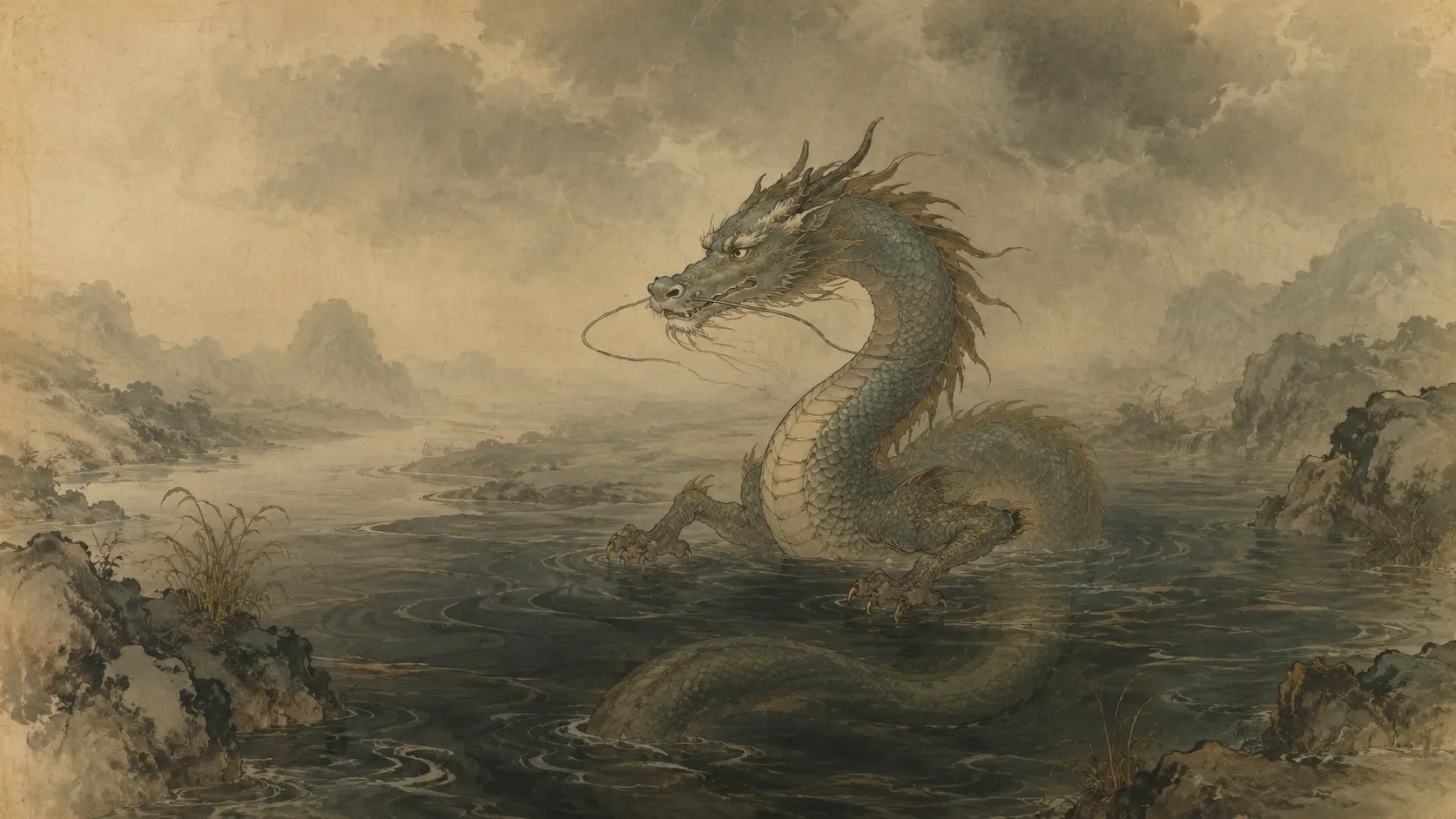
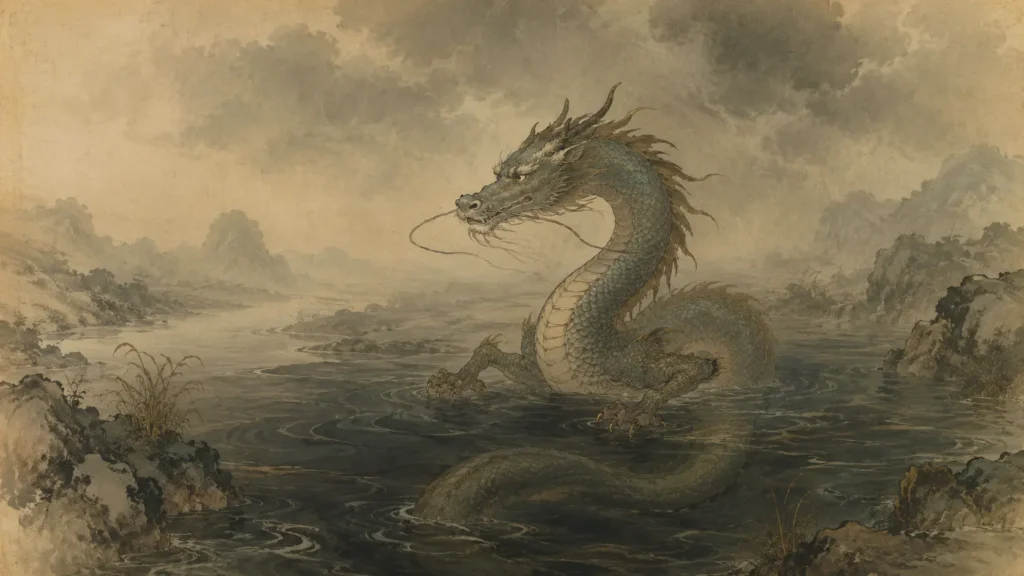
Something moves beneath the river.
Not a fish.
Not a snake.
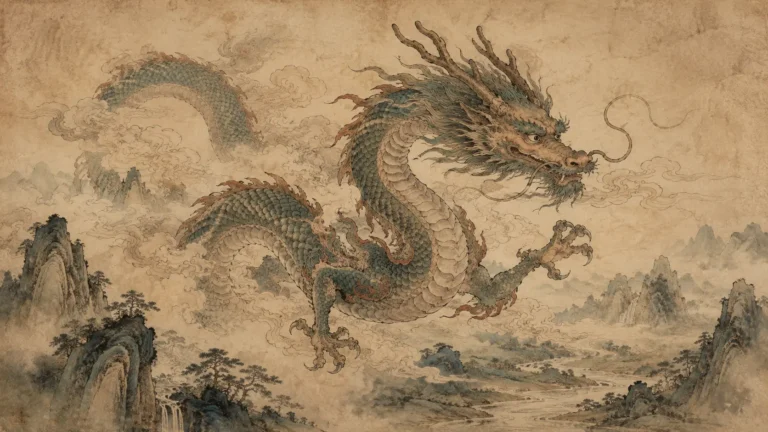
And not quite the magnificent dragon twisting through the clouds above an imperial palace.
The water darkens. Rain gathers overhead. Somewhere below the surface waits one of the oldest and most mysterious members of the Chinese dragon tradition:
Jiaolong.
Jiaolong (蛟龍 / 蛟龙, Jiāolóng), also called jiao (蛟), is an ancient dragon-like water being in Chinese mythology. Classical Chinese sources explicitly describe the jiao as a kind of dragon and associate Jiaolong with deep pools, rivers, clouds, rain, and powerful water. Some texts classify Jiaolong specifically as a scaled dragon, while later traditions give it more detailed serpent-like anatomy and stories of transformation.
Jiaolong Quick Facts
| Facts | Answers |
|---|---|
| Name | Jiaolong |
| Traditional Chinese | 蛟龍 |
| Simplified Chinese | 蛟龙 |
| Pinyin | Jiāolóng |
| Also called | Jiao (蛟) |
| Type | Aquatic dragon-like supernatural being |
| Associated with | Deep water, rivers, clouds, rain |
| Common English renderings | Scaled dragon, flood dragon, jiao-dragon |
| Related entities | Chinese Dragon, Yinglong, Dragon Kings |
What Is a Jiaolong?
One of our most valuable early definitions comes from the Shuowen Jiezi.
Its definition of jiao (蛟) begins simply:
龍之屬也
In natural English:
It is a kind of dragon.
That matters.
Jiaolong should not be treated as a completely separate monster that modern writers randomly decided to call a dragon. An old Chinese lexicographic tradition already places the jiao within the larger dragon family.
Another classification, preserved from the Guangya, makes the connection even clearer:
有鱗曰蛟龍
A dragon characterized by scales is called Jiaolong.
The same passage distinguishes winged Yinglong, horned Qiulong, and hornless Chilong.
This is exactly why there was never just one perfectly fixed “species” of Chinese dragon.
Jiaolong was one part of a much larger and changing dragon tradition.
Read the complete guide to Chinese Dragon mythology, meaning, powers and types.
Jiaolong Belonged to Deep Water
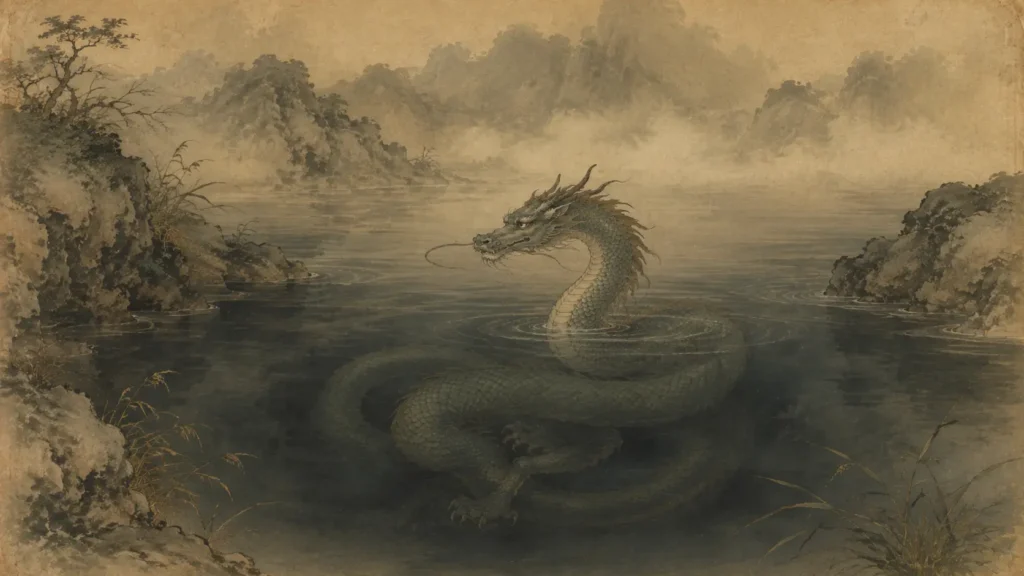
If there is one environment repeatedly connected with Jiaolong, it is deep water.
The Xunzi contains one of the most famous early references:
積水成淵,蛟龍生焉
As water accumulates and forms a deep pool, Jiaolong appears there.
This is much more interesting than simply calling Jiaolong a “water dragon.”
Ancient Chinese writers imagined profound waters as worlds containing creatures invisible from the surface.
Rivers and pools could provide food and life.
They could also drown travelers, destroy settlements, and hide dangers below their surface.
Jiaolong belonged to that uncertain boundary.
The ordinary world ended at the waterline.
Something older waited beneath it.
Was Jiaolong a Flood Dragon?
“Flood dragon” is a common English translation of Jiaolong, but it should not be treated as the only possible meaning of the name.
The Han dynasty thinker Wang Chong discusses jiao in the Lunheng and states that jiao are of the dragon kind. He also connects the appearance of jiao and dragons with the arrival of clouds and rain, followed by thunder and lightning.
Later dictionaries and traditions strengthened the connection between jiao, storms, floods, and dangerous water. Modern dictionaries consequently often gloss Jiaolong as a legendary dragon capable of producing rain or floods.
But we should avoid turning that into a videogame power:
“Jiaolong has the magical Flood Attack ability.”
The classical material is more atmospheric than that.
Deep water.
Clouds.
Rain.
Thunder.
And an aquatic dragon emerging into that environment.
What Did Jiaolong Look Like?
There is no single ancient anatomical blueprint.
Early sources establish Jiaolong mainly through its dragon identity and aquatic nature.
More detailed descriptions appear later.
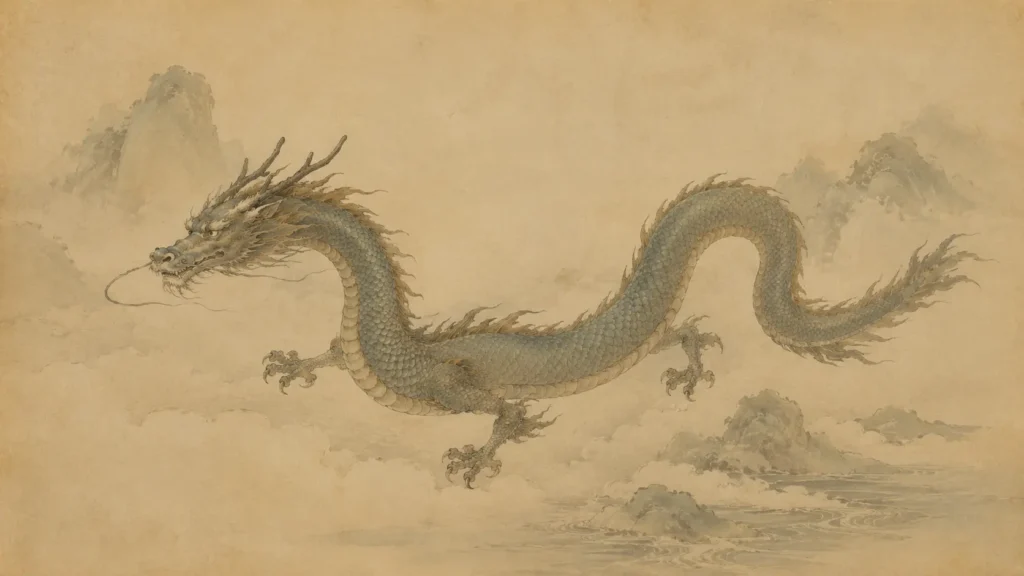
The Bencao Gangmu preserves an older account describing jiao as snake-like with four feet, a slender neck, and a white marking around the neck. Other traditional references similarly describe a large serpent-like creature with four legs.
That gives us a useful distinction:
Classical identity: aquatic dragon-kind.
Later physical description: serpent-like body, four legs, narrow neck, distinctive neck markings.
We should not assume every Jiaolong in every period looked exactly the same.
Chinese dragon imagery was never that rigid.
Is Jiaolong an Immature Dragon?
This is one of the most repeated claims online.
There is an old tradition behind it — but it is not the earliest definition of Jiaolong.
The later Shuyi Ji preserves a transformation sequence in which a water hui transforms into a jiao after five hundred years, and the jiao transforms into a dragon after another thousand years.
So later tradition absolutely could imagine Jiaolong as a stage in a dragon’s transformation.
But the older Shuowen simply calls jiao a type of dragon.
Therefore:
It is misleading to say that Jiaolong was universally understood as “a baby dragon that has not evolved yet.”
That is one later mythological model, not the only ancient definition.
And that distinction is exactly where simplified internet mythology often loses the real story.
Was Jiaolong Actually a Crocodile?
Possibly — but we cannot state that as fact.
Some scholars and translators have compared the jiao with crocodiles or other large aquatic reptiles. A recent academic discussion notes Edward Schafer’s description of the creature as spiritually akin to a crocodile, while other scholars translate the term as “flood dragon.”
That may help explain why some old descriptions combine:
a long reptilian body,
four legs,
water,
and danger to humans.
But the surviving Chinese texts did not simply describe Jiaolong as an ordinary zoological crocodile.
They placed it within the supernatural world of dragons, deep waters, clouds and transformation.
So the best answer is:
Jiaolong may preserve memories or imagery inspired by real aquatic reptiles, but in Chinese mythology it became a supernatural dragon-being.
Jiaolong vs the Chinese Dragon
Jiaolong is not another name for every Chinese dragon.
The broad term is:
龍 / 龙 — Lóng
Jiaolong belongs inside that larger tradition.
Think of the structure like this:
Chinese Dragon (Long)
→ broad supernatural dragon tradition
Jiaolong
→ ancient aquatic/scaled dragon form
Yinglong
→ specifically winged dragon tradition
Dragon Kings
→ divine rulers associated with water, seas and rain
Azure Dragon
→ celestial guardian of the East.
What Jiaolong Can Teach Us
There is a reason I especially like the Jiaolong story for Becoming Konstantin.
The Xunzi did not mention Jiaolong simply to catalogue a monster.
It used the creature inside a lesson about accumulation.
Water gathers.
The pool becomes deeper.
And only when enough has accumulated does Jiaolong appear.
The same passage moves from accumulating earth and water to accumulating learning and virtue.
That idea translates almost perfectly into training.
One workout rarely changes your body.
One disciplined morning rarely changes your life.
One article rarely builds a website.
One hour of practice rarely creates mastery.
But repeated effort creates depth.
Repetition becomes strength.
Knowledge becomes skill.
Days become years.
The result eventually looks sudden to everyone who did not watch the accumulation.
But the deep water was filling the entire time.
That may be Jiaolong’s most useful lesson:
Become deep enough that something powerful has no choice but to emerge.
Why Jiaolong Still Matters
Jiaolong is easy to flatten into another item on a list of “Chinese dragon types.”
The original tradition is stranger.
It lives beneath deep water.
It belongs to the dragon family, but its identity shifts between texts.
Rain and thunder gather around it.
Later writers imagine a serpent with four legs.
Still later traditions place it inside a transformation lasting centuries.
And more than two thousand years ago, one of China’s great philosophical texts used Jiaolong as an image of what happens when enough small things accumulate into something profound.
That is why Jiaolong belongs in more than a dragon taxonomy.
It belongs in the larger story of how ancient China imagined water, transformation, danger—and growth itself.
References & Sources
Chinese Text Project — Shuowen / dictionary entry for 蛟
Primary textual material defining jiao as a kind of dragon and preserving later lexicographical commentary. Chinese Text Project — 蛟
Chinese Text Project — Dragon classifications preserved in Yiwen Leiju
Includes the Guangya classification of Jiaolong as the scaled dragon, alongside Yinglong, Qiulong and Chilong. Chinese Text Project — Dragon classifications