The fields have begun to crack.
Weeks pass without rain.
A farming community looks toward a temple, burns incense and asks a supernatural ruler for something no human authority can provide.
Water.
This is one of the worlds in which the Dragon King, or Longwang (龙王 / 龍王, Lóngwáng), became important.
The name does not belong to only one dragon.
Longwang is a title and category of divine dragon rulers associated with water, rainfall and particular territories in Chinese religious tradition. Some ruled great seas. Others were connected with rivers, lakes, springs or local communities.
The famous Ao Guang is one Dragon King.
But the Dragon King tradition is far larger than Ao Guang.
Dragon King Quick Facts
| Chinese | 龙王 / 龍王 |
| Pinyin | Lóngwáng |
| Literal meaning | Dragon King |
| Identity | Category/title of divine water rulers |
| Main associations | Rain, water, seas, rivers and local water territories |
| Famous system | Dragon Kings of the Four Seas |
| Best-known literary figure | Ao Guang of the Eastern Sea |
| Religious context | Chinese popular religion with Daoist and Buddhist influences |
| Historical importance | Rain ritual, local temples and state-recognized worship |
What Does Longwang Mean?
The Chinese word is straightforward.
Lóng (龙 / 龍) means dragon.
Wáng (王) means king.
But translating the words is easier than understanding the tradition.
Longwang should not automatically be treated as the personal name of a single universal “Dragon King.”
Research into Chinese local religion shows something more complex: different communities could worship different Dragon Kings, each associated with a particular region, temple or body of water. In one ethnographic study, longwang functions more like the name of a type of divine being than the proper name of one god. MDPI
That distinction changes the entire picture.
There was not simply one dragon sitting beneath one ocean ruling every drop of water in China.
There were many Dragon Kings.

How Did Dragon King Belief Develop?
The Dragon King tradition grew from several layers of religious history.
Chinese dragons were associated with water and rainfall long before the mature Longwang cult developed. Rain mattered enormously in an agricultural society, so dragons naturally became connected with one of the most important forces affecting human survival. Museum material on Chinese dragon traditions similarly emphasizes the old relationship between dragons, rain and water. Natural History Museum
But the later Dragon King tradition was not simply identical to those older dragon beliefs.
Academic research traces its development through the interaction of older Chinese dragon worship, popular religious practice, political patronage and Buddhist influence. Buddhist traditions brought nāga and nāgarāja figures—serpentine water beings and kings—into China, where they interacted with existing Chinese dragon concepts. TCI
The tradition became increasingly prominent during the Tang and Song periods.
By the Song dynasty, the cult of Dragon Kings of the seas had developed into a much clearer form.
In other words:
the Chinese dragon is older than the Dragon King tradition.
That is one reason these should remain separate topics.
The Dragon Kings of the Four Seas
One of the most famous ways of organizing Dragon Kings is through the Four Seas (四海, Sìhǎi).
Each direction could be represented by its own Dragon King.
In the literary world of Journey to the West, the Four Seas Dragon Kings are named:
Ao Guang of the Eastern Sea, Ao Qin of the Southern Sea, Ao Run of the Western Sea and Ao Shun of the Northern Sea.
The Anthony C. Yu translation of Journey to the West identifies these rulers individually in its text and index. Journey to the West Research
But there is an important warning here.
These four literary names should not be turned into a universal blueprint for every Dragon King tradition in Chinese history.
Local religion was far less standardized.
The Four Seas system became extremely famous.
It was not the only way Dragon Kings existed.
Dragon Kings Beyond the Four Seas
This may be the most important part of the Longwang tradition.
A Dragon King did not need an ocean.
Across China, communities worshipped Dragon Kings associated with local water and local territory.
Historical and ethnographic research describes large numbers of Longwang temples, particularly in rural communities. Individual Dragon Kings could have their own stories, sacred sites and limited geographical spheres of influence. DOI
A community dependent on a river did not necessarily need to think first about Ao Guang.
Its concern was immediate.
Would rain arrive?
Would the river flood?
Would crops survive?
Would the local water source remain safe?
This helps explain why Dragon King worship became so widespread.
The deity’s importance could be tied directly to the landscape in which people lived.
What Did Dragon Kings Govern?
The central responsibility of Dragon Kings was water.
Their religious functions varied by place, but rain was especially important.
Late-imperial research describes Longwang as functional deities whose central duty was understood as the granting and control of precipitation, while regional traditions could assign additional responsibilities connected with water. Qucosa
This is different from asking:
“What powers do Chinese dragons have?”
That belongs to the broader Chinese Dragon tradition.
For Longwang, the more useful question is:
What was the Dragon King responsible for?
Rainfall.
Water supply.
Rivers.
Floods.
Drought.
And the relationship between a community and the water on which it depended.
Dragon King Temples and Rain Worship
Dragon Kings were not only characters in stories.
They were worshipped.
Dragon King temples existed across China, and communities could petition these deities when water conditions threatened agriculture and daily life.
The relationship eventually extended beyond purely local worship.
Research on Qing-period religious administration shows that dragon deities were incorporated into official ritual systems, with governments supporting temples, granting titles and institutionalizing rainmaking rites. TDR Library
This is why calling Longwang merely a “mythological creature” misses something important.
The Dragon King could be part of living religious practice.
People were not simply entertained by him.
They asked him for rain.
Where Does Ao Guang Fit?
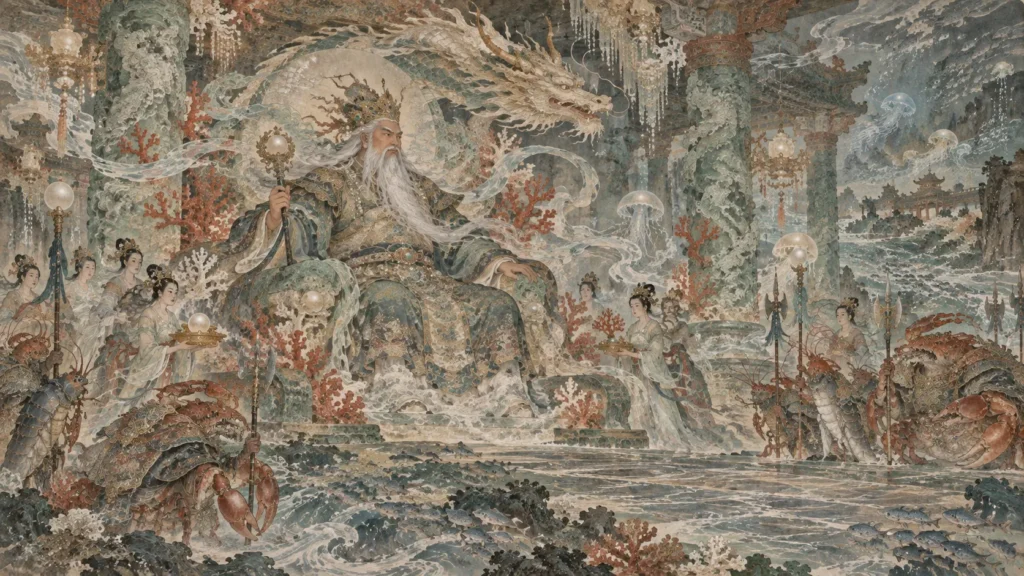
Ao Guang is not another name for Longwang.
He is a specific Dragon King.
More precisely, he is famously identified as the Dragon King of the Eastern Sea.
Popular literature made him particularly important, especially through his appearances in stories connected with Sun Wukong and Nezha.
Those stories deserve their own character page.
For the complete story of the ruler of the Eastern Sea, read Ao Guang: The Dragon King of the Eastern Sea.
Here, his purpose is different.
Ao Guang is the clearest example of how an individual figure fits inside the much larger Dragon King tradition.
Longwang is the category.
Ao Guang is one famous member of it.
Dragon King vs Chinese Dragon vs Azure Dragon
These three ideas overlap visually, but they are not interchangeable.
A Chinese Dragon (Long) belongs to the broad Chinese dragon tradition.
A Dragon King (Longwang) is a divine ruler associated with water and religious authority.
The Azure Dragon (Qinglong) is the eastern celestial guardian within the Four Symbols tradition.
Your existing Jiaolong article already makes essentially this same taxonomy.
Jiaolong, by contrast, is an ancient aquatic dragon form within the broader Chinese dragon tradition rather than a divine Dragon King.: Long as the broad tradition, specific dragon forms beneath it, Dragon Kings as divine rulers and Azure Dragon as the celestial guardian of the East. Becoming Konstantin
Keeping these identities separate makes Chinese mythology much easier to understand.
Why the Dragon King Tradition Matters
It is tempting to reduce the Dragon King to a fantasy ruler sitting inside an underwater palace.
That is only one part of the picture.
Longwang stands at the meeting point of several traditions:
ancient Chinese ideas about dragons and water,
Buddhist religious influence,
local community worship,
imperial ritual,
and later mythological literature.
A single Dragon King could be famous because he appeared beside Sun Wukong.
Another might be known only to communities living around one river.
Both could still be Longwang.
That is what makes the tradition so interesting.
The Dragon King was not simply a creature with water powers.
He represented an attempt to give authority, personality and responsibility to one of the most uncontrollable forces in human life.
Water could feed a civilization.
Water could destroy it.
And somewhere between drought and flood, people imagined a king responsible for keeping that power under control.
References & Sources
Qiao Yingfei — “The Origin and Formation of Dragon King Belief in China”
This is one of the strongest sources for this page because it specifically studies how Dragon King belief developed from older dragon worship through Buddhist influence, popular religion and official support. TCI
Academic record and English abstract
Andreas Berndt — The Cult of the Longwang
Useful specifically because it treats Longwang as widespread Chinese water deities rather than one mythological character and discusses Chinese dragon belief together with Buddhist nāga influence.