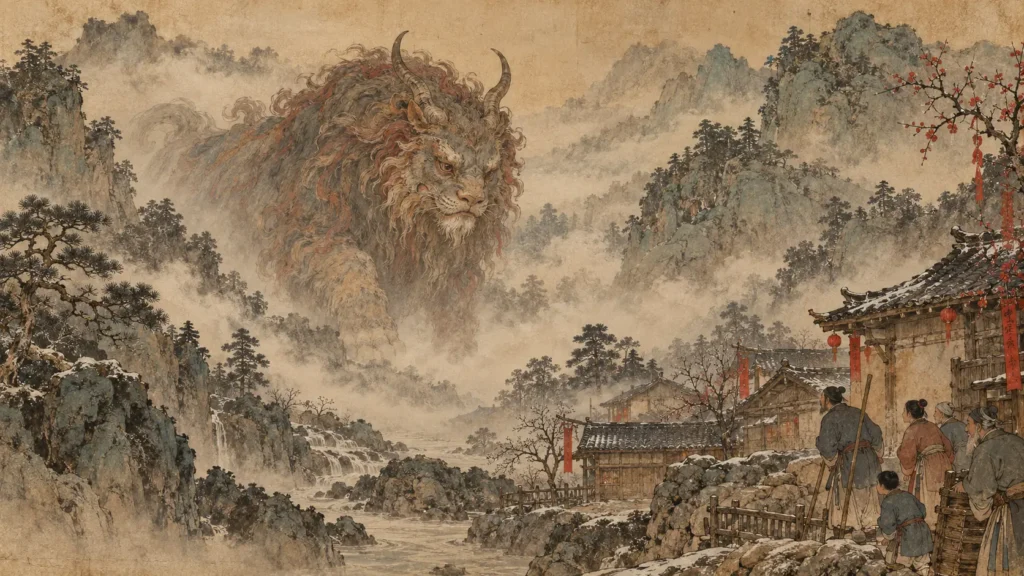
Every year, the monster returned.
Villagers closed their doors.
Families hid inside their homes.
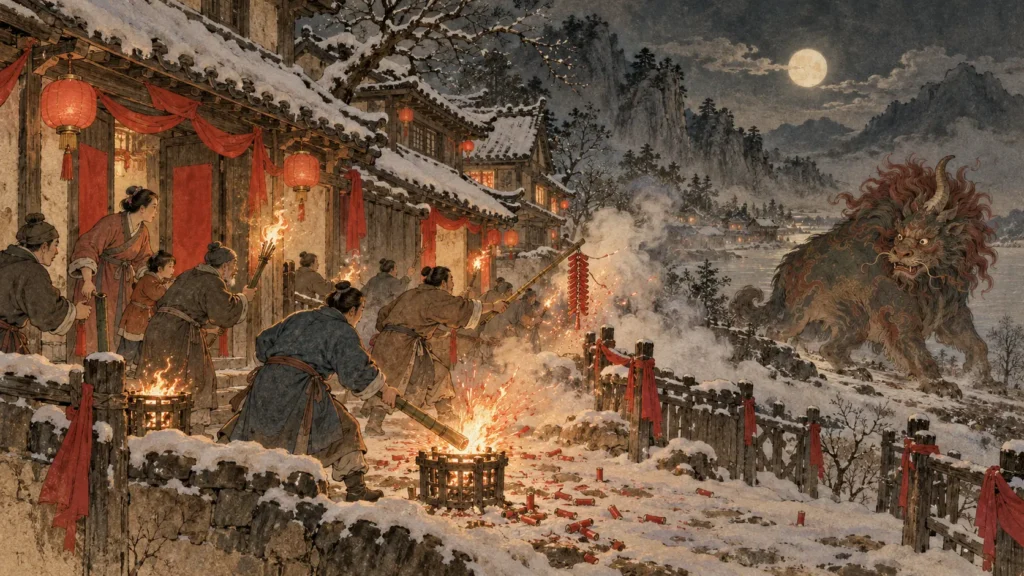
Then one night, they discovered what the creature feared:
red, fire and deafening noise.
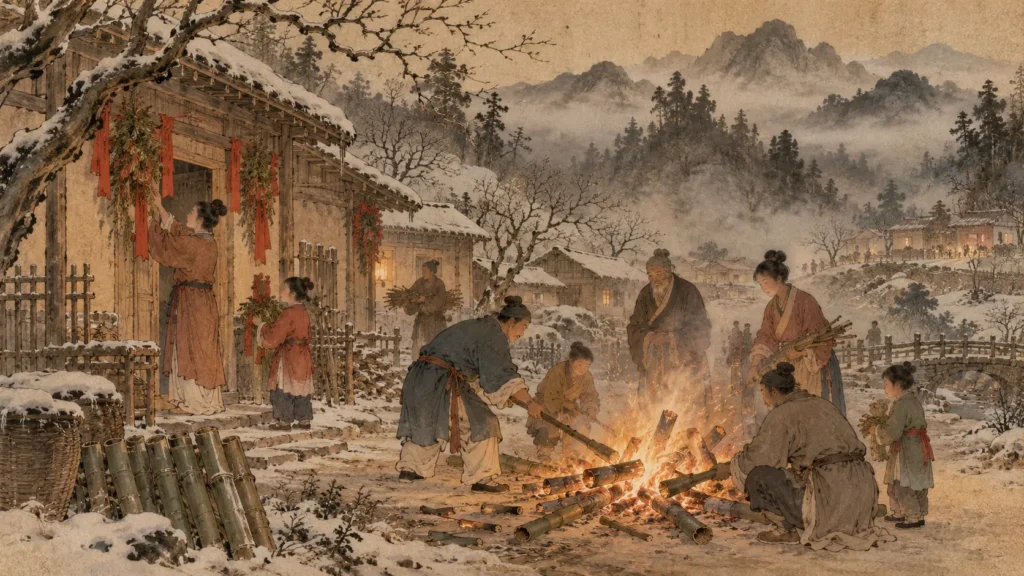
Red paper appeared on the doors.
Bamboo cracked in the flames.
The monster fled.
Today this creature is known as Nian (年兽 / 年獸, Niánshòu) — the famous monster associated with Chinese New Year.
The story is often presented as an ancient explanation for firecrackers, red decorations and other Spring Festival traditions.
But there is a problem.
The New Year customs are ancient. The documented Nian monster story appears to be much younger.
That does not make Nian meaningless or “fake.”
It makes the story more interesting.
Nian Monster Quick Facts
| Chinese | 年兽 / 年獸 |
| Pinyin | Niánshòu |
| Meaning | Nian beast / Year beast |
| Type | New Year folklore monster |
| Associated festival | Chinese New Year / Spring Festival |
| Common fears | Red, loud noise, fire or bright light |
| Common modern appearance | Horned or lion-like monster |
| Documented written tradition | Mainly modern |
| Important distinction | The customs associated with Nian are much older than the documented monster story |
What Is the Nian Monster?
Nian is a monster from modern Chinese New Year folklore that is said to appear around the end of the year and terrorize human communities.
There is no single fixed version.
In the most familiar telling, Nian spends most of the year hidden in the mountains or beneath the sea.
On New Year’s Eve, it emerges.
It attacks livestock, destroys property and, in darker versions, threatens people.
The villagers eventually discover that Nian cannot tolerate red, bright fire and loud sounds.
The creature is driven away.
From then on, people repeat these actions every New Year.
It is a perfect origin story for many familiar festival traditions.
Perhaps too perfect.
The Famous Story of Nian
One of the most widely repeated versions begins with an entire village preparing to flee before Nian arrives.
An old stranger appears.
While everyone else escapes, he remains behind.
Red decorations are placed around the house.
Lights burn.
Loud explosions fill the night.
When Nian comes, the combination terrifies the monster and drives it away.
The villagers return and realize that the creature can be defeated.
Versions of this modern narrative differ considerably.
Sometimes the hero is an old beggar.
Sometimes he is revealed to be a divine figure.
In other versions, Nian is eventually captured or controlled by an immortal.
Its home can be a mountain, cave or the sea.
Even the creature’s appearance changes from one telling to another. Visit Beijing
That variation becomes important when we ask how old the story actually is.
Is Nian an Ancient Chinese Myth?
The Nian monster is genuine Chinese folklore, but there is little evidence that the familiar monster story is an ancient myth.
Chinese New Year itself is enormously old.
The customs surrounding the turning of the year also have deep historical roots.
But scholars looking specifically for the Nian monster have struggled to find it in premodern sources.
A 2013 academic study by Ge Yun examining the Spring Festival and the Nian legend concluded that the monster story functions as a later explanatory legend built around older cultural material, rather than the original source of the festival customs. fsxb.cbpt.cnki.net
More recent historical source tracing reaches a similar conclusion.
Research into Republican-era newspapers has identified a striking reference from 17 January 1933.
Shanghai writer Sun Yusheng, writing about old seasonal customs, described a New Year image showing a strange beast chained to a stone pillar.
Some people, he wrote, said it was the Heavenly Dog.
Others said the beast was called Nian and wanted to eat people.
Significantly, Sun himself admitted that he did not know the origin of the tradition. The Paper
This is one of the earliest printed Nian references yet identified.
But we should be precise:
1933 is evidence for the written record, not proof that nobody told Nian stories orally before 1933.
Some modern researchers argue that several oral versions may have circulated before they appeared clearly in print. JfDaily
What Does “Nian” Mean in Chinese?
This is another part of the legend that is frequently misunderstood.
The character 年 (nián) means year.
Older lexicographical traditions connect the word with the ripening of grain and the agricultural cycle.
The Chinese Text Project’s historical dictionary records the older sense of grain becoming ripe, from which the concept of a yearly cycle developed. ctext.org
In other words, there is no good evidence that the word originally meant “monster.”
That matters because a popular explanation claims:
过年 (guò nián) originally meant “survive Nian” or “defeat Nian.”
It is a clever retelling.
But it should not be presented as established etymological history.
The ordinary meaning is connected with passing or celebrating the year.
The monster story later gives the expression a dramatic second interpretation.
Did Nian Create the Tradition of Firecrackers?
No — firecrackers and noise rituals existed long before the documented Nian story.
This is one of the clearest examples of why chronology matters.
The sixth-century Jingchu Suishiji describes people burning bamboo at the beginning of the year to produce loud cracks and drive away shansao and evil spirits.
It does not mention Nian. ctext.org
Centuries later, New Year sources continued to describe explosive noise and ritual protection.
A Qing-period account of Beijing New Year customs records extensive use of firecrackers and explicitly looks back to the older tradition of driving off harmful spirits. Again, the custom does not require a Nian monster to explain its existence. ctext.org
So the relationship seems to run in the opposite direction from the popular story:
Ancient customs did not necessarily develop because of Nian.
The later Nian story helped explain customs that were already ancient.
Why Is Nian Afraid of Red?
The modern story almost always gives Nian a fear of red.
That conveniently connects the beast with red couplets, lanterns, clothing and decorations used around Chinese New Year.
But just as with firecrackers, we should not assume the monster created the tradition.
New Year protective practices involving doors, charms and ritual imagery existed long before the clearly documented Nian legend.
The monster gradually gathered these existing customs into one simple narrative:
Why red?
Nian fears red.
Why explosions?
Nian fears noise.
Why stay awake?
Nian might come at night.
It is incredibly effective storytelling.
That helps explain why the legend spread so successfully.
What Did the Nian Monster Look Like?
There is no single ancient description.
Modern Nian is frequently shown as a massive lion-like or dragon-like beast, often with horns, sharp teeth and an elaborate mane.
But these images should not be mistaken for a fixed classical creature description.
The early 1933 account is surprisingly vague.
The chained creature is described essentially as looking like a dog but not being a dog. The Paper
Later versions differ dramatically.
Some give Nian one horn.
Others make it lion-like.
Some stories place it underwater.
Others put it in mountain caves.
This is very different from a creature such as the Qilin, whose appearance and symbolic development can be traced through long textual and artistic traditions.
Nian’s visual identity is much more fluid.
Is Nian Connected to the Lion Dance?
Modern illustrations can make Nian look remarkably similar to a Chinese lion-dance costume.
That visual resemblance has helped connect the two in popular imagination.
But we should again avoid reversing the chronology.
There is no strong evidence that the lion dance itself began as a ritual specifically designed to defeat Nian.
The safer explanation is that later Nian imagery borrowed from a visual world that audiences already associated with Chinese festivals, monsters and ritual performance.
The creature became recognizable partly because artists gave it forms people already understood.
Why Did the Nian Story Become So Popular?
Because it explains an entire festival in one story.
Children do not need a long history lesson about changing ritual practices, agricultural calendars, door gods, exorcism and regional customs.
They need one monster.
Nian takes many separate traditions and connects them:
red decorations,
firecrackers,
staying awake,
family protection,
and the arrival of a new year.
That simplicity is probably one reason the story became so powerful during the twentieth century.
A legend does not need to be thousands of years old to become culturally meaningful.
People tell it.
Parents teach it.
Books illustrate it.
Festivals perform it.
Eventually, the story becomes part of the tradition itself.
Why Nian Still Matters
Nian teaches us something important about mythology.
Traditions do not stop developing because ancient books have already been written.
New stories appear.
Old customs gain new explanations.
The explanation may become so popular that it feels older than it really is.
Nian is a perfect example.
The monster probably did not create Chinese New Year.
It did not invent red decorations.
It did not invent firecrackers.
But it gave generations of people an unforgettable story that tied those customs together.
And that is its own kind of mythology.
Sometimes legends survive because they are ancient.
Sometimes they survive because they explain something perfectly.
Nian may belong to the second kind.
References & Sources
Zhu Chunxiang — “Tracing the Origins of the Nian Beast Legend”
Detailed historical investigation of Republican-era newspapers, including Sun Yusheng’s 1933 description of a beast called Nian. The Paper
Read the historical investigation
Jingchu Suishiji — New Year customs
Early source documenting bamboo explosions used to repel harmful supernatural beings centuries before the modern Nian story. ctext.org
Chinese Text Project source