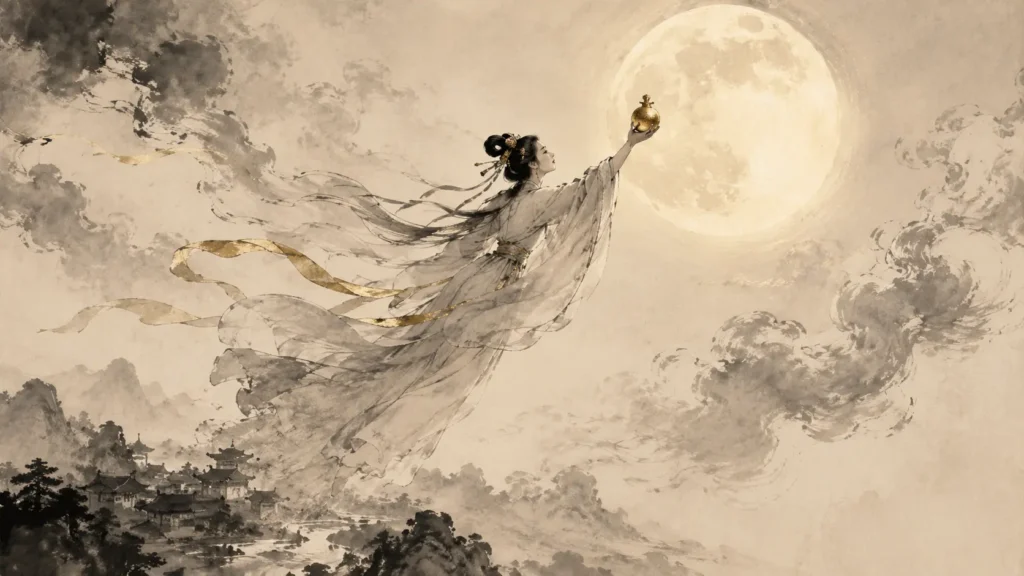
On the brightest nights of autumn, families look toward the full moon.
Some see light reflected across the sky. Others see the outline of a rabbit, a distant palace, and the lonely figure of a woman who left the human world behind.
Her name is Chang’e.
She is one of the most recognizable figures in Chinese mythology, yet her story is not as simple as it first appears. In some versions, she is selfish. In others, she sacrifices everything to protect the elixir of immortality. Sometimes she chooses the moon. Sometimes the moon becomes her punishment.
The details change, but one image remains:
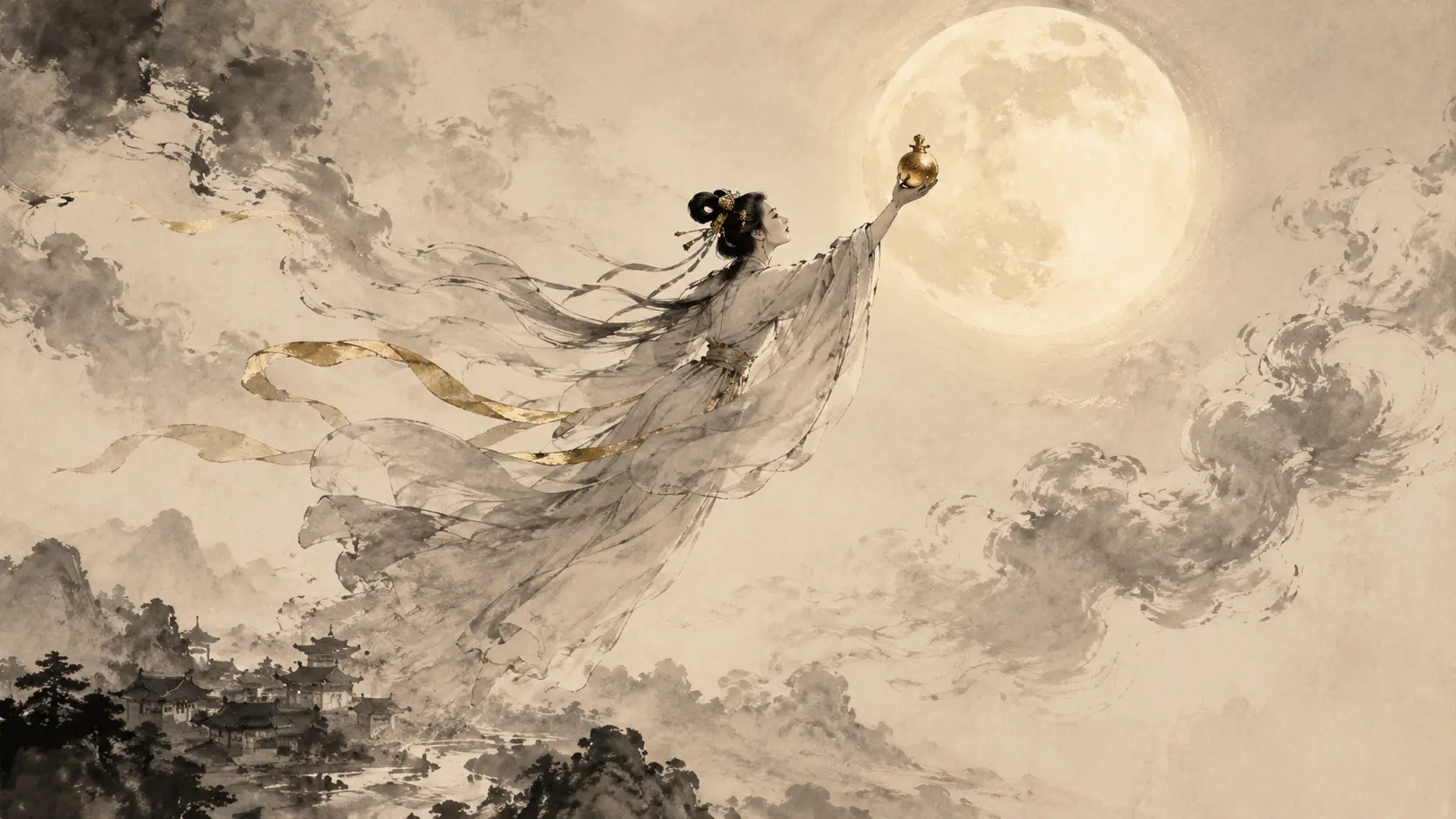
Chang’e rising from the earth, leaving Hou Yi below, and becoming forever connected with the moon.
Who Is Chang’e?
Chang’e is the moon goddess of Chinese mythology and the wife of the legendary archer Yi, commonly known today as Hou Yi.
Her name also appears in older sources as Heng’e or 姮娥. The spelling later changed to Chang’e, traditionally explained as an avoidance of the personal name of Emperor Wen of Han.
Unlike figures whose stories survive in one complete ancient narrative, Chang’e developed through texts, poetry, religious imagery, folklore, and festival traditions over many centuries.
That is why there is no single version that can be called the only correct one.
The oldest surviving accounts are much shorter and darker than the romantic story usually told today.
The Elixir of Immortality
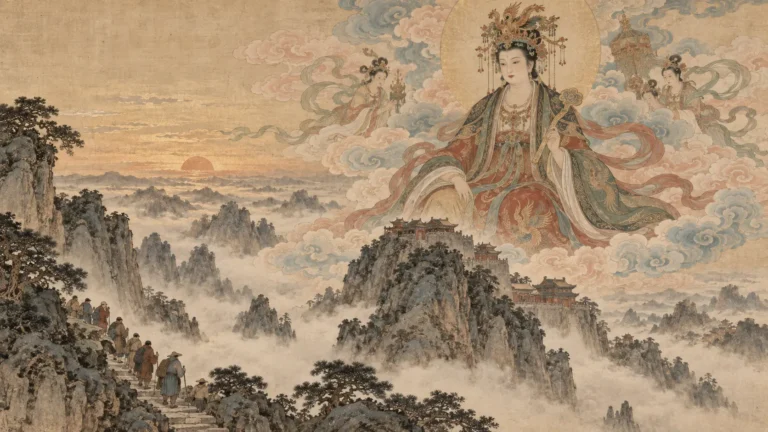
In the Huainanzi, a work completed during the early Han period, Yi receives the medicine of immortality from Xiwangmu, the Queen Mother of the West.
Chang’e secretly takes it and flees to the moon. The ancient passage offers little explanation of her feelings or motives. It does not describe an intruder entering their home, nor does it present her decision as an act of heroic sacrifice.
That simplicity is important.
The earliest story is not yet a full romance. It is a brief and unsettling image: immortality is obtained, trust is broken, and a woman disappears into the sky.
Later traditions expanded the story.
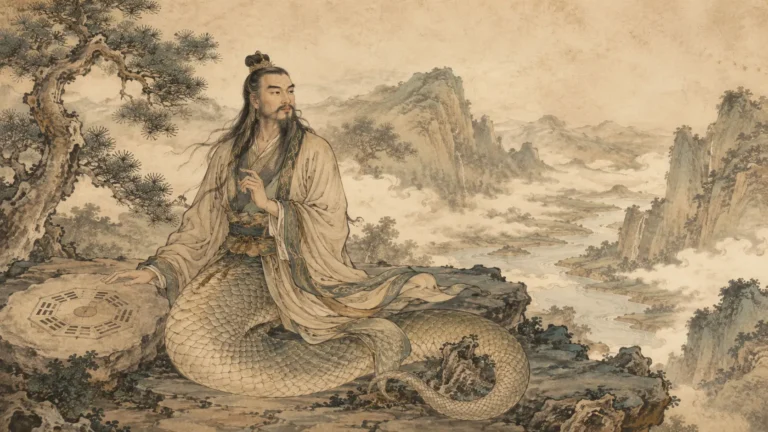
Hou Yi became the hero who had saved the world by shooting down nine of the ten suns. As a reward, he received an elixir that could free a person from death.
But Hou Yi did not immediately drink it.
He wished to remain with Chang’e.
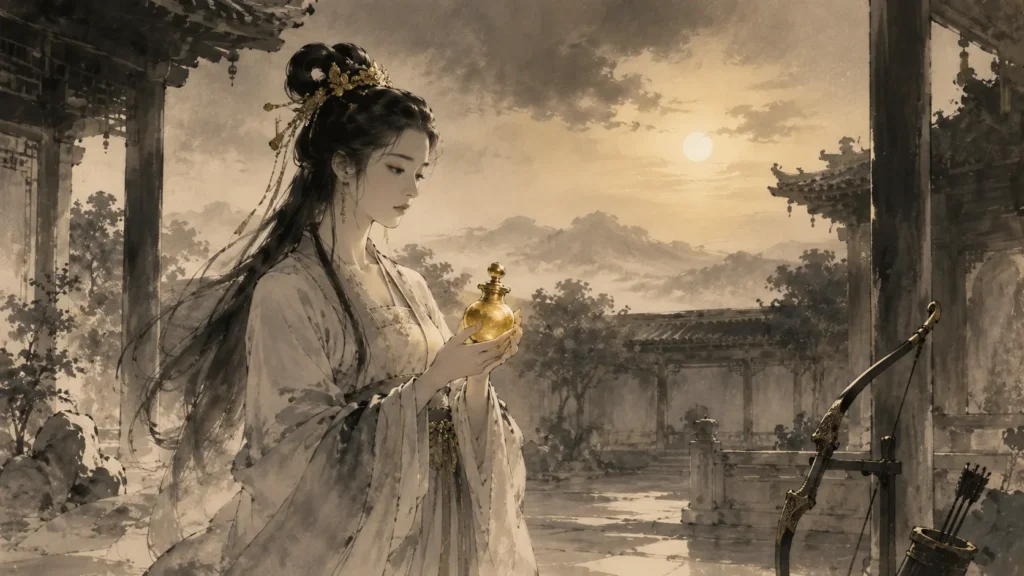
Why Did Chang’e Drink the Elixir?
This is where the legend divides into different paths.
In one popular modern retelling, a dangerous man attempts to steal the elixir while Hou Yi is away. Chang’e drinks it to prevent the medicine from falling into the wrong hands. Her body becomes light, and she rises toward the moon.
In another tradition, she takes the elixir for herself.
She chooses immortality, even though it means abandoning her husband and the mortal world. Museum descriptions preserve this less sympathetic version, describing her as stealing the elixir before fleeing to the moon.
Neither version should be presented as the final truth.
Myths change because the people telling them change. A figure once remembered as a thief can later become a protector. An act of betrayal can be reshaped into an act of sacrifice.
Perhaps this is one reason Chang’e remains so fascinating.
Her choice can be judged in completely different ways.
Chang’e Ascends to the Moon
After drinking the elixir, Chang’e begins to rise.
The house disappears beneath her. Mountains become shadows. Rivers turn into narrow silver lines, and the human world slowly falls away.
She eventually reaches the moon, where she becomes immortal.
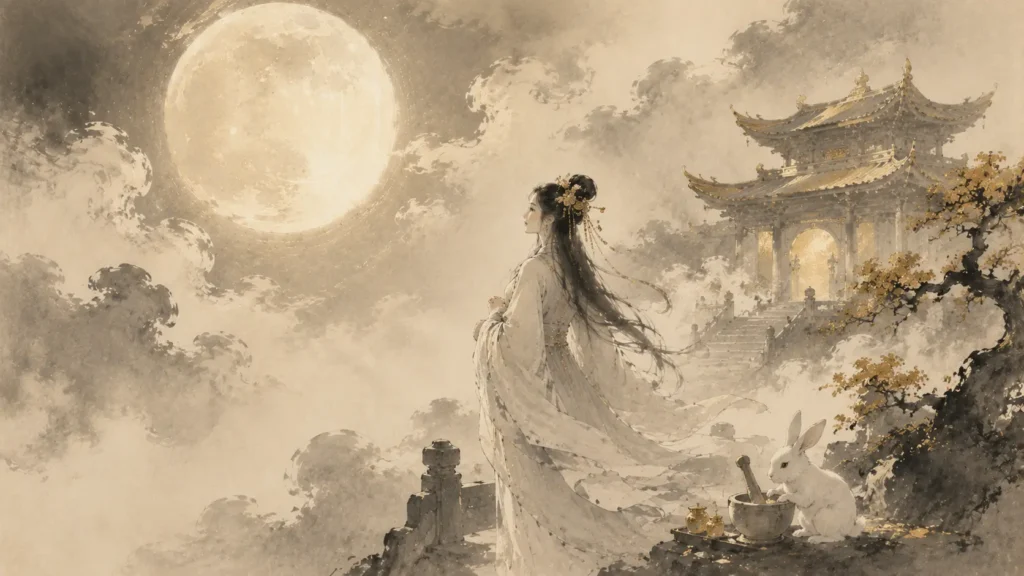
Later artistic traditions often place her inside a celestial moon palace, surrounded by attendants, magical plants, and symbols of longevity. Historical works of art also associate her with rabbits, osmanthus or cassia branches, and the preparation of the medicine of immortality.
Yet immortality does not necessarily bring happiness.
Chang’e possesses what human beings have desired for centuries: freedom from death. But she must live far from the person and the world she once knew.
She escapes mortality only to enter eternal separation.
The Toad and the Jade Rabbit
The beautiful moon goddess familiar today was not always imagined in the same form.
A tradition associated with the ancient astronomer Zhang Heng says that after reaching the moon, Chang’e became a toad. The toad itself was an old lunar symbol, connected with the moon’s changing shape and mysterious surface.
In later imagery, the toad became less prominent, while the Jade Rabbit emerged as Chang’e’s best-known companion.
The rabbit is often shown using a mortar and pestle to prepare magical medicine. It became so closely linked with Chang’e that rabbits appearing beside a female celestial figure can identify her in Chinese art.
Chang’e, the rabbit, the moon palace, and the elixir did not necessarily enter the myth at the same moment.
Over time, they became part of one shared lunar world.
Chang’e and the Mid-Autumn Festival
Chang’e is closely associated with the Mid-Autumn Festival, celebrated on the fifteenth day of the eighth lunar month.
The festival is connected with the full moon, harvest, family gatherings, and reunion. Stories about Chang’e and Hou Yi are among its best-known mythological traditions.
The connection contains a quiet contradiction.
Families gather together beneath the moon, but the goddess living upon it is separated from the person she loved.
The full moon represents completeness.
Chang’e represents the pain of what is missing.
Perhaps the story survives because it holds both ideas at once: reunion and separation, love and regret, freedom and loneliness.
Why the Legend of Chang’e Still Matters
Chang’e is sometimes reduced to a beautiful goddess standing beneath a full moon.
But her story asks a difficult question.
What would immortality be worth if it separated you from everything that made life meaningful?
Her legend does not provide one answer.
If she stole the elixir, the story can be read as a warning about desire. If she drank it to protect others, it becomes a story of sacrifice. If she was forced into an impossible decision, it becomes a tragedy.
In every version, Chang’e gains the heavens and loses the earth.
She becomes immortal, but not untouched by sorrow.
And each time the full moon rises, her story reminds us that getting what we desire does not always mean keeping what we love.
References and Sources
- Chinese Text Project — Huainanzi, Volume 22
Ancient textual account in which Yi receives the elixir of immortality from Xiwangmu and Chang’e secretly consumes it. - Chinese Text Project — Ancient Texts on the Moon and Chang’e
A collection of early Chinese passages concerning the moon, Chang’e, the elixir of immortality, and her journey to the lunar palace. - British Museum — Chang’e 嫦娥
Museum biography describing Chang’e as the Chinese moon goddess, her connection with Hou Yi, and the different versions of her legend.