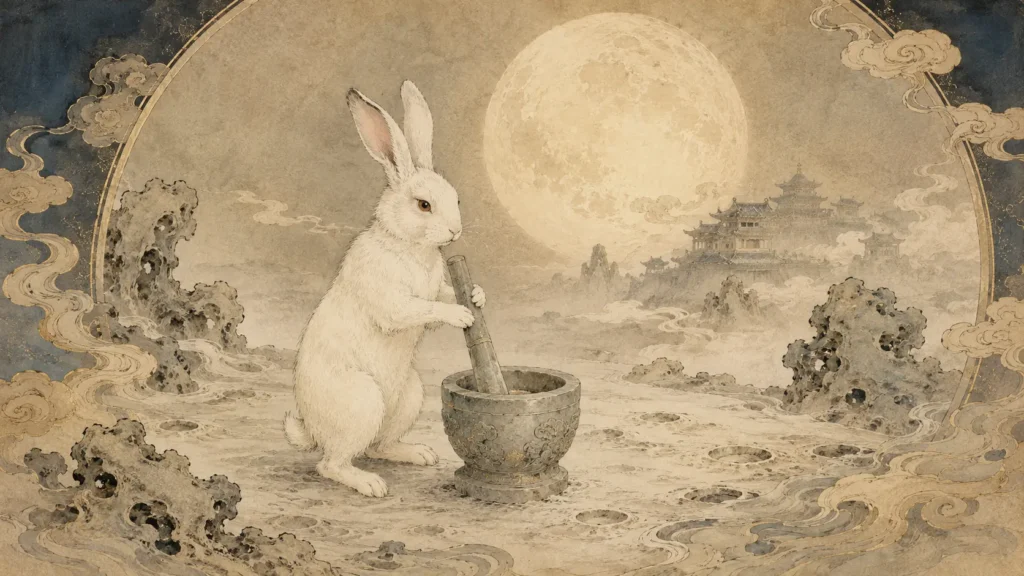
Look carefully at the full moon.
Across its pale surface, dark shapes stretch between the light.
Some cultures saw a face.
Ancient China saw something else.
A rabbit.
And over centuries, that animal became one of the most recognizable inhabitants of the Chinese mythological Moon—a mysterious creature forever connected with medicine, immortality, and eventually the moon goddess Chang’e.
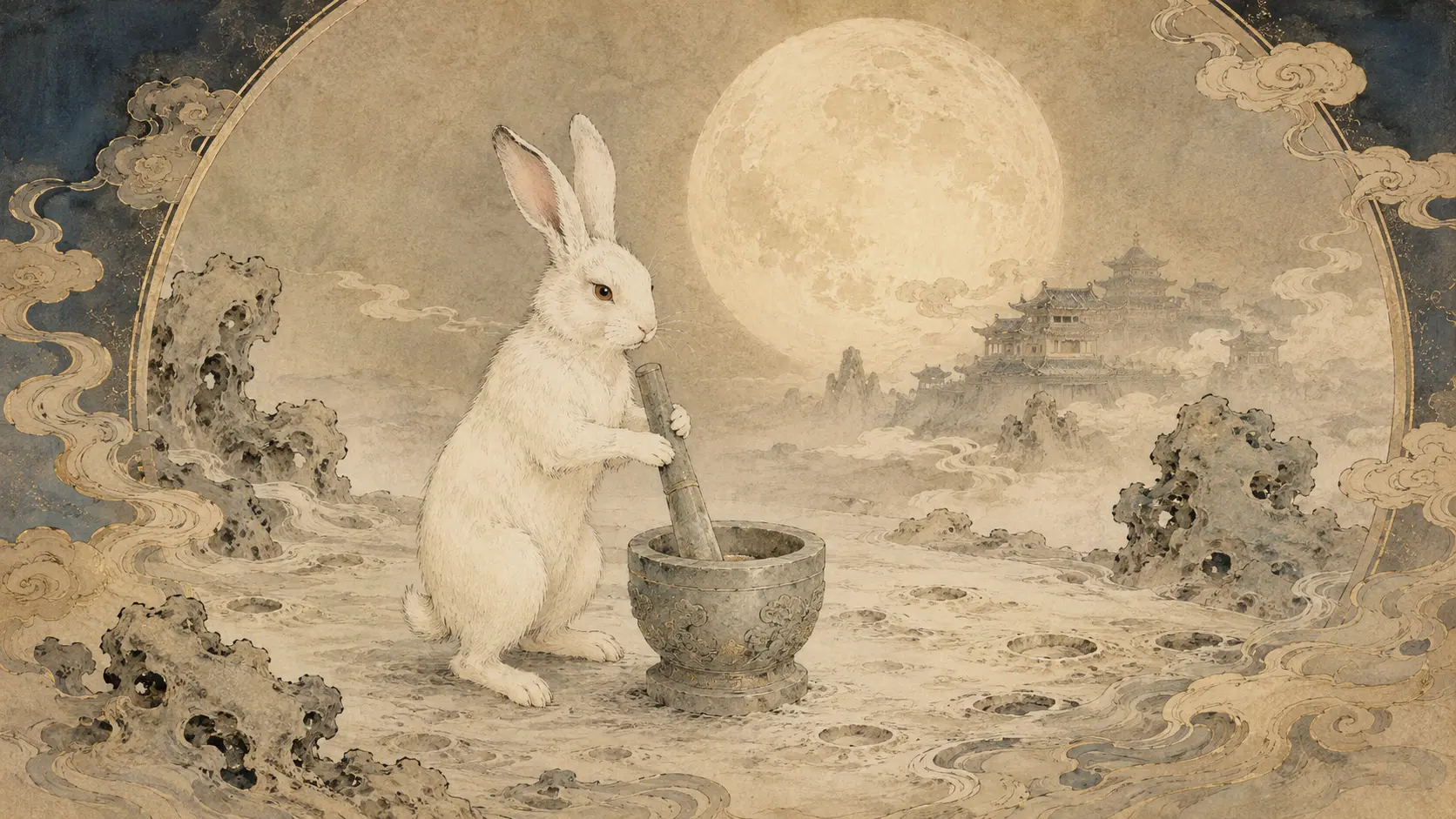
The Jade Rabbit (玉兔, Yùtù), also known as the Moon Rabbit (月兔, Yuètù), is the legendary rabbit on the Moon in Chinese mythology. Chinese tradition depicts the rabbit using a mortar and pestle to prepare medicine or the elixir of immortality, and later art frequently places it beside Chang’e in the Moon Palace.
What Is the Jade Rabbit?
The name Yùtù (玉兔) literally means “Jade Rabbit.”
Another common name is Yuètù (月兔)—the “Moon Rabbit.”
Both belong to the wider Chinese tradition of imagining a rabbit or hare living on the Moon.
This belief is ancient.
The Han-period Lunheng discusses the widespread claim that there is a rabbit and a toad in the Moon, while other early traditions preserved in later encyclopedic sources also refer explicitly to the lunar rabbit.
That means the Jade Rabbit was not created as a minor side character in the Chang’e story.
The lunar rabbit already had its own ancient identity.
The famous partnership between the rabbit and Chang’e developed within the larger Chinese mythology of the Moon.
Why Is There a Rabbit on the Moon?
The simplest explanation begins with the Moon itself.
Dark volcanic plains across the lunar surface create patterns visible from Earth. Across parts of Asia, these markings came to be interpreted as the shape of a rabbit.
JAXA research on the tradition notes that Asian cultures have associated the Moon’s visible surface pattern with a rabbit for well over a thousand years, and Chinese tradition became particularly influential in the later East Asian image of the Jade Rabbit.
But ancient Chinese writers did not treat the rabbit merely as an optical illusion.
Once placed on the Moon, it became part of a supernatural lunar world.
There was the rabbit.
There was the toad.
Later there was Chang’e.
And the rabbit eventually acquired one unmistakable task.
It began to pound medicine.
Why Does the Jade Rabbit Pound Medicine?
The mortar and pestle are among the Jade Rabbit’s most recognizable symbols.
An old Chinese poetic tradition preserved in the Taiping Yulan includes the image:
兔搗藥月間
A rabbit pounding medicine in the Moon.
Later Chinese tradition developed that medicine into an elixir of immortality.
This distinction matters because the rabbit is sometimes described online as making rice cakes.
That is primarily associated with later Japanese interpretations.
JAXA’s research specifically distinguishes the Chinese tradition: the Chinese Jade Rabbit pounds the elixir of immortality rather than mochi.
Chinese artworks repeatedly preserve this image.
A Tang-dynasty bronze mirror from the eighth or ninth century shows the lunar goddess, a toad, and a rabbit using a mortar and pestle to grind magical ingredients.
Centuries later, the same motif remained recognizable.
The rabbit kept pounding.
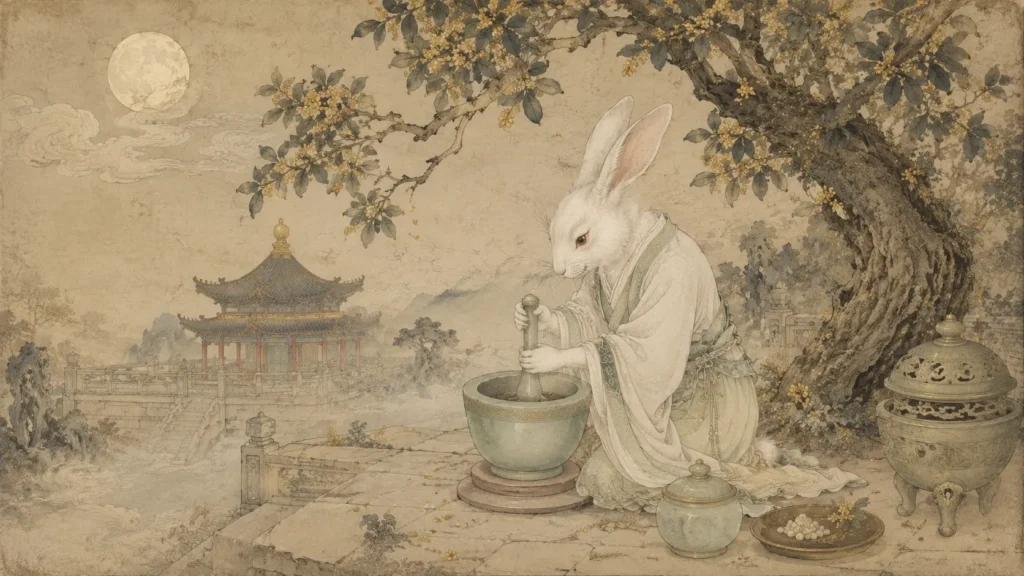
Jade Rabbit and Chang’e
Today, the Jade Rabbit is almost impossible to separate from Chang’e, the great moon goddess of Chinese mythology.
But historically, their traditions should not simply be collapsed into one origin story.
Chang’e’s mythology centers on the elixir of immortality and her ascent to the Moon.
The rabbit belongs to an older lunar-animal tradition.
Later Chinese imagination brought them together.
By the Tang dynasty, surviving art clearly places the rabbit within Chang’e’s lunar world. The Metropolitan Museum’s Mirror with Moon Goddess and Rabbit depicts Chang’e on the Moon alongside the rabbit preparing the magical elixir.
Later paintings make the relationship even clearer.
The Smithsonian’s The Goddess Chang’e in the Lunar Palace shows a white rabbit beside her and explains that the rabbit is traditionally depicted preparing the elixir of immortality with a mortar and pestle.
So the safest way to understand their connection is:
Chang’e and the Jade Rabbit are separate lunar traditions that became closely joined in later Chinese mythology and art.
For the full story of the goddess herself, read Chang’e: The Chinese Moon Goddess.
Does the Jade Rabbit Make the Elixir for Chang’e?
Modern retellings often say:
“The Jade Rabbit endlessly prepares the elixir of immortality for Chang’e.”
That is a useful summary of later folklore, but the historical picture is more complicated.
The lunar rabbit was already associated with pounding medicine, while Chang’e had her own separate connection to the immortality elixir.
Later literature and visual culture naturally fused these ideas.
A Ming-dynasty Moon Palace scene preserved by the Smithsonian shows the rabbit mixing the magical elixir while Chang’e presides nearby.
So yes—the Jade Rabbit preparing immortality medicine beside Chang’e is a genuine and longstanding Chinese tradition.
What we should avoid claiming is that one single ancient source first tells the entire modern version exactly as people repeat it today.
Chinese mythology grew through layers.
That is part of what makes it interesting.
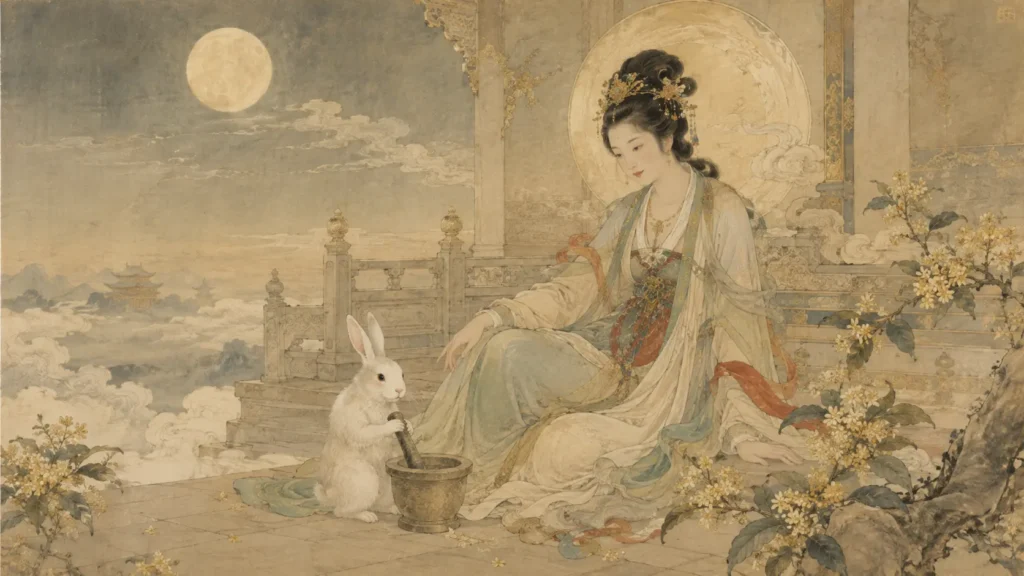
Is the Jade Rabbit White?
Today, the Jade Rabbit is often pictured as a beautiful white rabbit.
Later Chinese artworks support that visual tradition. The Smithsonian explicitly identifies the rabbit beside Chang’e as white in its description of the lunar palace painting.
But the oldest texts discussing a rabbit in the Moon are much less concerned with its fur color.
They establish the creature’s lunar presence.
Later painters and storytellers supplied more of the familiar visual identity.
That means a white Jade Rabbit is entirely appropriate for modern traditional-style illustration—but we should not pretend every early Chinese text explicitly describes white fur.
What Does the Jade Rabbit Symbolize?
The Jade Rabbit became strongly associated with the Moon, medicine, immortality, and longevity.
This connection appears clearly in Chinese art.
The Metropolitan Museum notes that the lunar rabbit assists Chang’e in preparing the elixir of immortality, while research published by the museum discusses the rabbit and Moon as familiar symbols of immortality and freedom from aging in later Chinese visual culture.
The rabbit’s meaning therefore comes from more than its appearance.
Its most famous action is repetitive and eternal:
pounding medicine beneath the Moon.
Night after night.
Century after century.
That makes it a natural companion to stories about immortality.
The Jade Rabbit and the Mid-Autumn Moon
The Jade Rabbit eventually became closely associated with the wider cultural world surrounding the full Moon and Mid-Autumn traditions.
This makes sense visually.
The legend begins with people looking upward.
A bright full moon offers the clearest canvas on which to imagine the rabbit’s silhouette.
Chang’e, the Moon Palace, the rabbit, the immortal elixir, and later lunar imagery gradually became part of a shared mythological landscape.
The rabbit is therefore not merely “another creature.”
It belongs to one of the most recognizable celestial spaces in Chinese culture.
Jade Rabbit vs Moon Rabbit
For SEO—and for mythology—this distinction is simple.
Jade Rabbit, Moon Rabbit, and Rabbit on the Moon are different English ways of reaching the same core Chinese lunar-rabbit tradition.
In Chinese, 玉兔 (Yùtù) emphasizes the “Jade Rabbit,” while 月兔 (Yuètù) literally means “Moon Rabbit.”
The names may appear differently depending on the text, translation, period, or modern retelling.
That is why this page should own all of these search intents rather than creating separate articles for each phrase.
Creating one page for “Jade Rabbit” and another for “Rabbit on the Moon” would split the authority of what is essentially the same entity.
Why the Jade Rabbit Still Matters
The Jade Rabbit has almost no great battle.
It carries no legendary sword.
It never challenged Heaven like Sun Wukong.
It does something far quieter.
It sits on the Moon.
A pestle rises.
A mortar waits below.
Medicine is crushed beneath the pale lunar light.
Nearby stands Chang’e, immortal and forever separated from the human world below.
And every time people look at the full Moon and recognize the outline of a rabbit in its shadows, the ancient image becomes visible again.
That may be the Jade Rabbit’s greatest power.
It does not need a temple or a monster to survive.
It only needs people to look up.
Reference:
1. Metropolitan Museum of Art — Celebrating the Year of the Rabbit
2. Metropolitan Museum of Art — Mirror with Moon Goddess and Rabbit
3. Smithsonian National Museum of Asian Art — The Goddess Chang’e in the Lunar Palace
Museum source showing Chang’e with the white rabbit preparing the elixir using a mortar and pestle.