Imagine pulling a fish from an ancient river.
At first, its head looks almost ordinary.
Then the water moves.
Behind that single head are not one, but ten bodies.
That is almost all the Shan Hai Jing needs to make Ziyu unforgettable.
There is no battle.
No legendary hero.
No cosmic power.
Just one of the strangest animals ever recorded in China’s ancient geography of the impossible.
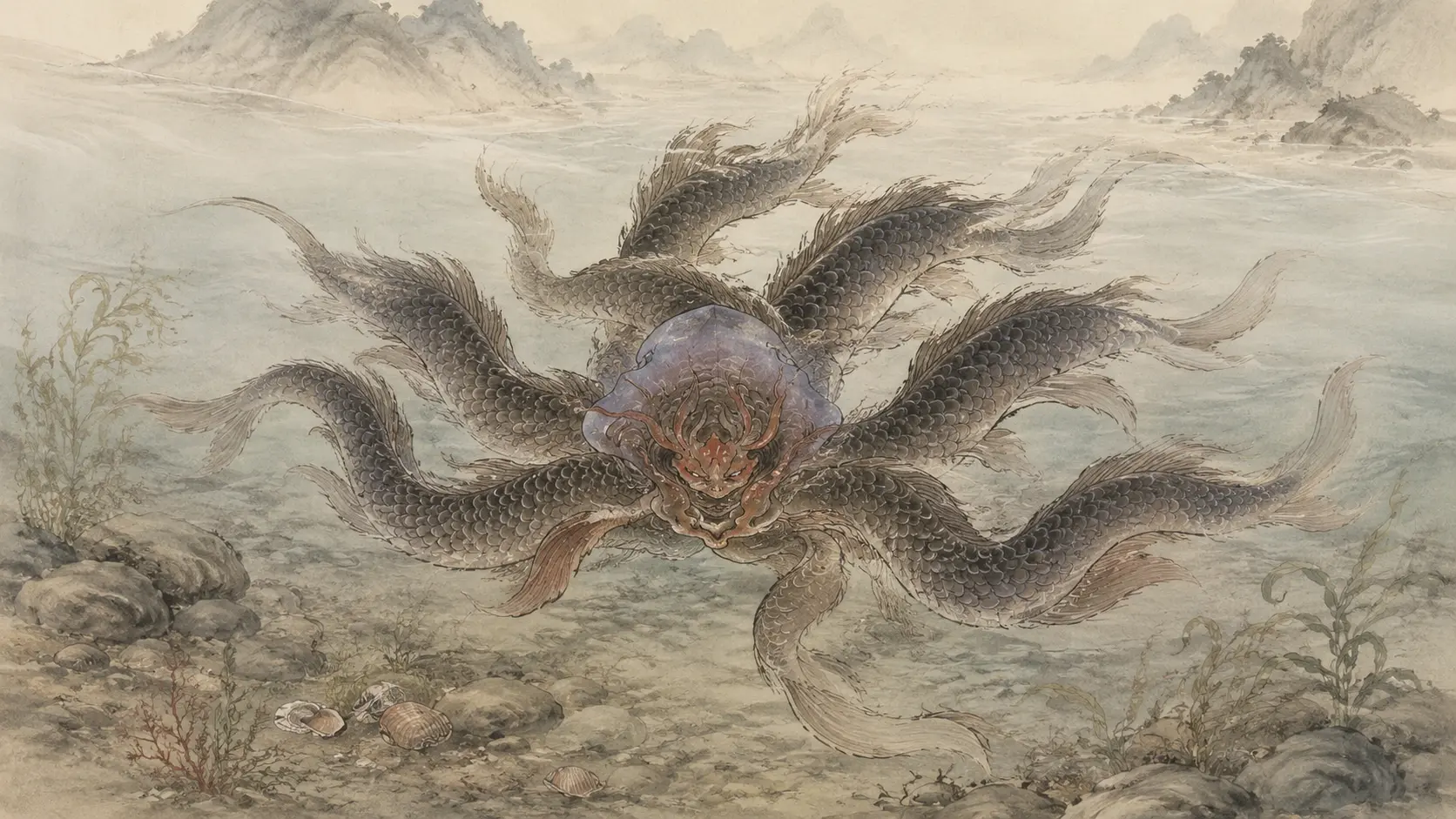
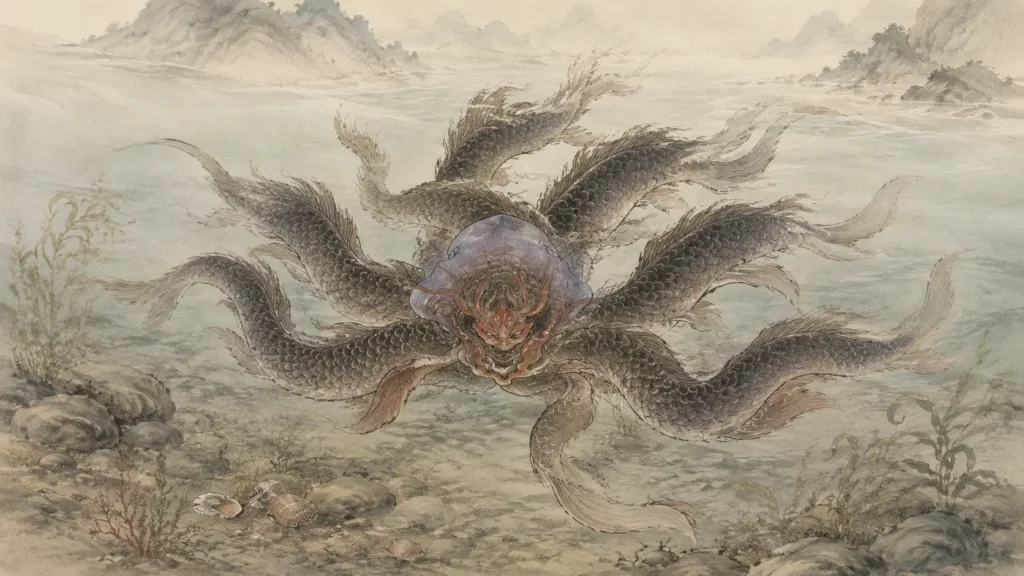
Ziyu (茈鱼, Zǐyú) is a mythical fish from the Eastern Mountains Classic of the Shan Hai Jing. The ancient text says it resembled a fù fish, commonly understood as a crucian-carp-like fish, but possessed one head and ten bodies. It lived in the Ci River near Dongshi Mountain, smelled like the plant miwu, and was believed to have an unusual dietary effect when eaten.
What Is Ziyu?
Ziyu appears in the Dongshan Jing (东山经), or Classic of the Eastern Mountains.
The text leads the reader to Dongshi Mountain (东始之山).
The mountain is described as containing abundant blue-green jade. A strange tree also grows there, resembling a poplar with red patterns and sap like blood.
From Dongshi Mountain flows the Ci River (泚水).
The river runs northeast into the sea and contains beautiful shells.
Then the text introduces Ziyu:
其中多美贝,多茈鱼,其状如鲋,一首而十身,其臭如蘪芜,食之不䊧。
In natural English:
Its waters contain many beautiful shells and many Ziyu. They resemble fù fish, but have one head and ten bodies. Their smell is like miwu, and eating them prevents 䊧.
It is a remarkably compact description.
Yet almost every detail is unusual.
One Head and Ten Bodies
The defining feature of Ziyu is expressed in five characters:
一首而十身
One head and ten bodies.
The text does not say ten heads.
It does not simply describe a fish with ten tails.
And it does not explain precisely how the ten bodies connect to the single head.
That distinction matters when reconstructing Ziyu visually.
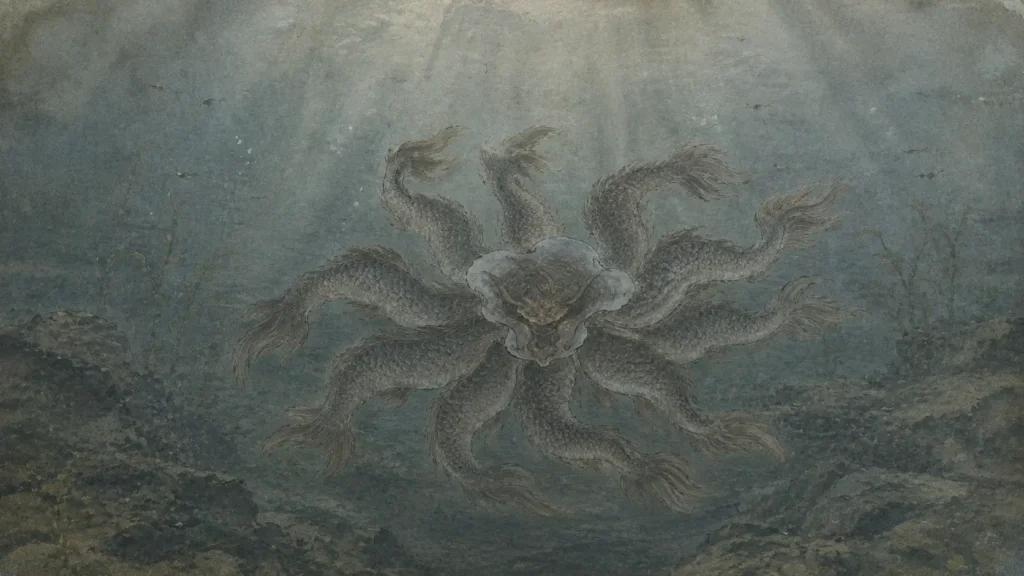
Modern illustrations often imagine a central head from which multiple fish bodies spread outward, producing something almost dragon-like.
That is a reasonable artistic solution, but the exact arrangement is not specified by the ancient source.
What we know for certain is stranger and simpler:
one head, ten bodies.
Nothing more needs to be invented.
What Did Ziyu Look Like?
Before describing the multiple bodies, the Shan Hai Jing says:
其状如鲋 — “its form resembles a fù fish.”
The word 鲋 / 鮒 traditionally refers to a small carp-like fish and is commonly associated with the crucian carp.
This gives Ziyu a surprisingly ordinary foundation.
Its head is not described as human.
It does not have horns.
It is not said to possess dragon claws or wings.
The supernatural element comes almost entirely from its impossible body structure.
That is why our illustrations should remain recognizably fish-like, even if the ten-body anatomy makes the creature look extraordinary.
The horned or dragon-like details found in some modern artwork are artistic interpretation rather than information given by the original passage.
Why Did Ziyu Have a Strange Smell?
The text gives Ziyu another unusually specific characteristic:
其臭如蘪芜 — “its smell was like miwu.”
Miwu (蘪芜) is the name of a plant mentioned in classical Chinese sources.
The Shan Hai Jing does not explain why Ziyu smelled like it.
There is no claim that the scent attracted prey, concealed the fish, or possessed supernatural power.
It is simply recorded as part of the animal’s identification.
That makes the Ziyu passage feel almost like an ancient field note:
appearance,
body structure,
smell,
and finally what happened if someone ate it.
What Happened If Someone Ate Ziyu?
This is easily the strangest part of the entry.
The final line says:
食之不䊧
The character 䊧 is obscure.
Fortunately, Guo Pu’s ancient commentary explains the term with:
止失气也
In other words, eating Ziyu was believed to prevent the downward release of bodily gas. Later sources preserve the same interpretation.
Put less delicately:
the ancient tradition associated eating Ziyu with preventing flatulence.
Yes, the Shan Hai Jing really includes that.
But an important distinction remains.
This is an ancient textual claim, not modern medical advice or evidence that such an effect actually existed.
The Shan Hai Jing frequently assigns unusual dietary effects to animals, plants, and other substances. Ziyu belongs to that wider pattern of strange creatures that were not merely observed but also described in terms of what eating them supposedly did.
Ziyu and the Heluo Fish
Ziyu has an exceptionally interesting relative elsewhere in the Shan Hai Jing.
The Northern Mountains Classic describes another creature called the Heluo Fish (何罗鱼).
And its anatomy sounds immediately familiar:
一首而十身 — one head and ten bodies.
But Ziyu and Heluo are not the same creature.
Heluo inhabits the waters flowing from Qiaoming Mountain (谯明之山).
Its cry sounds like a barking dog, and the text says eating it could cure yong (癰), usually referring to abscesses or swellings.
Ziyu, by contrast:
- lives in the Ci River near Dongshi Mountain;
- resembles a fù fish;
- smells like miwu;
- has the unusual dietary effect described above.
Their shared one-head, ten-body anatomy makes them one of the most fascinating pairs of creatures in the Shan Hai Jing.
But the text gives each one a separate identity, location, sound or scent, and effect.
When our dedicated Heluo Fish article is published, this should become the strongest internal link on this page.
Was Ziyu Based on a Real Animal?
The original text does not identify Ziyu with any known species.
Later writers naturally tried to understand bizarre Shan Hai Jing creatures by comparing them with real animals, but the ancient passage gives us no evidence strong enough to confidently identify Ziyu as a particular surviving fish.
The same caution should apply to its unusual anatomy.
A ten-bodied fish may invite comparisons with octopuses, malformed animals, groups of fish seen together, or symbolic imagery.
Those possibilities may be interesting.
They remain speculation.
For our purposes, Ziyu should first be understood exactly as the source presents it:
a strange fish of the Ci River with one head and ten bodies.
Why Ziyu Is Worth Remembering
Ziyu occupies only a few characters in an enormous ancient book.
Yet the image it creates is difficult to forget.
A river flows down from Dongshi Mountain toward the sea.
Beautiful shells cover its waters.
Among them swims something resembling an ordinary fish.
Until its body emerges.
One head.
Ten bodies.
A strange plant-like scent drifting from the water.
And an ancient claim about what happened to anyone willing to eat it.
The Shan Hai Jing rarely explains why creatures like Ziyu exist.
It simply tells us that somewhere beyond the familiar world, they did.
And sometimes that is enough to keep a monster alive for thousands of years.
Reference:
1. Chinese Text Project — Shan Hai Jing, Dongshan Jing
Primary text for Dongshi Mountain, the Ci River, and the original description of Ziyu.