Some creatures announce their arrival with fire, thunder, or a terrifying roar.
Mengji survives by doing the opposite.
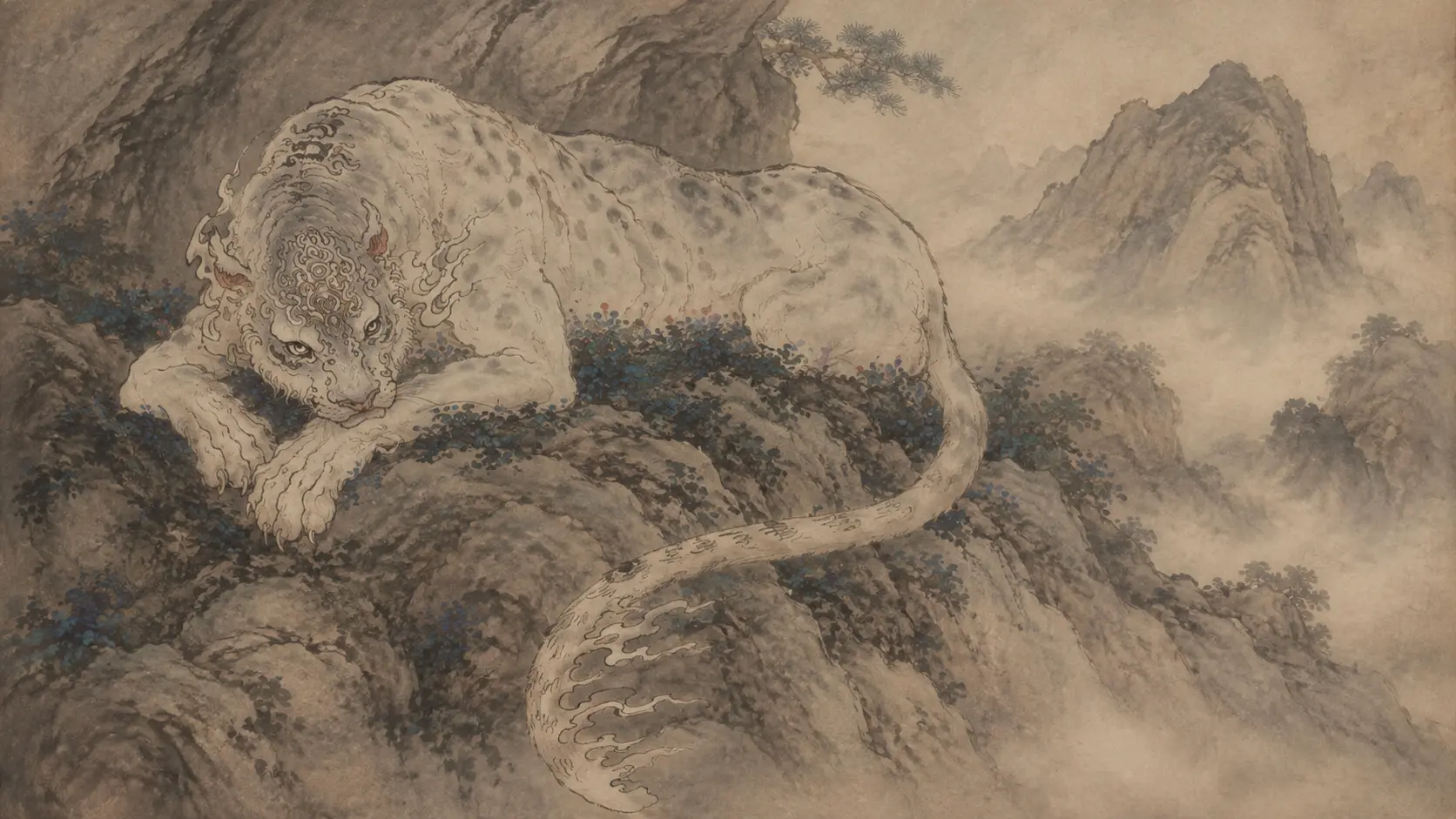
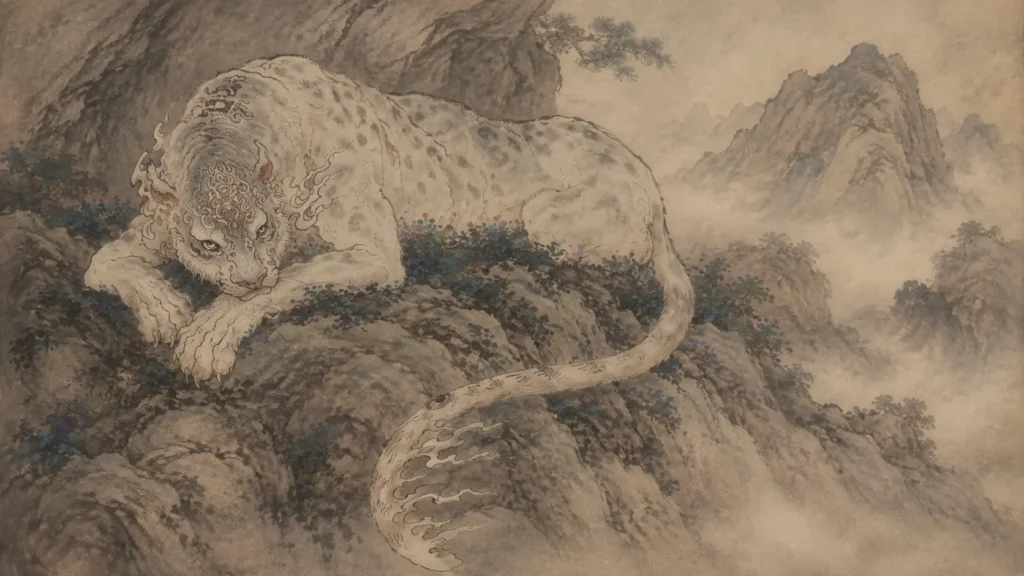
Hidden among the empty slopes of an ancient mountain, it waits without being seen. Its body resembles a leopard, but its fur is white and its forehead carries strange markings. It does not chase its prey through open ground.
It disappears into the landscape.
Mengji (孟极, Mèngjí) is a mysterious leopard-like beast recorded in the Shan Hai Jing. The ancient text describes it as having a patterned forehead, a white body, an extraordinary ability to hide, and a cry that sounds like its own name.
The description is short.
But it gives Mengji one of the clearest identities among the lesser-known beasts of ancient Chinese mythology.
What Is Mengji?
Mengji appears in the Beishan Jing, or Classic of the Northern Mountains, a section of the Shan Hai Jing.
The text places it on Shizhe Mountain, a barren landscape without grass or trees but rich in precious jade. A river flows from the mountain toward the Yellow River.
Among those empty slopes lives a beast shaped like a leopard.
Its body is white.
Its forehead is patterned.
And it is exceptionally skilled at concealment.
Unlike many famous creatures from Chinese mythology, Mengji is not given a dramatic battle, divine mission, or elaborate supernatural power.
Its defining ability is natural but formidable:
It knows how not to be seen.
Why Is Mengji Called Mengji?
The Shan Hai Jing states that Mengji’s cry “calls itself.”
This expression appears with several creatures in the ancient text. It generally means that the sound of the animal resembles the name by which people know it.
In other words, Mengji may have been named after its own call.
The text does not tell us exactly what that cry sounded like. It leaves the sound to the imagination, as though an unseen voice were repeating through the mountains:
Mèngjí. Mèngjí.
That detail makes the creature more unsettling.
A traveller might hear its name long before seeing the animal that produced it.
The Master of Concealment
The key phrase used for Mengji is 善伏 — shàn fú.
It means that the creature is skilled at hiding, crouching, lying concealed, or waiting in ambush.
This does not necessarily describe magical invisibility.
Mengji may simply have possessed exceptional natural camouflage and the patience of a predator.
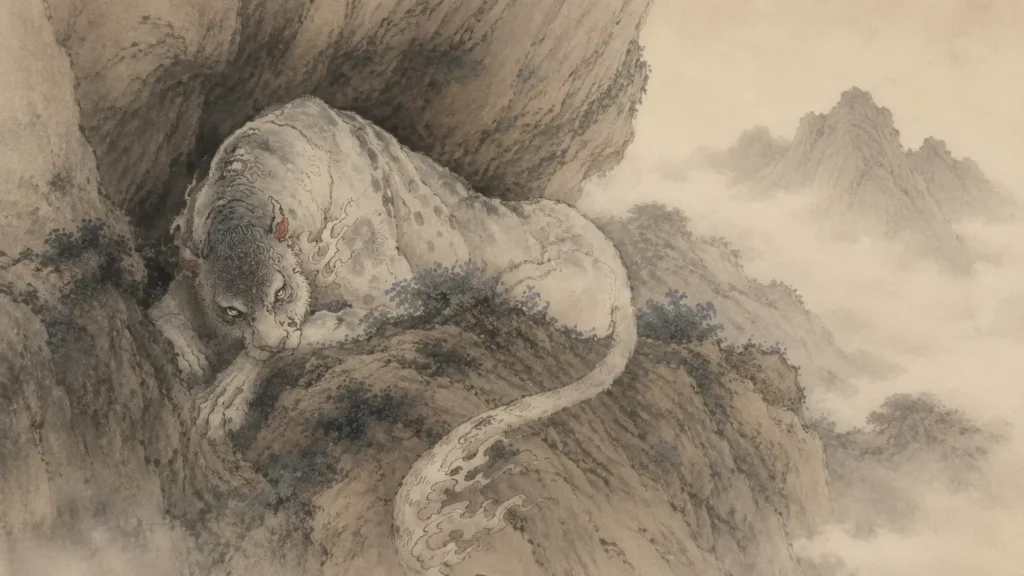
The illustration in the book captures this perfectly. Its body remains low against the rock, its enormous tail follows the shape of the mountain, and its pale coat seems capable of disappearing into mist, stone, or snow.
Mengji does not look like a creature preparing to overpower the entire world.
It looks like a predator that has already seen you—and knows you have not seen it.
Was Mengji a Real Leopard?
The ancient text does not provide enough information for a certain identification.
The modern commentary in the book suggests that Mengji may have been inspired by the North Chinese leopard, whose spotted coat and secretive hunting behaviour fit parts of the description.
However, the leopard’s ordinary coat does not fully explain Mengji’s white body.
Other researchers have proposed the snow leopard.
Snow leopards have pale fur, patterned heads and bodies, long tails, and an extraordinary ability to blend into rocky mountain environments. A scholarly discussion of snow-leopard history notes similarities between the animal and ancient descriptions of Mengji, while also warning that identifying a modern species from a brief ancient passage is difficult.
The honest answer is therefore:
Mengji may preserve a mythologized memory of a real leopard, but we cannot prove exactly which animal inspired it.
That uncertainty is part of what makes the creature fascinating.
Is Mengji a Monster?
The Shan Hai Jing does not call Mengji evil.
It does not say that the beast eats humans, causes war, predicts disaster, or grants protection when consumed.
It simply describes where it lives, what it looks like, how it hides, and how it sounds.
Calling Mengji a demon would therefore add something the original text never says.
It is better understood as a mysterious mountain beast existing somewhere between natural observation and mythological imagination.
Ancient travellers may have known that pale, elusive predators moved through remote landscapes.
The Shan Hai Jing transformed that knowledge into a creature worthy of an ancient bestiary.
Why Mengji Still Feels Powerful
Mengji is not memorable because it is the loudest creature.
It is memorable because it represents a different kind of power.
Patience.
Awareness.
Perfect control over when to move and when to remain still.
A predator that constantly reveals itself loses its advantage. Mengji survives because it understands the value of restraint.
That idea reaches beyond mythology.
Strength is not always demonstrated through noise, aggression, or attention. Sometimes real control means remaining unseen until the exact moment action becomes necessary.
The mountains of the Shan Hai Jing contain giants, monsters, and impossible hybrids.
But somewhere among them waits a white leopard with a patterned forehead.
You may never see Mengji.
That does not mean Mengji has not already seen you.
Reference:
- Chinese Text Project — Shan Hai Jing: Beishan Jing — the original passage describing Shizhe Mountain and Mengji.
- Chinese Text Project — Mengji Parallel Passage — the exact classical Chinese passage and parallel textual records.