Imagine entering a distant forest and hearing a creature call your name.
You have never seen it before.
You have never spoken.
Yet somehow, it already knows who you are.
Hidden inside the strange geography of the Shan Hai Jing, or Classic of Mountains and Seas, is a mysterious beast called the Xingxing—an ancient creature described in only a few lines, but remembered for one disturbing ability.
It knows the names of human beings.
The Beast with a Human Face
The Classic of the Southern Regions Within the Seas gives the Xingxing one of its clearest descriptions:
It knows human names, resembles a pig with a human face, and lives west of the legendary burial place of Emperor Shun. The text offers no explanation for how it learns those names—or what it intends to do with them.
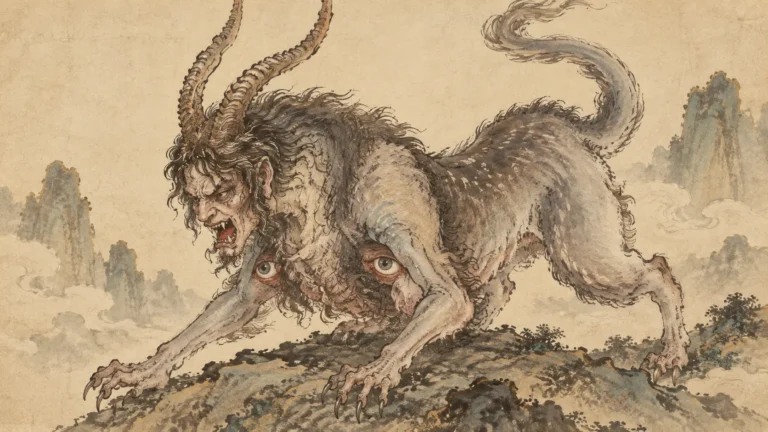
Another section of the Shan Hai Jing describes a green beast with a human face and calls it Xingxing.
Elsewhere, the creature looks different again.
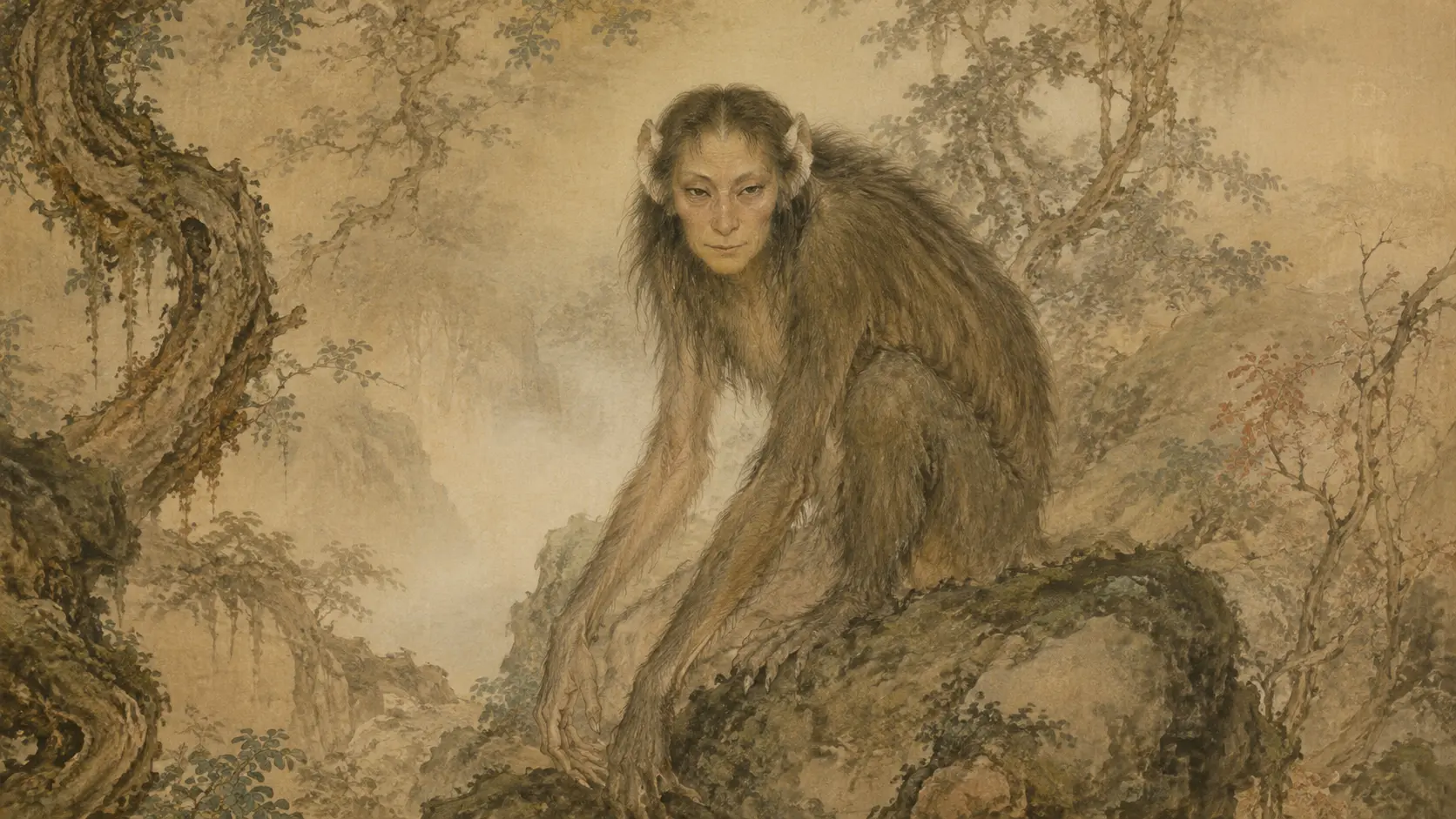
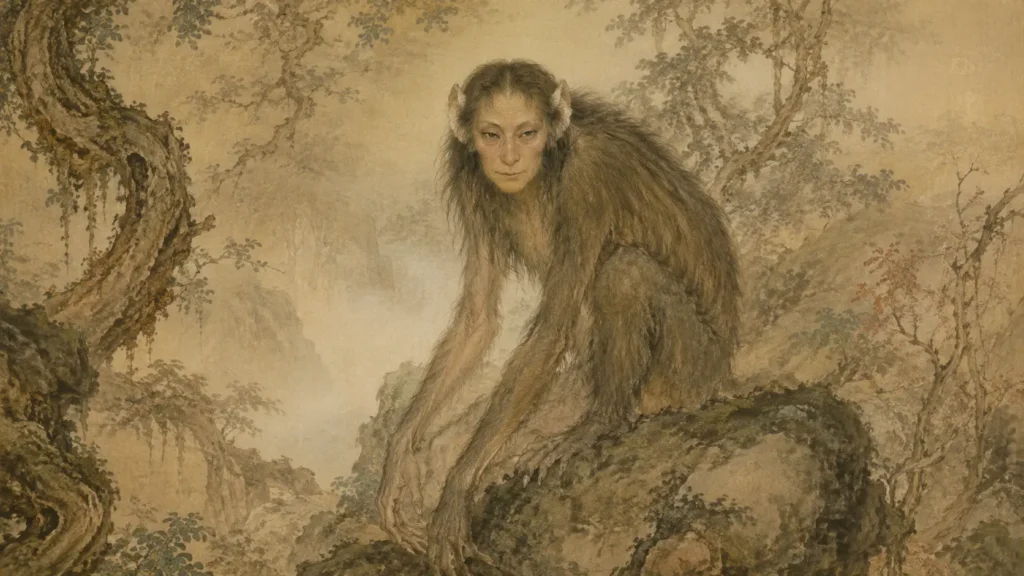
In the Southern Mountain Classic, the Shengsheng—an older written form associated with Xingxing—resembles a long-tailed ape with white ears. It crouches as it moves but can run like a human. The text even claims that eating its flesh would make a person a better runner.
These descriptions do not fit together perfectly.
The Xingxing may appear as:
- a pig-like animal with a human face;
- a green human-faced beast;
- or an ape-like creature with white ears.
Rather than one fixed monster design, the name may preserve several related traditions gathered from different places and periods. That is an interpretation, however—the original text never explains the differences.
A Monster That Is Not Entirely a Monster
The Shan Hai Jing does not say that the Xingxing hunts people.
It does not breathe fire, destroy villages, or guard a divine treasure.
Its disturbing quality is quieter.
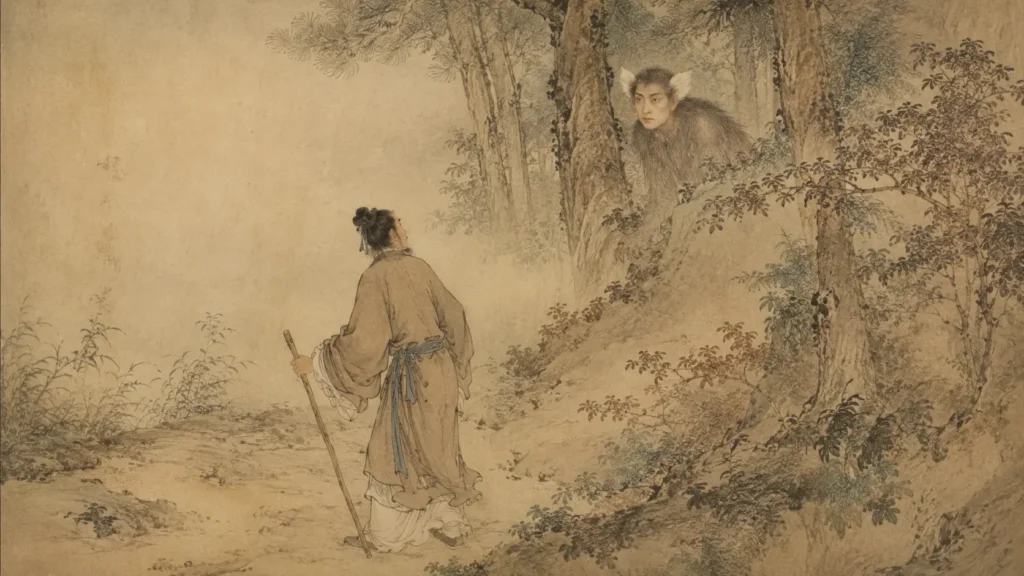
It looks partly human. It moves partly like a human. Most importantly, it possesses knowledge that no ordinary animal should possess.
The ancient text simply states that it knows people’s names and moves on.
That silence makes the creature more unsettling.
How did it learn them?
Did it hear them from travellers?
Could it recognise every person it met?
Or did knowing a name suggest that it understood something deeper about the person carrying it?
The surviving passage gives no answer. Any complete story about the Xingxing reading souls, stealing identities, or controlling people through names would therefore be a modern invention rather than something confirmed by the original source.
The Creature That Knew the Trap
Later Chinese texts expanded the Xingxing’s legend.
The Taiping Yulan, a large Song-dynasty encyclopedia preserving quotations from earlier works, describes conflicting traditions. In some accounts the creature resembles a pig, badger, dog, fox, or monkey. It may cry like a child, speak human language, and know the names of the people it encounters.
One later story gives the Xingxing a tragic weakness.
Hunters leave wine where the creatures can find it. The Xingxing supposedly understands that the offering is a trap. It even recognises the hunters and calls out their names.
But after initially resisting, it returns.
It tastes the wine, continues drinking, becomes intoxicated, and is captured.
The sixteenth-century Bencao Gangmu records versions of this tradition while also acknowledging that earlier descriptions disagreed over the creature’s appearance and ability to speak.
The Xingxing is therefore not portrayed as stupid.
It sees the danger.
It knows who created it.
It understands what will happen.
And it still walks into the trap.
Knowledge Without Self-Control
That is what makes the Xingxing more than another strange animal from an ancient bestiary.
Its defining gift is knowledge.
Its defining failure is the inability to act upon what it knows.
The creature can identify the hunter but cannot control its appetite. It can recognise the trap but cannot walk away from temptation.
That is also an uncomfortable human problem.
Most people already know that discipline requires consistent training, proper food, enough sleep, and repeated effort. The missing information is rarely the real obstacle.
Knowing what must be done is not the same as becoming the person capable of doing it.
A warrior does not build discipline by recognising every danger. He builds it by refusing to surrender when the danger arrives disguised as pleasure, comfort, or one harmless exception.
The Xingxing knew the names of the people hunting it.
But it did not yet know how to command itself.
And sometimes, that is the most dangerous kind of ignorance.
Reference:
- Chinese Text Project — Classic of the Southern Regions Within the Seas — the Xingxing knows human names and resembles a pig with a human face.
- Chinese Text Project — Southern Mountain Classic — the ape-like Shengsheng with white ears and human-like running ability.