At first, Zhujian almost sounds like a leopard.
Then the description keeps going.
Its tail is unusually long.
Its ears belong to an ox.
Its head looks human.
And in the middle of that face is only one eye.
Hidden on a barren mountain in the Shan Hai Jing, Zhujian is one of those creatures that becomes stranger with every detail.
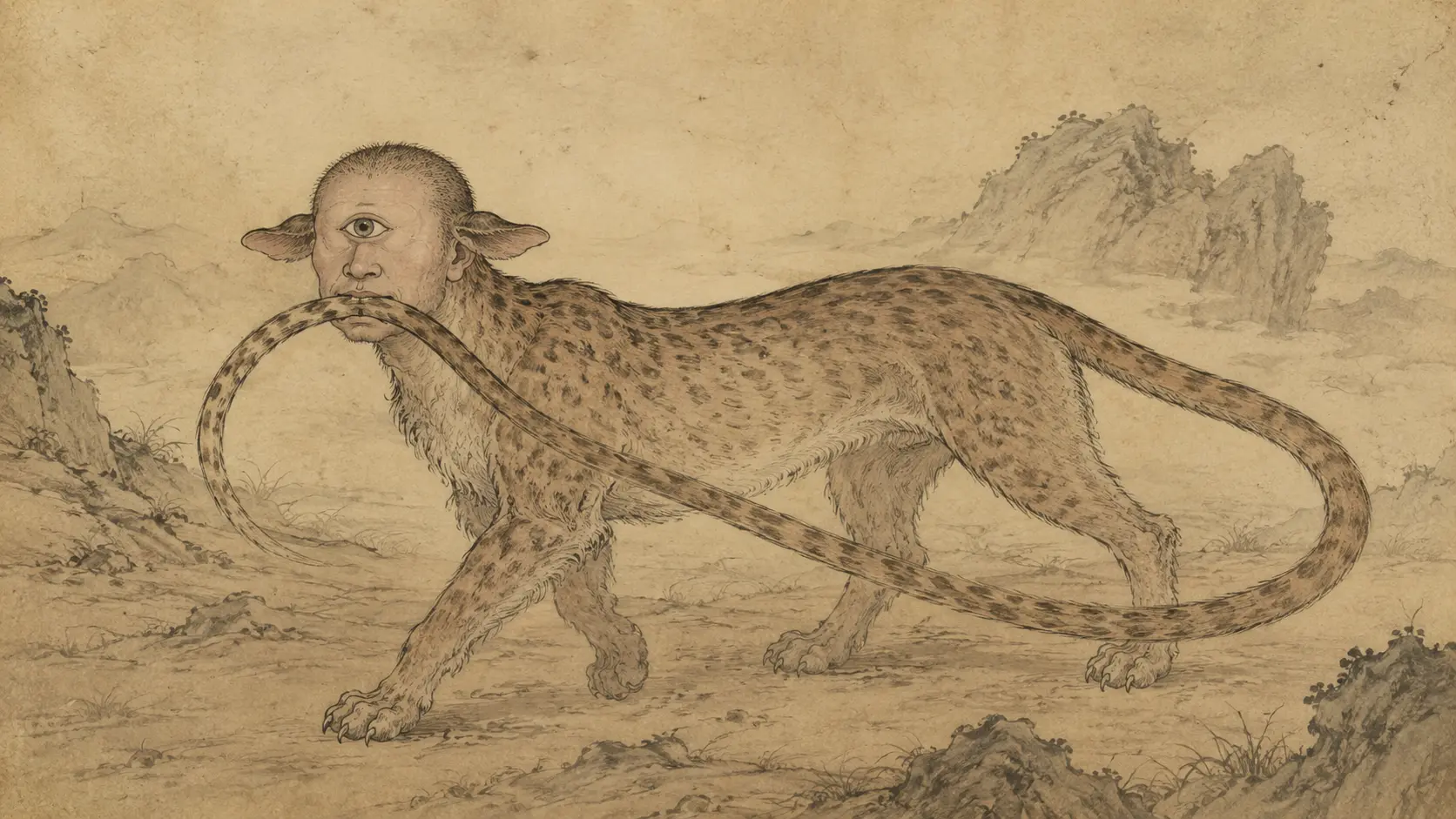
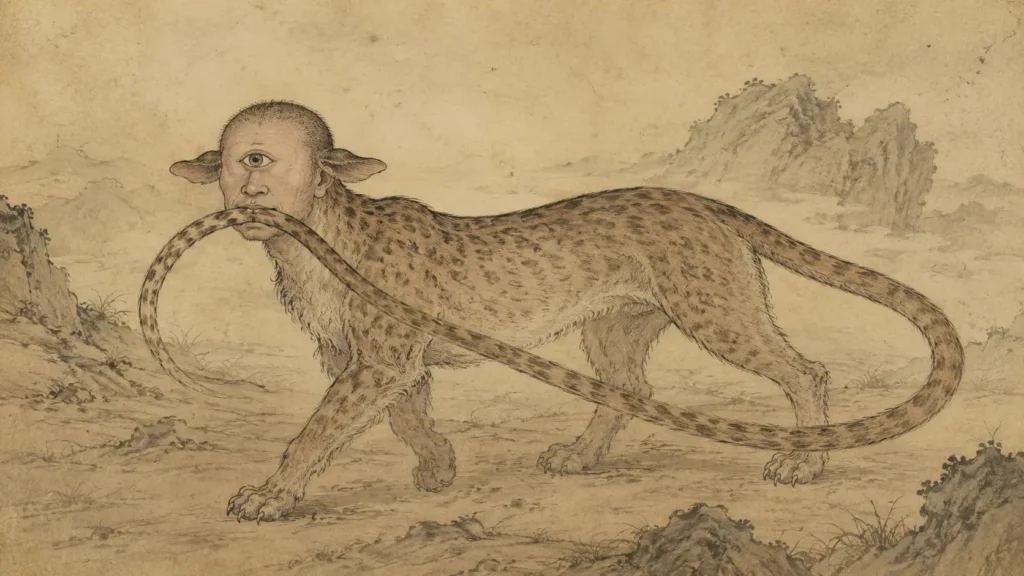
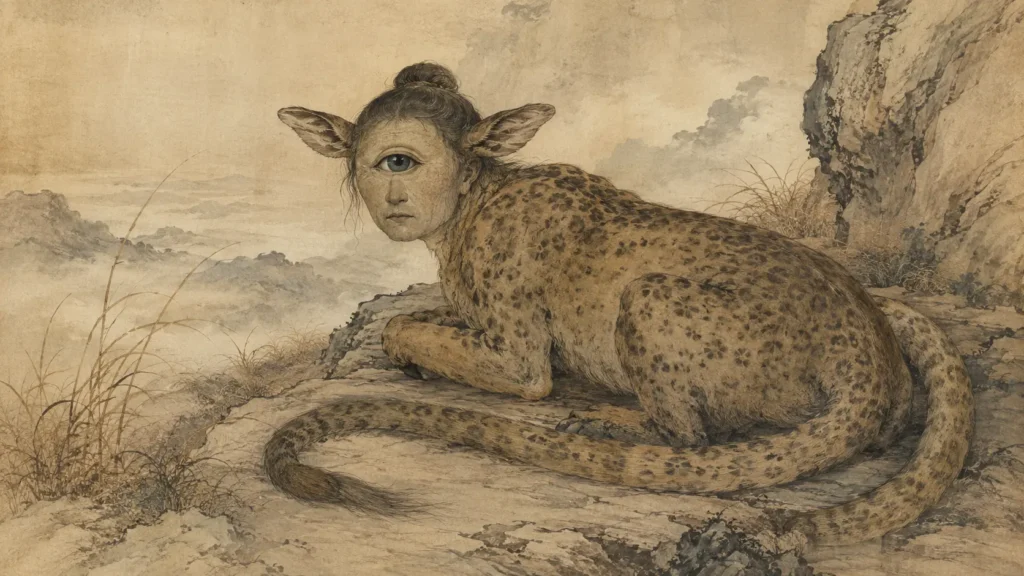
Zhujian (诸犍 / 諸犍, Zhūjiān) is a mythical beast from the Classic of the Northern Mountains. The ancient text describes it as leopard-like, with a long tail, human head, ox ears, and one eye. It was known for making powerful cries and behaved unusually with its tail—holding it in its mouth while walking and coiling it around itself while resting.
That is almost everything the original text tells us.
And honestly, it doesn’t need much more.
What Is Zhujian?
Zhujian appears in the Beishan Jing, or Classic of the Northern Mountains, section of the Shan Hai Jing.
The text takes the reader another 180 li north to Mount Danzhang (单张之山).
It is described as a barren place without grass or trees.
Then comes the beast:
有兽焉,其状如豹而长尾,人首而牛耳,一目,名曰诸犍。
In plain English:
There is a beast there shaped like a leopard with a long tail. It has a human head, ox ears, and one eye. It is called Zhujian.
The description is striking because the creature is not simply a random collection of animal parts.
Its basic body remains recognizable.
It is leopard-like.
Everything above the shoulders destroys that familiarity.
The Human Head and Single Eye
Zhujian’s most unsettling feature is probably its face.
The Shan Hai Jing explicitly gives it a human head, but also ox ears and only one eye.
The text does not explain where that eye was positioned or what the face looked like beyond those details.
That matters for how we illustrate it.
There is no reason to turn Zhujian into a giant Cyclops, demon warrior, or horned monster.
The safest reconstruction is exactly what the text gives us:
a leopard-like predator carrying an eerily human head with bovine ears and a single eye.
The strangeness comes from restraint.
The creature is disturbing because it is almost understandable.
Almost.
Zhujian’s Strange Tail
Then there is the tail.
The ancient description specifically says:
行则衔其尾,居则蟠其尾
When Zhujian walks, it holds its tail in its mouth.
When it rests, it coils the tail around itself.
It is an incredibly specific detail.
The text does not tell us why Zhujian behaves this way.
Maybe ancient storytellers imagined the tail as extraordinarily long and difficult to carry. Maybe the behavior came from observing a real animal and transforming it through imagination.
We simply do not know.
And we do not need to invent an explanation.
The image itself is memorable enough: a strange one-eyed leopard walking across a barren mountain with its own long tail held between its teeth.
What Did Zhujian Sound Like?
The Shan Hai Jing says Zhujian was 善吒 — shàn zhà.
The verb 吒 can describe a powerful shout or roar. Classical dictionaries preserve the Zhujian passage as an example of this meaning.
So Zhujian was not presented as a silent predator.
Its voice was one of the qualities ancient writers considered important enough to record.
But again, the text stops there.
It does not say that its roar caused earthquakes.
It does not paralyze enemies.
It does not predict disaster.
Zhujian simply possessed a powerful voice.
Turning that into a supernatural attack would be modern invention.
Was Zhujian Dangerous?
We do not know.
Unlike Mafu, which is explicitly said to eat humans, or other Shan Hai Jing creatures whose appearance predicts war or catastrophe, the Zhujian passage gives no warning about attacking people.
There is also no statement that eating it grants protection, cures illness, or provides supernatural abilities.
The ancient author seems interested primarily in what Zhujian looks like and how it behaves.
That places the creature in an interesting space between monster and impossible animal.
Maybe it was feared.
Maybe it was simply strange.
The original text never tells us which.
Zhujian and Mengji: Two Leopard Beasts of the Northern Mountains
Zhujian was not the only leopard-like creature hidden in the Northern Mountains Classic.
Another is Mengji, the pale leopard-like beast known for its patterned forehead and extraordinary ability to remain concealed.
And this connection is not something we’re inventing just to link the articles.
A later Chinese compendium, the Gujin Tushu Jicheng, preserves a quotation from the Pianya that groups the two together:
“Mengji and Zhujian belong to the leopard kind.”
That later classification gives us a genuine historical reason to compare them.
But visually, they could hardly be more different.
Mengji remains relatively close to a natural predator: pale, leopard-like, silent and concealed.
Zhujian moves into the impossible: human head, ox ears, one eye and that extraordinary tail.
If you want the other side of this strange leopard family, read our full guide to Mengji, the white leopard beast of the Shan Hai Jing.
Why Zhujian Is Worth Remembering
Zhujian has no surviving epic battle.
No famous hero hunts it.
No god explains why it exists.
We receive only a barren mountain and a handful of physical details.
Yet those details create an image almost immediately.
A leopard moves across empty rock.
Its single eye watches the landscape beneath human features.
Ox ears rise from its head.
Its own long tail hangs from its mouth as it walks.
Then it stops.
The tail coils around its body.
And somewhere across Mount Danzhang, the creature lets out a powerful cry.
That is the beauty of the Shan Hai Jing.
Sometimes a few lines are enough to keep a creature alive for thousands of years.
Reference:
- Chinese Text Project — Shan Hai Jing: Beishan Jing — primary passage describing Mount Danzhang and Zhujian’s appearance and behavior.
- Chinese Text Project — traditional annotated Shan Hai Jing — preserves Guo Pu’s pronunciation note and later commentary on the passage