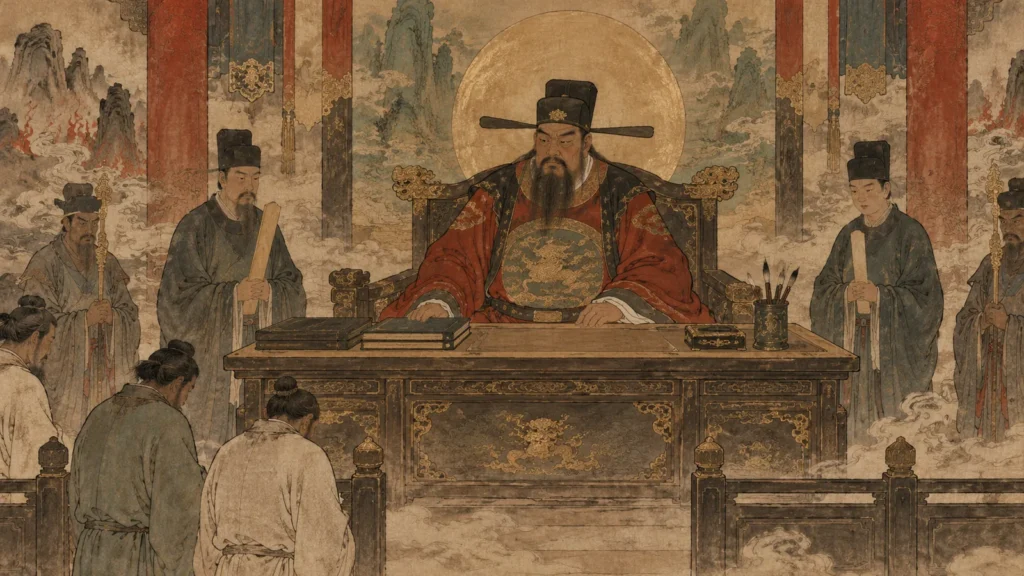
A clerk opens a register.
A soul waits below the desk.
Behind it sits the judge whose name became shorthand for death itself.
Yanluo Wang (阎罗王 / 閻羅王, Yánluó Wáng) is the Chinese form of King Yama, the Buddhist judge of the dead. In the widely depicted Ten Kings tradition, he presides over the Fifth Court of the Chinese underworld. His court is associated with a mirror that exposes a person’s past deeds. In Journey to the West, he appears alongside the other nine kings when the Monkey King demands to see the record of his lifespan.
Yanluo Wang at a Glance
| Detail | What to Know |
|---|---|
| Chinese | 阎罗王 / 閻羅王 |
| Pinyin | Yánluó Wáng |
| Also known as | King Yanluo, the Chinese King Yama |
| Role | Judge of the dead in the Ten Kings tradition |
| Court | Fifth Court of the underworld |
| Recognizable motif | Mirror of karma |
| Literary appearance | Journey to the West, Chapter 3 |
From King Yama to Yanluo Wang
An earlier Buddhist text introduces Yama through a series of questions. In the Devadūta Sutta, a man is brought before the king after death.
Yama asks whether he noticed the warnings that were already visible to him in life. Had he seen a person grow old, fall ill or die?
Those sights were reminders to act well while he still could. The deeds under review were his own.
As Buddhism spread to China, the figure acquired a Chinese name and a setting familiar from the world of officials and magistrates. Wáng (王) means “king.” The name Yánluó (阎罗 / 閻羅) preserves part of the sound of Yama’s name through its Buddhist transmission.
By late Tang times the Ten Kings tradition was taking shape. Its courts gave the passage through Diyu, the Chinese underworld, a sequence of hearings before rebirth.
What Happens in the Fifth Court?
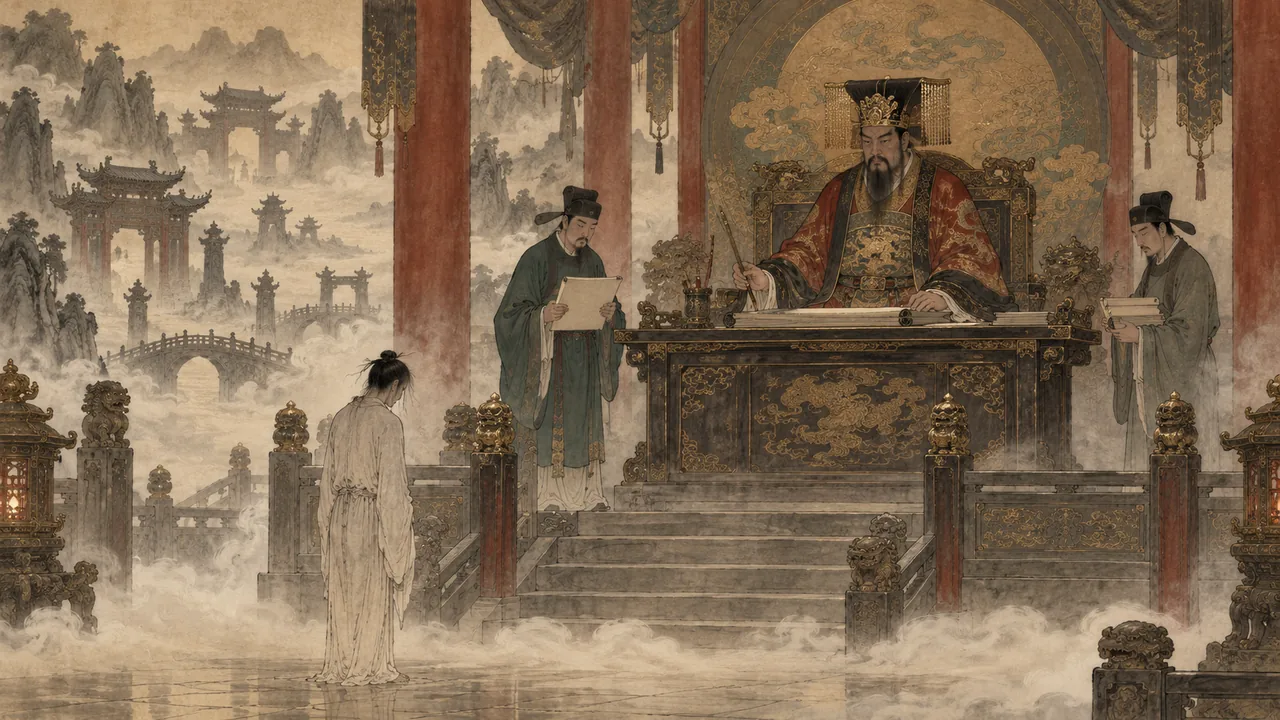
In the sequence described by the Nara National Museum, the first seven hearings occur at seven-day intervals. The fifth hearing therefore falls on the thirty-fifth day after death in that account.
Yanluo’s best-known emblem in these paintings is the mirror of karma. It shows the deeds that the person before him must answer for.
A Southern Song scroll at the Nara National Museum, attributed to Lu Xinzhong’s hand, places Yanluo at a desk among officials. The dead stand before the bench. In works from Jin Chushi’s studio at the Metropolitan Museum of Art, scribes and attendants help make the proceedings visible.
Look at where the painters put the paperwork. It sits within reach of the judge. The figures below the bench are waiting for a decision that can be entered into a record.
The scrolls survive as separate paintings, each with its own king. That makes the Fifth Court easier to understand. Yanluo’s name can stand for the underworld in popular speech, while the paintings give him one court in a larger sequence.
Yanluo Wang and the Monkey King's Life Register
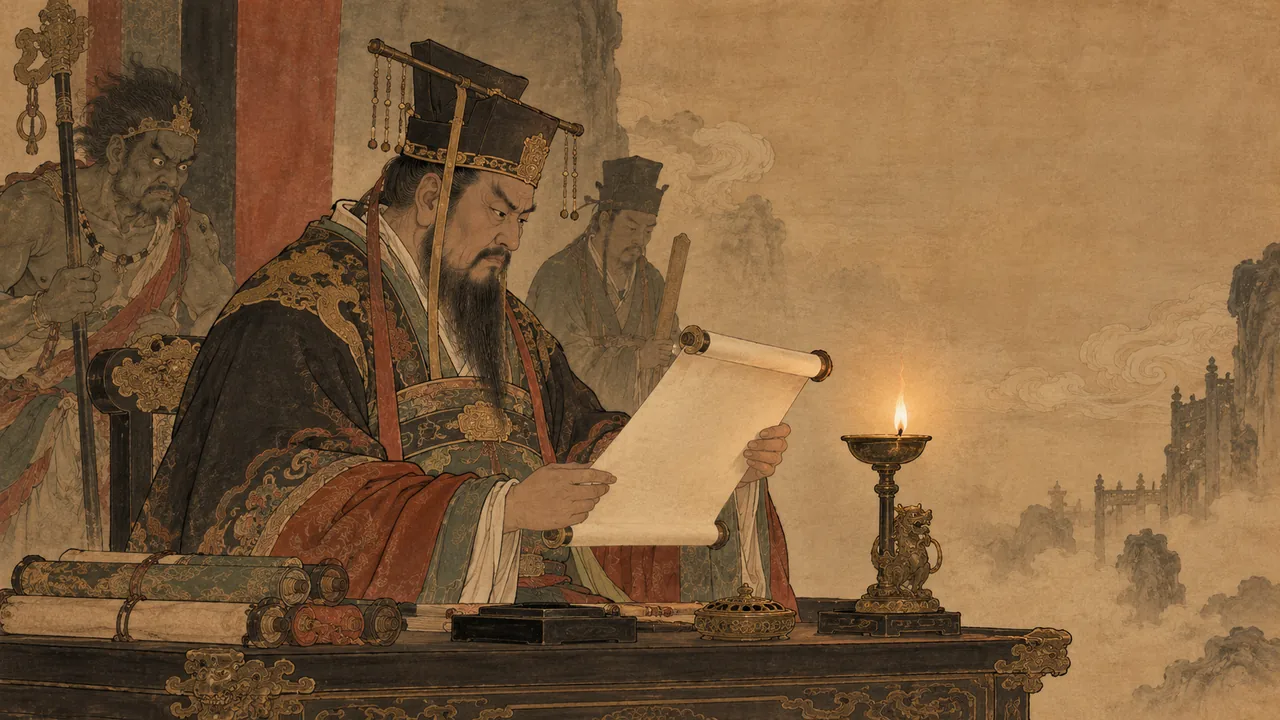
Chapter 3 of the Ming novel Journey to the West turns the court into a place where a record can be challenged.
Two messengers take Sun Wukong to the underworld. He demands the names of the Ten Kings. They introduce themselves in order, naming Yanluo fifth.
Then Wukong asks for the Book of Life and Death (生死簿, shēngsǐbù).
A clerk brings out several registers. Wukong finds his name among the monkeys, with a lifespan of 342 years written next to it.
He takes a brush and strikes through the entries for the monkeys. The kings later discuss sending a report to Heaven. Wukong wakes and tells the other monkeys what he did.
The scene works because the paperwork has authority. A lifespan is written down, a clerk can find it, and a monkey with a brush can make a problem for the entire court.
Judgment and the Road to Rebirth
The Fifth Court is one point on that road. In later popular accounts, Meng Po belongs to a different part of the journey. Her soup makes the dead forget the life they have just lived as they approach rebirth.
These stories give the dead two very different encounters with their past. At Yanluo’s bench, the past is brought into view. At Meng Po’s crossing, it slips away.
For more figures of Chinese religion and folklore, explore the Chinese Gods and Immortals collection.
References
- Devadūta Sutta (MN 130), translated by Ṭhānissaro Bhikkhu
- Nara National Museum, The Ten Kings of Hell: King Yanluo, Lu Xinzhong
- The Metropolitan Museum of Art, Ten Kings of Hell, Jin Chushi
- Sarah Tang, Between Death and Rebirth, The Columbia Journal of Asia
- Journey to the West, Chapter 3, Chinese Text Project
- David K. Jordan, The Jade Guidebook: Introduction, UC San Diego