At the end of the road through the Chinese underworld, there is said to be one final thing a soul must lose.
Not its body.
Not its possessions.
Not even its name.
Its memories.
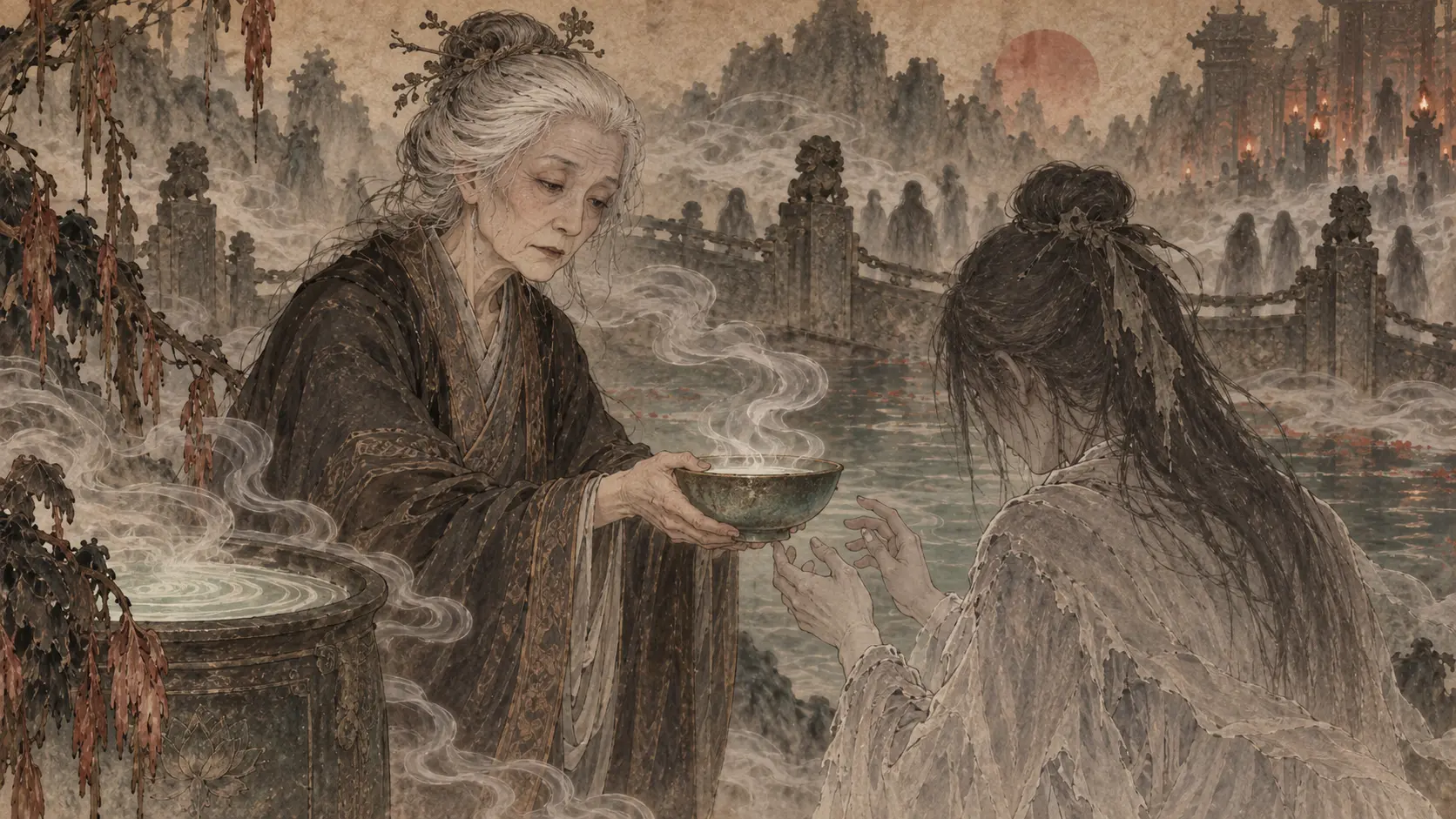
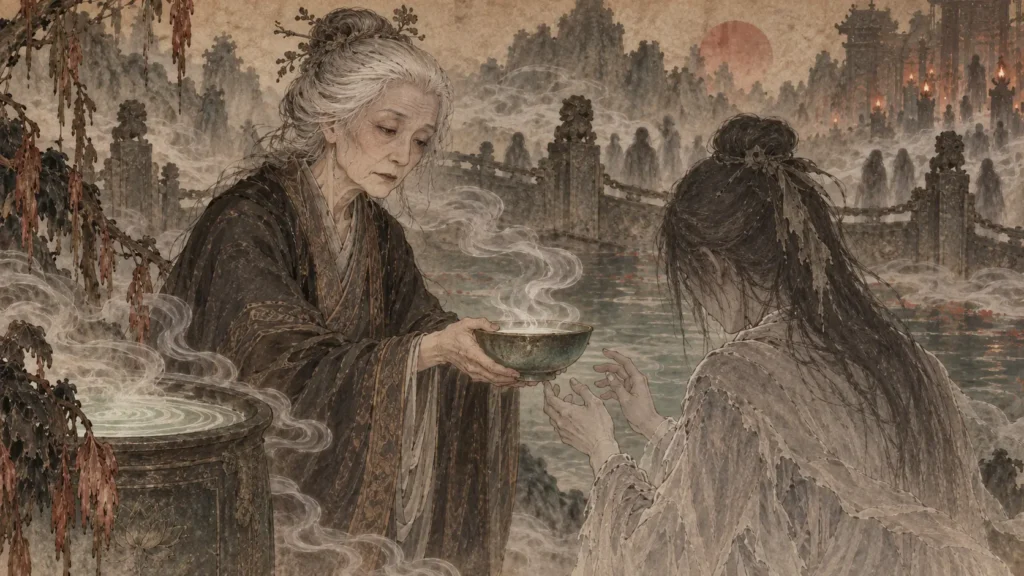
In popular Chinese underworld tradition, an old woman waits for the dead before they return to the world of the living.
Her name is Meng Po (孟婆, Mèng Pó).
In her hands is a bowl containing one of the strangest substances in Chinese mythology: Meng Po Tang (孟婆汤), the Soup of Forgetfulness.
Drink it, and an entire lifetime disappears.
Parents.
Friends.
Enemies.
Love.
Regret.
Everything that made the soul remember who it once was.
Only then can another life begin.
Who Is Meng Po?
Meng Po is a supernatural figure associated with death, forgetting and reincarnation in Chinese folk tradition.
Her name can be translated simply as “Old Lady Meng” or “Granny Meng.”
Unlike gods who command lightning or divine warriors who hunt demons, Meng Po performs a quieter duty.
She makes the dead forget.
In later descriptions of the Chinese afterlife, souls pass through Diyu, where their actions in life are judged and their future rebirth determined.
At the end of that process, Meng Po gives those preparing to return to the mortal world a mysterious drink.
Once consumed, memories of the previous existence disappear.
The soul can begin again.
But Meng Po’s story is more complicated than the modern legend suggests.
Older Chinese literary references also use the name Meng Po for a wind deity. The familiar underworld figure developed through later religious and folk traditions, eventually becoming one of the most recognizable characters associated with the Chinese world of the dead.
That distinction matters.
There is no single ancient text containing the complete Meng Po legend exactly as it is told today.
Her mythology grew over time.
Meng Po and the Chinese Underworld
To understand Meng Po, we first have to understand where she belongs.
Chinese traditions developed elaborate visions of the afterlife commonly associated with Diyu (地狱) — a realm where the dead could be judged before entering another existence.
Later traditions describe courts, judges, officials and punishments operating almost like a supernatural bureaucracy.
A soul’s journey did not necessarily end there.
After judgment came rebirth.
And that created a problem.
What would happen if every soul entered a new body while still remembering everything from the life before?
Old hatred could survive death.
Lost lovers might search for one another.
Children could remember other parents.
Enemies might continue feuds that should have ended generations earlier.
In the mythology surrounding Meng Po, forgetting became the solution.
Death separated one life from another.
Meng Po separated one memory from the next.
What Is Meng Po Soup?
Her most famous symbol is Meng Po Tang (孟婆汤).
Tang means soup or broth.
Later religious descriptions say Meng Po prepared a drink from earthly ingredients that was neither quite wine nor ordinary soup.
One influential tradition describes it as possessing five flavors:
sweet,
bitter,
pungent,
sour,
and salty.
Together they almost resemble the experiences of a human lifetime.
Pleasure and suffering.
Love and anger.
Success and disappointment.
Everything eventually mixed into a single bowl.
The dead drink it before reincarnation, and the memories of their previous existence disappear.
That makes Meng Po Soup frightening at first glance.
But it can also be interpreted as merciful.
Imagine entering every new life while remembering every funeral you attended.
Every person you failed.
Every betrayal.
Every moment of grief.
Every death you had already experienced.
Perhaps forgetting is not a punishment.
Perhaps it is what makes beginning again possible.
Meng Po and Naihe Bridge
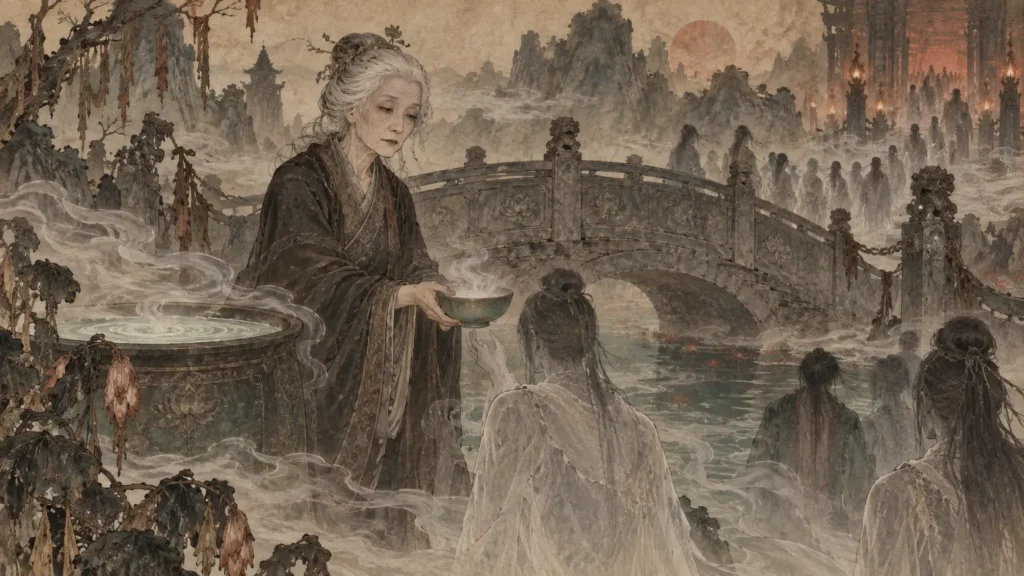
Modern retellings usually place Meng Po beside Naihe Bridge (奈何桥, Nàihé Qiáo).
The name is often rendered as the Bridge of Helplessness or a bridge from which there is no easy turning back.
It has become one of the most famous images of the Chinese supernatural world.
A dead soul approaches the bridge.
Behind it lies the world it once knew.
Ahead waits reincarnation.
And somewhere near that final boundary stands Meng Po with her bowl.
Different stories rearrange the details.
Some place the drink before the crossing.
Others connect Meng Po to different locations within the underworld bureaucracy.
This is common in Chinese mythology, where folk religion, Buddhist ideas, Daoist traditions, literature and regional storytelling can overlap without producing one universal version.
What remains consistent is the central image:
before returning to life, the soul must leave its old memories behind.
Was Meng Po Always a Goddess of Forgetfulness?
No.
This is one of the most interesting parts of her history.
Chinese dictionaries preserve an older use of Meng Po as the name of a wind deity.
The fully developed underworld Meng Po appears much more clearly in later sources.
A text known as the Yuli Baochao (玉历宝钞) gives a detailed story in which Meng Po had once lived as a woman surnamed Meng.
She studied Confucian writings and later Buddhist teachings, avoided dwelling on the past or worrying about the future, and encouraged people to avoid killing.
According to this later account, Heaven eventually appointed her as a deity of the underworld.
She was placed in charge of a structure associated with forgetting and given responsibility for preparing the drink that erased the memories of souls awaiting rebirth.
This should not automatically be treated as Meng Po’s original biography.
It is a later religious tradition.
But it shows how dramatically her mythology had developed.
A name once associated with the wind became attached to one of China’s most powerful symbols of memory and death.
What Happens If Someone Does Not Drink the Soup?
Popular stories sometimes imagine souls escaping Meng Po’s drink.
That provides a mythological explanation for one of humanity’s oldest mysteries:
Why do some people claim to remember another life?
In these stories, fragments of memory survive because the soul somehow avoided or failed to completely drink Meng Po’s soup.
Such tales belong to folklore rather than a single authoritative doctrine.
But they reveal how useful the Meng Po myth became.
She explains not only why people forget previous lives.
The rare person who seems to remember one can also be explained.
Perhaps the soup simply did not work.
What Does Meng Po Represent?
Meng Po is sometimes described as the goddess of forgetfulness.
But reducing her to memory loss misses what makes her interesting.
Her story sits between ending and beginning.
The judges of the underworld look backward.
They examine what a person has already done.
Reincarnation looks forward.
It opens the possibility of another existence.
Meng Po stands between the two.
Her bowl destroys the connection.
And that gives her an unusual kind of power.
Sun Wukong fights Heaven.
Nezha is reborn through divine intervention.
The Dragon Kings command seas and storms.
Meng Po simply offers you a drink.
Yet refusing to remember may be one of the most profound transformations in Chinese mythology.
The Woman Waiting at the End
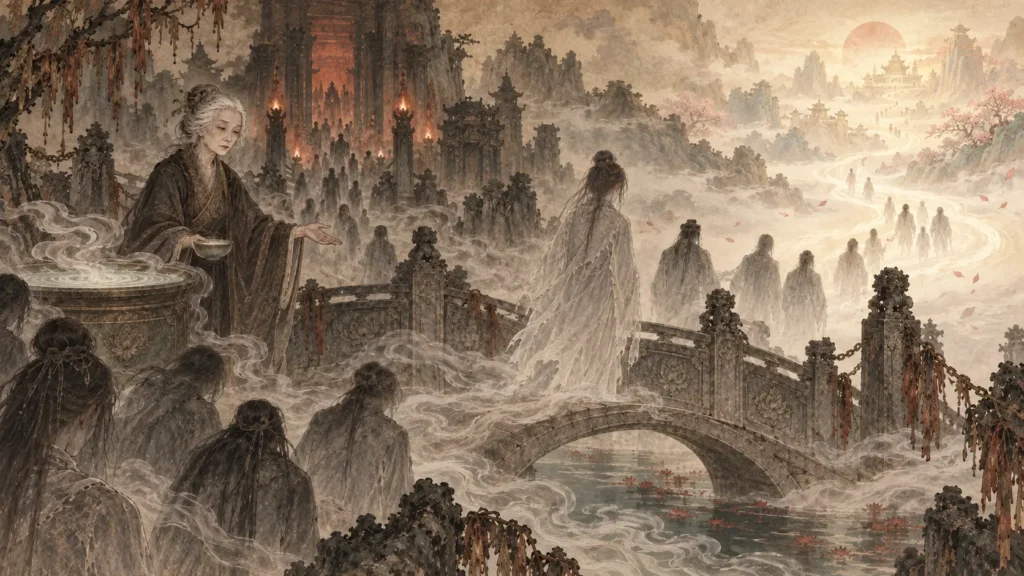
Imagine the final moment.
The courts of the dead are behind you.
Your judgment has been made.
Somewhere beyond the bridge is another life — another face, another family, perhaps another century.
But you still remember this one.
Then an old woman places a bowl in your hands.
You may have spent an entire lifetime trying not to be forgotten.
Now forgetting is the price of moving forward.
You drink.
The people you loved disappear first.
Then the places.
The victories.
The mistakes.
Finally, even the person you believed yourself to be fades away.
The bowl becomes empty.
And somewhere in the living world, a child takes its first breath.
Meng Po’s legend leaves us with an uncomfortable thought:
Sometimes starting again requires more than surviving the past.
It requires finally letting it go.
References
Ministry of Education, Republic of China (Taiwan) — Revised Mandarin Chinese Dictionary, entry for 孟婆.
Preserves both the older wind-deity meaning of Meng Po and the later tradition of the female deity whose drink causes souls to forget their previous lives.