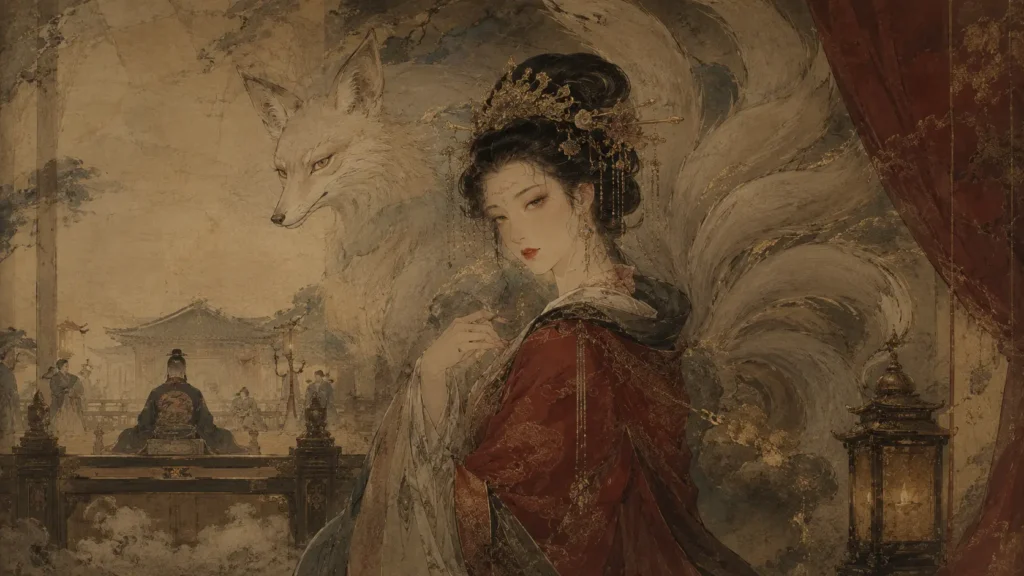
Long before nine-tailed foxes appeared in anime, games, and modern fantasy, one was already wandering through the strange landscapes of ancient China.
It lived in Qingqiu—a distant country of mountains, jade, rivers, and creatures that seemed to exist somewhere between the natural and supernatural worlds.
Sometimes, the Nine-Tailed Fox was a monster whose cry sounded like a human infant.
Sometimes, it was an omen that appeared when a kingdom was peaceful and virtuous.
Centuries later, it would become something darker: a beautiful fox spirit accused of entering the imperial court and helping destroy a dynasty.
Few creatures in Chinese mythology have changed so completely.
The Nine-Tailed Fox of Qingqiu
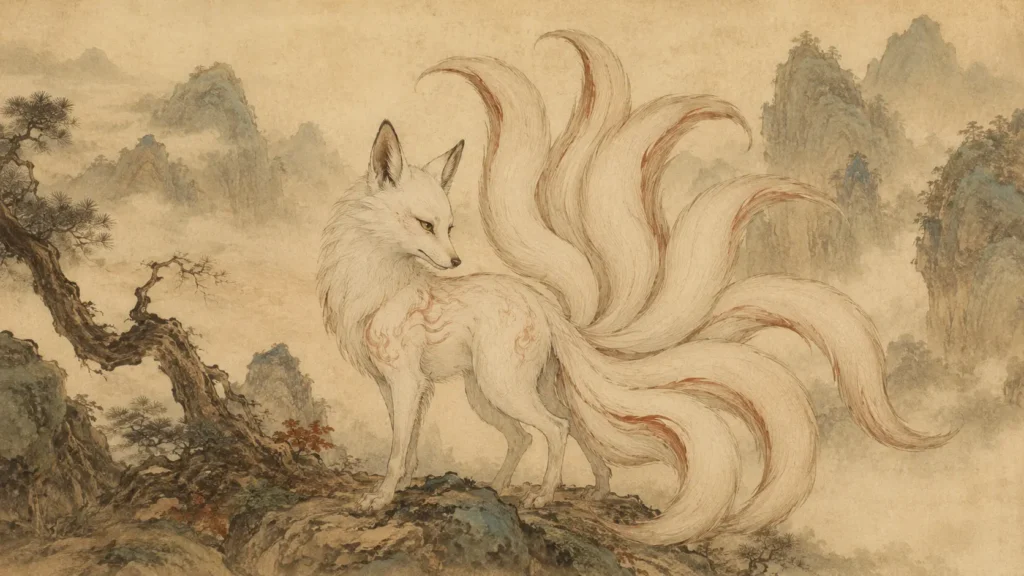
One of the best-known descriptions appears in the Shan Hai Jing, or Classic of Mountains and Seas.
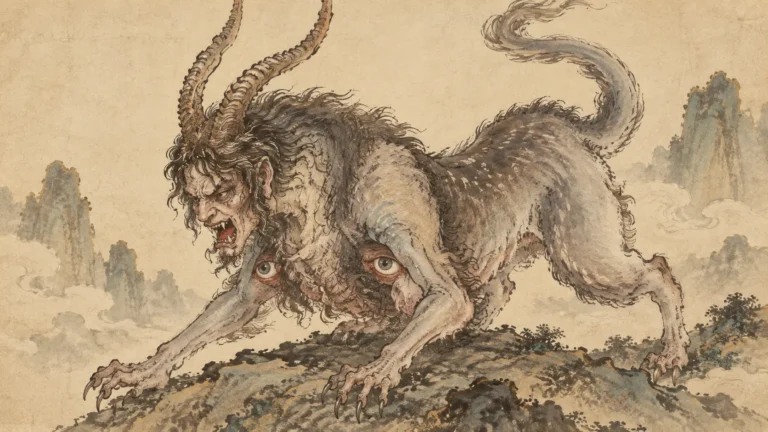
The text places the creature on Qingqiu Mountain. It resembles an ordinary fox but has nine tails, and its cry sounds like that of a baby. The passage also states that it can eat humans. Strangely, eating the creature itself was believed to protect a person from harmful supernatural influences or poison.
Other sections of the same ancient work are less threatening. They simply describe the country of Qingqiu as a place where four-legged foxes with nine tails live, without explaining their powers or behaviour.
The earliest Nine-Tailed Fox was therefore not clearly a goddess, woman, or seductive shapeshifter.
It was a mysterious beast.
Its home was distant. Its voice was human-like. Its body crossed the boundaries between something familiar and something impossible.
A Creature of Opposing Meanings
The Nine-Tailed Fox did not remain only a man-eating monster.
Later texts connected it with peace, prosperity, strong descendants, and righteous government.
The Bai Hu Tong, a work associated with Han-dynasty political and ritual thought, explains the nine tails as signs of flourishing descendants and a prosperous queen. It also associates the fox with remembering its origins, because foxes were believed to turn their heads toward their native hills when they died.
Other collected traditions describe the Nine-Tailed Fox as an auspicious creature that appears when virtue prevails. A poetic account attributed to the scholar Guo Pu calls it a strange beast of Qingqiu whose appearance announces an age of good order.
This creates one of the most fascinating contradictions in Chinese mythology.
The same creature could represent:
- danger and cannibalism;
- peace and successful government;
- fertility and abundant descendants;
- supernatural intelligence;
- or a warning that appearances cannot be trusted.
The Nine-Tailed Fox was never limited to a single moral identity.
How the Sacred Fox Became a Demon
As stories about fox spirits developed, foxes became increasingly associated with transformation, illusion, beauty, and the ability to enter human society.
The most famous dark transformation of the Nine-Tailed Fox appears in the Ming-dynasty novel Fengshen Yanyi, commonly translated as Investiture of the Gods.
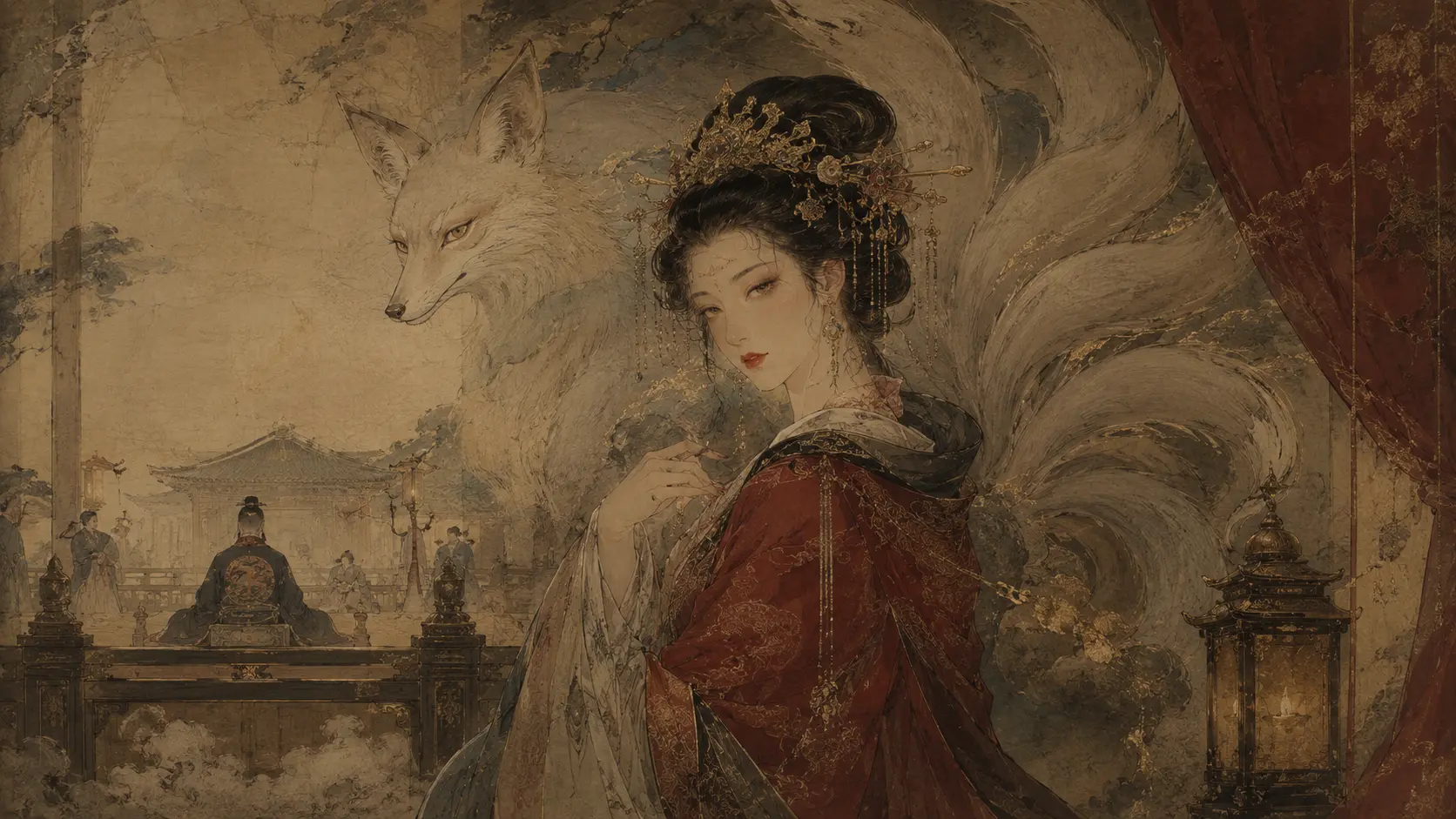
The story begins with Daji, a human noblewoman who is being taken to the court of King Zhou, the final ruler of the Shang dynasty.
During the journey, a thousand-year-old fox spirit attacks her. The novel states that the spirit devours Daji’s soul, takes possession of her body, and continues to the royal court disguised as the beautiful young woman.Intrestingly there is one more kind of fox-Huli Jing.
This is important: the historical Daji and the demonic fox are not originally the same figure.
Daji was remembered as a consort of King Zhou. Her identity as a fox spirit belongs to later legendary and literary traditions, which eventually made the connection famous.
Daji and the Fall of a Dynasty
Inside the palace, the fox spirit uses Daji’s beauty to gain influence over King Zhou.
In Fengshen Yanyi, the king neglects government, ignores loyal ministers, and becomes involved in increasingly cruel and extravagant acts. The disguised fox is presented not merely as a monster attacking from outside the walls, but as a corrupting force already inside the centre of power.
Her true nature is eventually exposed.
Near the end of the novel, Jiang Ziya identifies her as the Nine-Tailed Fox that killed the real Daji and used her body to deceive the ruler. She is blamed for cruelty, political destruction, and the suffering that accompanied the fall of Shang.
The old auspicious animal of Qingqiu had now become one of Chinese literature’s most recognisable demons.
It no longer announced the arrival of a virtuous ruler.
It revealed what happens when a ruler loses control of himself.
What Do the Nine Tails Represent?
There is no single explanation that covers every period.
In some political interpretations, the tails represented numerous descendants, prosperity, and the flourishing of a royal household.
In later popular imagination, multiple tails increasingly suggested supernatural age and power.
But the original Shan Hai Jing does not explain that each tail was earned through centuries of cultivation. It simply describes a fox that possesses nine of them.
That distinction matters.
Many modern explanations combine Chinese, Japanese, Korean, literary, religious, and popular-culture traditions into one universal fox legend. In reality, the Nine-Tailed Fox changed depending on the text, place, and period.
The Lesson of the Nine-Tailed Fox
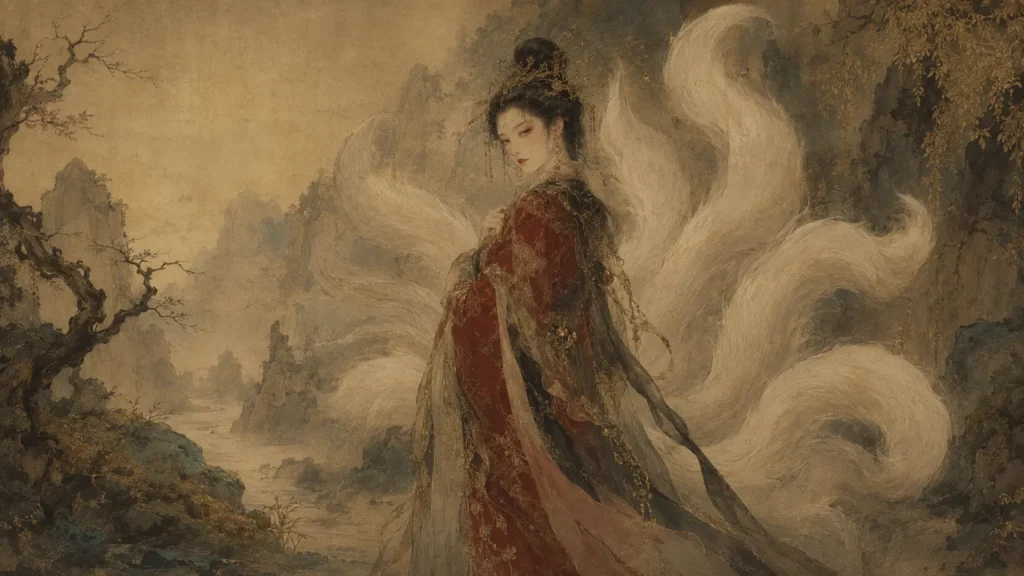
The Nine-Tailed Fox teaches us something unusual about reputation.
The creature itself remained recognisable: a fox with nine tails.
But people repeatedly changed what those tails meant.
To one generation, they promised prosperity.
To another, they concealed danger.
To later storytellers, they belonged to a beautiful demon who could destroy an empire without personally leading an army.
The same thing happens to strength.
Power can protect, create, or corrupt. Intelligence can guide a person—or teach them how to manipulate others. Beauty can inspire devotion, but it can also become a weapon when self-control disappears.
Training alone does not decide what kind of person you become.
It gives you greater capacity.
Character decides where that capacity is directed.
The Nine-Tailed Fox was feared not only because it could transform its appearance.
It was feared because it understood exactly what other people desired—and could use those desires against them.
The warrior’s answer is not to eliminate every desire.
It is to become disciplined enough that desire cannot rule him.
A fox may change its face.
A disciplined person knows what must remain underneath.
Reference:
- Chinese Text Project — Southern Mountain Classic — the Nine-Tailed Fox of Qingqiu Mountain, its infant-like cry and its dangerous nature.
- Chinese Text Project — Classic of the Eastern Great Wilderness — Qingqiu as the country of foxes with nine tails.
- Chinese Text Project — Eastern Classic of the Overseas Regions — another early geographical description of the Qingqiu foxes.