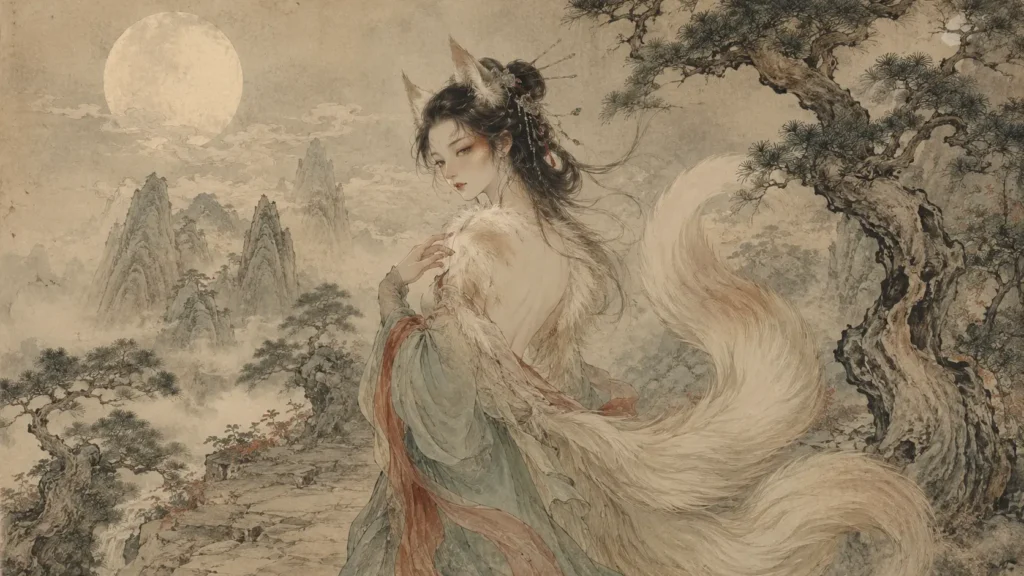
A fox waits long enough in the dark.
Years become decades.
Decades become centuries.
Then something changes.
The animal learns.
It watches.
It transforms.
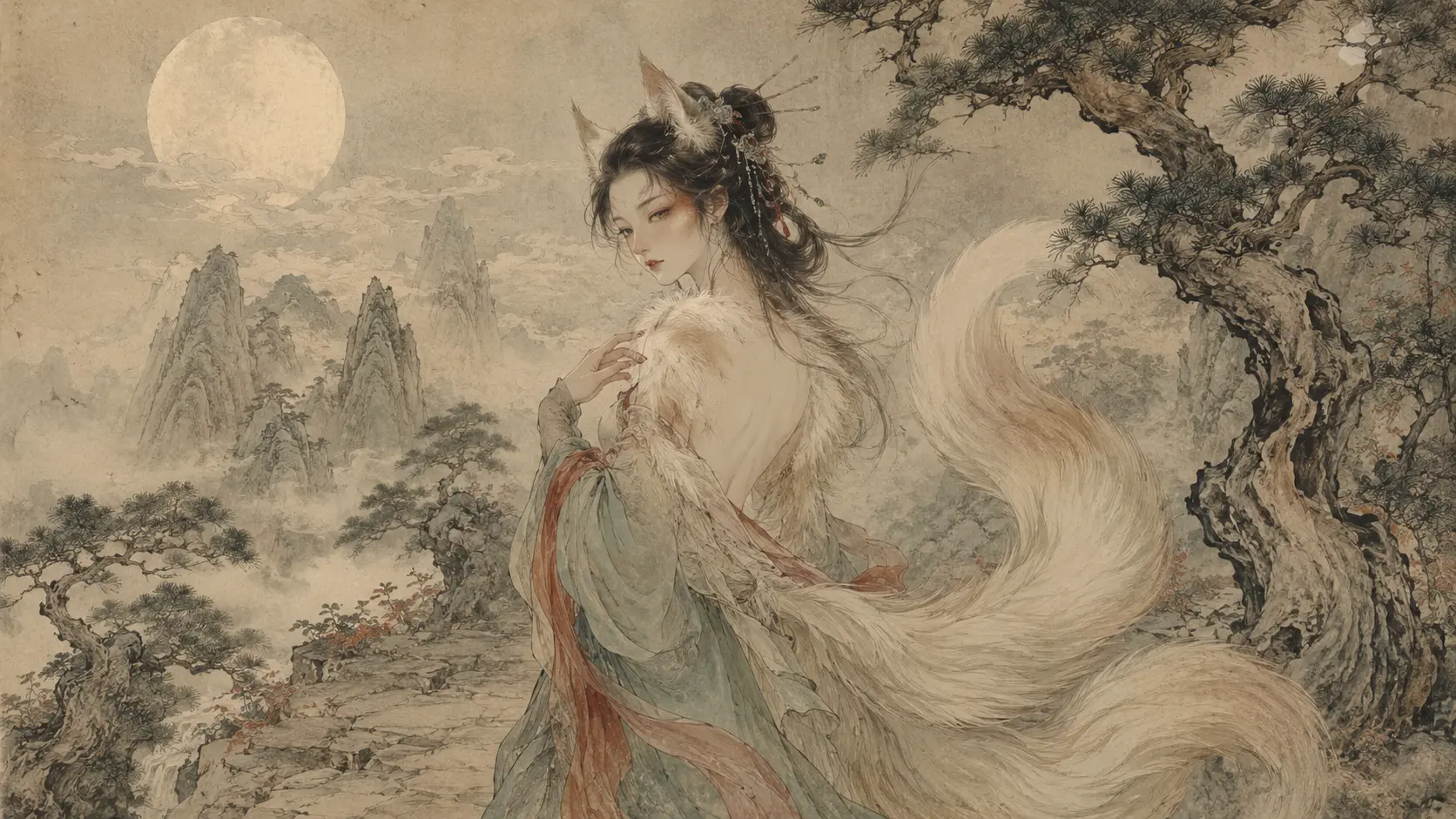
And one night, the fox that entered the forest may return wearing a human face.
Huli Jing (狐狸精, húlí jīng) are supernatural fox spirits in Chinese folklore and literature, famous for transformation, enchantment and their ability to appear in human form. Some stories portray them as dangerous deceivers, while others describe fox spirits as lovers, companions, scholars, protectors or beings pursuing spiritual transformation. They are related to—but not identical with—the ancient Nine-Tailed Fox of the Shan Hai Jing.
That last distinction matters.
Because Chinese fox mythology is much older, stranger and more complicated than the modern image of a beautiful woman with nine tails.
Huli Jing at a Glance
| Chinese | 狐狸精 |
| Pinyin | Húlí jīng |
| Common translation | Fox spirit |
| Type | Transforming animal spirit |
| Known for | Shapeshifting, enchantment, supernatural longevity |
| Typical human form | Often female, but not exclusively |
| Moral nature | Benevolent, dangerous or ambiguous depending on the story |
| Related traditions | Nine-Tailed Fox, fox immortals, Daji, Liaozhai Zhiyi |
| Important sources | Xuanzhong Ji, later anomaly tales, Ming–Qing literature and folk religion |
What Is a Huli Jing?
The name 狐狸精 combines the ordinary Chinese word for fox, 狐狸, with 精, a term that can refer to an essence or supernatural spirit.
So “fox spirit” is generally a better English translation than “fox demon.”
Why?
Because demon implies something inherently evil.
Chinese fox traditions are not that simple.
A huli jing may deceive humans.
It may cause illness.
It may seduce someone.
But another fox may fall in love with a human, repay kindness, become a loyal companion or receive worship as a powerful supernatural being.
Modern scholarship describes fox-spirit stories as occupying a wide moral range rather than one fixed good-or-evil category.
How Does a Fox Become a Huli Jing?
One of the most remarkable early descriptions survives in a text preserved under the title Xuanzhong Ji.
It says that a fox at fifty years can transform into a woman.
At one hundred years, it can become a beautiful woman, a spirit medium or even a man.
Such a fox can know events far away and bewilder people.
At one thousand years, the text says, it can communicate with Heaven and become a tianhu — 天狐, a heavenly fox.
This passage gives us one of the most important ideas in Chinese fox lore:
supernatural power develops through age and transformation.
The fox is not necessarily born as a magical monster.
It becomes something more.
That model appears repeatedly in later Chinese stories of animals, spirits and cultivated supernatural beings.
Are Huli Jing Always Women?
No.
This is another modern simplification.
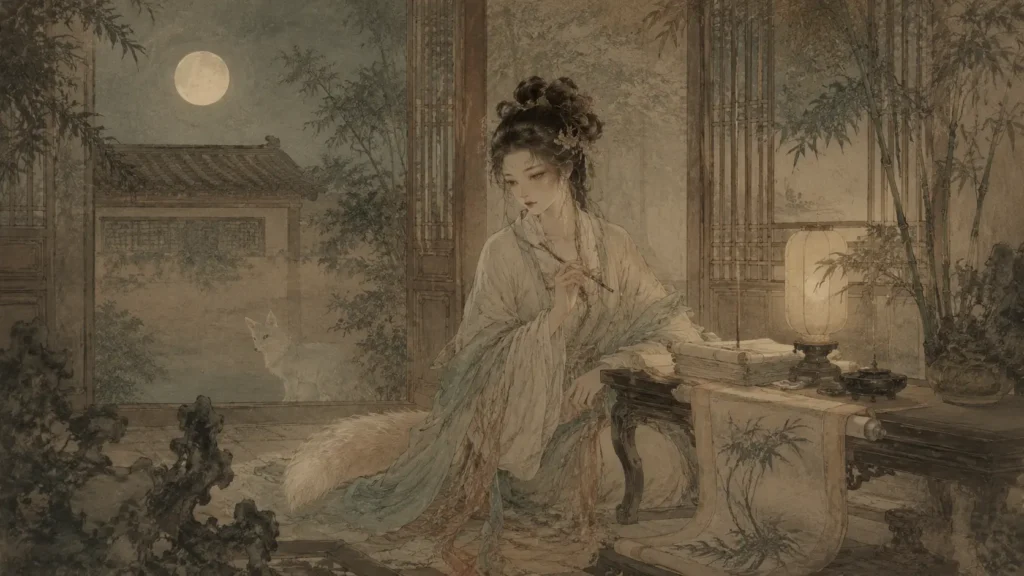
Female fox spirits became extremely prominent in Chinese literature, especially stories involving seduction, romance and marriage.
But the Xuanzhong Ji passage explicitly says that an aged fox may also transform into a man.
So:
Huli Jing ≠ supernatural woman.
The underlying being is a fox spirit.
Its human appearance depends on the story.
The dominance of beautiful fox-women in later literature says as much about Chinese storytelling, gender and social anxieties as it does about the imagined biology of fox spirits.
Huli Jing vs the Nine-Tailed Fox
This is the section I especially want us to win.
They are related—but not identical.
The ancient Shan Hai Jing describes a creature at Qingqiu Mountain:
有獸焉,其狀如狐而九尾
A beast resembling a fox with nine tails.
It cries like an infant and is dangerous enough to eat humans.
Notice what the passage does not say.
It does not say:
that the creature is a beautiful woman,
that every fox eventually becomes it,
or that it is called Huli Jing.
The Nine-Tailed Fox — 九尾狐, Jiǔwěihú is therefore best treated as an important ancient fox-creature tradition.
Huli Jing, by contrast, is the broader world of supernatural fox spirits that becomes especially rich in later folklore and literature.
There is overlap.
Later storytellers combine the traditions.
But they should not be flattened into one entity.
That is why our existing Nine-Tailed Fox page stays separate.
Does Every Huli Jing Have Nine Tails?
No reliable source lets us make that universal rule.
Nine tails became an extremely powerful visual symbol of supernatural foxes.
Later stories frequently connect extraordinary age or power with increasingly fantastic fox forms.
But a fox spirit does not need nine tails to be a Huli Jing.
This is one of the biggest mistakes in modern fantasy descriptions.
The safest distinction is:
Nine-Tailed Fox → specific ancient and later mythological motif
Huli Jing → broader category of Chinese fox spirits
Are Huli Jing Evil?
Sometimes.
But definitely not always.
This is where Chinese fox stories become much more interesting than a simple monster entry.
Academic research on fox-spirit narratives identifies a remarkable range of morality—from predatory and dangerous beings to spirits capable of love, loyalty and self-sacrifice.
In some stories, a fox manipulates humans.
In others, it forms genuine emotional relationships.
A fox can punish.
Reward.
Teach.
Love.
Deceive.
Or simply live between categories that humans prefer to keep separate:
animal and person,
spirit and mortal,
danger and desire,
stranger and family.
That ambiguity became one of the central reasons fox spirits remained so powerful in Chinese storytelling.
Daji and the Fox Spirit
The most notorious fox-woman in later Chinese literature is Daji.
But again, chronology matters.
The historical Daji and the supernatural fox-spirit Daji should not automatically be treated as the same thing.
In the Ming novel Fengshen Yanyi, Jiang Ziya eventually identifies the creature using Daji’s form as a nine-tailed fox spirit that killed the original Su Daji and used her body to deceive King Zhou.
That literary story became enormously influential.
But it belongs to later literature.
It should not be projected backward as a straightforward historical account of the Shang dynasty.
Our existing Daji page should remain the owner of that story.
Huli Jing in Strange Tales from a Chinese Studio
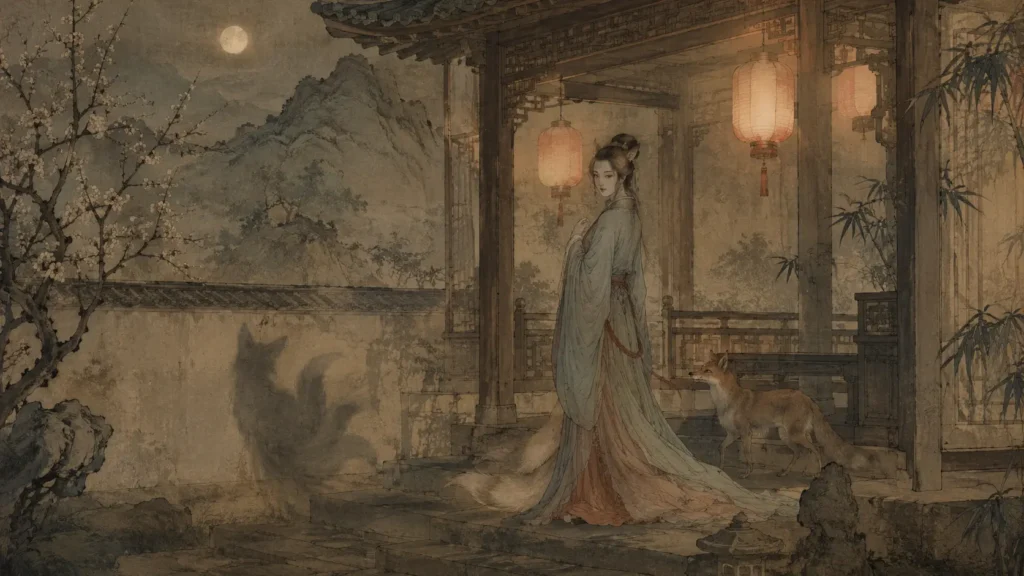
Fox spirits reach one of their richest literary forms in Pu Songling’s Liaozhai Zhiyi — Strange Tales from a Chinese Studio.
Pu Songling lived from 1640 to 1715, and his collection became one of the most celebrated works of classical Chinese supernatural fiction.
The Academy of Chinese Studies describes the collection as filled with fox spirits, ghosts, immortals and demons, while modern scholarship treats Liaozhai as a major development of China’s older zhiguai—“records of the strange”—tradition.
Here the fox spirit becomes far more than a villain.
Fox figures can be:
lovers,
companions,
strangers,
tricksters,
or supernatural mirrors of human society.
This is one reason the idea that “Huli Jing are always evil seductresses” does not survive serious reading.
Were Fox Spirits Actually Worshipped?
Yes—and this is one of the most interesting parts of the tradition.
Fox spirits were not confined to fiction.
Historian Xiaofei Kang documents a long-lasting fox cult in late imperial and modern North China, practiced in private homes and community shrines despite repeated attempts by political and religious authorities to suppress it.
That gives us an important distinction:
A fox spirit in a frightening story is one thing.
A fox treated as a powerful supernatural protector or local divine presence is another.
Chinese fox traditions cross the boundary between:
mythology,
literature,
popular religion,
and everyday belief.
That is why one English label can never capture every fox tradition.
Huli Jing, Huxian and Fox Immortals
Later Chinese traditions also use titles such as Huxian — 狐仙, usually translated as Fox Immortal.
These terms overlap with the broader world of supernatural fox belief, but they should not automatically be treated as perfect synonyms.
Huli Jing is the broader fox-spirit concept.
Huxian is particularly useful when discussing foxes treated as cultivated or divine beings within popular religious contexts.
Again, Chinese tradition is layered rather than taxonomically neat.
The same supernatural animal can appear very differently depending on whether the source is:
a strange tale,
a novel,
a temple cult,
a household belief,
or modern fantasy.
Huli Jing vs Kitsune and Kumiho
Huli Jing are often compared with:
Kitsune in Japan
and
Kumiho in Korea.
The comparison makes sense.
All three traditions contain supernatural foxes, transformation and human encounters.
Modern scholarship even studies these East Asian fox-spirit traditions together.
But they should not be treated as interchangeable names for one creature.
Each tradition developed within different:
religious systems,
literatures,
historical periods,
and cultural expectations.
So:
Huli Jing are Chinese.
Kitsune are Japanese.
Kumiho are Korean.
Shared motifs do not erase their individual histories.
What Does Huli Jing Mean in Modern Chinese?
There is one final layer.
狐狸精 survives in modern Chinese as more than a mythology term.
It can also be used negatively for a seductive person—especially a woman perceived as interfering in another relationship.
That modern insult grows out of centuries of stories connecting fox spirits with beauty, seduction and dangerous attraction.
But reducing the entire mythological tradition to that insult would be a mistake.
The fox spirit existed long before the modern colloquial stereotype, and Chinese literature gives the creature a much wider range of identities.
Why Huli Jing Still Matter
The fox spirit survives because it refuses to stay in one category.
Animal or human?
Monster or immortal?
Lover or predator?
Spirit or god?
Victim or deceiver?
The answer changes with the story.
The ancient Shan Hai Jing gives us strange fox-like beasts.
The Xuanzhong Ji describes aged foxes transforming into humans and eventually reaching Heaven.
Later literature turns fox spirits into some of Chinese fiction’s most memorable supernatural characters.
And popular religion transforms them again into beings people could fear, respect or worship.
That history is much richer than:
“A woman with nine fox tails.”
Huli Jing are not one monster.
They are an entire Chinese tradition of transformation.
SOURCES & CLAIM VERIFICATION
Early / Primary Texts
Chinese Text Project — Xuanzhong Ji
This supports the age/transformation sequence: 50 years → woman; 100 years → more advanced human forms and supernatural abilities; 1,000 years → heavenly fox.
Read Xuanzhong Ji at Chinese Text Project
Chinese Text Project — Shan Hai Jing, Southern Mountain Classic
Primary evidence for the Qingqiu nine-tailed fox and crucial for separating the ancient Jiǔwěihú from the broader Huli Jing concept.
Read the Shan Hai Jing passage
Chinese Text Project — Fengshen Yanyi, Chapter 97
Supports the later literary Daji / nine-tailed fox relationship.