Most snakes disappear into the grass.
Changshe lived where there was none.
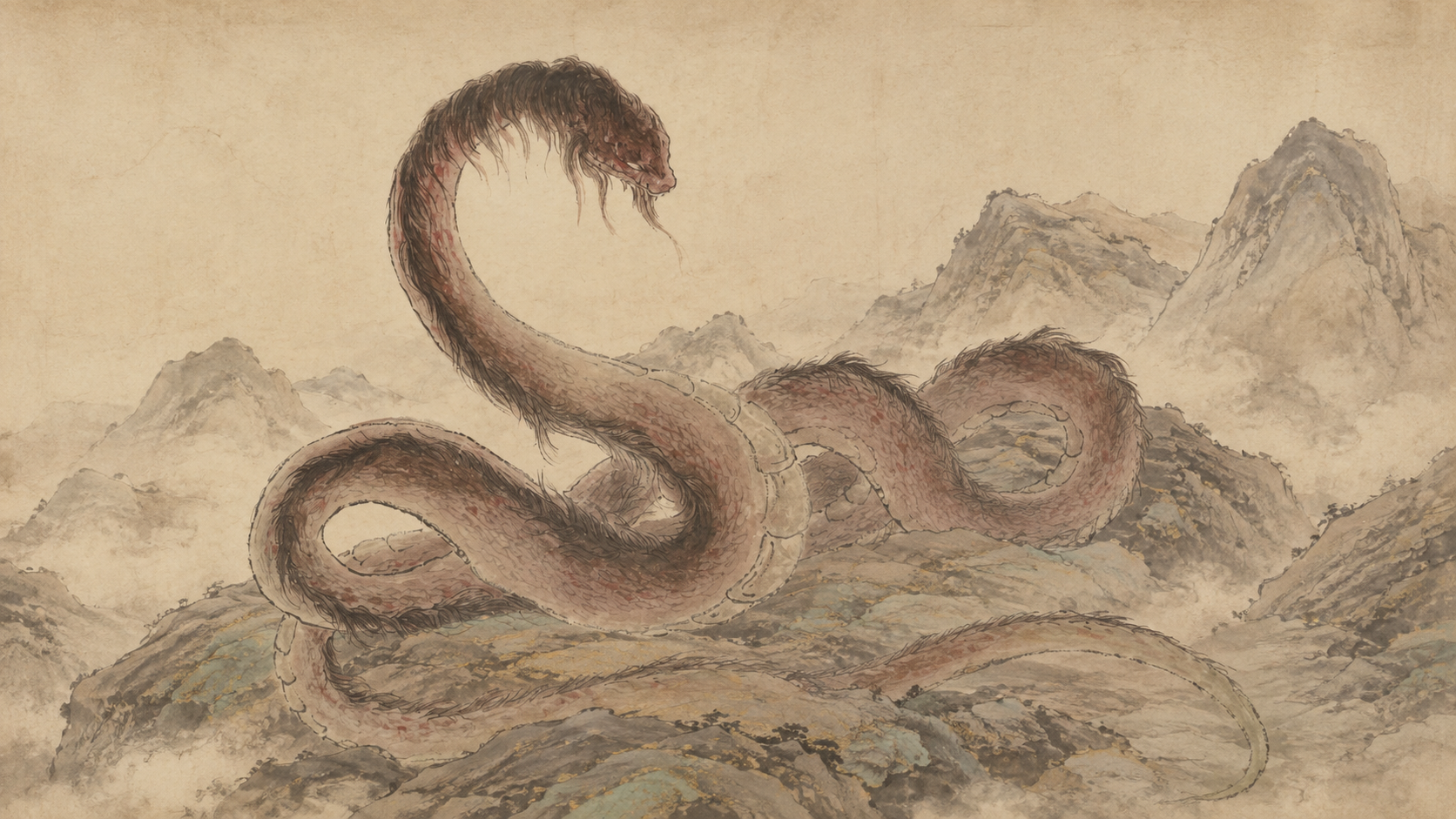
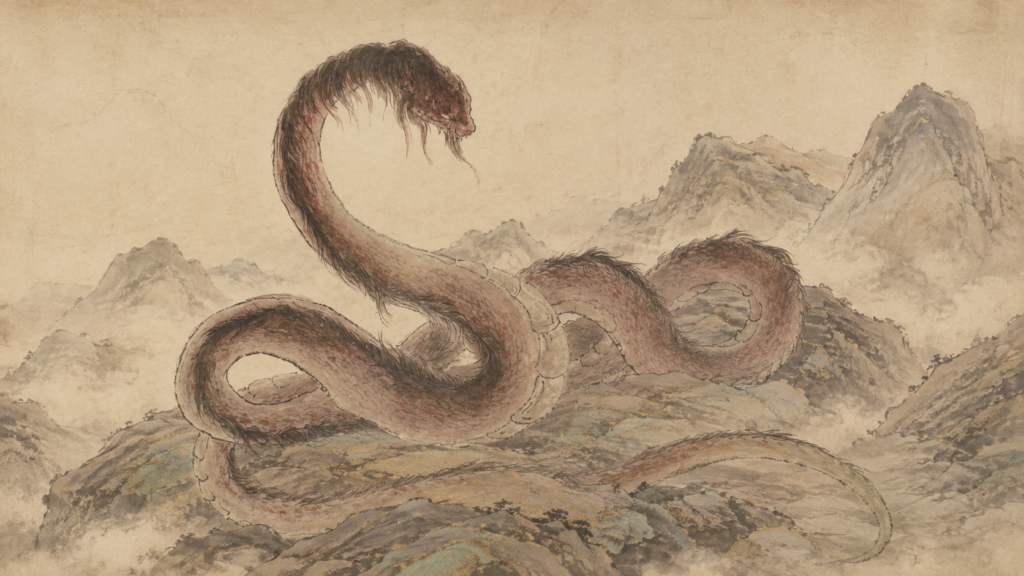
On the barren slopes of an ancient mountain described in the Shan Hai Jing, a strange serpent moved across exposed stone. Its body was covered not in the smooth skin we expect from a snake, but in coarse hair resembling the bristles of a pig.
And when it made a sound, it did not hiss.
It sounded like someone striking a wooden night-watch clapper in the distance.
Changshe (长蛇, Chángshé) is an unusual serpent recorded in the Shan Hai Jing. The ancient text places it on Daxian Mountain and describes it as having pig-like bristles and a call resembling the clacking sound used by ancient night watchmen.
That short description is almost everything the original source gives us.
And it is enough.
What Is Changshe?
Changshe appears in the Beishan Jing, the Classic of the Northern Mountains section of the Shan Hai Jing.
The text leads the reader 280 li north to Daxian Mountain (大咸之山).
It describes a strange landscape:
- no grass or trees grow there;
- jade can be found below the mountain;
- the mountain is square;
- its summit cannot be climbed.
Then comes Changshe.
有蛇名曰长蛇,其毛如彘豪,其音如鼓柝。
In natural English:
There is a snake called Changshe. Its hair is like the bristles of a pig, and its sound resembles the striking of a night watchman’s wooden clapper.
The description does not continue into a battle or a longer legend.
Changshe simply exists there.
Hidden somewhere on an impossible mountain.
Why Is Changshe So Unusual?
The most obvious feature is the hair.
Snakes do not normally have fur, which immediately turns an otherwise recognizable animal into something unnatural.
The original Chinese compares Changshe’s covering to 彘豪 (zhìháo) — coarse pig or boar-like bristles.
That distinction matters visually.
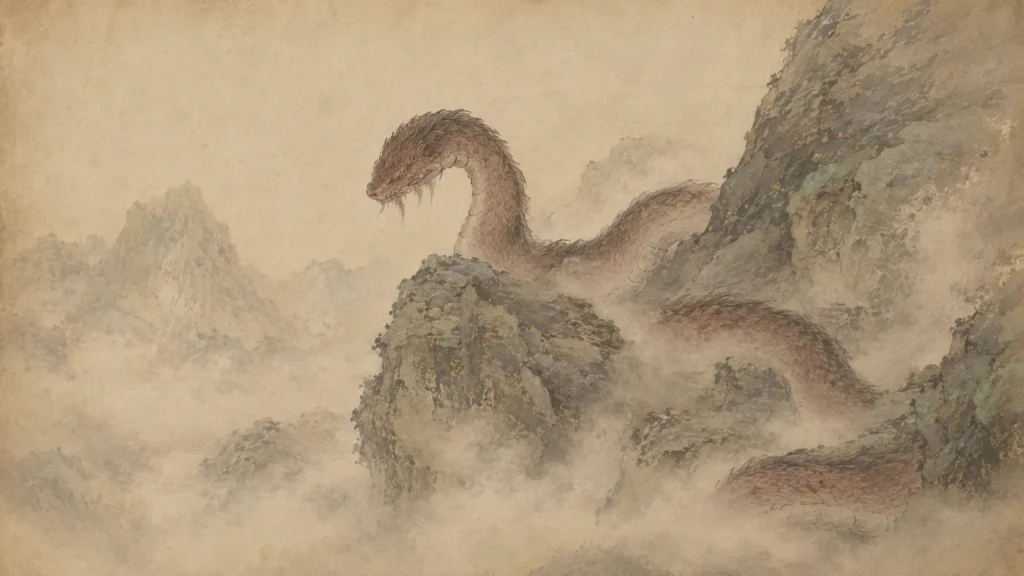
Changshe should not look like a normal snake covered in soft mammal fur. The book illustration captures the idea much better: a long serpent whose body carries rough, irregular hair along portions of its back and neck.
Its appearance remains unmistakably serpentine.
But something about it is wrong.
That is exactly the kind of transformation the Shan Hai Jing uses again and again—taking an animal people understood and changing one or two features until it belongs to another world.
What Did Changshe Sound Like?
This might be its strangest characteristic.
The Shan Hai Jing says its voice was like 鼓柝 (gǔtuò).
The word tuò refers to a wooden clapper traditionally struck by night watchmen while making their rounds. An early commentary by Guo Pu explains the passage as resembling the sound of someone striking such a wooden instrument at night.
Imagine the setting.
No trees.
No grass.
Bare mountain rock disappearing into darkness.
Then somewhere beyond the mist:
Clack.
Silence.
Clack.
Except there is no watchman.
There is only Changshe.
That single detail gives the creature more atmosphere than an entire invented battle ever could.
How Big Was Changshe?
We do not know.
The name 长蛇 (Chángshé) literally means something like “long snake” or “long serpent,” and later commentary sometimes imagined it as an enormous creature.
But the original Shan Hai Jing passage does not give a measurement.
That means we should not confidently describe Changshe as hundreds of feet long simply because later retellings do so.
The ancient text tells us it is a strange serpent.
How far its body stretched across Daxian Mountain is left unanswered.
Was Changshe Dangerous?
The original passage never says.
This is important because many creatures in the Shan Hai Jing receive explicit warnings.
Some eat humans.
Some cause drought.
Some appear before war or disaster.
Changshe receives no such statement.
The text does not tell us that it was venomous, that it attacked people, or that seeing it predicted catastrophe.
Its strange body and eerie call were apparently remarkable enough.
That actually makes Changshe more interesting.
Not every creature in the ancient bestiary needed to be evil.
Some were simply unexplained.
Snakes in the Shan Hai Jing
Changshe belongs to a much larger pattern.
Snakes appear repeatedly throughout the Shan Hai Jing: as independent creatures, parts of hybrid animals, supernatural signs, and companions or attributes of divine beings.
The commentary in the book you photographed also points this out, noting how frequently serpent imagery appears throughout the work.
Some snakes are connected with disaster. Others appear around gods and supernatural beings.
So the serpent was not simply a symbol of evil.
It could represent danger, supernatural power, mystery, or something existing beyond the boundaries of ordinary nature.
Changshe fits perfectly into that world.
It does not need a complicated story.
A hairy serpent making the sound of a night watchman on an unclimbable mountain is already strange enough.
Why Changshe Is Worth Remembering
Changshe has no famous warrior to fight.
No kingdom falls because of it.
No surviving story tells us who discovered it.
Yet more than two thousand years later, its description still creates an image immediately.
A barren mountain.
Mist moving across stone.
A long body covered in coarse bristles.
And somewhere in the emptiness, the rhythmic sound of wood striking wood.
The Shan Hai Jing often works best exactly like this.
It gives us only a few lines.
Then it leaves the rest of the mountain unexplored.
Reference:
- Chinese Text Project — Shan Hai Jing: Beishan Jing — original passage describing Daxian Mountain and Changshe.
- Shidian Guji — Beishan Jing — classical Chinese text preserving the Changshe passage