A pig’s body is only the beginning.
The Shan Hai Jing adds eight feet and a snake’s tail.
Then it records something more unexpected: the offering these mountain gods were supposed to receive.
The eight-legged mountain gods are ten unnamed deities in the Northern Mountains section of the Shan Hai Jing.
They share pig-like bodies, eight feet and serpent tails. Each receives a buried jade bi disc in the text’s ritual instructions.
The descriptive label 彘身八足蛇尾神 (zhì shēn bā zú shé wěi shén) means gods with pig bodies, eight feet and snake tails.
It describes their appearance; it is not a personal name supplied by the ancient passage.
Eight-Legged Mountain Gods at a Glance
| Detail | What the text records |
|---|---|
| Chinese description | 彘身八足蛇尾神 |
| Pinyin | zhì shēn bā zú shé wěi shén |
| Identity | Ten unnamed mountain deities |
| Source | Shan Hai Jing 山海經 |
| Section | Northern Mountains, third mountain sequence |
| Appearance | Pig bodies, eight feet and snake tails |
| Ritual | One jade bi disc buried for each deity |
| Omen or cry | Neither is specified for this group |
Ten Gods at the End of a Mountain Route
Their description appears in a closing summary, after a long sequence of mountain entries.
The route stretches from Taihang Mountain (太行之山) to Wufeng Mountain (無逢之山 / 无逢之山).
The text counts forty-six mountains and gives a total distance of 12,350 li.
Those figures describe the whole itinerary, rather than the territory of one named god.
Within its final summary, the deities fall into three groups.
Twenty have horse bodies and human faces. Fourteen have pig bodies and bear jade.
The remaining ten have pig bodies, eight feet and snake tails.
Together, these groups make the forty-four gods counted in the summary.
The eight-legged figures therefore belong to a larger sacred landscape, with different forms and different rites.
What Did Their Eight Feet Look Like?
The ancient wording is compact: 彘身而八足蛇尾, pig-bodied, with eight feet and snake tails.
Zhì (彘) refers to a pig. Zú (足) means foot; the usual English description is “eight-legged.”
The passage supplies no diagram showing how those feet connect to the body.
It also leaves their faces, posture and proportions undescribed.
That gives an illustrator considerable room, but the written anatomy remains specific.
A pig-like body, eight feet and a serpent tail are the details any interpretation must account for.
The Buried Jade Offering
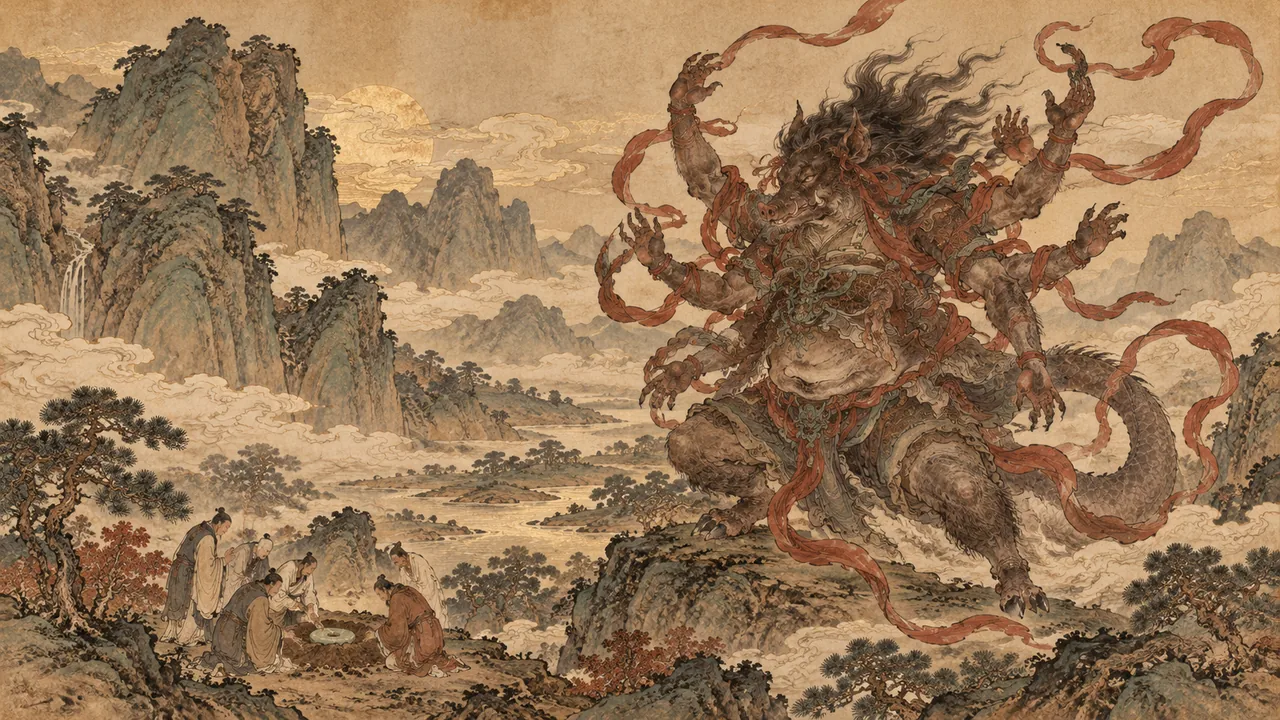
The next instruction turns the strange body into part of a ritual relationship.
For each of these ten gods, the text prescribes one 璧 (bì), buried as an offering.
A bi is a disc with a central opening, commonly made from jade.
The Metropolitan Museum of Art preserves ancient examples and discusses their possible ritual and status-related uses.
Those surviving objects help explain the offering’s material form. They do not prove worship of these particular ten gods.
The mountain summary also mentions rice offerings for the larger group of forty-four deities.
Its emphasis is on what should be offered, rather than an adventure involving a hero.
The Ancient Passage and the Modern Image
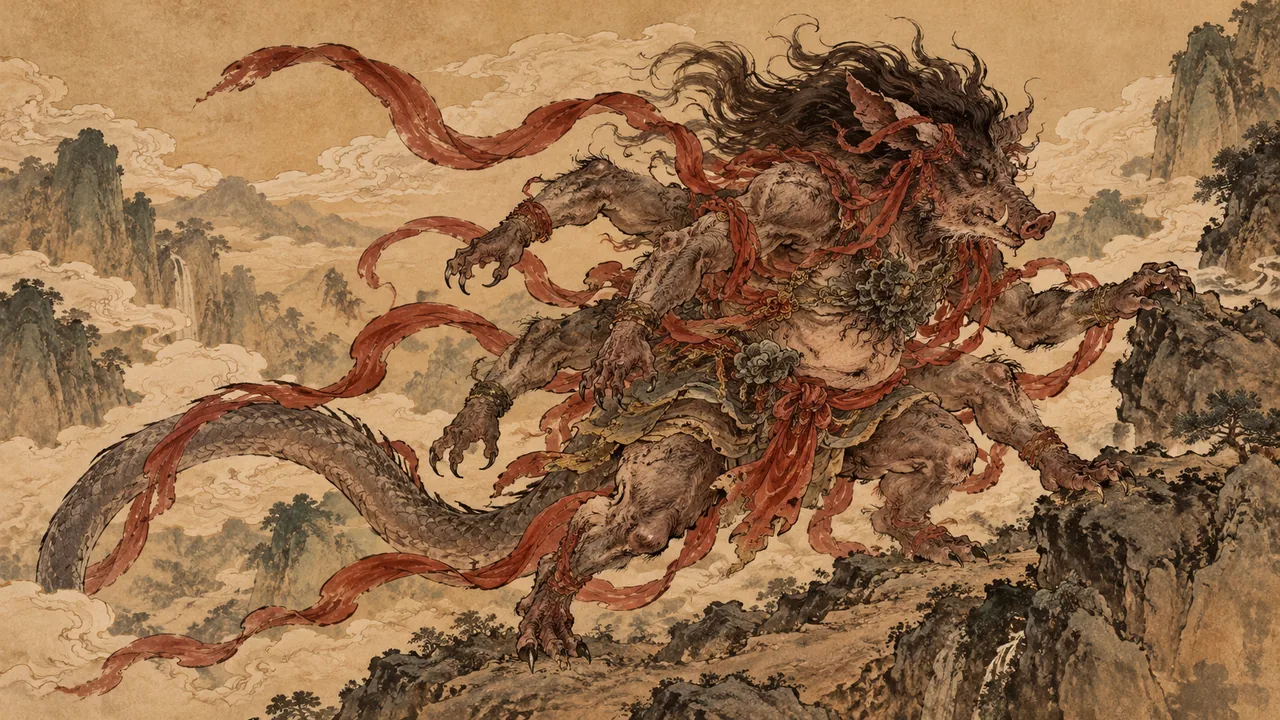
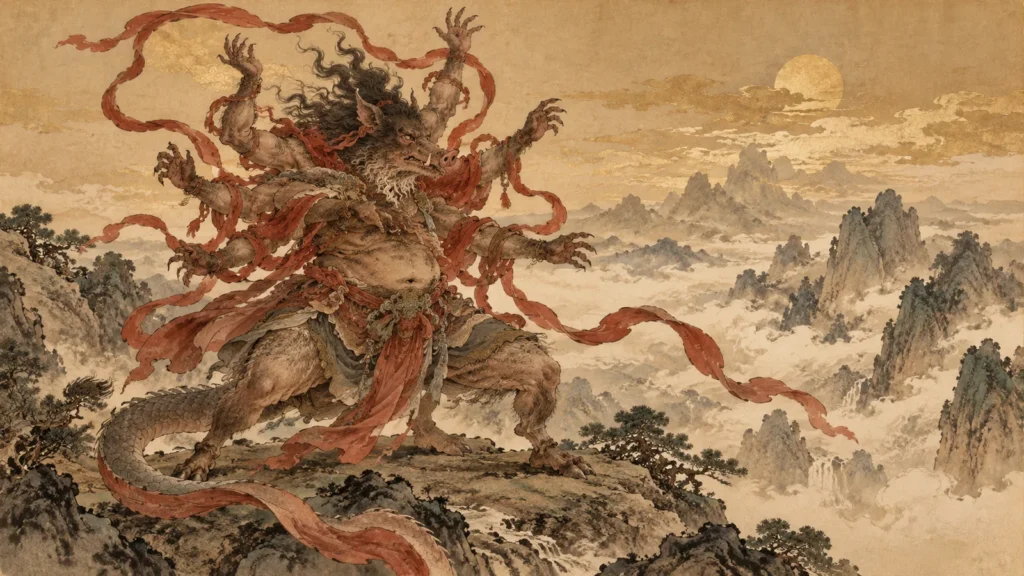
An armored figure with flowing ribbons makes the deity immediately vivid.
That visual language belongs to modern interpretation, however. The quoted description specifies neither armor nor weapons.
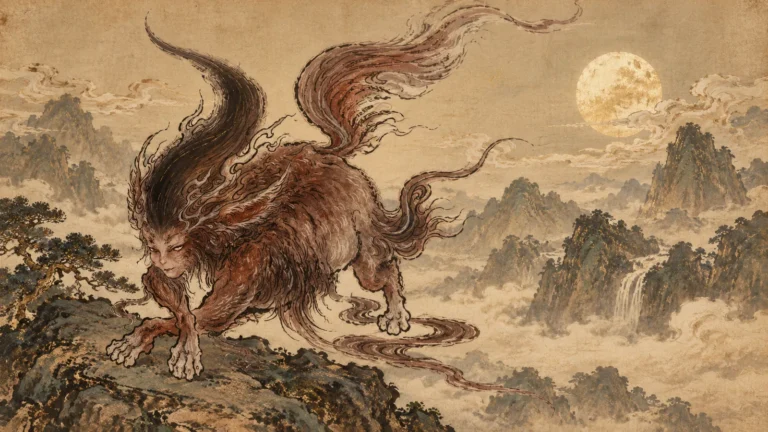
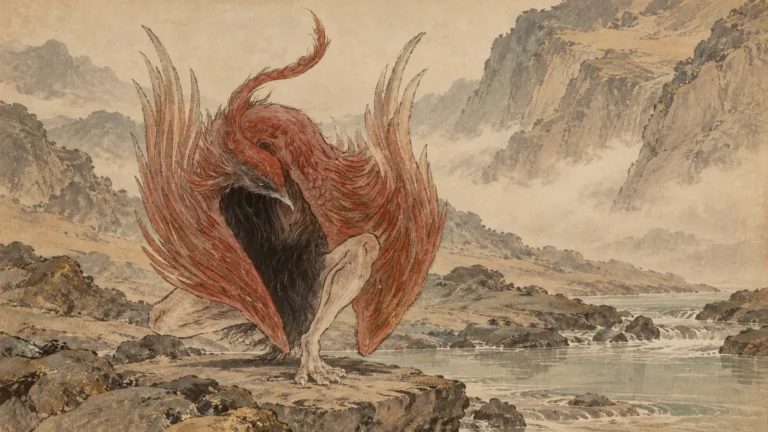
The illustrations here explore that interpretation; their overlapping limbs are not anatomical diagrams.
The text itself gives these ten gods no individual names, spoken call or appearance-linked omen.
There is no explanation of why they have eight feet or what their snake tails symbolize.
Their strange form survives more clearly than any story about their origins.
Other Mountain Gods, Different Identities
The sheep-horned gods belong to a separate Eastern Mountains sequence.
Elsewhere, dragon-bodied, human-faced gods provide another example of deities described collectively.
These comparisons reveal a recurring pattern: a mountain route ends with divine forms and ritual requirements.
Each group still needs to be read within its own passage.
The wider Shan Hai Jing collection contains many such sharply drawn encounters between landscape and the extraordinary.
What Remains on the Ridge
Only a few lines preserve these ten gods.
Yet their identity is difficult to forget: a familiar animal body changed by an impossible number of feet.
Beside that image sits a precise ritual detail: one jade disc, placed beneath the earth.
The mountains have their distances and resources. They also have beings who must be approached on different terms.
References and Sources
Shan Hai Jing, Northern Mountains, Shidian edition — closing summary of the third northern sequence; text presented with Guo Pu’s commentary and Huang Pilie’s collation.
Shan Hai Jing, Northern Mountains, Wikisource revision 442532 — parallel primary passage for the gods’ appearance and offerings.
The Metropolitan Museum of Art, Annular disk (bi), object 17.118.43 — material and historical context for jade discs; not evidence identifying these deities.