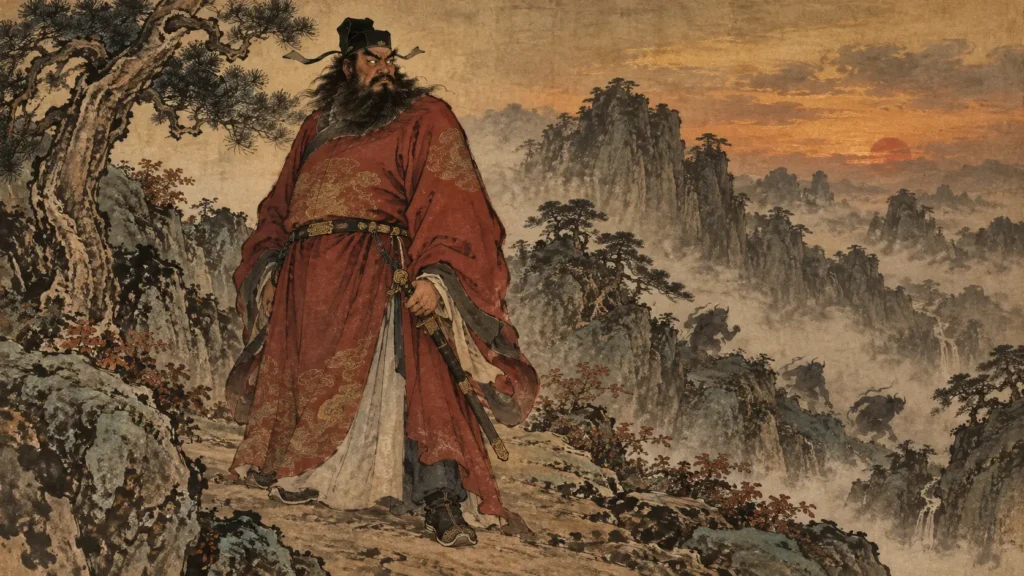
A fierce man stands at the doorway.
His beard is wild. His eyes are intense. A sword hangs at his side, while demons flee from him—or, in stranger paintings, follow him like servants.
This is Zhong Kui (钟馗 / 鍾馗, Zhōng Kuí), one of the most recognizable supernatural protectors in Chinese folklore.
For centuries, images of Zhong Kui have been used to drive away harmful spirits, illness and bad fortune. Yet behind the terrifying face is an unusual legend: not a monster, but a scholar whose tragic story transformed him into the great Demon Queller.
Zhong Kui Quick Facts
| Chinese | 钟馗 / 鍾馗 |
| Pinyin | Zhōng Kuí |
| Best known as | Demon Queller |
| Role | Protective folk figure and vanquisher of demons |
| Traditional origin | Tang-dynasty legend |
| Famous connection | Emperor Xuanzong’s dream |
| Common appearance | Bearded scholar, official cap, boots and sword |
| Associated customs | New Year protection and the fifth lunar month |
| Historical status | Legendary rather than securely documented as a historical person |
Who Is Zhong Kui?
Zhong Kui is a legendary Chinese demon queller and protective figure believed to drive away ghosts, evil spirits and harmful influences.
His frightening appearance can make him look like a demon himself, but his traditional role is the opposite.
He fights them.
The Metropolitan Museum of Art traces the famous demon-quelling story to the Tang dynasty, when Emperor Minghuang—better known as Emperor Xuanzong—was said to recover from illness after dreaming of a large supernatural figure destroying demons. The Metropolitan Museum of Art
That figure became Zhong Kui.
Over time, he moved far beyond one dream story and became one of Chinese art’s most enduring supernatural guardians.
The Dream of Emperor Xuanzong
The most famous Zhong Kui legend begins in the Tang dynasty.
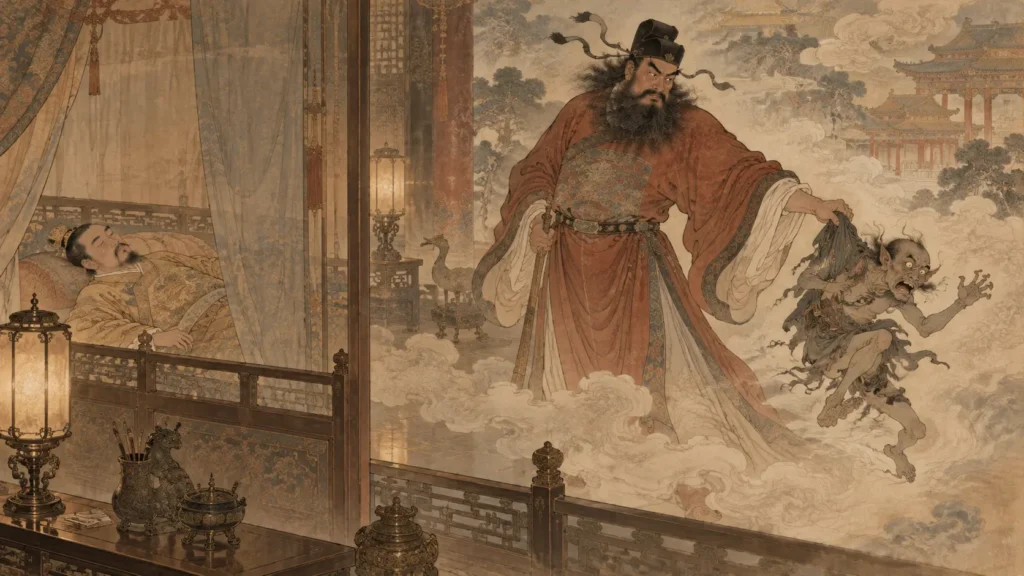
According to later tradition, Emperor Xuanzong became seriously ill. During his illness, he dreamed that a powerful ghostly man appeared and destroyed the evil spirit tormenting him.
When the emperor awoke, his health had returned.
The National Museum of Asian Art preserves a fuller popular version: after recovering, Xuanzong ordered the celebrated painter Wu Daozi to paint the figure he had seen and encouraged the display of Zhong Kui’s portrait as protection. Freer and Sackler Galleries
This became the foundation of Zhong Kui’s identity as the Demon Queller.
But there is an important historical distinction.
The British Museum notes that although the legends place the story in the eighth century, the surviving legends themselves postdate that period. British Museum
So we should not treat the dream as an eyewitness account from Xuanzong’s court.
It is a later tradition attached to a Tang emperor.
The Tragic Scholar Behind the Demon Queller
Later versions gave Zhong Kui a human life before his supernatural career.
In the best-known story, he was a gifted scholar who performed exceptionally well in the imperial examination.
But his appearance was considered so ugly or unconventional that he was denied the honor he deserved.
Humiliated by the injustice, Zhong Kui died by suicide.
Later versions say that an emperor granted him an honorable burial. In gratitude, Zhong Kui vowed after death to protect the world from demons and evil spirits. The Metropolitan Museum preserves a version of this narrative in its description of Zhong Kui as a scholar denied the first rank who later returned as an exorcist. The Metropolitan Museum of Art
The details are not identical in every tradition.
That matters.
Zhong Kui does not have one perfectly fixed biography preserved unchanged since antiquity. His scholar story, imperial dream, supernatural role and artistic image developed together across later folklore.
Was Zhong Kui a Real Person?
There is no secure historical evidence that allows us to identify Zhong Kui as a documented Tang scholar whose life unfolded exactly as the legend claims.
Museum collections consistently treat him as a legendary or mythological figure.
The safest way to understand him is therefore not as a historical official who later acquired a few supernatural stories, but as a folk figure whose legend was increasingly given a biography.
The Tang court setting gave the story antiquity and authority.
The rejected-scholar narrative gave Zhong Kui tragedy.
His return as a demon hunter turned that tragedy into power.
Is Zhong Kui a God?
Calling Zhong Kui simply a “god” is not completely wrong, but it can flatten the tradition.
He appears as a protective deity, supernatural guardian, exorcistic figure and demon queller depending on the source and context.
The National Museum of Asian Art describes him as a popular deity, while museum art frequently identifies him simply as the legendary Demon Queller. Freer and Sackler Galleries
His most consistent function is easier to define than his exact theological rank:
Zhong Kui protects people from dangerous supernatural forces.
What Powers Does Zhong Kui Have?
Modern searches often ask about Zhong Kui’s “powers,” but traditional folklore does not give him a video-game-style ability list.
His central power is exorcistic authority.
He can defeat, capture and control demons and ghosts.
In art, that authority is often represented by his sword, fierce expression and strange entourage.
Some images show demons being crushed beneath him. Others show them carrying objects or serving him, suggesting that Zhong Kui does not merely destroy supernatural beings—he can also subdue them and place them under his command. The Met’s Qing-dynasty sculpture, for example, shows Zhong Kui seated on one demon while others approach with offerings. The Metropolitan Museum of Art
His sword became one of his best-known visual attributes, but it is better understood as part of his evolving iconography than as one universally defined magical weapon. The Metropolitan Museum of Art
Why Does Zhong Kui Look So Frightening?
Zhong Kui’s appearance is deliberately intimidating.
Traditional images commonly give him a heavy beard, forceful expression and scholarly or official clothing.
That contradiction is important.
He looks frightening enough to belong among the demons—but he wears the dress of an educated man and acts as their enemy.
The visual message is almost immediate:
evil should be more afraid of Zhong Kui than people are.
This is also why artists could portray him in many different ways.
Sometimes he is a raging exorcist.
Sometimes a stern official.
Sometimes even an eccentric scholar sitting quietly with flowers and books. An 1883 painting by Ren Yi deliberately presents Zhong Kui as a cultivated scholar rather than a violent demon hunter. The Metropolitan Museum of Art
Zhong Kui at Chinese New Year
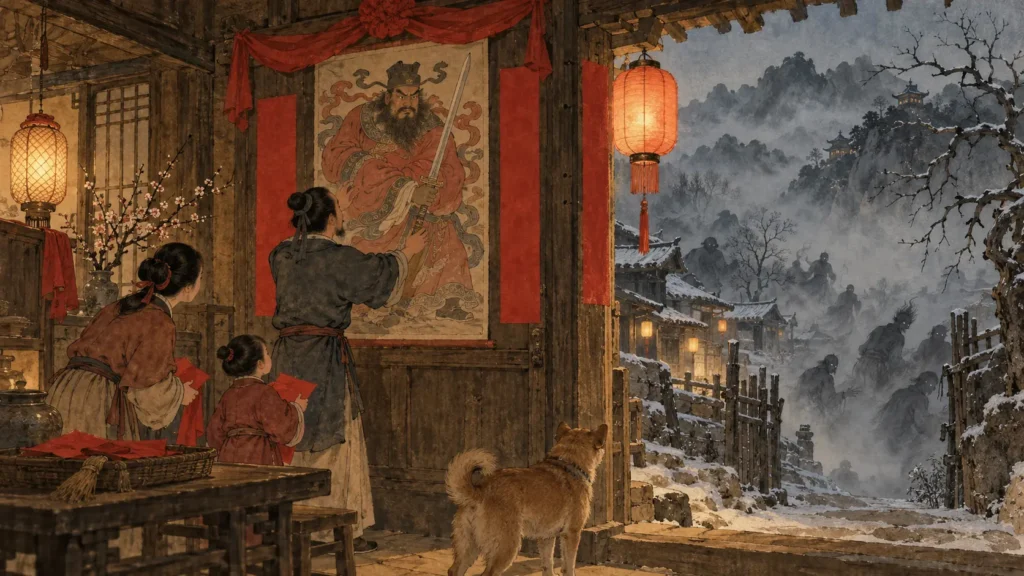
Zhong Kui eventually became strongly associated with household protection.
The British Museum records that images of him were displayed around Chinese New Year to protect homes from harmful supernatural influences. British Museum
A Zhong Kui image therefore did more than decorate a wall.
It could function as a protective presence.
This makes him comparable in function—not identity—to other Chinese traditions in which powerful figures protect entrances, households and boundaries from unwanted forces.
Zhong Kui and the Dragon Boat Festival
Zhong Kui was also associated with protection during the fifth day of the fifth lunar month, the period connected with the Duanwu or Dragon Boat Festival.
Traditionally, this part of the year was associated with heat, disease and dangerous influences.
The British Museum notes that Zhong Kui images were considered useful both at New Year and during the “Double Five” period to dispel evil and misfortune. British Museum
This seasonal protective role helps explain why Zhong Kui became much more than a character in a single story.
People could actually bring his image into their homes.
Zhong Kui and His Sister
One of the stranger later traditions shows Zhong Kui giving his sister away in marriage.
A Yuan-dynasty handscroll in The Metropolitan Museum of Art depicts Zhong Kui leading his sister toward her new home while demons accompany the strange wedding procession.
The scene is humorous rather than terrifying: Zhong Kui himself is shown drunk and supported by demonic attendants.
The museum explains that the motif also worked as a visual pun connecting “marrying off one’s sister” with the idea of subjugating demons. The Metropolitan Museum of Art
This tells us something important about Zhong Kui.
He was not confined to solemn religious imagery.
Artists could make him frightening, protective, comic or even ridiculous while audiences still recognized the same Demon Queller.
Zhong Kui and Journey to the West
Modern audiences often place Zhong Kui beside Sun Wukong, demons and the supernatural bureaucracy familiar from Journey to the West.
But Zhong Kui’s famous tradition has a different center.
His identity grows from the Xuanzong dream legend, protective customs, exorcistic folklore and centuries of visual art rather than from the Monkey King’s journey to India.
So when discussing Zhong Kui, it is better to treat him as his own Chinese folklore tradition, not simply another Journey to the West character.
Why Is Zhong Kui So Popular Again?
There is now a very modern reason millions of people are encountering his name.
Game Science is developing Black Myth: Zhong Kui, the second title in its Black Myth series. The studio explicitly says that the game is rooted in ancient Chinese mythology and folklore and that Zhong Kui is its new central figure. gamesci.cn
That modern adaptation may change how a new generation imagines him.
But the game did not create Zhong Kui.
Long before digital monsters, boss battles or action RPGs, his image already hung in homes, appeared in ritual seasons and filled paintings with terrified demons.
Why Zhong Kui Still Matters
Zhong Kui’s legend begins with rejection.
The brilliant scholar is judged by his face rather than his ability.
He dies without receiving the position he deserved.
Yet folklore does not leave him defeated.
After death, the rejected man becomes powerful enough to make demons fear him.
Perhaps that transformation explains part of his endurance.
Zhong Kui is frightening—but protective.
Dead—but powerful.
Excluded by the human world—but given authority over the supernatural one.
The face that supposedly prevented him from receiving honor eventually became the very face people placed on their walls for protection.
References and Sources
The Metropolitan Museum of Art — Demon Queller Zhong Kui with Demons. Useful for the Tang dream tradition and Zhong Kui’s relationship with subdued demons. The Metropolitan Museum of Art
Met Museum — Demon Queller Zhong Kui
National Museum of Asian Art — Zhong Kui and the Lunar New Year. Museum account of the examination legend, Xuanzong’s dream and protective New Year tradition. Freer and Sackler Galleries
National Museum of Asian Art — Zhong Kui and the Lunar New Year