Deep inside the mountains of the Shan Hai Jing, there is a god described in only a few lines.
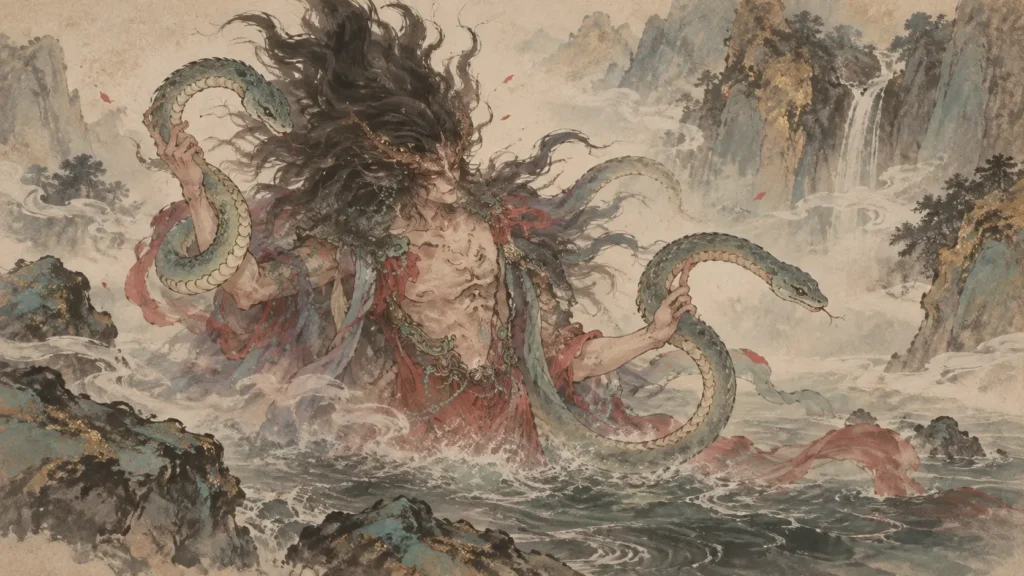
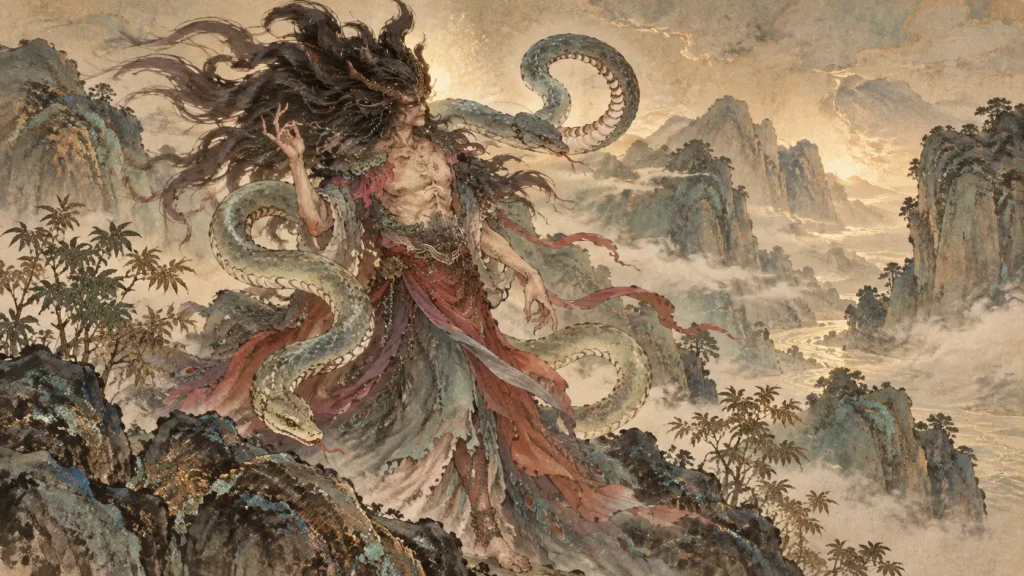
He looks human.
Two snakes are in his grasp.
He moves through the deep waters of rivers.
And whenever he enters or emerges, light follows him.
This mysterious figure is Yu’er (于儿, Yú’ér), commonly called Yu’er Shen (于儿神) in later descriptions and illustrations.
Yu’er is one of the many strange mountain deities recorded in the Shan Hai Jing, but his connection with snakes, deep water and supernatural light gives him an image unlike most others.
Quick Facts About Yu’er Shen
- Chinese: 于儿神
- Pinyin: Yú’ér Shén
- Name: Yu’er
- Source: Shan Hai Jing
- Section: Zhongshan Jing — Classic of the Central Mountains
- Home: Mount Fufu (夫夫之山)
- Appearance: Human-bodied
- Distinctive feature: Holds two snakes
- Associated place: Deep river waters
- Phenomenon: Light appears when he enters or emerges
Who Is Yu’er Shen?
Yu’er appears in the Classic of the Central Mountains of the Shan Hai Jing.
The ancient text reaches a place called Mount Fufu (夫夫之山) and describes the mountain’s natural resources before introducing its divine inhabitant.
The surviving passage states:
神于儿居之,其状人身而身操两蛇,常游于江渊,出入有光。
A cautious natural translation would be:
The deity Yu’er dwells there. His form is human, and he holds two snakes. He often moves through the depths of the river, and when he enters or emerges there is light.
The Chinese Text Project preserves this passage within the Zhongshan Jing. Chinese Text Project
And remarkably, that brief description contains almost everything the ancient text explicitly tells us about him.
The God of Mount Fufu
Yu’er is associated with Mount Fufu, not with a celestial palace or famous imperial court.
The same passage describes the mountain as containing gold, blue-green mineral substances including realgar, mulberry and paper-mulberry trees, as well as bamboo and other vegetation. Chinese Text Project
But we should be careful here.
The text does not say Yu’er controls gold.
It does not say those minerals are magical.
And it never states that they are the source of his powers.
They describe the sacred geography surrounding him.
This is common in the Shan Hai Jing: landscape, minerals, animals and gods appear together, but that does not mean every feature should be turned into a supernatural ability.
Why Does Yu’er Hold Two Snakes?
The most memorable part of Yu’er’s description is his relationship with snakes.
The text portrays him with a human body while 操两蛇 — handling or holding two snakes.
Snake-holding imagery appears more than once among divine figures in the Shan Hai Jing. Nearby descriptions even mention other strange gods associated with snakes. Chinese Text Project
But the source never explains exactly what Yu’er’s two snakes mean.
It does not tell us that they are weapons.
It does not name them.
It does not say they grant him poison, immortality or control over other serpents.
Those interpretations may work in modern fantasy, but they go beyond the ancient account.
The safest conclusion is also the most interesting:
the snakes are part of Yu’er’s divine identity, but their precise symbolism has been lost.
Yu’er and the Deep Waters
Yu’er is a mountain deity, yet the text also says he often travels through the deep waters of the river.
That gives him an unusual position between mountain and water.
He is not described simply standing on Mount Fufu.
He moves.
He enters the depths.
He emerges again.
And when he does, something supernatural happens.
Light appears.
The phrase 出入有光 literally associates his coming and going with light. Chinese Text Project
The text does not explain whether the light comes from his body, his snakes or another phenomenon surrounding him.
So it is better not to claim that Yu’er possesses a specific “light power.”
We only know what the ancient description gives us:
when he enters and emerges, there is light.
Is Yu’er the Snake-Holding God From the Story of Yu Gong?
There is a fascinating later connection, but it should be treated carefully.
The Liezi contains the famous story of Yu Gong Moving the Mountains.
Near the end, a mysterious “god who holds snakes” (操蛇之神) hears of Yu Gong’s determination and reports it to the supreme deity. The deity then orders powerful beings to remove the mountains. Chinese Text Project
The Liezi itself does not call this god Yu’er.
However, later commentator Hao Yixing suggested that the unnamed snake-holding deity may have been the same figure as Yu’er. Zhihu
That makes the connection interesting.
But not certain.
So the accurate version is:
A later scholar identified Yu’er with the snake-holding god from the Yu Gong story, but the original Liezi does not explicitly name him.
What Powers Did Yu’er Shen Have?
This is another place where modern retellings can easily invent too much.
The original Shan Hai Jing does not say Yu’er can:
- command snakes;
- control rivers;
- summon storms;
- shapeshift;
- heal people;
- grant immortality;
- control light.
What it actually tells us is much narrower.
Yu’er is divine.
He has human form.
He handles two snakes.
He travels through river depths.
His entrances and exits are accompanied by light.
That is enough.
One of the strengths of the Shan Hai Jing is that it does not explain everything.
Yu’er Shen and the Forgotten Gods of the Shan Hai Jing
Yu’er is nothing like the great celestial rulers who dominate later Chinese mythology.
There is no enormous biography.
No war against Heaven.
No famous magical weapon.
His entire identity survives in a handful of ancient words.
Yet those words create an unforgettable image:
A strange god lives on a mineral-rich mountain.
He looks almost human.
Two snakes move with him.
Below the mountain lie the dark depths of a river.
Then the water shifts.
The deity emerges.
And there is light.
The Shan Hai Jing is full of figures like this.
Gods remembered not through long legends, but through fragments.
Sometimes the fragment is enough.
References
Shan Hai Jing — Zhongshan Jing, passage on Mount Fufu and Yu’er
Primary ancient source describing Yu’er, his human form, the two snakes, his movement through deep water and the light accompanying him. Chinese Text Project
Chinese Text Project — Shan Hai Jing passage
Liezi — Tang Wen
Primary source for the separate story of the unnamed “snake-holding god” in the tale of Yu Gong Moving the Mountains. Chinese Text Project
Chinese Text Project — Liezi Tang Wen