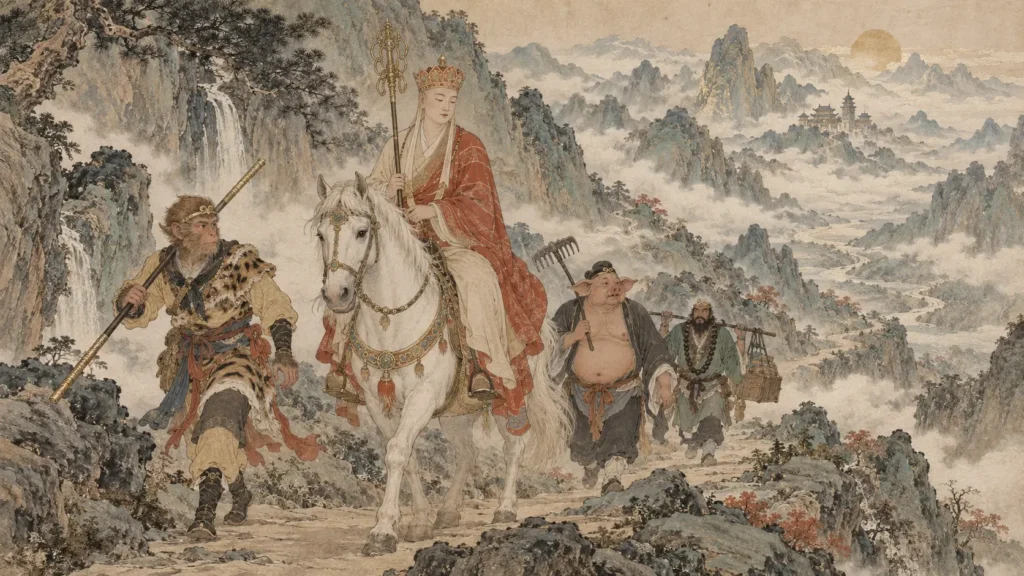
Tang Sanzang (唐三藏, Táng Sānzàng) is the Buddhist monk at the heart of Journey to the West. Also known as the Tang Monk, Tang Seng, and Tripitaka, he leads the pilgrimage from China toward India in search of sacred Buddhist scriptures.
Sun Wukong can fight gods.
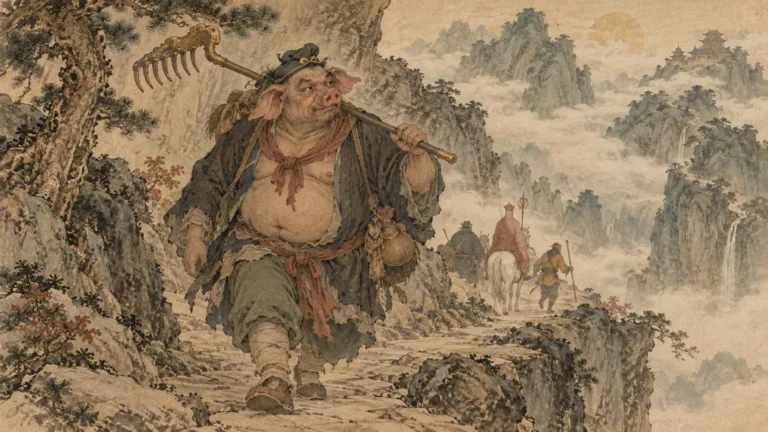
Zhu Bajie can overpower monsters.
Sha Wujing can survive dangers that would destroy an ordinary man.
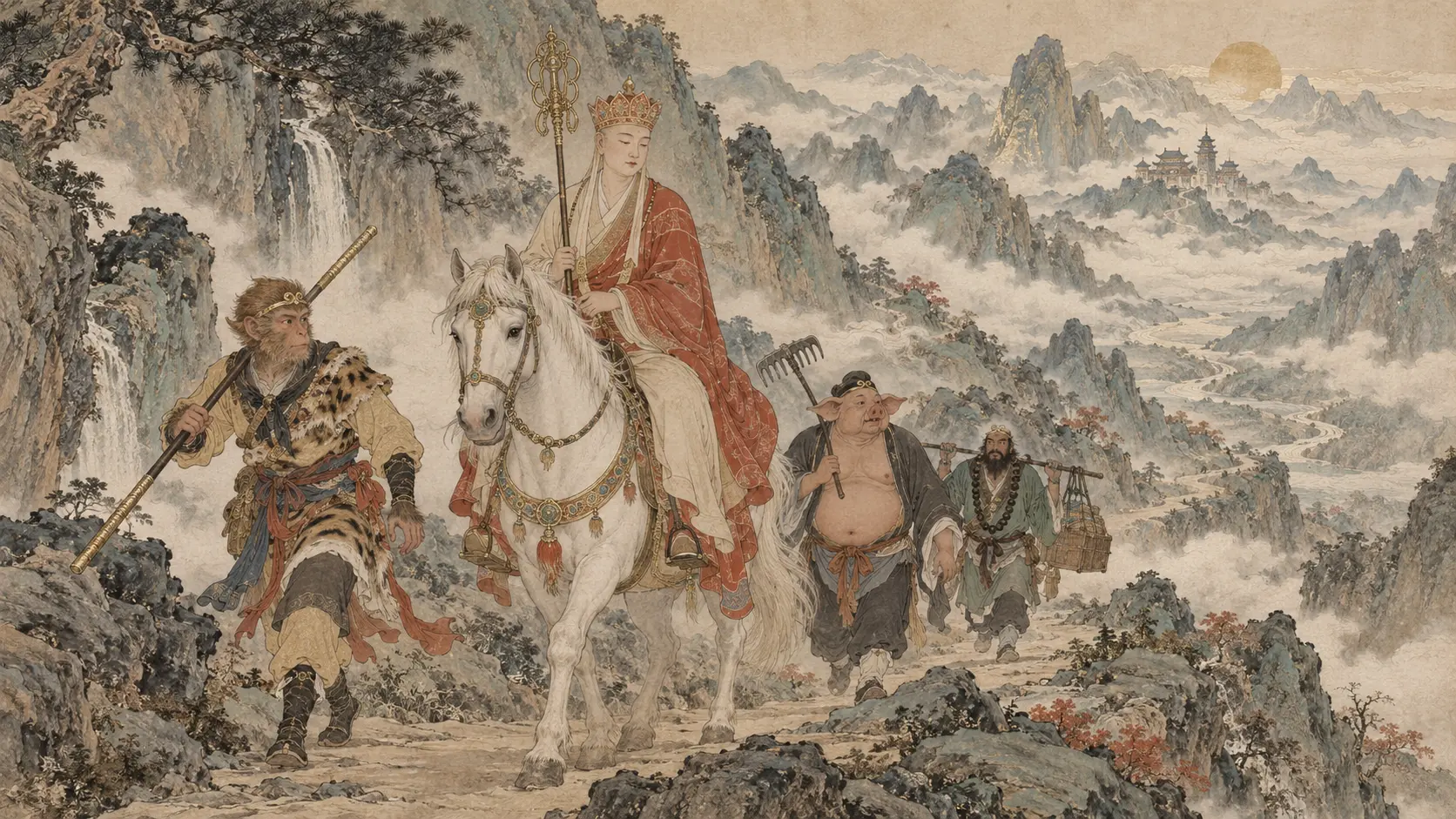
Yet none of them would be traveling west without the quiet figure riding at the center of the group.
Unlike his supernatural disciples, Tang Sanzang is physically vulnerable. He cannot fly across the clouds, transform into animals, or defeat armies with a magical weapon.
And that is exactly what makes him important.
Behind the fictional monk is also a real man: Xuanzang, the seventh-century Chinese Buddhist scholar whose extraordinary journey to India helped inspire one of the greatest stories in Chinese literature.
Quick Facts About Tang Sanzang
- Chinese name: 唐三藏 (Táng Sānzàng)
- Also known as: Tang Monk, Tang Seng, Tripitaka
- Main story: Journey to the West (西游记, Xīyóu Jì)
- Historical inspiration: Xuanzang (玄奘), 602–664
- Role: Buddhist pilgrim and master of the group
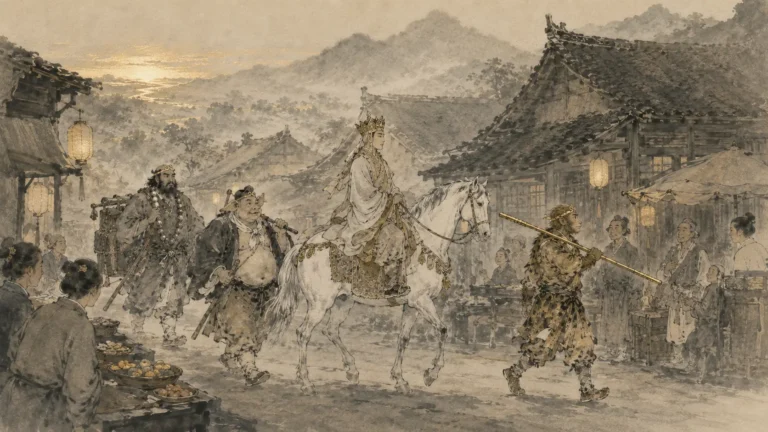
- Disciples: Sun Wukong, Zhu Bajie and Sha Wujing
- Companion: White Dragon Horse
- Previous incarnation: Golden Cicada
- Goal: Retrieve Buddhist scriptures from the West
- Final spiritual title: Buddha of Candana Merit
Was Tang Sanzang a Real Person?
Tang Sanzang is a fictional character, but he is based on the real Buddhist monk Xuanzang.
Xuanzang lived during the Tang dynasty and became one of the most important Buddhist pilgrims and translators in Chinese history.
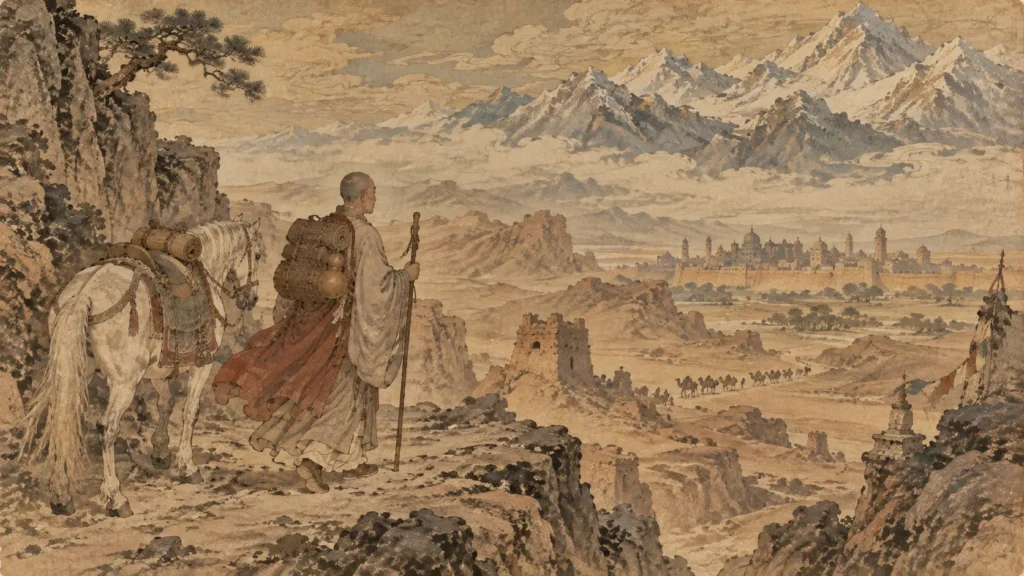
Around 629 CE, he left China and traveled west through Central Asia toward India. His motivation was not to fight demons or complete a divine adventure. He wanted to study Buddhist teachings more deeply and resolve contradictions he had encountered in the texts available in China.
The journey was extraordinary even without mythology.
Xuanzang crossed deserts and mountains, traveled through kingdoms across Central Asia, studied in India—including at the famous Buddhist center of Nalanda—and eventually returned to Chang’an in 645 carrying large numbers of Sanskrit Buddhist texts. He then spent much of the rest of his life translating them into Chinese.
That historical pilgrimage became legendary.
Over centuries, storytellers transformed the scholar’s dangerous journey into something far stranger.
Monsters appeared.
Gods intervened.
A magical monkey joined the road.
Eventually, the historical Xuanzang became the literary Tang Sanzang of Journey to the West. Earlier versions of the scripture-pilgrimage story circulated centuries before the famous full-length novel, showing how history gradually transformed into legend.
Tang Sanzang vs Xuanzang – History and Legend
This distinction is important.
Xuanzang was the real monk. Tang Sanzang is the legendary version inspired by him.
The historical Xuanzang actually left China despite restrictions on foreign travel. He was not originally dispatched west by Emperor Taizong as an official imperial scripture seeker.
Journey to the West changes the story.
In the novel, the Tang emperor supports the pilgrimage, and Tang Sanzang travels west with a sacred mission. His road is filled with demons, immortals, Buddhist figures and supernatural trials.
The novel also gives him something the historical Xuanzang certainly did not have:
Sun Wukong.
Along with the Monkey King come Zhu Bajie, Sha Wujing and the White Dragon Horse.
The real journey was already extraordinary.
The novel turned it into mythology.
Why Is Tang Sanzang Called Tripitaka?
This is where his many names can become confusing.
Sanzang (三藏) literally refers to the “Three Baskets,” the traditional threefold division of the Buddhist canon. The Sanskrit equivalent is Tripiṭaka, which is why many English translations call the monk Tripitaka.
Sanzang was also used as an honorific associated with learned Buddhist masters knowledgeable in scripture. Xuanzang himself became strongly associated with this title.
The Tang in Tang Sanzang identifies him with the Tang dynasty.
In Journey to the West, the emperor accepts the monk as an oath-brother before his departure, strengthening this association with the Tang court.
So when English readers encounter Tripitaka, Tang Monk, Tang Seng, or Tang Sanzang, they are usually looking at different names or titles connected with the same central character.
Tang Sanzang in Journey to the West
Tang Sanzang is not simply an ordinary monk who accidentally meets the Monkey King.
The novel gives him a supernatural past.
Before his human life, he was Golden Cicada (金蝉子, Jīn Chánzǐ), a disciple of the Buddha. After failing to properly respect or attend to Buddhist teaching, he is sent into the mortal world and eventually reborn as the monk destined to undertake the great pilgrimage.
His mission is to travel from the Tang Empire toward the Western Paradise and obtain true Buddhist scriptures.
But Tang Sanzang cannot complete that mission alone.
That is where his disciples enter the story.
Sun Wukong brings overwhelming supernatural power.
Zhu Bajie brings strength, appetite, comedy and constant temptation.
Sha Wujing brings patience and reliability.
The White Dragon Horse carries the monk across much of the road.
Tang Sanzang gives all of them something different:
a destination.
Tang Sanzang and Sun Wukong
The relationship between Tang Sanzang and Sun Wukong is one of the most important relationships in the entire novel.
They are almost opposites.
Wukong is powerful, suspicious and quick to attack.
Tang Sanzang is compassionate, physically vulnerable and determined to follow Buddhist moral principles.
That difference constantly creates conflict.
Wukong can often recognize a demon immediately.
Tang Sanzang sees someone who appears frightened, wounded or innocent and hesitates to believe that killing them could be justified.
The famous encounters with deceptive demons repeatedly exploit this weakness.
To control his powerful disciple, Tang Sanzang can recite the Tight-Fillet Spell, causing the magical band around Wukong’s head to constrict painfully.
Yet their relationship becomes far deeper than master controlling disciple.
Wukong protects Tang Sanzang again and again.
Tang Sanzang gives Wukong a path through which his enormous power can finally serve something beyond his own pride.
For Wukong, the pilgrimage becomes a road toward discipline.
For Tang Sanzang, Wukong becomes the protector without whom the journey would be impossible.
Why Do Demons Want to Eat Tang Sanzang?
Being a sacred monk creates a strange problem.
Everyone wants to eat him.
Throughout Journey to the West, demons repeatedly hear that eating Tang Sanzang’s flesh can grant or prolong immortality.
That belief makes the monk one of the most valuable targets in the mythological world.
Instead of simply blocking the travelers, many monsters capture Tang Sanzang and begin preparing elaborate plans to consume him.
The idea is connected with his extraordinary spiritual status, his identity as the reincarnated Golden Cicada, and his long history of religious cultivation.
This recurring danger becomes one of the great patterns of the novel:
Tang Sanzang is captured.
His disciples pursue him.
Wukong fights, tricks, investigates or seeks divine assistance.
The monk survives.
And the journey continues.
What Powers Does Tang Sanzang Have?
Compared with Sun Wukong, almost none.
And that is deliberate.
Tang Sanzang is not a warrior.
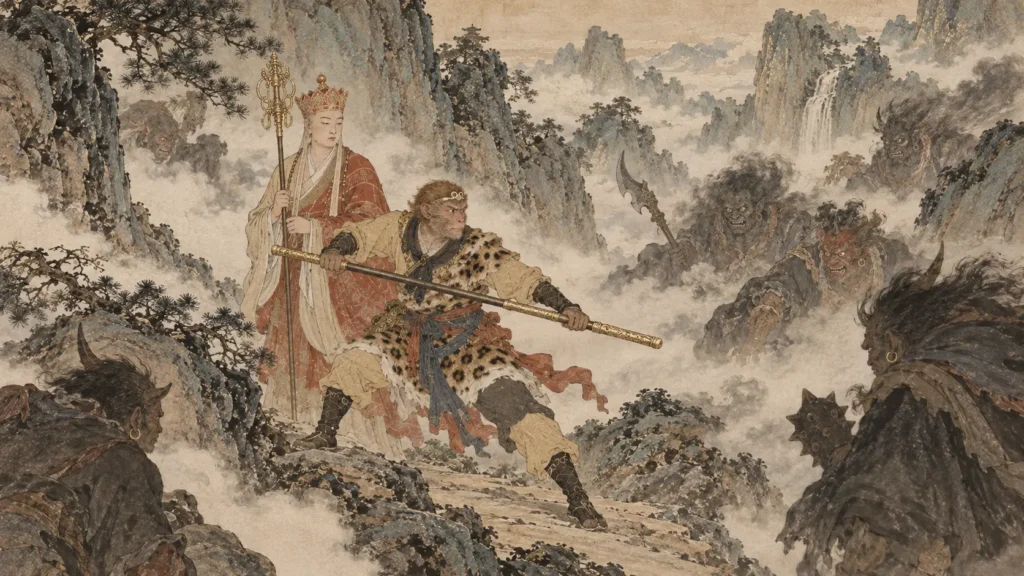
He does not possess Wukong’s 72 transformations, supernatural staff, cloud somersault or immense physical strength.
His authority is primarily spiritual rather than martial.
He can use the Tight-Fillet Spell associated with Wukong’s magical headband, and his sacred identity makes him far more than an ordinary traveler.
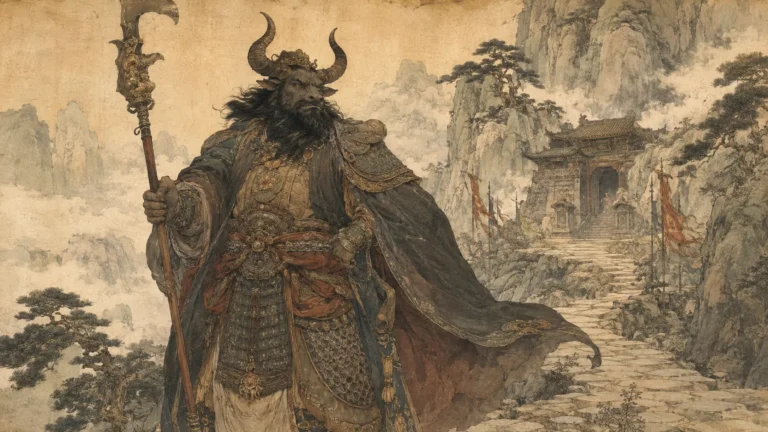
But when a powerful demon attacks like Bull Demon King, Tang Sanzang usually cannot simply defeat it himself.
He needs his companions.
This makes him unusual in a story filled with overwhelmingly powerful beings.
Tang Sanzang’s strength is endurance.
He continues walking.
He keeps believing that the scriptures are worth reaching.
And despite fear, kidnapping, temptation and repeated disaster, he refuses to abandon the purpose of the journey.
How Does Tang Sanzang’s Journey End?
The pilgrims eventually reach the Western Paradise and obtain the Buddhist scriptures they have spent so long seeking.
But even reaching the destination is not quite enough.
The structure of the novel revolves around nine times nine—eighty-one trials, a number associated with completion. When the pilgrims have experienced only eighty trials, one final ordeal is arranged before their journey can truly be completed.
After the pilgrimage succeeds, the travelers receive spiritual rewards.
Tang Sanzang is elevated to Zhantan Gongde Fo (旃檀功德佛), commonly translated as the Buddha of Candana Merit or Sandalwood Merit Buddha.
The vulnerable monk who spent much of the journey being protected, captured and rescued finally reaches Buddhahood.
Sun Wukong also achieves enlightenment.
The road has transformed both master and disciple.
Why Tang Sanzang Matters
Sun Wukong gets most of the attention.
It is easy to understand why.
A magical monkey who fights Heaven is difficult to compete with.
But remove Tang Sanzang from Journey to the West and the story loses its direction.
Without him, Wukong is still enormously powerful.
But he has nowhere meaningful to go.
Tang Sanzang represents something different from physical strength.
He represents purpose.
The historical Xuanzang crossed enormous distances because he believed knowledge was worth seeking. The fictional Tang Sanzang crosses a world of monsters because the mission remains more important than his fear.
That combination of history and mythology is what makes the character so fascinating.
Behind the demons, magic and immortals stands the memory of a real Chinese monk who actually traveled thousands of kilometers in search of Buddhist learning.
Centuries later, storytellers placed gods and monsters around him.
Then they gave him the Monkey King.
But the destination remained.
The monk still had to keep moving west.
And sometimes that is the quieter lesson hidden behind one of China’s greatest adventures:
You do not always need to be the strongest person on the road.
You need a reason strong enough to keep walking.
References
Internet Encyclopedia of Philosophy — Xuanzang (Hsüan-tsang)
Най-силният ни исторически източник за реалния Xuanzang: 602–664, причината за пътуването, забраната да напусне Китай, Nalanda, завръщането през 645 и работата му като преводач. Xuanzang — Internet Encyclopedia of Philosophy
This article is based on my own research into Chinese mythology, Buddhist history, and Journey to the West
Together with notes from books I have been reading on Chinese myths and legends. I compared historical information about Xuanzang with the literary portrayal of Tang Sanzang to separate the real pilgrimage from the mythology that later grew around it.