By Konstantin Aleksandrov — researcher and creator at Becoming Konstantin, combining Chinese mythology research with first-hand China experience. More about Konstantin → Last updated: [insert publish/update date]. Researched from primary Chinese texts and academic sources listed below; drafted with AI assistance and fact-checked/edited by a human before publishing.
You die.
Nothing goes dark.
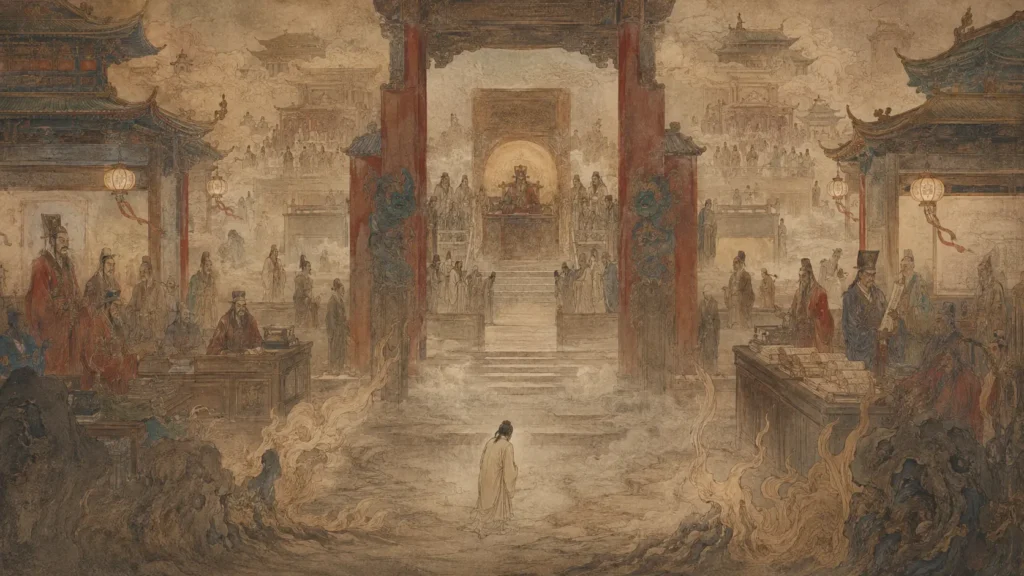
Instead, a local spirit is already waiting for you — the guardian of the ground you died on — and he has your file.
He walks you to a gate.
Beyond it is not fire and a single devil with a pitchfork.
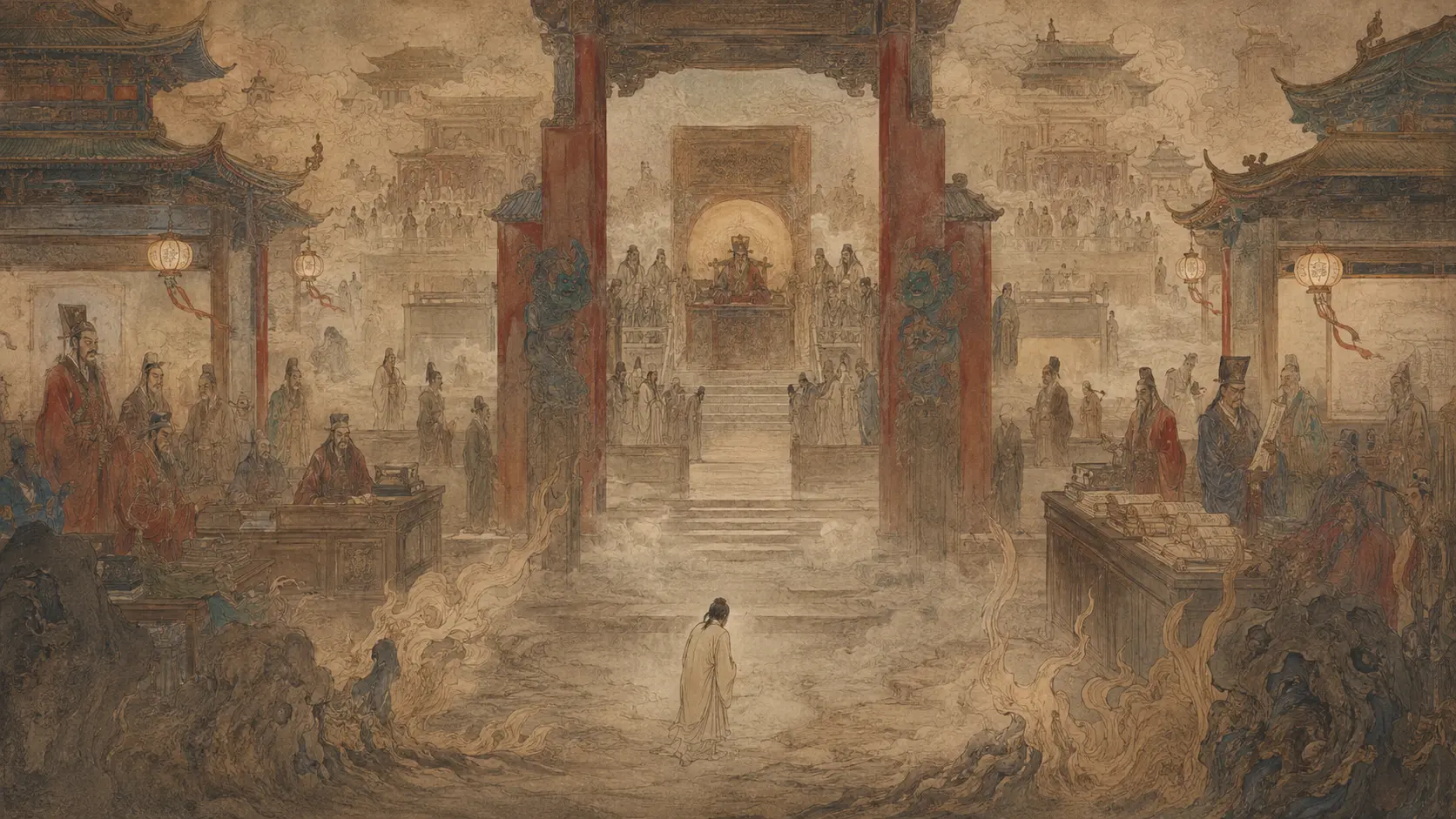
It’s an office.
Ten of them, actually. Each with its own king, its own department, its own specific punishments for specific sins — and its own paperwork.
This is Diyu (地狱), the Chinese underworld. And unlike the afterlife most Western readers picture, it isn’t a place you stay forever. It’s a place you pass through.
Diyu at a Glance
| Chinese | 地狱 |
| Pinyin | Dìyù |
| Literal meaning | “Earth prison” |
| Type | Underworld / realm of judgment and punishment |
| Older names | Huangquan (黄泉, “Yellow Springs”), Jiuyou (九幽, “Nine Netherworlds”), Youdu (幽都) |
| Governing system | The Ten Courts (十殿阎罗, Shídiàn Yánluó), each ruled by a king |
| Purpose | Judgment, punishment proportional to sin, then reincarnation |
| Is it permanent? | No — for almost all souls, it is purgatorial, not eternal |
| Related traditions | Yanluo Wang, Meng Po, Fengdu Ghost City, Journey to the West |
What Is Diyu?
Diyu is not one fixed idea. It’s a layered one.
The Chinese underworld as most people describe it today is, in Britannica’s framing, principally a Buddhist concept that was reshaped by Daoism and Chinese folk religion — and the descriptions still vary depending on which text or tradition you’re reading.
But Diyu wasn’t the first name for the Chinese land of the dead.
Before Diyu: Huangquan, the Yellow Springs
Centuries before Buddhism reached China, there was already a word for where the dead went: Huangquan (黄泉), the “Yellow Springs.” It’s recorded as early as the Zuo Zhuan, a commentary text from around the 4th century BCE — making it one of the oldest layers of Chinese afterlife belief, long before judges, courts, or karma entered the picture.
In this older layer, Huangquan is simpler: a shadowy underground realm beneath the earth, not yet organized into a bureaucracy of punishment.
That changes once Buddhism arrives.
Buddhism Brings the Judge
Indian Buddhist cosmology introduced Yama, lord of the dead and judge of souls, along with the concept of Naraka — a realm of karmic punishment. As this idea moved into China, it fused with native Daoist and folk beliefs about Huangquan, Mount Tai as a seat of the dead, and the City God (城隍神, Chénghuángshén) who kept records of the living.
By the Tang dynasty (618–907 CE), Chinese tradition had done something distinctly Chinese to the idea: it turned a single judge into a bureaucracy. One Yama became ten kings, each running a separate court, because — as more than one modern retelling of the myth notes — a civilization this large clearly wasn’t going to be judged efficiently by just one official.
What Happens to a Soul After Death, Step by Step?
Direct answer: After death, the soul is met by a local guardian spirit, passes through the Ghost Gate, travels the Yellow Springs Road to be recorded by the City God, is judged in sequence by the Ten Kings of the underworld courts, and — unless it earns direct passage to paradise — eventually crosses the Naihe Bridge, drinks Meng Po’s Soup of Forgetfulness, and is reincarnated.
In more detail, the traditional sequence looks like this:
- The tutelary spirit claims the soul. The local deity of the place where someone died (土地神, Tǔdìshén) takes charge of the newly dead.
- The Ghost Gate. The soul passes through Guimen Guan (鬼門關), the Ghost Gate, where it’s checked before being allowed into the underworld proper.
- The Yellow Springs Road. The soul travels Huangquan Lu (黄泉路) toward the City God, who holds the record of its good and bad deeds.
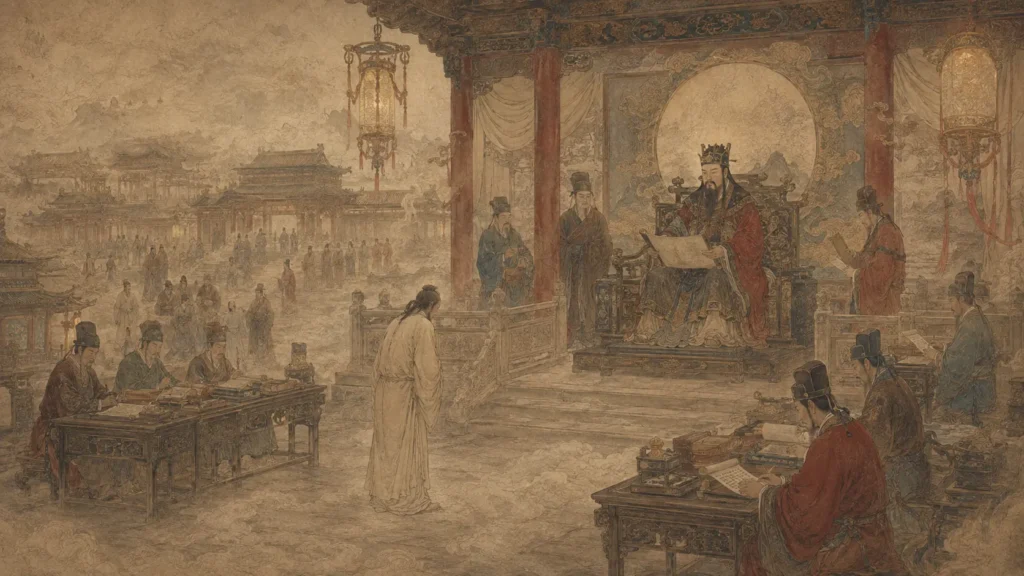
- Judgment by the Ten Kings. The soul is presented, court by court, before the Ten Kings of Diyu, who assign punishment matched to specific offenses.
- The Naihe Bridge. Most souls must cross Naihe Qiao (奈何桥) — a bridge test tied to how virtuously they lived.
- Meng Po’s soup. At the bridge, Meng Po (孟婆) offers the Soup of Forgetfulness (孟婆汤), erasing memory of the past life before rebirth.
- Reincarnation. The soul is returned to the world in a new form, appropriate to its karmic balance.
Exceptionally virtuous souls skip most of this — sent directly to the Pure Land of Amitābha Buddha or to Heaven under the Jade Emperor, without standing before all ten courts.
What Are the Ten Courts of Hell?
The Ten Courts (十殿阎罗, Shídiàn Yánluó) are the core structure of Diyu: ten judicial regions, each ruled by its own king, each handling a different category of sin. Sources vary somewhat on the exact ordering and titles — this is folk religion layered over centuries, not a fixed legal code — but the version below is the one most consistently repeated across temple tradition and later texts like the Yuli Baochao (玉历宝钞, the “Jade Records”).
| Court | King | Domain (commonly cited) |
|---|---|---|
| 1st | Qinguang Wang (秦广王) | Initial judgment; the Mirror of Retribution shows a soul its own deeds |
| 2nd | Chujiang Wang (楚江王) | Punishes theft and corruption |
| 3rd | Songdi Wang (宋帝王) | Punishes the ungrateful and disrespectful |
| 4th | Wuguan Wang (五官王) | The Lake of Blood; home to the City of Innocent Death for those who died unjustly |
| 5th | Yanluo Wang (阎罗王) | The best-known king — originally the first judge, demoted here for excessive leniency |
| 6th | Biancheng Wang (卞城王) | Corrects administrative and record-keeping errors from the courts above |
| 7th | Taishan Wang (泰山王) | Tied to Mount Tai’s older role as a seat of the dead |
| 8th | Dushi Wang (都市王) | Punishes those who failed their duty to parents |
| 9th | Pingdeng Wang (平等王) | Enforces impartial, “equal” treatment of remaining cases |
| 10th | Zhuanlun Wang (转轮王) | Turns the Wheel of Reincarnation, deciding the soul’s next form |
Beneath — or alongside, depending on the source — the Ten Courts sits a separate, older tradition: the Eighteen Levels of Hell (十八层地狱, Shíbā Céng Dìyù), where punishments are matched with dark precision to specific sins: liars have their tongues pulled, corrupt officials are crushed, and so on. The two systems — ten courts and eighteen levels — are often blended together in temple art and popular retellings rather than kept strictly separate.
Who Is Yanluo Wang (King Yama)?
Yanluo Wang (阎罗王) — also widely known in English as King Yama — is the Chinese adaptation of Yama, the Buddhist and Hindu lord of the dead. He’s the figure most people mean when they picture “the King of Hell,” and searches for “king yama” actually outnumber searches for “diyu” itself, so it’s worth knowing both names refer to the same figure.
According to the Ten Courts tradition, Yanluo Wang was originally the first judge, the one who met every soul at the gate. He was demoted to the fifth court specifically because he was too lenient with the dead. He appears with a scowling red face, bulging eyes, and the character for “king” (王) on his crown or headwear — an image still printed today on Chinese hell money.
He also has a literary cameo: in Journey to the West, Sun Wukong descends into the underworld, gets drunk with a group of demon kings, and ends up erasing his own name — and every monkey’s name — from the Books of Life and Death, effectively making his kind immortal by bureaucratic sabotage rather than combat.
What Is the Naihe Bridge and the Soup of Forgetfulness?
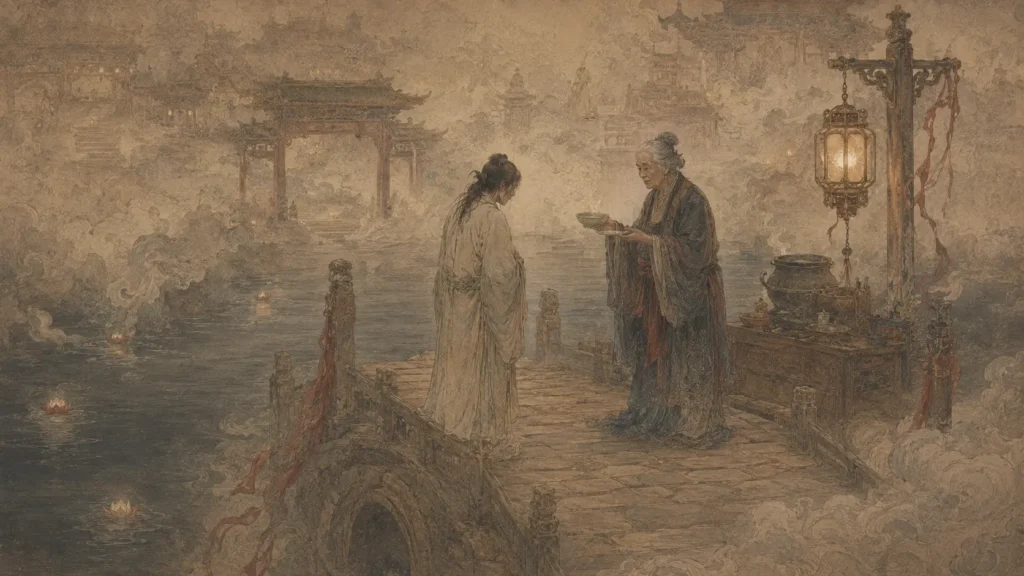
The Naihe Bridge (奈何桥) sits at the end of the Yellow Springs Road, over the Wangchuan River (忘川河, “River of Oblivion”) — a river Tang-dynasty texts already describe as running with blood rather than water.
Waiting at the bridge is Meng Po (孟婆, “Granny Meng”), who serves every crossing soul a bowl of Mengpo Tang (孟婆汤), the Soup of Forgetfulness, so that no one enters their next life remembering the last one. Meng Po is a relatively late addition to the mythology — she’s first recorded in the Yuli Baochao during the Qing dynasty, centuries after the Ten Courts system itself had taken shape.
Not every soul takes the same crossing. The exceptionally virtuous are said to be spared the ordinary bridge entirely, crossing instead by a Golden Bridge or Silver Bridge reserved for them.
Is Diyu Eternal?
No — and this is one of the clearest differences between Diyu and hell in the Abrahamic sense.
For nearly every soul, Diyu is purgatorial, not permanent. Punishment lasts only as long as it takes to work off a specific karmic debt; once that’s settled, the soul proceeds to the Naihe Bridge and reincarnation. Diyu is a processing system, not a final sentence.
Is Fengdu Ghost City a Real Place?
Yes — and this is one of the more surprising facts for readers outside China. Fengdu Ghost City (酆都鬼城) is a real, physical site on Ming Mountain in Fengdu County, Chongqing, on the Yangtze River.
According to local legend, its reputation dates to the Eastern Han dynasty, when two officials — Yin Changsheng and Wang Fangping — came to the mountain to practice Daoism and became immortals. Later tradition combined their surnames, Yin and Wang, into “Yinwang,” which happens to sound like “King of the Underworld” — and from there, the mountain became identified as the King of Hell’s earthly seat.
Temples were added across the Tang, Song, Ming, and Qing dynasties, and the site today recreates the mythology architecturally: its own Naihe Bridge, a Ghost Gate Pass, a Yellow Springs Road, and the Wangxiang Terrace (“Home-Viewing Platform”), where souls are said to take one last look back at the world of the living.
How Does Journey to the West Portray the Underworld?
Journey to the West contains one of Chinese literature’s most detailed underworld scenes: Emperor Taizong of Tang’s journey into Diyu, where he is judged, shown his own life record, and eventually returned to the living world with a mission — to sponsor a great Buddhist rite for the souls trapped below.
This episode wasn’t invented whole by the novel. An earlier, much shorter version of Taizong visiting the underworld already existed in Chaoye Qianzai (朝野僉載), a Tang-dynasty text attributed to Zhang Zhuo. The novel expanded a brief historical rumor into a full narrative — which is a useful reminder for any of these myths: the version most people know today is often the last and most elaborate stop in a much longer chain of retellings.
Diyu vs. Huangquan: What’s the Difference?
They’re often used as if interchangeable, but they belong to different layers of the tradition:
- Huangquan is the older, simpler concept — a shadowy land beneath the earth, recorded in pre-Buddhist Chinese texts, without courts, kings, or a bureaucratic judgment system.
- Diyu is the fuller, later system — the Buddhist-influenced “earth prison” with its Ten Courts, specific punishments, and processing pipeline toward reincarnation.
In practice, most modern retellings treat Huangquan Road as the path into Diyu rather than a separate destination — the older name absorbed into the newer, more elaborate system rather than replaced by it.
Why the Chinese Underworld Still Matters
Diyu isn’t really a horror story. It’s a mirror of how Chinese tradition thought about justice itself: proportional, bureaucratic, and — crucially — not final. Every soul, however punished, is still moving toward another chance. In a sense being inspired by Chinese Mythology.
That’s a very different shape of afterlife than “reward or eternal damnation.” It’s closer to a system than a sentence — which may be exactly why, centuries later, a mountain on the Yangtze still gets built out in its image, and a monkey king still gets to cheat it entirely.
Sources & Claim Verification
Primary / historical:
- Zuo Zhuan (左传), “Yin Gong Yuan Nian” — earliest known reference to Huangquan, 4th century BCE.
- Stephen F. Teiser, The Scripture on the Ten Kings and the Making of Purgatory in Medieval Chinese Buddhism, University of Hawaiʻi Press. University of Hawaiʻi Press – Scripture on the Ten Kings
- The Worship of the Ten Kings of Purgatory during the Ming-Qing Period, Cambridge / Amsterdam University Press. Cambridge – Worship of the Ten Kings