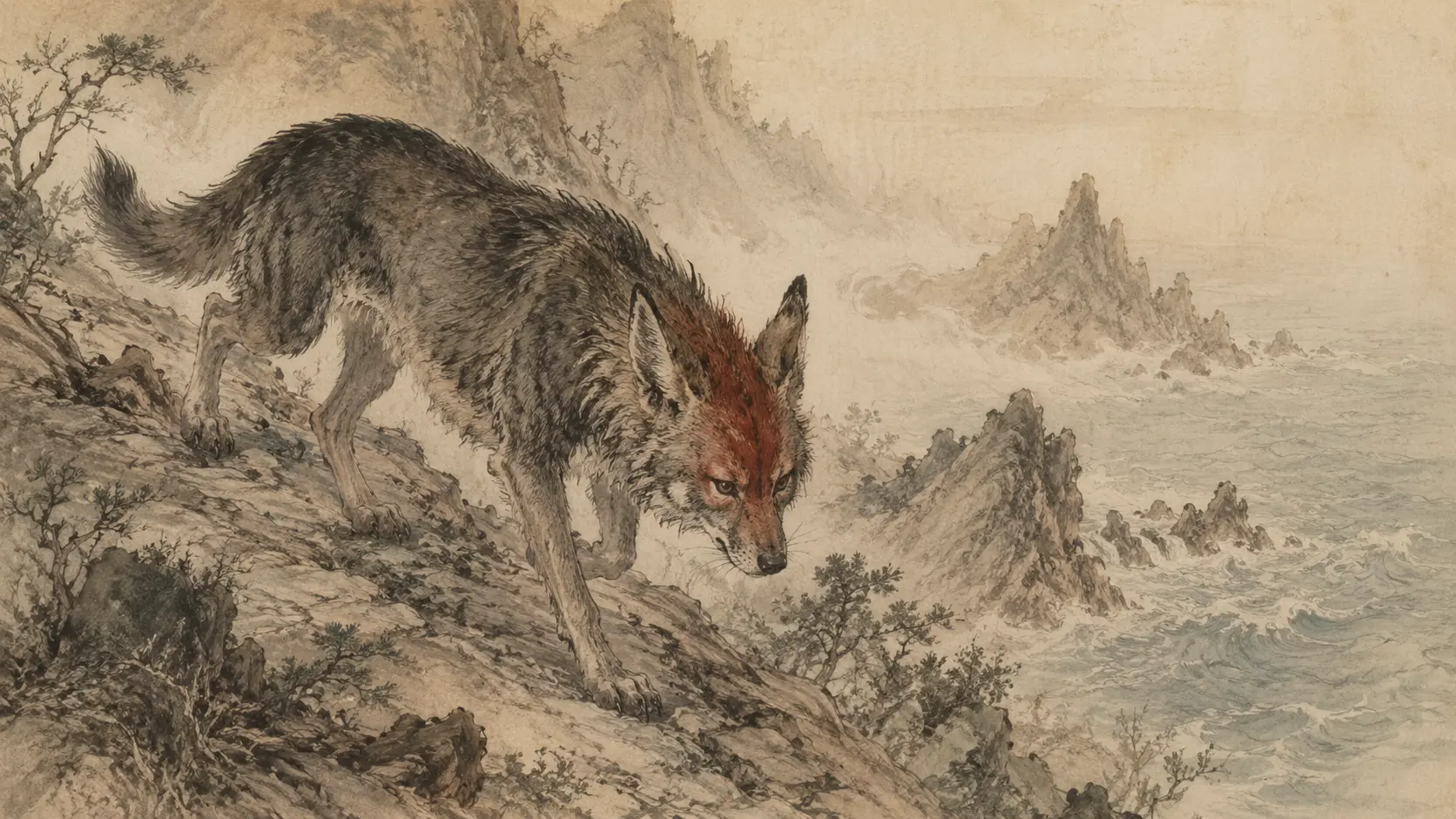
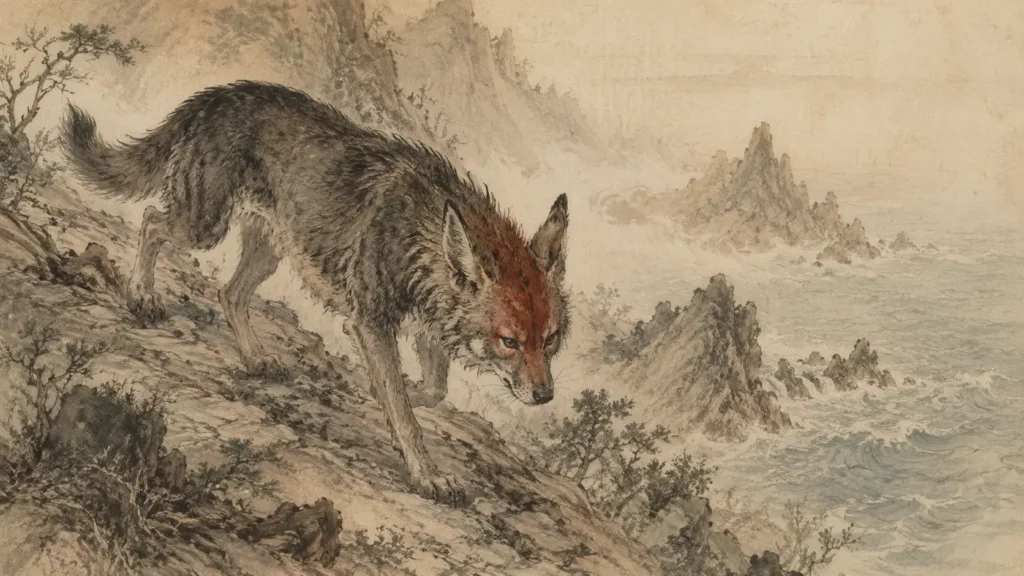
A wolf waits beside the northern sea.
But its head is red.
Its eyes resemble those of a mouse.
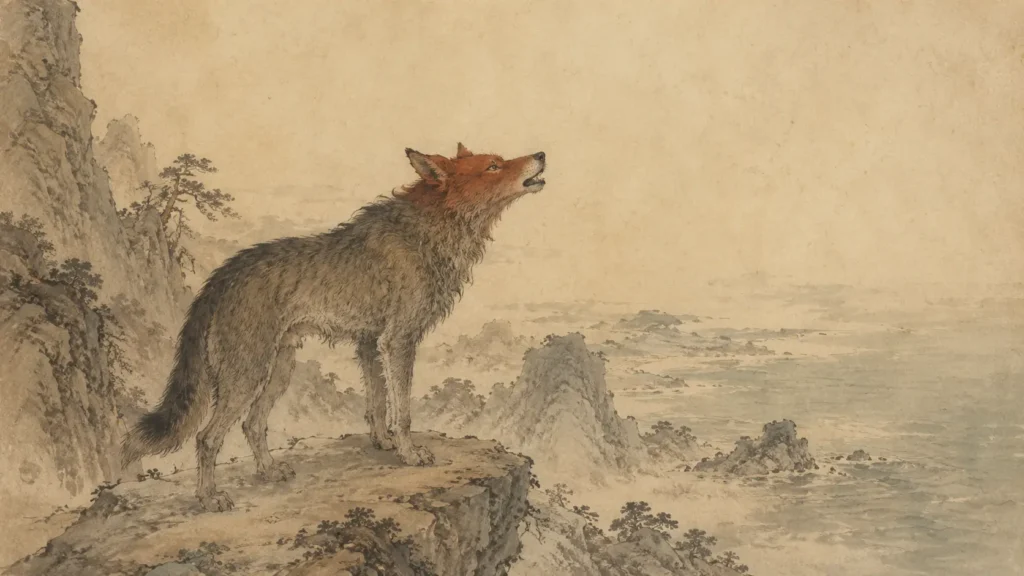
And when it opens its mouth, the sound that comes out is not a howl.
It sounds like a pig.
The Shan Hai Jing gives this creature only a few lines before adding the detail that changes everything:
it eats humans.
Heju (猲狙, Hèjū) is a man-eating beast from the Eastern Mountains Classic of the Shan Hai Jing. The ancient text describes it as wolf-like, with a red head, mouse-like eyes, and a voice resembling a pig. It lived on Beihao Mountain near the northern sea.
What Is Heju?
Heju appears at the beginning of the fourth itinerary of the Dongshan Jing (东山经), or Classic of the Eastern Mountains.
Its home is Beihao Mountain (北号之山), which the text says stood beside the northern sea.
The original passage reads:
有兽焉,其状如狼,赤首鼠目,其音如豚,名曰猲狙,是食人。
In natural English:
There is a beast there shaped like a wolf, with a red head and mouse-like eyes. Its voice is like that of a pig. It is called Heju, and it eats humans.
That short description contains almost everything we can safely say about the creature from the original text.
A Wolf With a Red Head
The foundation of Heju’s appearance is simple:
其状如狼 — “its form is like a wolf.”
The Shan Hai Jing does not describe horns, armor, supernatural flames, a skull necklace, or any other elaborate features.
Its most distinctive physical detail is 赤首 — a red head.
That wording matters.
The ancient source does not say that Heju’s entire body was red. It specifically identifies the head.
So the safest reconstruction is a predominantly wolf-like animal whose head is noticeably reddish or red.
The dramatic illustration found in modern books can be useful visual inspiration, but additional ornaments should not automatically be treated as part of the ancient creature.
What Does “Mouse-Like Eyes” Mean?
Heju is also described with the unusual phrase:
鼠目 — “mouse eyes.”
Unfortunately, the text does not explain exactly what its authors meant by that description.
It could refer to the size, shape, or appearance of the eyes, but assigning one precise interpretation would go beyond the surviving passage.
What we can say with confidence is that the eyes were considered unusual enough to distinguish Heju from an ordinary wolf.
The combination creates a strange image:
a wolf-shaped predator with a red head and small, rodent-like eyes watching the landscape around Beihao Mountain.
Heju Did Not Howl Like a Wolf
Heju’s voice makes the creature even stranger.
The text says:
其音如豚 — “its sound is like a pig.”
Rather than giving Heju the expected howl of a wolf, the Shan Hai Jing compares its cry to a 豚, a pig or young pig.
There is no indication that this sound had magical effects.
It did not summon other beasts.
It was not said to paralyze travelers.
And the text does not say Heju deliberately used the sound to lure people.
It is simply one of the characteristics the ancient description preserves.
Did Heju Eat Humans?
Here the source leaves no ambiguity.
是食人 — “it eats humans.”
This separates Heju from many Shan Hai Jing creatures whose descriptions are strange but not explicitly hostile.
Some beasts predict drought.
Others appear before war.
Some can be eaten for protection from illness.
Heju receives none of those roles in its original passage.
It is simply described as a predator that eats people.
The text does not explain how it hunted them, how large it was, or whether humans actively feared or hunted the creature.
Anything more would be speculation.
What Else Lived on Beihao Mountain?
Heju was not the only man-eating creature recorded on Beihao Mountain.
Immediately after describing Heju, the Shan Hai Jing introduces a bizarre bird called Qique (鬿雀).
Qique is described as resembling a chicken with a white head, mouse-like feet, and tiger claws.
Then the text adds:
亦食人 — “it also eats humans.”
That makes Beihao Mountain especially interesting.
Within a single short passage, the text places two different human-eating creatures on the same mountain:
Heju on the ground and Qique among the birds.
We should not invent a relationship between them—the source never says that they hunted together or competed with one another.
But geographically and textually, they are genuine neighbors.
When our dedicated Qique article is published, this section should link directly to it.
A Later Variant of Heju’s Description
There is also a small textual curiosity worth preserving.
A later Chinese encyclopedic source, the Gujin Tushu Jicheng, reproduces the standard Heju description but notes that Yang Shen’s Guyin Lüe quoted a slightly different wording.
Instead of 赤首 — “red head,” that version gives 赤眉 — “red eyebrows.”
This does not mean we should replace the standard description.
The received Shan Hai Jing text and Guo Pu’s transmitted version give red head, which should remain our primary description.
The variant simply shows that ancient texts can survive through slightly different textual traditions.
Was Heju a Real Animal?
The Shan Hai Jing itself does not identify Heju with a known species.
Because the creature is fundamentally wolf-like, it is tempting to search for a real wolf, dog, or other predator that may have inspired the description.
But there is no evidence in this passage that allows us to confidently identify Heju with a particular surviving animal.
The safest position is therefore simple:
Heju is the creature described by the ancient text. Any attempt to connect it with a real species is a later hypothesis, not part of the original account.
Why Heju Stands Out
Heju does not need an elaborate legend.
The Shan Hai Jing gives us only a mountain, a body, a face, a voice, and a warning.
A wolf-shaped animal moves somewhere near the northern sea.
Its head is red.
Tiny, mouse-like eyes watch from its face.
Then, instead of a howl, a sound like a pig breaks the silence.
And unlike many strange creatures in the ancient mountains, the text tells us exactly what happens when predator meets human.
Heju eats people.
Sometimes the shortest entries in the Shan Hai Jing leave the clearest monsters behind.
Reference:
1. Shan Hai Jing — Dongshan Jing (Eastern Mountains Classic)
Primary ancient text for Beihao Mountain, Heju, Qique, and the fourth Eastern Mountains itinerary.
2. Shan Hai Jing — Siku Quanshu Edition, Volume 4
Historical transmitted edition preserving the Heju passage and Guo Pu’s commentary.