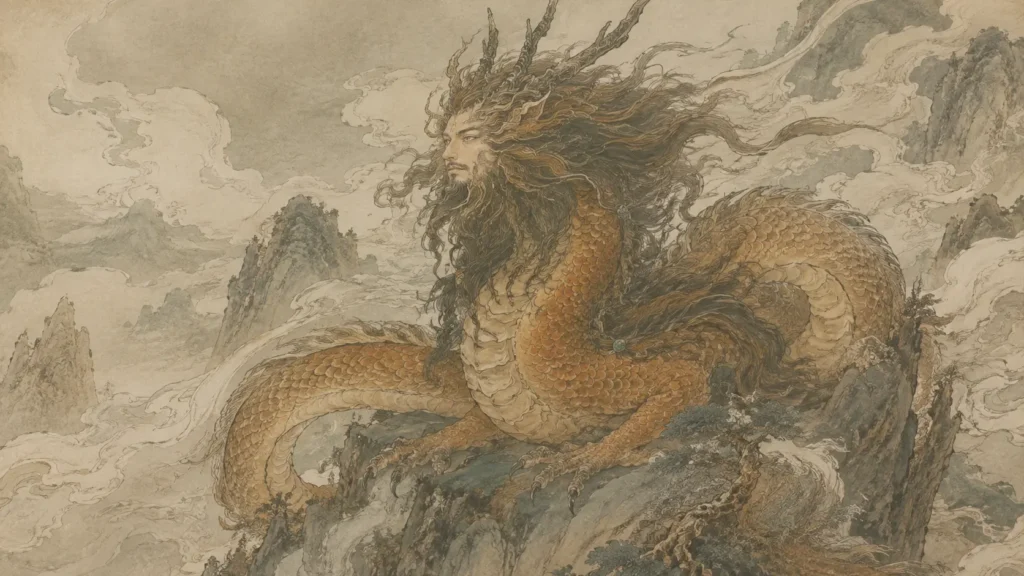
Some beings in the Shan Hai Jing are given names.
Others are remembered only by what they looked like.
Across entire chains of ancient mountains, the text describes gods with a form that is both divine and strangely human:
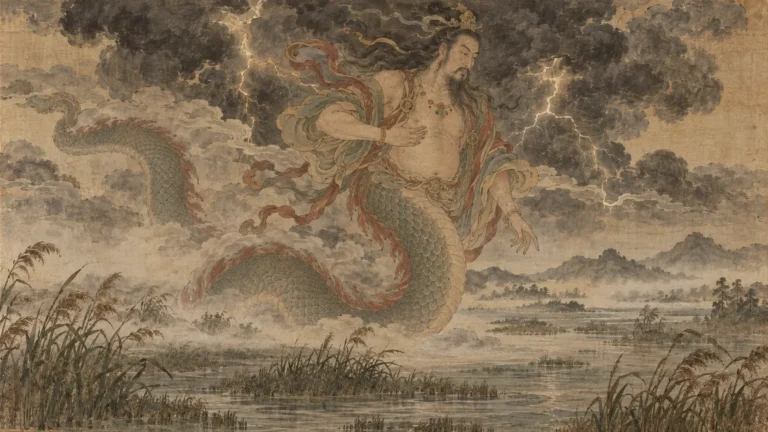
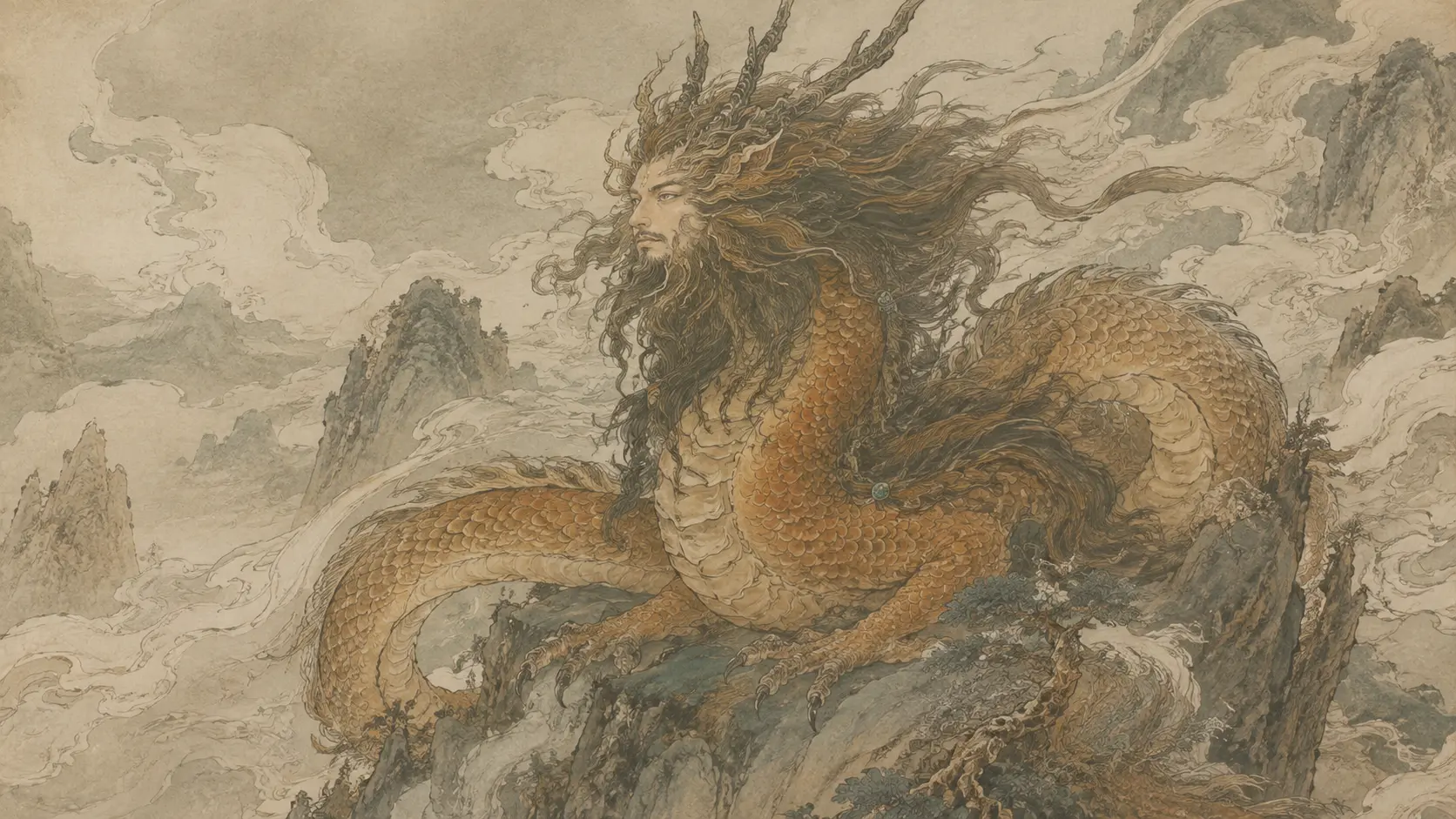
the body of a dragon and the face of a person.
They have no surviving individual names.
No great battle is recorded.
No special weapon or supernatural attack is described.
Yet ancient worshippers were given precise instructions for approaching them.
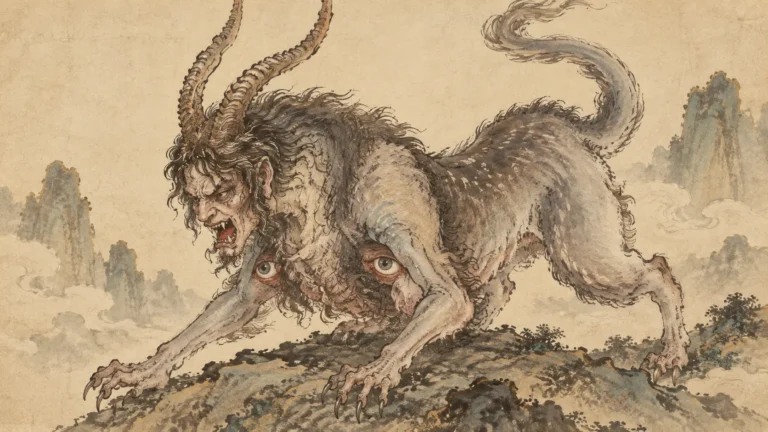
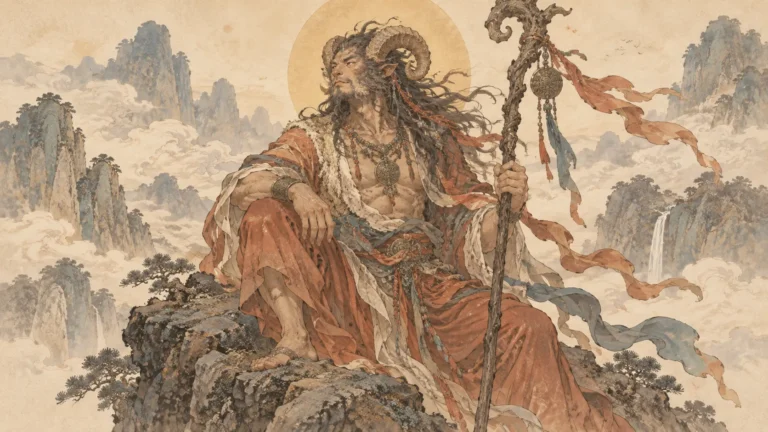
The Dragon-Bodied Human-Faced Gods (龙身人面神, Lóngshēn Rénmiàn Shén) are groups of mountain deities described in the Shan Hai Jing. The ancient text says their gods had dragon bodies and human faces and records specific offerings used in their worship. They are not one named deity, and they should not be confused with Zhulong, the separate Torch Dragon.
What Are the Dragon-Bodied Human-Faced Gods?
The name 龙身人面神 can literally be understood as “dragon-bodied, human-faced gods.”
But there is an important distinction.
The Shan Hai Jing does not introduce a single being whose personal name is Longshen Renmian Shen.
Instead, it describes the appearance of groups of gods associated with particular mountain routes.
The key phrase is:
其神状皆龙身而人面
In natural English:
Their gods all had dragon bodies and human faces.
This collective wording is important. These figures belong to the sacred geography of the mountains rather than to a surviving biography about one individual god. Scholarly analysis of the mountain itineraries likewise treats these hybrid figures as local spirits connected with particular regions and routes.
The Nine Gods of the Central Mountains
The passage shown in the book comes from the Central Mountains Classic — Zhongshan Jing (中山经).
The tenth Central Mountains itinerary begins at Shouyang Mountain and continues through a chain ending at Bingshan.
The summary states that the route contained nine mountains covering 267 li.
Then the text gives the extraordinary description:
the gods of these mountains possessed dragon bodies and human faces.
The individual mountains are described before that summary with their own landscapes and resources—gold, jade, iron, trees, stone and other features.
But when the gods are finally described, the same physical form is applied collectively across the mountain chain.
That makes them very different from a creature such as Mengji or Mafu.
Those beings inhabit a particular place.
These figures represent the divine presence connected with an entire sequence of mountains.
They Were Worshipped, Not Hunted
The Shan Hai Jing does something especially interesting here.
It does not tell us how to defeat these gods.
It tells us how to worship them.
For the Central Mountains group, the text prescribes a male chicken that was buried as part of the rite, together with grain offerings made from five kinds of grain.
This is one of the clearest reasons we should not describe them simply as “monsters.”
The source calls them 神 — shén, a word used for gods or divine spirits, and immediately follows their physical description with ritual instructions.
The focus is therefore not on hunting the strange dragon-bodied beings.
It is on approaching the sacred powers associated with the mountains correctly.
The Same Gods Appear in the Southern Mountains
The Central Mountains are not the only place where this unusual divine form appears.
The Southern Mountains Classic contains another entire mountain group whose gods are described in almost the same way.
From Tianyu Mountain to Nanyu Mountain, the text counts fourteen mountains spanning 6,530 li and states:
其神皆龙身而人面
Again:
their gods all had dragon bodies and human faces.
But the ritual is different.
For this southern group, the text prescribes a white dog for the rite and rice as the grain offering.
That difference is valuable.
It shows that “dragon body + human face” was not necessarily the identity of one travelling god appearing everywhere.
The same divine form could belong to different mountain systems whose ritual requirements were not identical.
What Powers Did These Gods Have?
This is where modern mythology pages can easily go too far.
The original passages do not give these mountain gods specific supernatural powers.
They are not said to breathe fire.
They are not said to summon storms.
They are not described as controlling rivers simply because they possess dragon bodies.
They are not said to grant immortality or predict disasters.
The surviving passages tell us their form, geographical association and ritual requirements.
Anything beyond that needs to be clearly identified as later interpretation rather than information from the original Shan Hai Jing.
Are They the Same as Zhulong?
No.
This distinction is worth making very clearly.
Zhulong, or the Torch Dragon, belongs to a different tradition in the Shan Hai Jing. A northern passage names the deity associated with Zhongshan as Zhuyin, later closely identified with Zhulong, and gives it extraordinary cosmic characteristics connected with daylight, darkness, winter, summer and wind.
The dragon-bodied human-faced mountain gods discussed here are different.
They are described collectively.
They are not individually named Zhulong.
And the text does not assign Zhulong’s cosmic abilities to them.
The visual resemblance is not enough to combine separate mythological beings.
Why Do So Many Shan Hai Jing Gods Have Hybrid Bodies?
The human face and dragon body are part of a much larger pattern inside the Shan Hai Jing.
Different mountain systems are associated with gods displaying different combinations: human faces with animal bodies, dragon heads with other bodies, bird forms, snake forms and other hybrids.
Research on the geographical structure of the Shan Hai Jing has noted that these physical patterns help distinguish groups of local guardian spirits within different mountain itineraries.
That gives us a safer interpretation than inventing symbolic meanings for every body part.
We cannot confidently say the human face meant wisdom.
We cannot claim the dragon body meant control over weather.
The ancient text does not explain the imagery that way.
What we can say is that appearance, geography and ritual are repeatedly connected.
These strange bodies helped define the supernatural inhabitants of different parts of the ancient landscape.
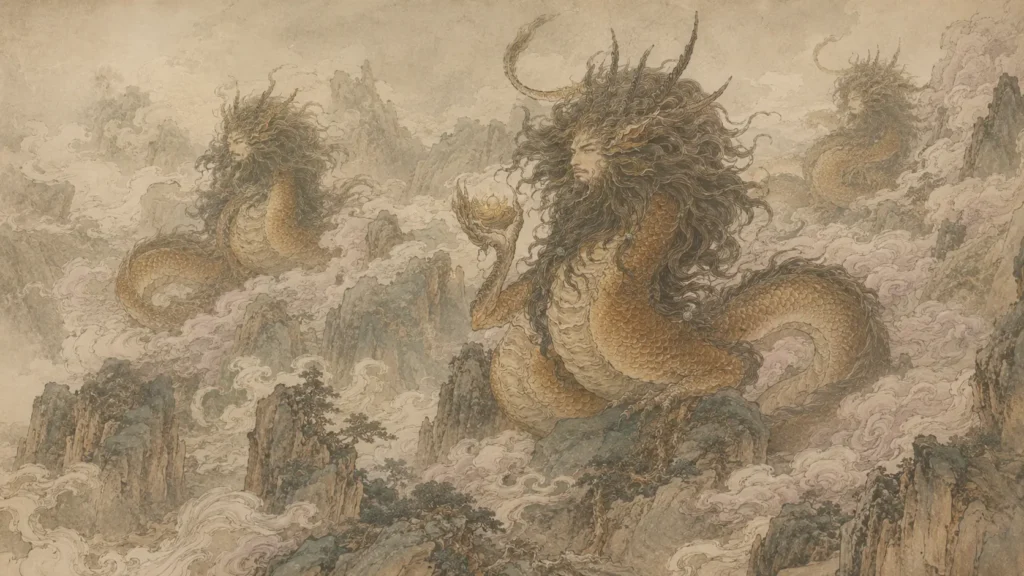
Gods Without Names
Perhaps that is what makes the Dragon-Bodied Human-Faced Gods so fascinating.
We know what they looked like.
We know where groups of them were believed to dwell.
We even know what offerings were prescribed for them.
Yet their individual names have disappeared—or perhaps were never recorded at all.
Across nine mountains in one region and fourteen in another, the same impossible form returns:
a dragon’s body beneath a human face.
Not an enemy waiting to be defeated.
Not a monster searching for prey.
A god belonging to the mountain itself.
And thousands of years later, a few lines of the Shan Hai Jing are enough for those forgotten faces to look back at us again.
Reference:
1. Chinese Text Project — Shan Hai Jing, Southern Mountains Classic
Primary ancient passage describing the fourteen-mountain group, the dragon-bodied human-faced gods, and their ritual offerings.