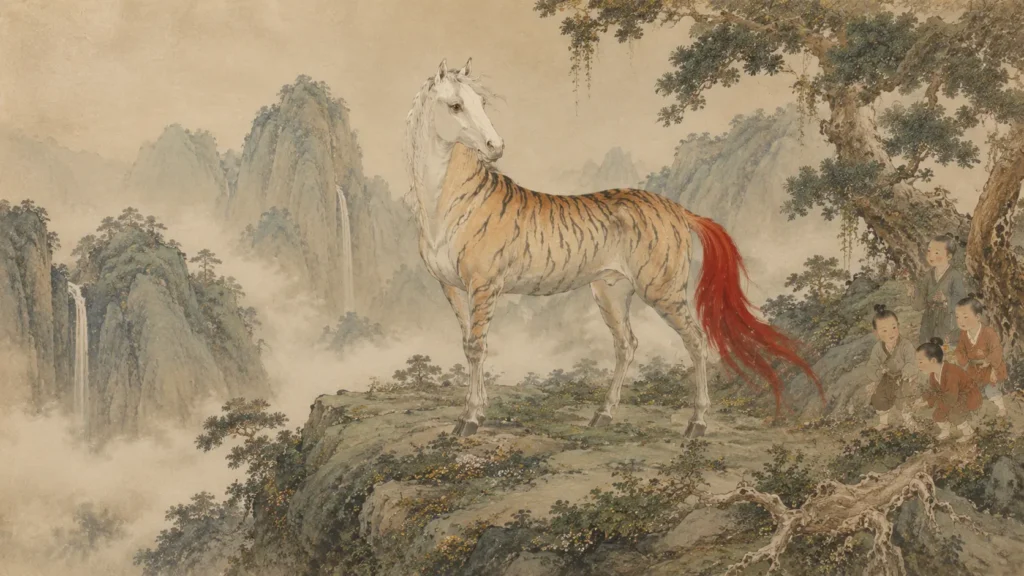
Deep within an ancient mountain lived a creature that looked as though several animals had been woven into one.
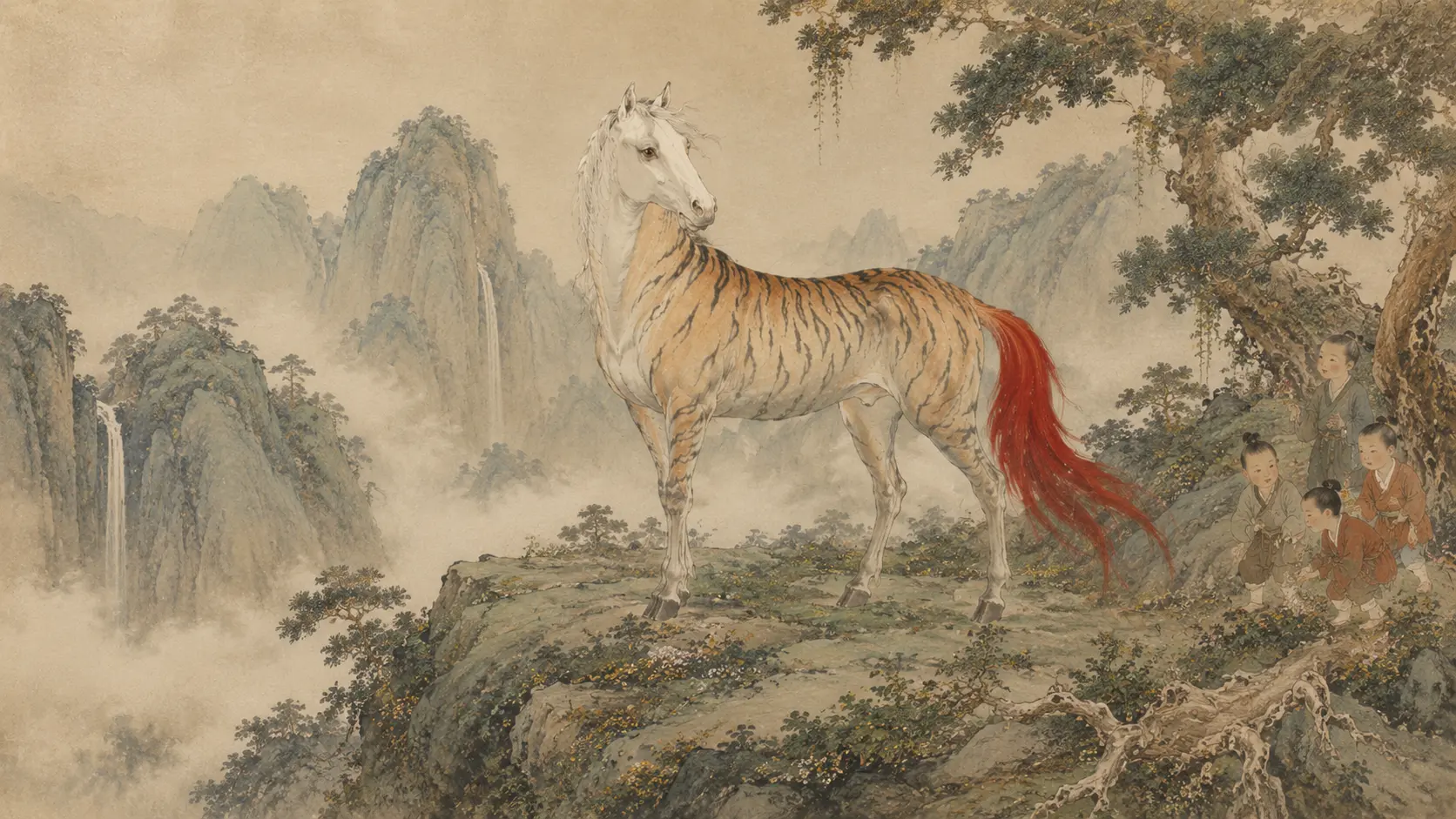
Its body resembled a horse.
Its head was white.
Tiger-like markings covered its skin, while a bright red tail followed behind it.
But the strangest thing about the Lushu was not its appearance.
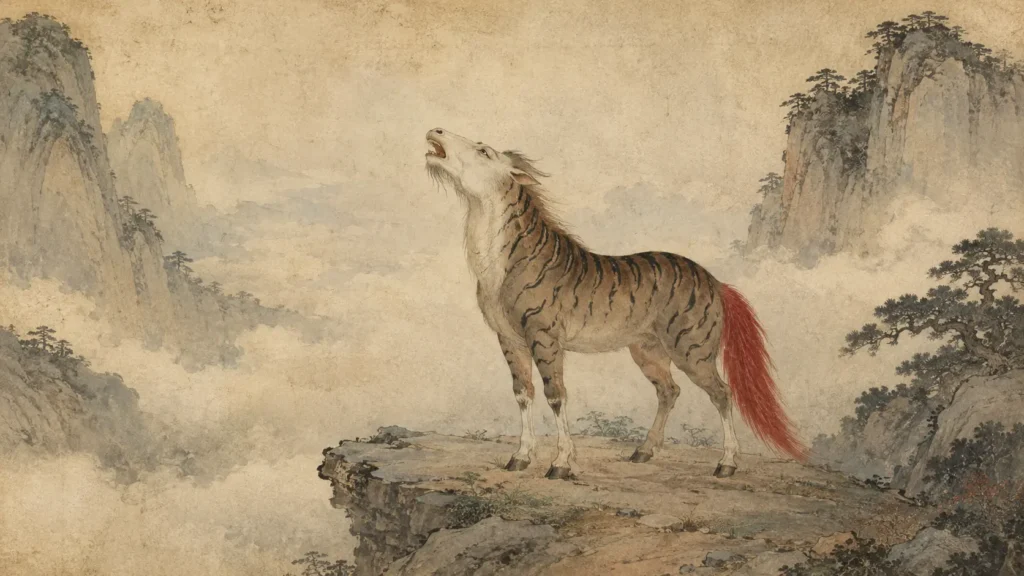
It was its voice.
When the creature called from the mountains, it sounded as though someone was singing.
The Beast of Niuyang Mountain
The Lushu, written 鹿蜀 and pronounced approximately Lùshǔ, appears in the Southern Mountain Classic, one of the sections of the ancient Chinese work known as the Shan Hai Jing or Classic of Mountains and Seas.
Its home was Niuyang Mountain, a place described as containing red metal on its southern face and white metal on its northern side.
The text then introduces the creature:
It resembles a horse with a white head, has markings like a tiger, possesses a red tail, and makes a sound like singing.
The passage is remarkably brief. It provides no battle, named hero, or explanation for why such an animal existed.
The Lushu simply lives within the mountain landscape—beautiful, strange and completely unlike any ordinary creature.
A Voice Like a Human Song
Many creatures in the Shan Hai Jing are identified by their voices.
Some cry like children. Others sound like dogs, birds, cracking wood or unfamiliar animals.
The Lushu is different because its call is compared to a song or folk melody.
A later commentary attributed to the scholar Guo Pu explains the phrase as meaning that its voice resembled a person singing.
That small detail changes the entire atmosphere surrounding the creature.
Imagine travelling through an empty mountain valley and hearing music drifting between the cliffs.
At first, you might assume that another traveller was nearby.
Then the singer would emerge from the mist—a white-headed, tiger-striped animal with the body of a horse and a red tail.
The original text does not say that the Lushu could speak, imitate specific people or deliberately lure travellers. Those would be modern additions.
All we know is that it sang.
And sometimes, a mystery becomes stronger when the surviving source refuses to explain it.
The Blessing of Future Generations
The Shan Hai Jing gives the Lushu one additional quality.
It states that wearing or carrying something associated with the creature would benefit one’s descendants.
The exact meaning is not fully explained in the original passage.
Later commentary interprets this as wearing part of its skin, fur or tail. A traditional verse about the creature further connects it with descendants becoming numerous “like clouds.”
Because of this, the Lushu came to be associated with:
- flourishing descendants;
- continuity of the family;
- fertility and abundance;
- protection of future generations.
However, the ancient text does not describe a ritual for hunting the creature or explain precisely how its blessing worked.
We should therefore be careful not to turn one mysterious sentence into an elaborate ceremony that the source never records.
Monster, Animal or Sacred Omen?
Modern readers often describe every strange creature in the Shan Hai Jing as a monster.
But the Lushu is not presented as evil.
It does not attack villages, consume travellers or bring disaster.
Its appearance combines the speed of a horse, the visual power of a tiger and the striking symbolism of a red tail. Its song gives it an almost human quality, while its connection with descendants makes it more like a fortunate supernatural animal than a demon.
The Shan Hai Jing itself resists simple classification. Across history, readers have treated it as geography, mythology, a catalogue of strange beings, a source of omens and a record of distant lands.
The Lushu belongs perfectly within that uncertain world.
It feels partly natural, partly sacred and partly impossible.
Why the Lushu Still Matters
The Lushu has no famous war.
It never challenged Heaven.
No legendary warrior needed to defeat it.
Yet it preserves an idea that was deeply important to the people who remembered it: strength should extend beyond a single lifetime.
Its blessing concerned descendants—the people who would continue after the current generation was gone.
That creates a different kind of lesson from the myths of rebellious gods and invincible warriors.
Training is often presented as something personal.
You become stronger.
You become more disciplined.
You build a better body and a more capable mind.
But the greatest value of discipline is not limited to what it gives you.
Your habits affect the people who live beside you. Your decisions influence the family, students, friends or community that may follow your example. What you build can survive longer than your own strength.
The Lushu’s song disappeared into the mountains thousands of years ago.
Its meaning survived because someone believed the future was worth preparing for.
Real strength is not only the power to overcome what stands before you.
It is the ability to leave something valuable behind.
Reference:
- Chinese Text Project — Shan Hai Jing: Southern Mountain Classic
Primary text describing the Lushu’s horse-like body, white head, tiger markings, red tail, singing voice and association with descendants. - Chinese Wikisource — Imperial Collection of Illustrations and Writings, Volume 123
Preserves later commentary explaining the singing voice and the interpretation of wearing the creature’s skin or tail. - Hong Kong Metropolitan University — Reception of the Shan Hai Jing in Han China
Academic discussion of the different ways the ancient work has been classified and interpreted.