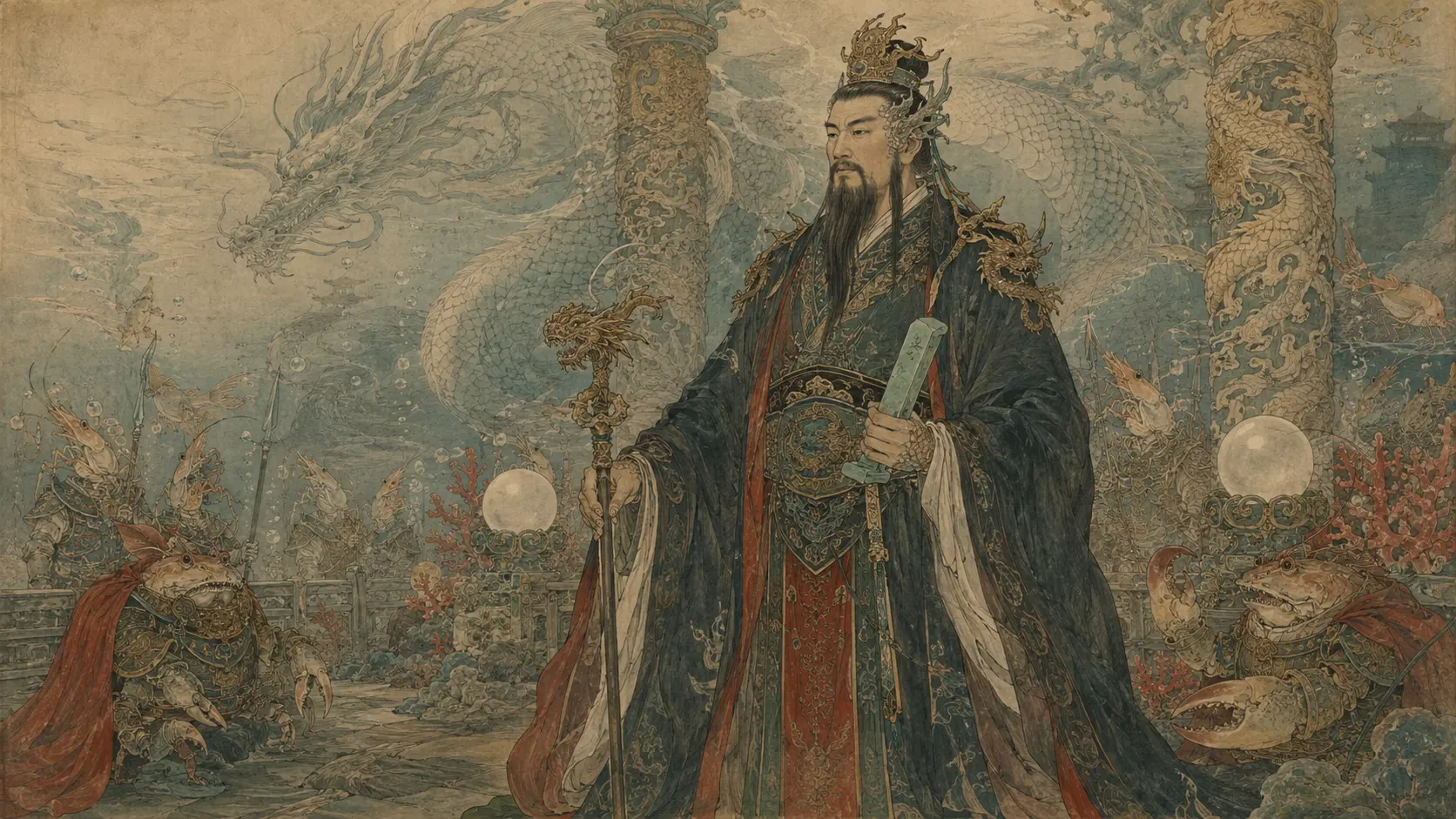
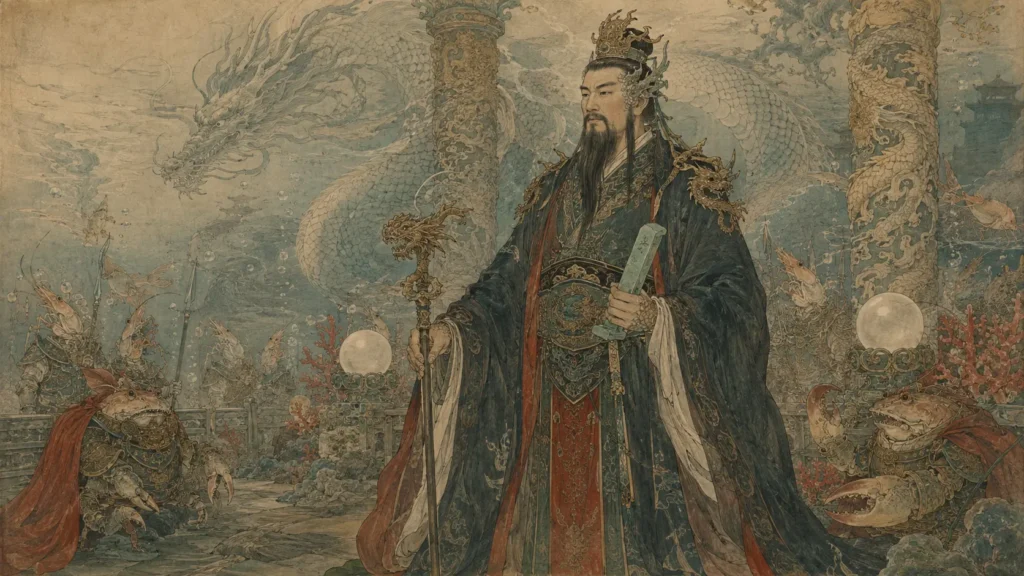
Far below the waves of the Eastern Sea stood a palace of crystal.
Its halls were guarded by shrimp soldiers and crab generals. Dragons moved through its courts, treasures filled its chambers, and above it stretched an ocean whose storms could determine whether people on land survived another year.
This was the kingdom of Ao Guang—the Dragon King of the Eastern Sea.
He commanded water, possessed treasures coveted by immortals, and belonged to one of the most powerful divine families in Chinese mythology.
Yet two of China’s greatest rebellious heroes—Nezha and Sun Wukong—entered his world, challenged his authority, and left him humiliated.
How could the ruler of an entire sea be so powerful and still appear so vulnerable?
The Lord Beneath the Eastern Sea
Ao Guang is best known as the Dragon King of the Eastern Sea, one of the rulers associated with the Four Seas surrounding the traditional Chinese world.
In Journey to the West, he lives beneath the Eastern Ocean inside the Crystal Palace. When Sun Wukong arrives, Ao Guang comes to welcome him with dragon descendants, shrimp soldiers and crab generals. The scene presents the sea not as an empty wilderness, but as a complete underwater kingdom with its own ruler, court, army and treasury.
Ao Guang should not be understood simply as “the god of every dragon.”
He belongs to the broader tradition of the Dragon Kings—divine rulers connected with seas, rivers, wells, clouds and rain. Chinese dragons were deeply associated with water and the life-giving rain required for agriculture. Temples and local rituals dedicated to Dragon Kings reflected people’s dependence on forces that could bring either fertile harvests or destructive floods.
Ao Guang therefore represented more than a sea monster.
He represented organized power over nature.
A King Who Still Answered to Heaven
Ao Guang’s title sounds absolute, but his authority had limits.
In a later episode of Journey to the West, Sun Wukong summons him to bring rain to a region suffering from drought. Ao Guang explains that although he can produce rain, he cannot simply release it whenever he chooses. He is an official within Heaven’s administration and must receive authorization before acting.
This detail reveals something important about Chinese mythology.
The supernatural world often mirrors an imperial government.
There are rulers, ranks, petitions, responsibilities and punishments. Even a Dragon King who controls rain remains accountable to a higher celestial order.
Ao Guang possesses enormous power.
But that power is not entirely his own.
When Sun Wukong Entered the Dragon Palace
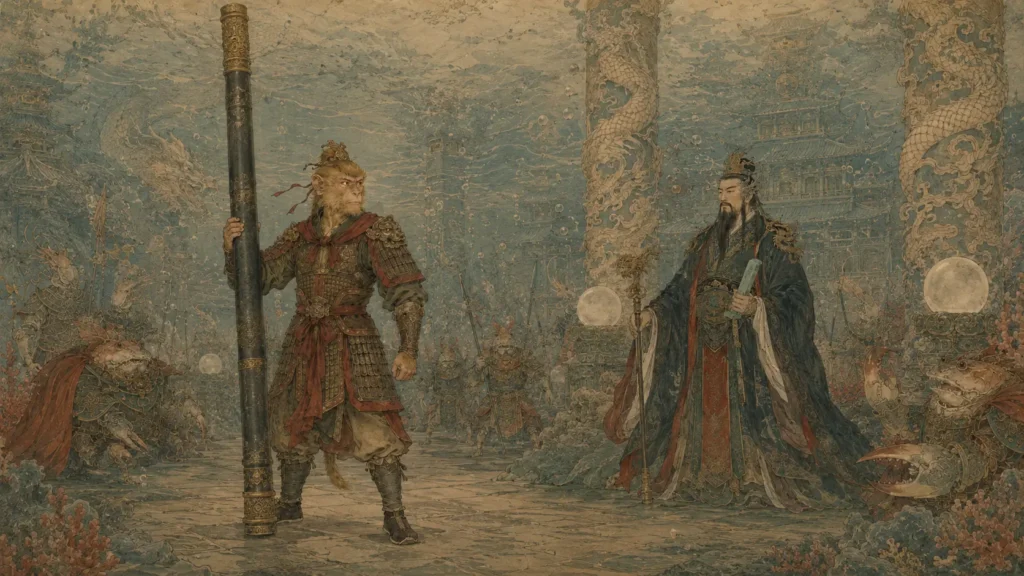
Before Sun Wukong challenged Heaven, he needed a weapon worthy of his strength.
He descended beneath the Eastern Sea and entered Ao Guang’s palace. The Dragon King offered him weapons, but Wukong rejected them as too light. Eventually, he discovered an enormous iron pillar kept within the sea treasury.
It was the Ruyi Jingu Bang—the staff that could change its size and would become inseparable from the Monkey King’s identity.
The encounter is often remembered as another of Wukong’s victories.
But from Ao Guang’s perspective, it is an invasion.
An unpredictable stranger enters his territory, dismisses the weapons he is offered, takes one of the sea’s greatest treasures, and then demands armor as well.
Ao Guang welcomes him with ceremony because he is a king.
He gives way because he understands the danger in front of him.
That is not heroic courage—but it is not simple stupidity either.
Sometimes rulers survive by knowing when authority is no longer enough.
Ao Guang and the Tragedy of Nezha
Ao Guang’s most famous conflict appears in Fengshen Yanyi, or Investiture of the Gods.
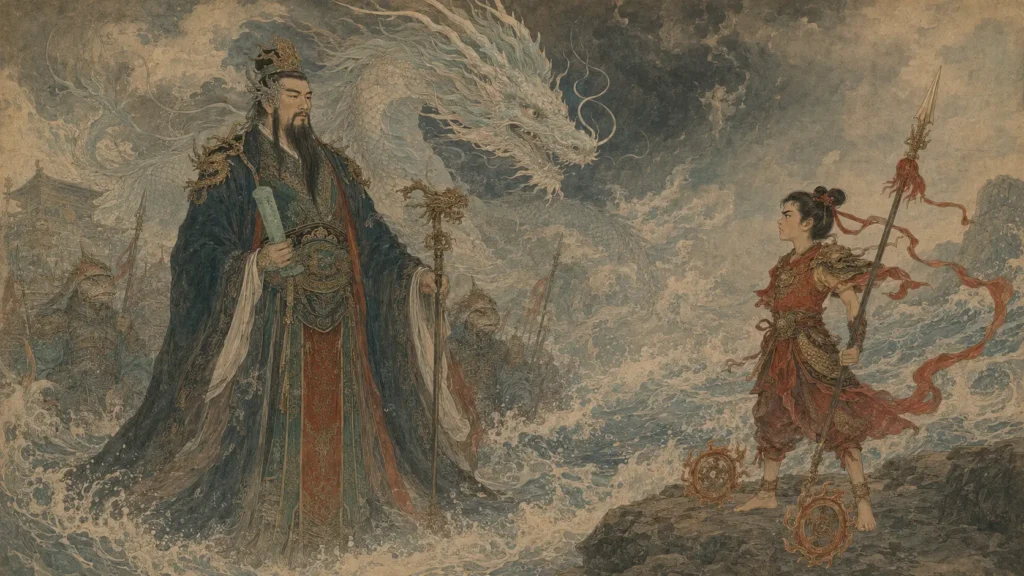
The young Nezha creates violent disturbances near the sea, kills the sea guardian Li Gen and then kills Ao Bing, Ao Guang’s third son. The Dragon King responds as both a grieving father and a divine official. He prepares to report the crime to Heaven and demand punishment.
Nezha intercepts him.
The confrontation becomes another humiliation for Ao Guang, and the conflict eventually expands to involve the Dragon Kings of the Four Seas and Nezha’s family. To prevent his parents from being punished for his actions, Nezha accepts responsibility and gives up his life before later being reborn through divine intervention.
This version belongs to later literary tradition, not to one single unchanged ancient myth.
But it shaped the popular image of both characters.
Nezha became the child who refused to bow before inherited authority.
Ao Guang became the ruler whose demand for justice helped push the story toward tragedy.
Is Ao Guang a Villain?
It is easy to treat Ao Guang as the villain because the heroes oppose him.
But his motives are more complicated.
Sun Wukong enters his palace and takes a treasure.
Nezha kills his official and his son.
Ao Guang’s anger is not without reason.
His weakness is not that he wants justice. His weakness is that he relies almost entirely on rank, procedure and the authority of Heaven to restore order.
When those systems fail him, he struggles to respond.
That makes him different from the younger rebels who challenge him. Nezha and Wukong act immediately, often recklessly. Ao Guang represents hierarchy, obligation and controlled authority.
Neither side is completely innocent.
One possesses power without restraint.
The other possesses authority without adaptability.
More Than a Defeated Dragon
Ao Guang does not disappear after losing to Sun Wukong.
Later in Journey to the West, he receives the Monkey King respectfully and assists him when water and rain are needed. Their relationship changes from confrontation to reluctant cooperation.
This is one reason Ao Guang remains interesting.
He is not a final demon waiting to be destroyed.
He is part of the world’s structure.
Heroes may embarrass him, threaten him or force him to retreat, but the sea still requires a ruler. Rain must still be managed. The natural world must remain connected to Heaven’s order.
Ao Guang survives because his role is greater than his pride.
The Dragon King’s Lesson
Ao Guang teaches a different lesson from the warriors we usually admire.
A title does not guarantee control.
A powerful body does not guarantee victory.
Authority does not prepare you for every person who refuses to respect it.
Training should make you stronger, but it should also make you adaptable.
In combat, a rigid fighter may possess excellent technique and still fail when an opponent breaks the expected rhythm. In life, a person can follow every rule and still collapse when reality refuses to cooperate.
Ao Guang ruled a palace, commanded an army and controlled the treasures of the sea.
But Nezha and Sun Wukong entered his world without accepting the rules that protected him.
That was his real weakness.
The strongest ruler is not the one who never yields.
It is the one who understands what must be defended, what can be surrendered, and how to remain standing after authority alone is no longer enough.
Reference:
- Norton Museum of Art — Dragons: Commanders of Rain
- Museum source explaining the historical association between Chinese dragons, heavenly authority, rainmaking rituals and agricultural survival. The Concise Oxford Dictionary of World Religions — Dragon Kings
- Reference source describing the Dragon Kings as divine figures responsible for rain who nevertheless remain accountable to a higher celestial authority.