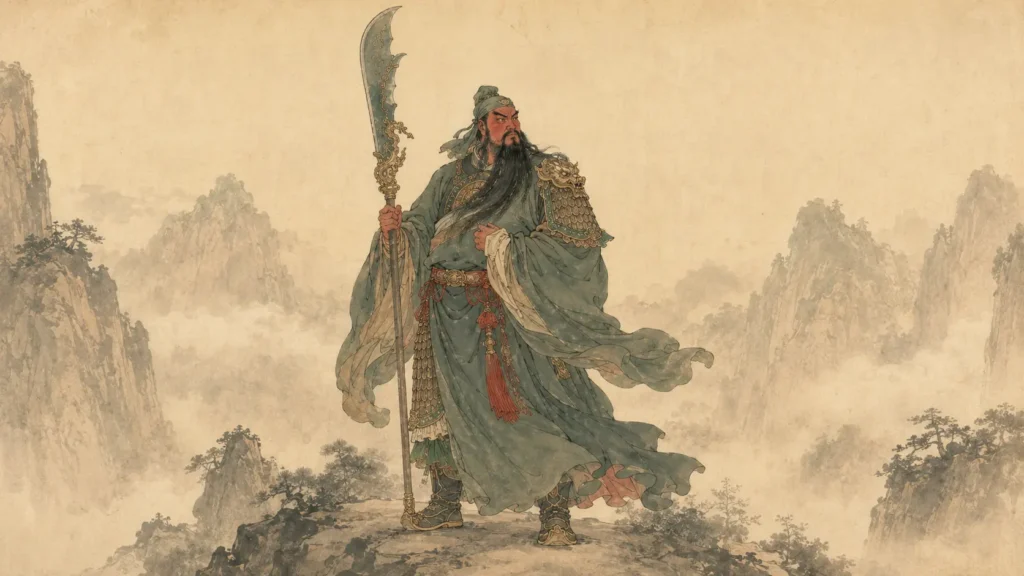
Walk into a Chinese temple, traditional shop, martial arts school, or restaurant, and you may find the same warrior watching from the shadows.
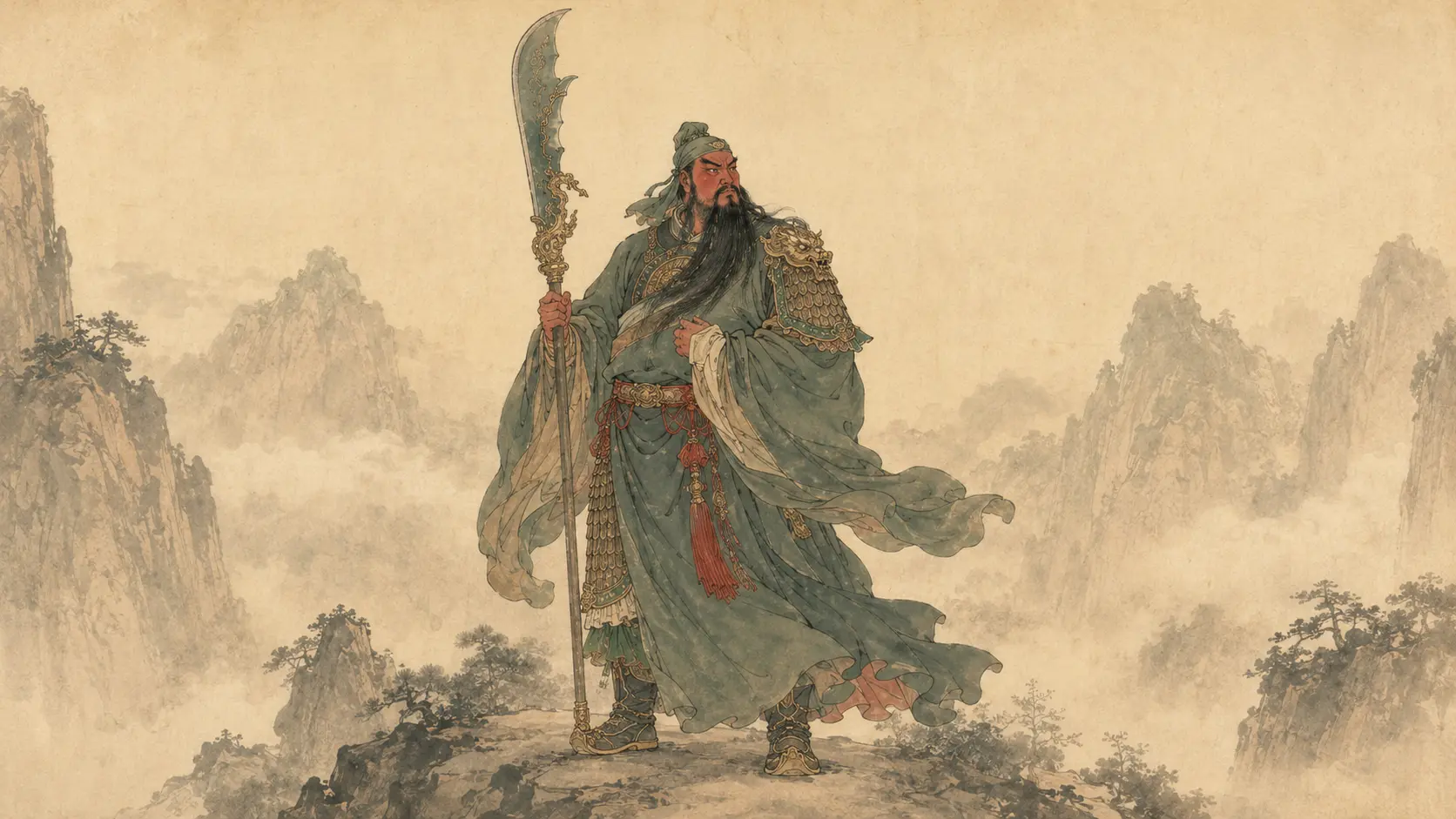
His face is red. His beard falls across his chest. One hand rests near a massive blade.
This is Guan Yu—general, guardian, symbol of loyalty, and one of the rare men whose reputation continued to grow long after death had already defeated him.
He was not an emperor. He did not unite China. His final military campaign ended in capture and execution.
Yet centuries later, emperors granted him divine titles, merchants asked for his protection, and worshippers knew him as Guan Gong—Lord Guan—or Guandi, Emperor Guan.
How did a mortal warrior become a god?
The Historical Man Behind the Red Face
Guan Yu lived during the collapse of the Eastern Han dynasty, when rival warlords fought over a divided China.
The earliest major account of his life appears in Chen Shou’s Records of the Three Kingdoms. It describes Guan Yu and Zhang Fei joining Liu Bei and following him through danger and hardship. Liu Bei reportedly treated the two men with the affection of brothers.
The famous Peach Garden Oath, in which the three swear to live and die as brothers, belongs to the later literary tradition. The historical record presents a close bond, but not the dramatic ceremony made famous by Romance of the Three Kingdoms.
The same distinction applies to Guan Yu’s appearance.
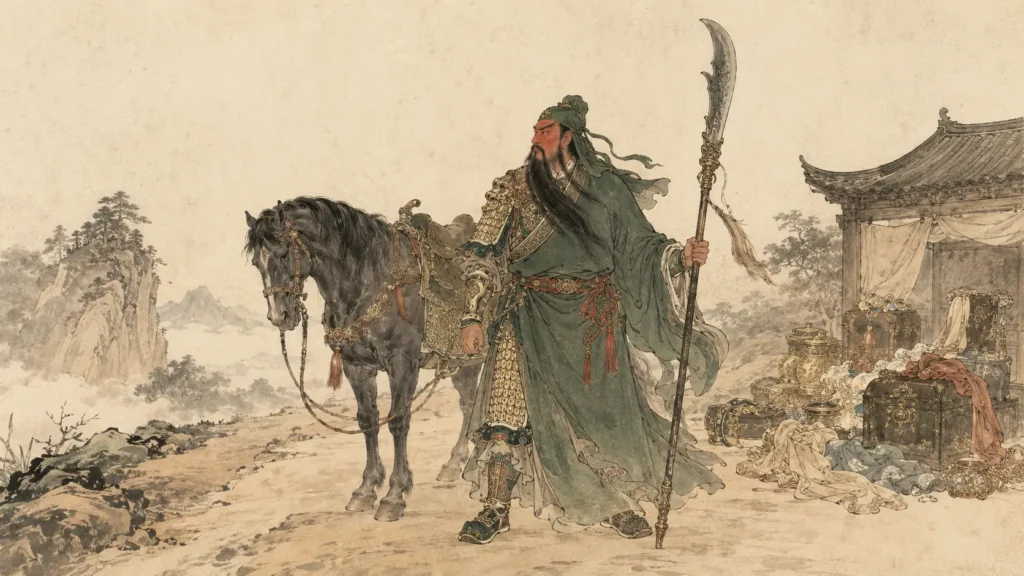
History remembers his exceptional beard, but the red face, elaborate armor, Green Dragon Crescent Blade, and horse Red Hare became part of the larger legend shaped by theatre, folklore, religious images, and the novel.
The man was real.
The image recognized around the world was built over centuries.
The Choice That Defined His Name
Guan Yu’s reputation for loyalty was not created from nothing.
Around the year 200, Liu Bei was defeated and Guan Yu came under the control of Cao Cao, the most powerful warlord in northern China. Cao Cao treated him generously and hoped to win his permanent allegiance.
Guan Yu accepted his temporary position, but he did not pretend that his loyalty had changed.
During Cao Cao’s campaign against Yuan Shao, Guan Yu killed the enemy commander Yan Liang. Having repaid Cao Cao’s kindness through military service, he left behind the gifts he had received and returned to Liu Bei. The historical biography presents this decision as evidence that Guan Yu understood both gratitude and obligation: he honoured what he owed Cao Cao without abandoning the man he had originally chosen to follow.
That balance became the foundation of his legend.
His loyalty was not simply obedience. It was the refusal to let comfort, status, or wealth purchase a different identity.
The Fall of Guan Yu
Loyalty did not make Guan Yu invincible.
In 219, he launched a major northern campaign from his position in Jing Province. His early successes created fear among his enemies, but the political situation around him was collapsing.
Forces belonging to Sun Quan attacked his territory from behind. Guan Yu’s position disintegrated, his soldiers scattered, and he was eventually captured and executed.
Even the traditional historical judgment of Guan Yu was not entirely flattering. He was celebrated for courage and righteousness, but criticised for pride and inflexibility.
That contradiction matters.
Guan Yu did not become immortal because he was perfect. He became unforgettable because his greatest virtue and his greatest weakness could exist in the same man.
His certainty made him loyal.
It may also have made him unable to bend when survival required it.
How Guan Yu Became Guan Gong
Guan Yu’s death was only the beginning of his second life.
Worship connected to him first developed around the region where he had been killed. Later traditions associated his spirit with Buddhist monasteries, while Daoist ritual specialists transformed him into a powerful general capable of defeating demons and protecting communities.
His cult spread through temples, oral stories, reported miracles, travelling merchants, and local religious practices. Academic research suggests that his worship had already become widespread before the written Romance of the Three Kingdoms reached its later popularity. The novel strengthened Guan Yu’s heroic image, but it did not create his religious importance by itself.
Over time, he became many things to many people:
A protector against demons.
A guardian of temples and communities.
A bringer of rain.
A moral judge.
A symbol of military courage.
And, because loyalty and honesty were essential to trustworthy business, a god connected with merchants and wealth.
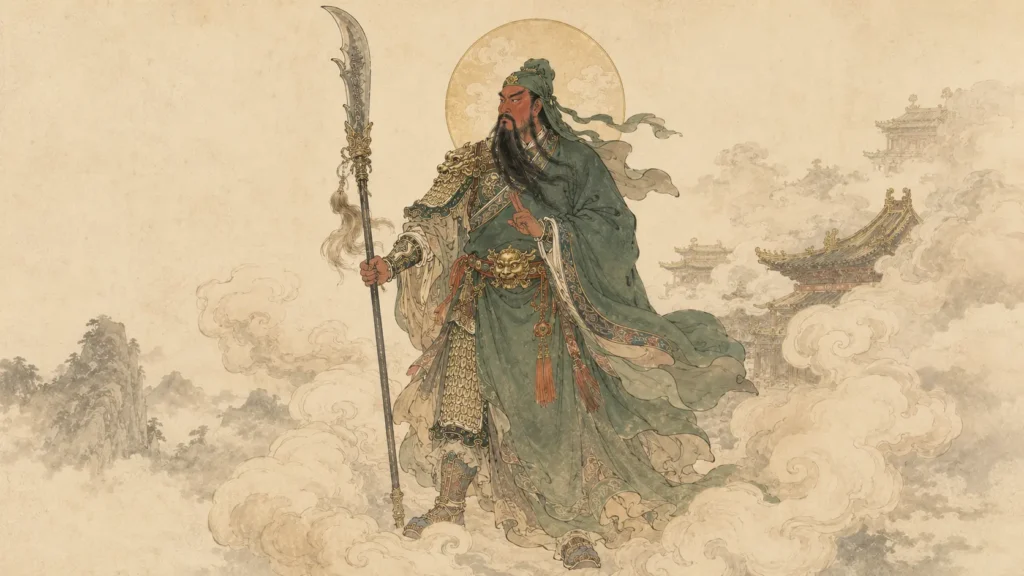
During the Ming dynasty, the Wanli emperor elevated him to imperial divine status. By the Qing dynasty, Guandi had become an important protector of the ruling house, and shrines dedicated to him appeared throughout the empire.
A general who had lost his final battle now carried the title of emperor among the gods.
More Than the Chinese God of War
Calling Guan Yu only the “Chinese god of war” misses the point.
He was not worshipped simply because he could kill enemies. China had many successful commanders, including men who achieved victories far greater than his.
Guan Yu became sacred because martial power was joined to a moral code.
His weapon represented the ability to act.
His upright posture represented self-command.
His long beard and severe expression represented dignity.
His red face came to express courage and loyalty.
For worshippers, the divine Guan Yu was not merely a warrior who won battles. He was a guardian expected to direct violence toward a righteous purpose. Museums preserve images of him descending from Heaven as an imperial protector rather than charging blindly into combat.
That is the difference between strength and honour.
Strength tells the world what you are capable of doing.
Honour decides what you will actually do.
The Warrior’s Lesson
Guan Yu’s life offers a lesson more complicated than blind loyalty.
Keep your word—but do not let pride make you deaf.
Become powerful—but remain capable of adapting.
Show gratitude—but never sell your identity for comfort.
Training should build the same balance.
In the gym or martial arts, strength without control produces recklessness. Discipline without purpose becomes empty repetition. Loyalty without judgment can turn into stubbornness.
The goal is not simply to become harder.
It is to become dependable.
A trained body should respond when the mind gives it direction. A trained mind should remain calm when insult, fear, and pride demand an immediate reaction.
Guan Yu lost his territory, his army, and his life.
But he protected something more difficult to preserve: the belief that a warrior’s word should mean something.
That is why the defeated general outlived the men who defeated him.
And that is how a mortal warrior became a god.
References and Sources:
- Chinese Text Project — Biography of Guan Yu in Records of the Three Kingdoms — principal early historical biography of Guan Yu.
- Chinese Text Project — Guan Yu: Historical Sources and Later Tradition — summary of historical records, traditional appearance and worship.
- Oxford University Press — Guan Yu: The Religious Afterlife of a Failed Hero — Barend J. ter Haar’s academic study of Guan Yu’s transformation into one of imperial China’s most influential deities.