Some rulers inherited armies, palaces, and powerful family connections.
Liu Bei inherited almost nothing but an ancient surname and the ability to make exceptional men believe in him.
He lost territory repeatedly. He served beneath stronger warlords. He fled from enemies who possessed larger armies, deeper treasuries, and more secure political power.
Yet he survived long enough to become an emperor.
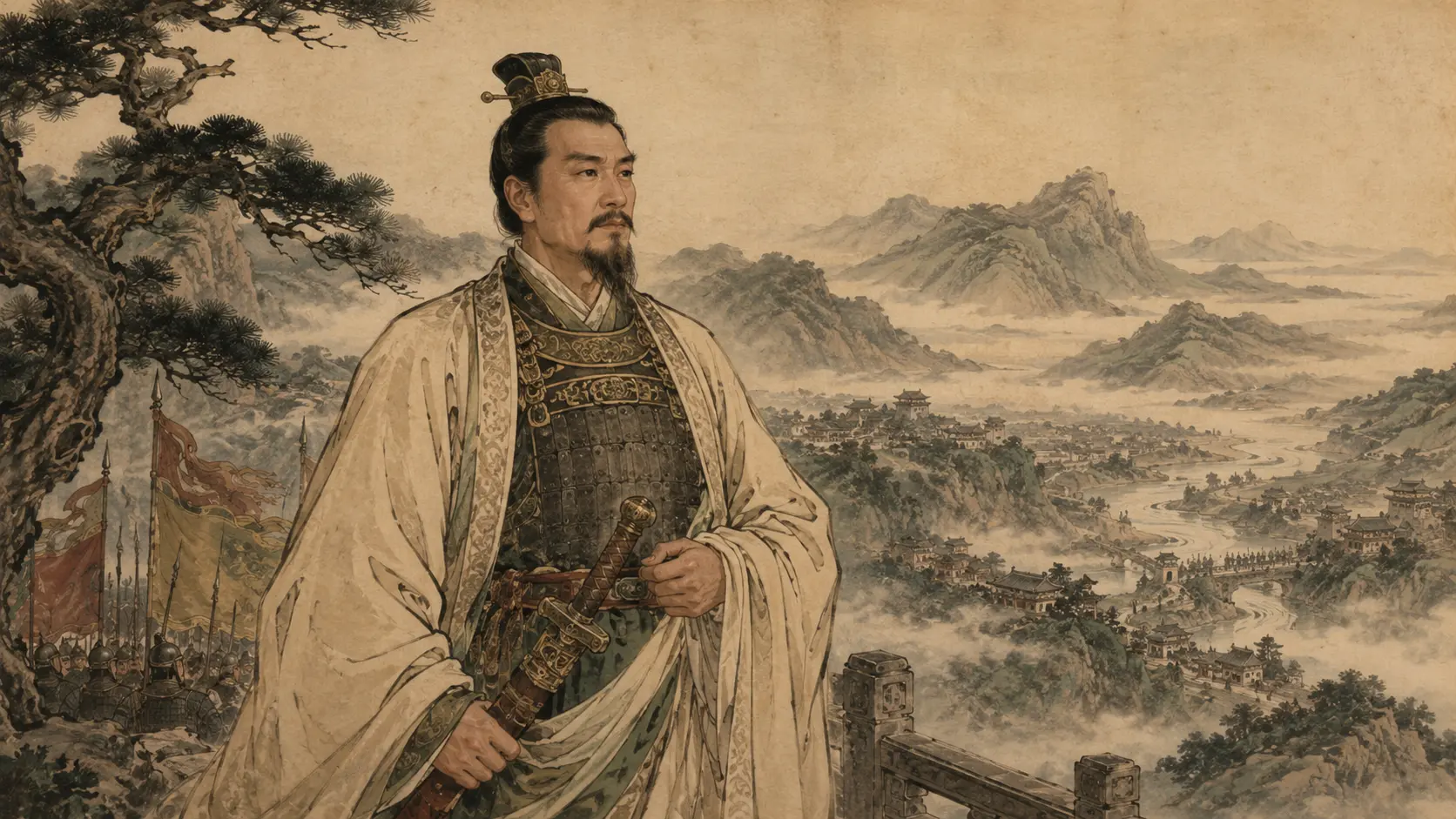
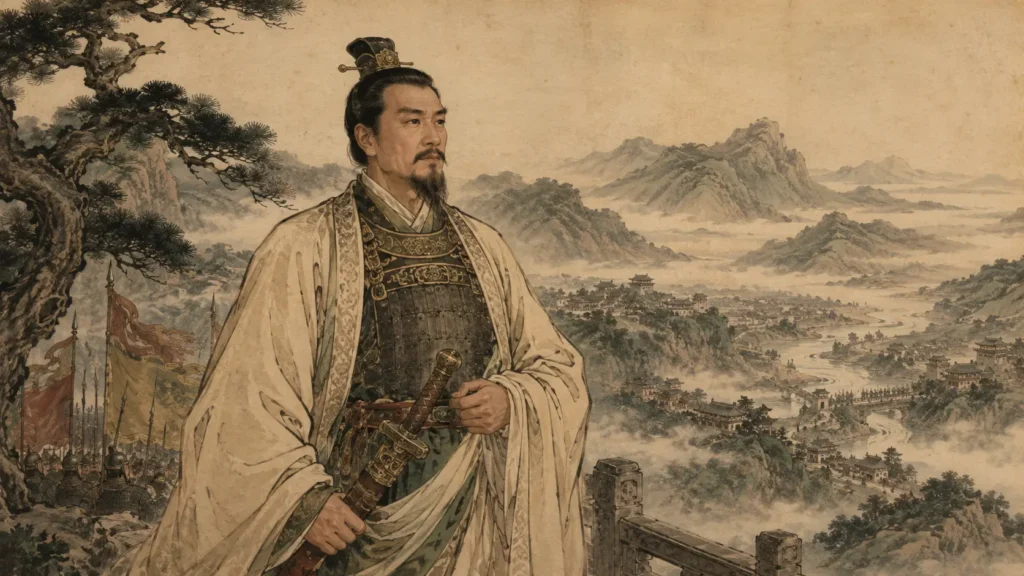
Liu Bei (刘备 / 劉備, Liú Bèi), courtesy name Xuande, was a warlord during the collapse of the Eastern Han dynasty and the founding ruler of Shu Han. He is remembered as the leader followed by Guan Yu and Zhang Fei, the ruler who recruited Zhuge Liang, and one of the central figures of the Three Kingdoms era.
His greatest strength was not winning every battle.
It was convincing the right people to remain beside him after he lost.
Who Was Liu Bei?
Liu Bei was born in 161 CE in Zhuo Commandery.
Historical tradition connected him distantly to the imperial Liu family of the Han dynasty, but that ancestry did not give him wealth or immediate political power. His father died while Liu Bei was young, and accounts describe him helping support his family by making and selling straw mats and sandals with his mother.
His path toward power began during the Yellow Turban Rebellion, when he gathered followers and entered military service.
From there, Liu Bei spent years moving between positions, alliances, and powerful patrons. He served under or cooperated with men such as Gongsun Zan, Tao Qian, Cao Cao, Yuan Shao, and Liu Biao.
This was not a straight march toward an imperial throne.
It was a long struggle to avoid disappearing.
The Men Who Chose Liu Bei
Liu Bei’s story cannot be separated from the people who chose to follow him.
The most famous were Guan Yu and Zhang Fei.
The historical Records of the Three Kingdoms says that the two warriors joined Liu Bei early and served him on the battlefield. When Liu Bei held office in Pingyuan, they commanded troops beneath him and reportedly protected him during public gatherings. Historical accounts describe their relationship as exceptionally close.
The famous Peach Garden Oath, in which Liu Bei, Guan Yu, and Zhang Fei swear brotherhood beneath flowering trees, belongs to the later novel Romance of the Three Kingdoms rather than the earliest historical record.
But the legend was built around something real.
These men stayed connected through defeat, separation, danger, and political uncertainty.
Our dedicated article about Guan Yu, the Chinese God of War explores why Guan Yu returned to Liu Bei even after Cao Cao offered him wealth and status.
From Liu Bei’s perspective, the deeper lesson is different:
A leader without the greatest army can still become dangerous when powerful people trust his purpose.
The Leader Who Refused to Disappear
Liu Bei suffered enough defeats to end the careers of several ordinary commanders.
He lost bases, abandoned territory, changed alliances, and repeatedly escaped stronger enemies. Cao Cao once recognised him as one of the few men capable of becoming a true rival, but Liu Bei lacked the secure northern power base that Cao Cao controlled.
His survival required patience.
Instead of treating every retreat as the end, Liu Bei used each new position to rebuild relationships, recruit supporters, and search for another opportunity.
His most important turning point came through his alliance with Sun Quan against Cao Cao. Their combined forces defeated Cao Cao’s southern advance at the Battle of Red Cliffs in 208, creating the political space from which Liu Bei could begin establishing a lasting territorial base.
He had survived long enough for the balance of power to change.
This time, he was ready to use it.
Liu Bei and Zhuge Liang
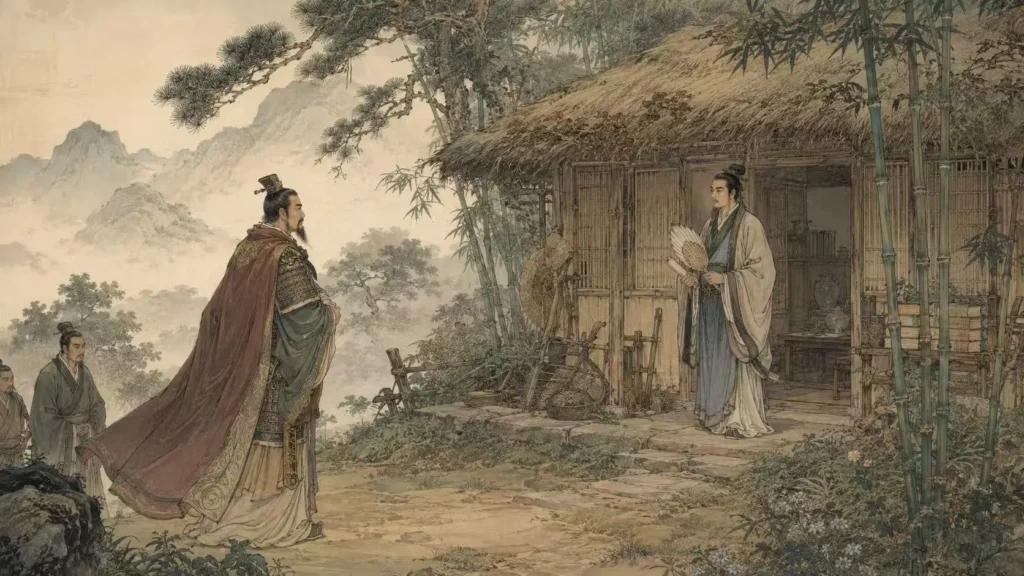
Liu Bei’s recruitment of Zhuge Liang became one of the defining moments of his legend.
The traditional story says that Liu Bei personally visited Zhuge Liang’s isolated cottage three times before the young strategist agreed to serve him. The historical record preserves the repeated visits, although the novel later transformed them into a far more elaborate scene.
What matters is the decision behind them.
Liu Bei was already an experienced commander. Zhuge Liang was younger and living outside political office. Yet Liu Bei was willing to seek him out personally and ask for guidance.
That humility was strategic strength.
A weak leader feels threatened by talented people.
Liu Bei understood that the right adviser could see possibilities that courage alone could not create.
Zhuge Liang helped provide the political vision that would eventually support the foundation of Shu Han.
How Liu Bei Founded Shu Han
After gaining influence in Jing Province, Liu Bei moved west and took control of Yi Province, centred on modern Sichuan and Chongqing.
He later captured Hanzhong and declared himself King of Hanzhong. By this point, he possessed territory, experienced commanders, an organised administration, and a defensible centre of power.
When Cao Pi ended the Eastern Han dynasty and established Cao Wei, Liu Bei claimed that the Han imperial line should continue through him.
In 221, he declared himself emperor.
The state is now commonly called Shu Han, distinguishing it from the earlier Han dynasty Liu Bei claimed to restore. He ruled from Chengdu and received the later posthumous title Emperor Zhaolie.
The man who had once sold sandals had built a kingdom.
But reaching the throne did not protect him from grief.
Guan Yu’s Death and Liu Bei’s Final Campaign
In 219, forces belonging to Sun Quan captured Jing Province and executed Guan Yu.
Liu Bei lost more than a general.
He lost a trusted companion, strategically important territory, and one of the relationships upon which his rise had been built.
After becoming emperor, Liu Bei launched a major campaign against Eastern Wu. The war was connected both to the loss of Jing Province and to Guan Yu’s death.
The campaign ended disastrously.
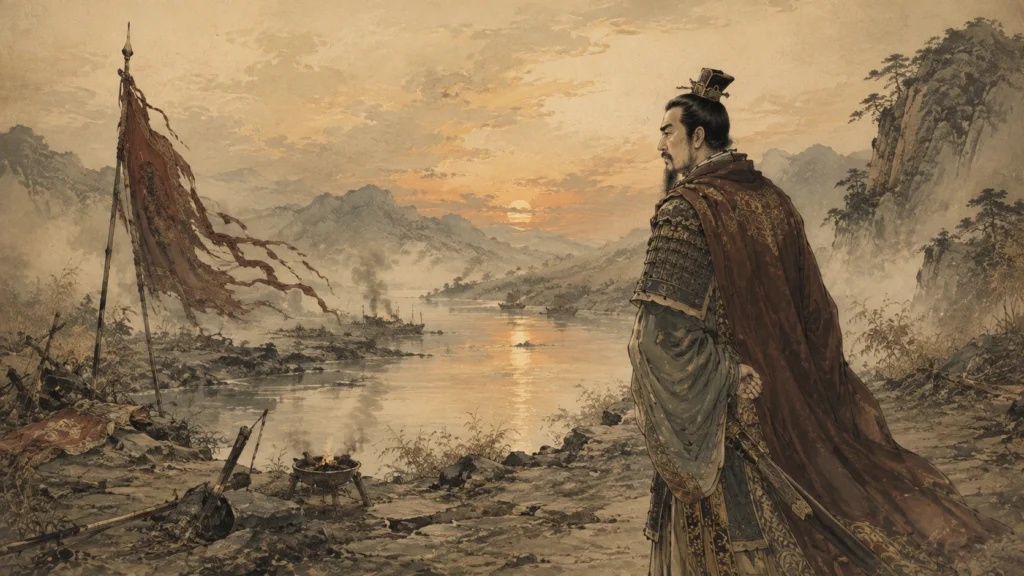
Wu commander Lu Xun avoided being forced into an early battle, waited until Liu Bei’s extended position became vulnerable, and then destroyed the Shu camps through a major counterattack at Yiling. Liu Bei escaped west but never fully recovered from the defeat. He died at Baidicheng in 223.
The final campaign reveals the contradiction inside Liu Bei.
The loyalty that helped build his power also influenced a decision that weakened everything he had created.
History and Romance
The Liu Bei of Romance of the Three Kingdoms is often presented as the moral centre of the story: compassionate, legitimate, loyal to the Han, and surrounded by heroic brothers and brilliant advisers.
The historical Liu Bei was more complicated.
He was capable of loyalty and personal generosity, but he was also a practical warlord who changed alliances, seized territory, and fought to create his own state.
The novel did not invent him.
It selected certain qualities, magnified them, and shaped Liu Bei into the ideal opponent of Cao Cao. Research comparing the historical Records of the Three Kingdoms with the later novel shows how relationships and personalities were expanded to create a more dramatic moral world.
Understanding both versions makes Liu Bei more interesting.
The legend gives us the righteous emperor.
History gives us the survivor who became one.
The Leader’s Lesson
Liu Bei was not the strongest warrior beneath his banner.
Guan Yu and Zhang Fei carried greater martial reputations.
He was not the greatest strategist.
Zhuge Liang became the mind most closely associated with Shu Han.
Liu Bei’s gift was recognising what other people could become—and giving them a reason to build something beside him.
That is leadership at its best.
But his final campaign reveals the danger on the other side.
Commitment can build loyalty.
Uncontrolled grief can turn that same loyalty into obsession.
Liu Bei rose because he remained patient after defeat, sought better minds, and inspired powerful men to follow a fragile cause.
He fell when personal loss became stronger than strategic restraint.
His life therefore offers more than a story about becoming emperor.
It shows that building something great requires endurance, humility, and trust.
Protecting it requires the discipline not to let pain make the final decision.
Reference:
- Chinese Text Project — Records of the Three Kingdoms, Volume 32: Biography of Liu Bei — principal early historical biography of Liu Bei.
- Berkshire Encyclopedia of China — Liu Bei — edited overview of Liu Bei’s background, rise, foundation of Shu Han, and final campaign.
- The Cambridge History of China — Shu-Han — academic history of Liu Bei’s state and its political development.