Some creatures in Chinese mythology destroyed villages, hunted travelers, or challenged the gods.
Liangqu needed only to appear.
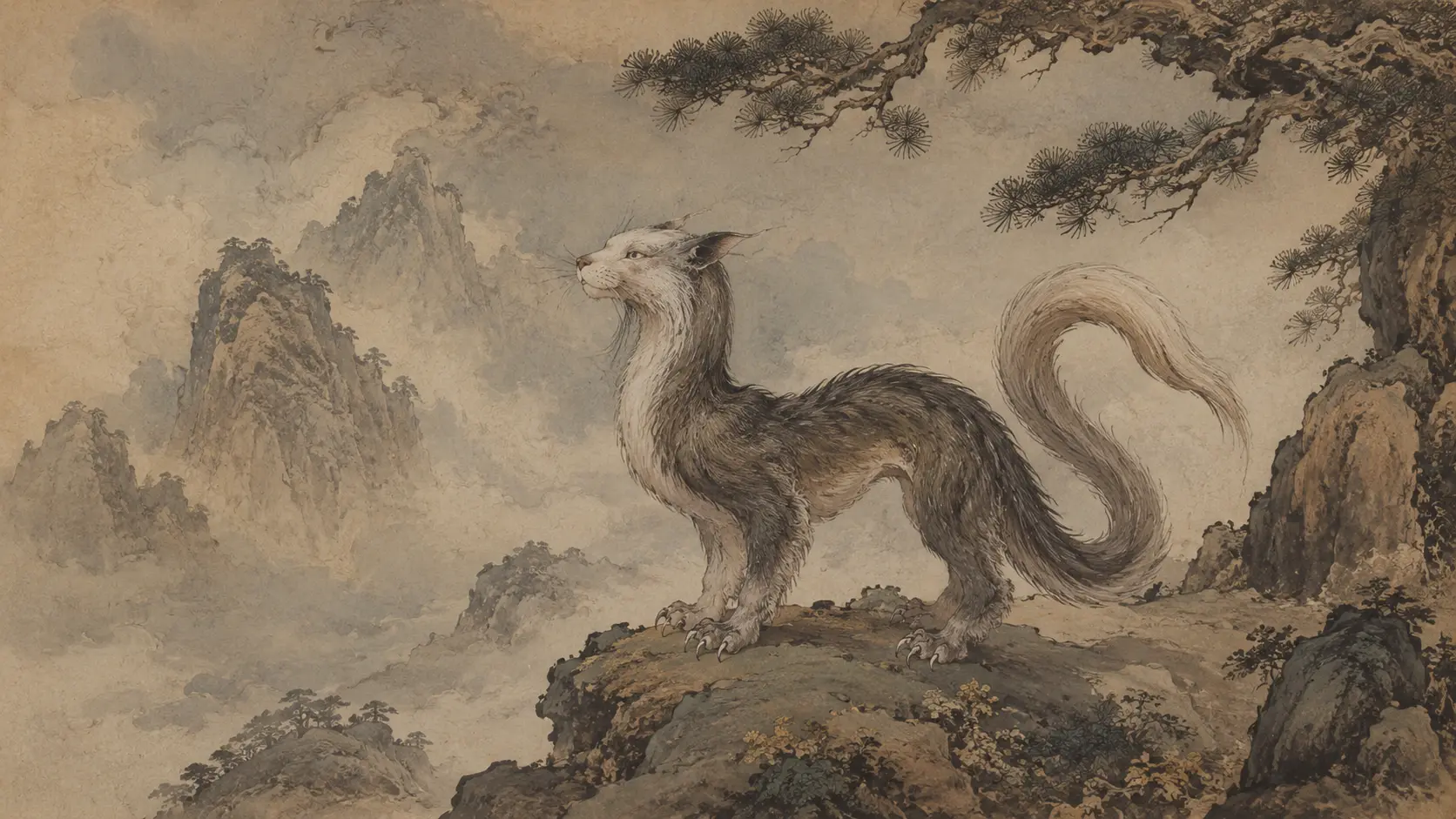
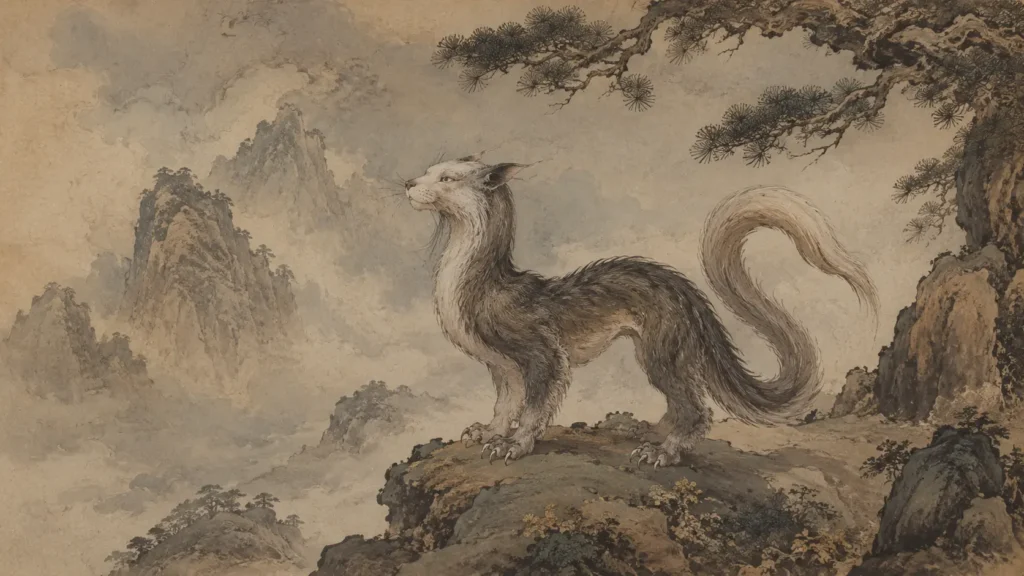
Hidden among the strange mountains of the ancient Shan Hai Jing was a small but unsettling beast. It resembled a wild, cat-like animal. Its head was white. Its paws carried the claws of a tiger.
And wherever it was seen, a great war was believed to follow.
Liangqu was not described as violent. It did not breathe fire, command storms, or attack armies. Its power came from something quieter—the fear that its appearance meant peace was about to end.
What Is Liangqu?
Liangqu (梁渠, Liángqú) is a mysterious creature recorded in the Shan Hai Jing, or Classic of Mountains and Seas.
The ancient text places it on Lishi Mountain, a landscape rich in vegetation, gold, and sharpening stone. Among those natural resources lived a beast described as resembling a li—a term translated in different ways as a weasel or a small wild, cat-like animal.
Liangqu had two features that separated it from any ordinary creature:
- a white head;
- claws like those of a tiger.
The description is remarkably short, but its final sentence transforms Liangqu from a strange animal into an omen:
“When it appears, there will be great warfare in that country.”
That is almost everything the original source tells us. Yet those few details create one of the most memorable creatures hidden within the Shan Hai Jing.
The Beast of Lishi Mountain
The world of the Shan Hai Jing is not organized like a modern collection of myths.
It moves through mountains, rivers, plants, minerals, spirits, and animals as though guiding a traveler across an enormous sacred landscape. Richard Strassberg describes the work as an ancient cosmography containing hundreds of strange beings, medicinal substances, geographical locations, and omens.
Liangqu belongs perfectly within that world.
It is not introduced through a dramatic story. There is no hero hunting it and no god explaining its origin. The reader is simply warned that this creature exists in a particular mountain—and that seeing it carries terrifying consequences.
That directness makes the encounter feel almost believable.
Imagine crossing a remote mountain trail and noticing a long-tailed animal watching from the rocks. Its body appears small compared with a dragon or giant, but its pale head and oversized claws reveal that it is not an ordinary beast.
The danger is not what Liangqu might do to you.
The danger is what its presence means.
Did Liangqu Cause War?
The original passage does not say that Liangqu attacked kingdoms or created wars through supernatural power.
It says that when the creature appeared, the country would experience great military conflict.
That difference matters.
Liangqu was an omen, not necessarily the cause of the disaster. Like an unnatural storm, a strange celestial event, or the unexpected appearance of another mythical animal, it warned that the normal order of the world was breaking apart.
A later Chinese compendium preserved the original description and grouped Liangqu with other li-like animals. It also repeated the old association through the phrase 梁渠致兵, which connects the appearance of Liangqu with the arrival of warfare.
There is no surviving explanation of why this particular creature became linked with war.
Perhaps its tiger claws suggested hidden violence beneath an otherwise ordinary appearance. Perhaps the contrast between its white head and predatory body made it seem unnatural. Or perhaps the original meaning came from a tradition now lost.
Those are interpretations, not confirmed facts.
The ancient text gives us the omen but keeps its reason hidden.
What Did Liangqu Look Like?
Liangqu was probably much smaller and more agile than creatures such as Haozhi.
Its body resembled a li, while its claws belonged visually to a much larger predator. This creates an unusual combination: the shape of a small mountain animal carrying the weapons of a tiger.
The exact identity of the ancient li remains difficult to reproduce in English with complete precision. The Chinese Text Project translates it as a weasel, while later commentary describes Liangqu as belonging to the broader li type.
For a visual interpretation, the safest approach is therefore not to turn Liangqu into a tiger or an ordinary house cat.
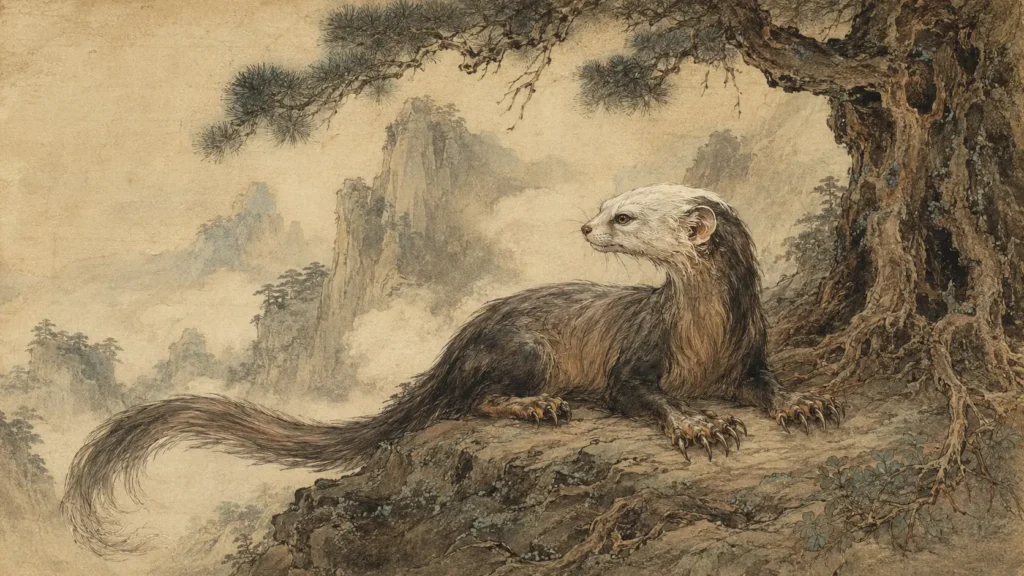
It should appear as a long-bodied, wild mountain creature with:
- a pale or white head;
- a large flowing tail;
- a low, agile body;
- powerful paws with visibly tiger-like claws.
The illustration from the book captures this combination extremely well. It gives Liangqu the body of a rare wild animal while allowing the exaggerated claws and alert posture to reveal its mythical nature.
Why Liangqu Still Feels Unsettling
Many legendary monsters are frightening because their intentions are obvious.
Liangqu is different.
It does not roar at an army. It does not announce the coming disaster. It simply appears somewhere in the wilderness, perhaps long before anyone understands what has been witnessed.
That silence makes it more disturbing.
Liangqu represents the fear of recognizing a warning only after it is too late. The creature itself may be calm, beautiful, or even harmless—but beyond the mountains, armies are already beginning to move.
This is where its story still feels powerful today.
Not every danger arrives with violence.
Sometimes the first sign is small, strange, and easy to ignore.
A Forgotten Warning from the Shan Hai Jing
Liangqu may never become as famous as the Chinese dragon, the phoenix, or the warriors of the great classical novels.
Its surviving description is too short to provide a complete legend.
But that mystery is exactly what makes it worth remembering.
A white-headed beast waits among the mountains. Beneath its small body are the claws of a tiger. Its appearance does not begin a battle—but it tells humanity that one is coming.
In the vast world of the Shan Hai Jing, even the quietest creature can carry the shadow of war.
Reference
- Chinese Text Project — Shan Hai Jing: Zhongshan Jing: original Chinese passage with an English translation of Liangqu’s description.
- Wikisource — Shan Hai Jing: Classic of the Central Mountains: public-domain Chinese edition containing the Liangqu passage.