Some monsters breathe fire.
Others poison rivers or darken the sky.
But one creature from ancient Chinese mythology needed nothing more than its own body to become deadly.
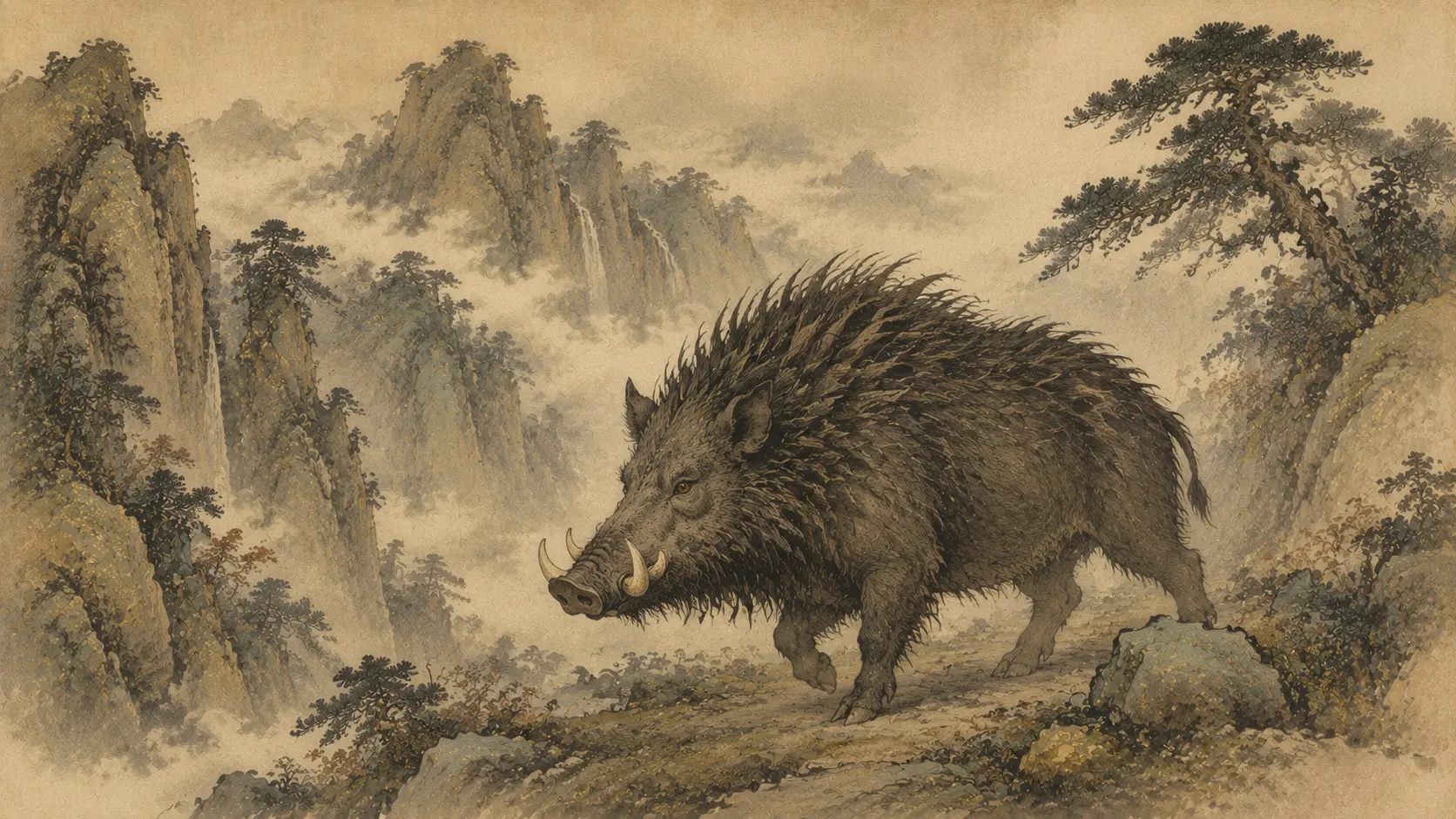
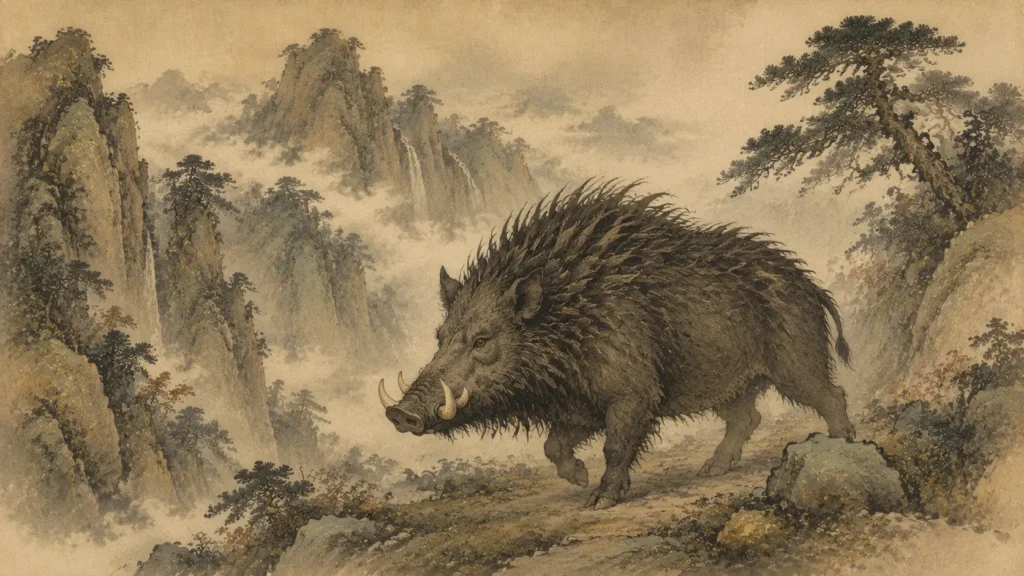
Imagine standing deep inside an untouched mountain forest. Everything is silent—until heavy footsteps echo through the trees. A massive beast appears, looking almost like a gigantic wild boar. At first glance, it doesn’t seem unusual.
Then you notice its bristles.
They aren’t soft hair.
Every single one is as sharp as a blade.
This is Haozhi (豪彘), one of the many mysterious creatures recorded in the Classic of Mountains and Seas (Shan Hai Jing). Although it is far less famous than dragons or phoenixes, Haozhi perfectly represents the strange, dangerous, and unpredictable world imagined by ancient Chinese storytellers.
What Is Haozhi?
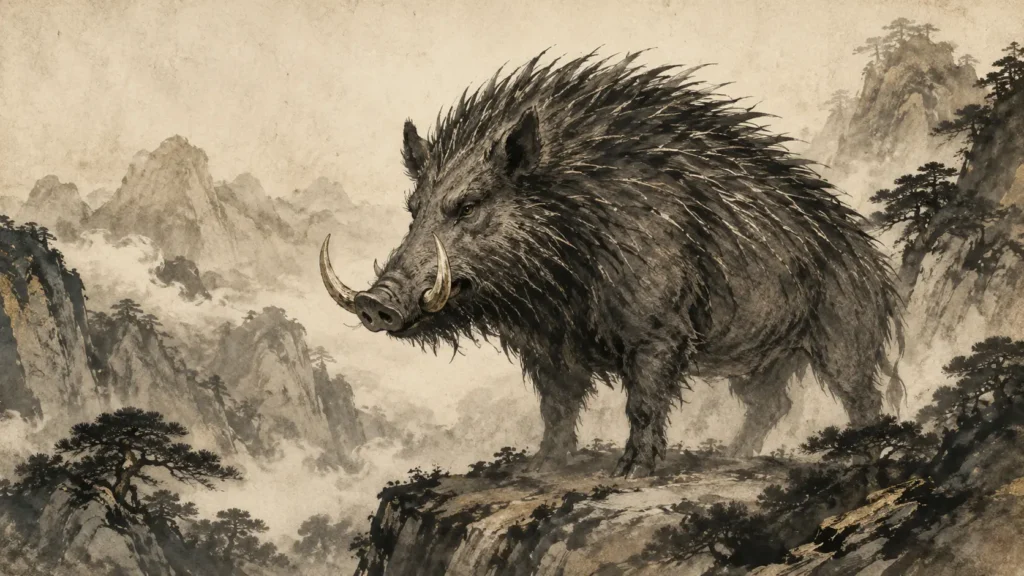
Ancient descriptions portray Haozhi as a creature resembling an enormous wild boar.
Its most remarkable feature is its body, covered with extremely sharp, weapon-like bristles capable of injuring anything that comes too close. Unlike many mythical beasts that rely on supernatural powers, Haozhi itself is the weapon.
This simple but terrifying concept makes the creature memorable. Rather than magic, its danger comes from raw physical power and the natural defenses of an untamed beast.
The earliest known description appears in the Shan Hai Jing, one of China’s oldest collections of mythology, geography, and fantastic creatures. Like many entries in the text, the description is brief, leaving later generations to imagine how frightening such a creature must have been.
A Creature Born from the Wild
Many monsters in Chinese mythology symbolize the unknown.
Thousands of years ago, vast mountain ranges and forests remained unexplored. Travelers never knew what waited beyond the next valley.
Haozhi reflects that fear perfectly.
Its appearance resembles a familiar animal—a wild boar—but with one impossible feature that transforms it into something terrifying. This blending of reality and imagination appears throughout Chinese mythology, where ordinary animals often become extraordinary by possessing one supernatural trait.
Instead of representing pure evil, Haozhi embodies the dangers of nature itself.
Ancient people respected the wilderness because survival depended on understanding its risks. Dangerous animals, steep mountains, and hidden forests were real threats, and mythical creatures like Haozhi gave those fears a legendary form.
Why a Boar?
Wild boars have long been respected across Asia.
Unlike domesticated pigs, wild boars are aggressive, incredibly strong, and surprisingly fast. Even today, they can seriously injure hunters and predators with their tusks.
Ancient Chinese storytellers likely drew inspiration from these real animals before exaggerating their most dangerous qualities.
Instead of larger tusks or greater strength, Haozhi received razor-sharp bristles—turning an already intimidating animal into something nearly impossible to approach safely.
This transformation is common throughout Chinese mythology, where familiar creatures become extraordinary without losing their recognizable appearance.
Symbolism Behind Haozhi
Although the surviving texts do not explain Haozhi’s symbolic meaning directly, several themes naturally emerge.
The creature represents the idea that danger is not always obvious.
From a distance, Haozhi resembles an ordinary animal. Only when someone gets close does its true threat become clear.
This makes Haozhi a powerful reminder that appearances can be deceptive.
It also symbolizes the untamed force of nature. Unlike dragons that rule the heavens or divine beasts that protect humanity, Haozhi exists without purpose beyond survival. It is simply another powerful creature inhabiting the wild mountains described throughout the Shan Hai Jing.
In many ways, Haozhi reminds readers that nature demands respect—not because it is evil, but because it is powerful.
Haozhi in Modern Culture
Compared with famous figures such as the Jade Emperor, Nezha, or Sun Wukong, Haozhi rarely appears in modern films, games, or television.
Yet creatures like Haozhi have become increasingly valuable for people exploring the lesser-known corners of Chinese mythology.
Artists frequently reinterpret forgotten beasts from the Shan Hai Jing, giving them fresh life through illustrations, novels, and digital art. Their mysterious descriptions leave enormous room for imagination, allowing every generation to visualize these ancient creatures differently.
For mythology enthusiasts, that mystery is part of Haozhi’s appeal.
Why Haozhi Still Matters Today
Not every legendary creature needs to save kingdoms or battle gods.
Sometimes a single unforgettable idea is enough.
A giant beast covered in razor-sharp bristles may sound simple, but it captures something timeless: humanity’s respect for the unknown.
Haozhi reminds us that ancient mythology wasn’t created only to entertain. It helped people explain a world filled with mysteries, hidden dangers, and landscapes few had ever explored.
Even today, more than two thousand years after its first appearance, Haozhi remains one of the many fascinating creatures waiting to be rediscovered within the pages of the Classic of Mountains and Seas.
Reference:
- Chinese Text Project — Southern Mountain Classic — the Nine-Tailed Fox of Qingqiu Mountain, its infant-like cry and its dangerous nature.
- Chinese Text Project — Classic of the Eastern Great Wilderness — Qingqiu as the country of foxes with nine tails.